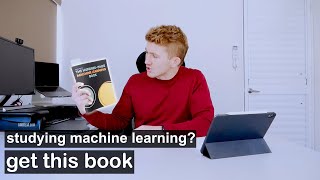
In this concise YouTube review, Daniel Bourke walks viewers through Andrey Burkov’s The Hundred‑Page Machine Learning Book, positioning it as a “start here, continue here” reference for anyone interested in data science or machine learning. He explains that, despite the title, the book runs about 130 pages and can be read in a day, but he recommends a slower, note‑taking approach to fully absorb the material. Bourke outlines the book’s audience—both beginners and experienced engineers—highlighting that the author adopts a “read‑first, buy‑later” model and that a physical copy serves as a handy coffee‑table reference. He summarizes the core content: an overview of the four main learning paradigms (supervised, unsupervised, semi‑supervised, reinforcement), a notation primer that demystifies symbols like the capital‑π product operator, concise definitions of key algorithms (linear/logistic regression, SVMs, k‑means, etc.) and guidance on selecting the right algorithm for a problem. The book then introduces deep learning and neural networks as extensions of the earlier concepts. Bourke emphasizes practical ML engineering topics—data cleaning, handling missing or imbalanced data, over‑/under‑fitting, and appropriate evaluation metrics (accuracy, precision, recall, AUC). He notes the QR‑coded online wiki that links to extra reading and code examples. Finally, he shares personal learning advice: read, apply, iterate, and keep notes, encouraging viewers to treat the book as a foundational scaffold before diving into larger, more detailed texts. All relevant links are provided in the video description.
Chapters
The 100 Page Machine Learning Book by Andrey Burkov, or in other words, the Start Here and Continue Here of machine learning. At least that's what I'm calling it. Now it's just over 100 pages, about 130 or so, so the title's a little bit of a lie, but that's all right. I mean, you could read it in the space of a day if you wanted to, but it took me a little while longer than that. You see, I like to read books slowly ingest them, write down notes. See, I've covered the front pages here with my favorite page numbers. I mean, basically the whole book, right? And then every page is annotated with my own notes. If the author's written something and I want to understand it a bit more, I like to write it down in my own words. So, we'll keep this video nice and short and answer any questions that you might have before getting one of these. Should you read it? Well, the TL;DR of this video, or TL;DW, is that if you're into data science or machine learning, experienced or beginner, you should get this book. Put it on your coffee table, after you've read it of course, and then when your friends come over and they ask you, "What's machine learning? Are the robots really going to take over?" Well, you can answer them and tell them what machine learning is because you've read the book. Who's the book for? I mentioned in one of my previous videos that I was reading this book, and someone messaged me asking, "What are the prerequisites to read it?" Well, I read it from the perspective of a machine learning engineer, so I'd been putting machine learning techniques into practice for, for over a year before I even started reading it. And I still learned a lot. So I think experienced or beginner, you're still going to gain something from this, and you can read it online for free before even buying it because Burkhoff has released it on a read first, buy later principle. But I think despite that, you should still just get one, right? Because there's nothing quite like holding a physical book, especially such a totem of machine learning. But yeah, if you're a complete beginner and you read some things and you don't understand them, don't worry. I'm the same. I've been practicing machine learning for the past year and a half, and I read some things and I still didn't understand them. But that's the beautiful thing about having a book like this, is that you can go back and reference something and look it up. Go, "Oh yeah, I completely forgot what normalization was." And you can go back and find normalization is the process of converting an actual range of values which a numerical feature can take into a standard range of values, typically the interval -1 to 1 or 0 to 1. Now, you might ask yourself, what could it possibly contain in only 100 or so pages? Well, what works, right? What works in machine learning? It starts off with a different type of learning: supervised, unsupervised, semi-supervised, and reinforcement learning, and gives you a conceptual idea of what each of them are. So supervised learning is when you have data and labels. It's probably the most common type of machine learning. Unsupervised learning is when you just have a whole bunch of data and no labels. Semi-supervised learning is when you have some data with labels, or you can learn the labels from the data, but you don't explicitly have a bunch of labels. And reinforcement learning, like having a computer program play chess and then rewarding it if it wins the game. Once you build up an intuition of each of the 4 main types of learning, then you can start to assess what problems require what type of machine learning solution. Then you've got notations and definitions. So one of the biggest questions people ask me of how to get into machine learning is, is how much math, right? And if you see machine learning like a paper or a blog post or some— something like that, it can have a lot of these math symbols, Greek symbols you haven't seen since high school, or maybe you've never seen at all. And that kind of stuff, like what you don't know, that's scary. So Chapter 2 is probably one of my favorite chapters, is because it clears up this type of notation, right? So it'll go through an equation like one of my favorites, which is capital π notation. Now I've taken this straight from the book. So you can see here, that symbol there is capital π, and essentially what it means is product of. So let's say you had a number of things, 10 things, n, n things, because people like to use n for number of things. 10 things, let's say numbers 1 through to 10. Now if you had capital π, x_i x i_1, i_2, i_3. If you see that capital π symbol, It means the product of the things all the way up to n. So if we had 10 things, 1 times 2 times 3 times 4, etc., all the way up to 10, which equals 3.6 million or something. You see examples of these different symbols explained all throughout Chapter 2, and what that does is it sets you up, right? It sets you up with the, the math notation that you need to know for the next chapters, which explain some of the most common and useful machine learning algorithms. —things like linear regression, logistic regression, support vector machines, k-means clustering, the list goes on, right? But most importantly, you'll learn about what type of algorithm should be used for what type of problem. Like, what kind of algorithm should you use for a classification problem? What exactly is a classification problem? Now I've taken this definition straight from the book: Classification is a problem of automatically assigning a label to an unlabeled example. Spam detection is a famous example of classification. You'll find these kind of definitions sprawled throughout the book. So if there's some kind of common key term that's used in machine learning, it'll often have a 1 to 2 sentence definition. Okay, so you've read through the fundamental algorithms. Then the book dives into the machine learning paradigm taking the world by storm: deep learning and neural networks. And this is the kind of machine learning that you'll often hear referred to as artificial intelligence or AI. But after reading through the previous chapters in the book, you'll start to realize that as much as neural networks and deep learning, as valuable as they are, and as much as they're artificial intelligence, you'll realize that they're also a clever combination of the math functions you've read through throughout the previous chapters. You'll also see how a machine learning engineer or data scientist works with basic practices and advanced practices. Now, what do I mean by this? Alright? Now, you'll see in the book why a data scientist or machine learning engineer doesn't usually invent a new algorithm. Instead, their job is to figure out how some of the best algorithms can be applied to problems, right? Like finding information out of data. But what you'll also see is that much of the work, rather than, than applying the algorithm, right, is making sure that the data is in a format that the algorithm can be applied to. What if you had missing data? Or what if one of your labels had more samples than the other, aka imbalanced classes? Now, what if your model's doing too well, aka overfitting, or not well enough, underfitting? What if you got 99.99% accuracy? Is that the right metric to use? What about the precision and recall? Or the area under the curve? Don't worry, the book has you covered with these. Finally, don't forget the online wiki. The book is scattered by each chapter. Let me find one for you. The book is scattered throughout— well, this is scattered throughout. No. These QR codes are scattered throughout the book. So, what you can do is grab your mobile phone, scan the QR code, and if there's something like more reading or code examples or something like that, if you want to dive deeper, so basically the QR codes are for those who want some extra curriculum. Alright, so it sounds like it's an amazing resource and it actually is, but what doesn't it contain? Everything in machine learning, right? Those books are 1,000+ pages, far more scarier, and you can't really just put them in your backpack and take them wherever you go. You can use this one as a foundation, and then if you want to dive deeper on something, maybe one single topic, right, then you can grab one of those 1,000-page books and use the extra 900 pages to really dive deep. I really wish I read books like this more often, right? So 2 years ago, I started learning machine learning, created my own AI master's degree, and this is on it now. It would have been on there from the beginning if it was out. But remember, when learning anything, it's always going to be difficult, right? Learning by definition is hard. Have a bias towards doing. So, that means read something in here. If you want to try to learn it, apply it. If it doesn't work, that's okay. Reread it, try and apply it. That's, that's how I learn best. That's how majority of people learn best, right? Put things into practice. All the links you need, including an article version of this video, will be in the description. So check it out, get yourself a copy of the book, do yourself a favor, right? Read it end to end, take notes to start here and continue here of machine learning. As always, keep learning, keep creating. I'll see you next video.