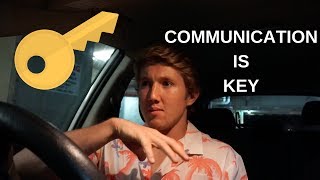
In this solo vlog/podcast episode, Daniel Bourke shares his recent experience studying Stanford's free Coursera machine‑learning course, recounting a failed quiz and praising the instant feedback and affordability of online education. He argues that artificial intelligence and machine learning represent the next massive technological boom, likening it to the rise of the internet and virtual reality. Bourke describes his ongoing project: an AI‑powered Facebook Messenger bot aimed at improving personal communication, and he expands into a philosophical vision of dramatically expanding communication bandwidth—potentially transmitting thoughts directly. He reflects on how many of his personal relationship problems stem from communication failures and issues a daily challenge to listeners to reach out and communicate more effectively. The episode ends with a reminder of the show’s continuation and a personal sign‑off.
Chapters
Yo, what's going on everyone? Welcome back to day 98 of the Daniel Bourke Show. Thank you so much for tuning in, whatever you're up to. What have I been doing today? So this morning I got up, I did some study again, doing this machine learning course on Coursera. It's free, it's by Stanford University. I highly recommend it. Give it a go if you're looking to get into the field of machine learning. I know it's an extreme niche at the moment, but If a lot of what I've been reading, the world is being taken over by software because there's so much tech out there and software is just taking over the world. Every industry has been dramatically changed by software and machine learning is eating up software. So I think, I don't know, if the internet was a massive boom, if websites were a massive boom, I think artificial intelligence and machine learning is going to be the next massive boom. And virtual reality, like this is just all my intuition by the way, I might be completely wrong, but I'm thoroughly enjoying it. And I've been reading some articles on what AI can actually do right now. One of the headlines, I haven't read the full article, but the headline was, if it takes a human about less than a second or around a second to do, a computer can probably do it. So any task that takes a human being a bit longer than a second, AI probably can't do it just yet. So that's what I've been up to most of today. I spent probably at least 6 hours studying. I find once I hit a certain point, like, it just doesn't stick anymore. Like, there was a quiz actually— actually, I failed 3 times today. I need to try again in about— in tomorrow morning. I can only try 3 times every 8 hours, I think. So I failed this quiz on my machine learning course. It's only 5 questions and I need to get 80%. I got 3 out of 5, 3 times. So, I don't know. I don't know what's going on. I failed, but every time I think I got a different question wrong or right, I'm not sure. I'll work it out. I know I can pass it tomorrow sometime, but yeah, I failed. I failed. It was actually— it sucked, but it's a good feeling at the same time because I feel like when I used to do university exams and I failed, I never got really feedback on, on why I failed, whereas I feel like, to me, an online course is— I get instant feedback. And the fact that I can chat in the forums and, and learn where other people have gone wrong and, and ask questions and whatnot and get instant feedback, that's such a valuable education resource. There's so many resources online to learn right now. Coursera, Udemy, Udacity. All these, all these places, a lot of the courses are free or cheap. I paid, I think, $10 for a 70-hour course. Like, that is, that is incredible. And what, what are my plans? What do I want to do with this? Well, as I want to help the world move more, I'm building an artificial intelligence-based messenger bot to do that through Facebook Messenger. You can find out more details at my Facebook page, facebook.com/MrDBurke. Really, because I feel like a lot of the, the massive communication technologies. Like, a lot of the things, a lot of the problem we have, problems we have are communication problems. And if you can, if you can nail communication between two people, between education or something like that, if you can tailor, tailor education to someone, if you can tailor communication to individuals, then, then you're in a good place. Like, what, what Elon Musk is trying to do with Neuralink is, is reduce the bandwidth onosore, increase the bandwidth of communication. So, if you think about communication, I think of a thought and for me to communicate that to you guys, I have to think of that thought, translate it into speech in my mind, and then speak the speech with my mouth. You— the— sorry, the microphone records that speech and then it comes out through your speakers or however you're listening or watching this, this piece of media. Then your eyes or your ears absorb that communication into your brain, and then it deciphers that, and then you create a thought of what I communicated to you. And so, what I'm thinking in my head may be totally different to what you're thinking after I communicate this. And so, imagine if that communication bandwidth that was just completely opened up. And so, if I thought of a thought, you could tune into that thought straight away. And you could think the exact same thing as me, you could experience the exact same thing as me. Look, it's an incredibly hard thing to do, but I believe with enough hard work, with enough, I don't know, advances in technology and whatnot, that's where we're going one day. That maybe even within my lifetime that I'm able to have a thought and then someone else on the other side of the globe even, because we're all connected through satellites or something like that, be able to see that thought as well. And it's, it's, what are the, what are the implications of that? What are the ethics? How can, what, what are the chances of someone else getting inside my head? Well, I think it'll almost be the same as if someone was already talking to you. Can you, can you block them out or something like that? I don't know. I don't know. I need to learn more about this myself. But where's all this going? I think communication, number one thing. It's like the root of, the root of many of the problems in my life have been because of because of communication, whether it be relationship issues, friendship issues, everything like that. It's because it's come down to some sort of communication issue. I forgot to ask for something, I forgot to talk to someone about something, I didn't say the right thing at the right time. It's all, I don't know, this is what I just keep, this is what I've been finding. I don't know if I'm right, but it's just a recurrent pattern in my life. It's like Whenever I forgot to ask for something or whenever I didn't ask for anything or whenever I didn't say something I thought I should have said or I said something wrong, like that's, that's, that's what's gotten me into trouble and that's what's caused issues in my life. So I think if we can solve communication, then we solve a lot of things. But the question is, how do you do it? Who knows? So what's today's daily challenge? Think about a way that you can more effectively communicate with someone else. So, is there, I don't know, your spouse, your husband, your spouse, your husband, it's late, I'm sorry. That's no excuse, by the way, no excuse. So, whoever it is in your life, could you say hello to them? If you haven't talked to someone in a while, could you say hello to them? Or even if it's just maybe once a week you ask your mom, how are things going, whatnot. And I need to do this too, I think I need to do this too. So, maybe this is— the daily challenge is me subliminally telling me what I should actually be doing. That's crazy, right? Well, I am in a car park and recording a podcast and recording this video, so maybe that's crazy, but oh well. I'm having fun. But whatever you're doing, have an awesome day, have an awesome night. If you're listening to this on the treadmill or driving in the car, I thank you so much for tuning in. Thank you so much for watching. Call someone, tell them you love them, and I'll catch you tomorrow. It's day 99. I believe we have 2 more episodes till the experiment's over, but don't worry, we're going to keep going with this. We're going to keep going with this. It won't be daily, but I will have a podcast. Not sure what it's about. Maybe it'll have a rebranding. Maybe it won't be The Daniel Bourke Show. I need to work that out, but that's a problem for future me. I'll get it all down. You know I will. Love you all, and I'll catch you later.