These books will help you learn machine learning
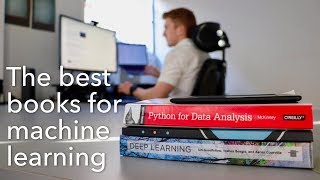
Daniel Bourke walks through seven books that shaped his machine learning education, ordered by difficulty. He starts with code and high-level concepts, then fills gaps with math. His picks include Machine Learning for Humans, Python for Data Analysis, Grokking Deep Learning, and Deep Learning by Goodfellow, Bengio, and Courville.
Chapters
Reading is learning, and as you'll see in this video, I've put together some of my favorite books that have helped me learn machine learning. And it's by all means not an exhaustive list, right? I've missed out plenty of things. So if, if you do watch the video and you think I've missed something, leave a comment below so that someone else can benefit from it. But otherwise, my style of learning is code and concepts first. So I've listed the books in this video in order of approachability. So I learn the code and concepts first and then fill in the gaps with math where needed. Alright, now you know that, let's get started. Number 1: Machine Learning for Humans by Vishal Maini and Sameer Sabri. Now machine learning is broad, right? There's algorithms for this, there's data for this, there's different ways to manipulate data for this algorithm. There's problems that you'll have collecting data, et cetera, et cetera. We know this, right? There's supervised learning, unsupervised learning, deep learning, and there's all different ways to work about them. But somehow Vishal and Sameer have managed to compilate a beautiful collection of explanations on all of the main topics in machine learning, right? Right from supervised learning, unsupervised learning, reinforcement learning, deep learning, neural networks. It's in there, all within 96 pages, right? And you can read this online for free. I don't have the full PDF, but I've read it on Medium as a series and both the PDF article. Now, why is it important? Well, if you're new to machine learning, as I said, it'll introduce you conceptually to some of the main topics in machine learning. But if you're already in machine learning, if you're already a practitioner, it will give you an idea of a way to communicate communicate a complex topic in a way that people can understand, right? Because even if you are the smartest person in the room, if you can't communicate what you know, how helpful is that knowledge to someone else? Number 2, Python for Data Analysis by Wes McKinney. Now this one I do have a physical copy of. Why? Well, because it's worth it. Now, most of my time as a machine learning engineer is spent manipulating data, analyzing it, and getting it ready for modeling. And 99% of the time I do that with Pandas, right? So performing data analysis with Pandas. And so what is this? Well, this is Python for, for data analysis, data wrangling with Pandas, NumPy, and IPython, which is Jupyter Notebooks now. But the important thing is that it's— the author is Wiz McKinney. Right, who's one of the creators of Pandas, which is the library I most use for manipulating and wrangling data. So if you want to get into data science or machine learning, you have to know how to manipulate data, and this book will show you how. Okay, number 3. So once you've read Python for Data Analysis, you've got comfortable wrangling data with Pandas, you'll probably want to model it. Well, how do you do that? You use machine learning algorithms to find patterns out of data. And now I don't have a physical copy of this book, but I do have it on the Kindle. You can't really even see it there, so I'm not sure why I'm holding up the Kindle. I'll just put a nice photo of it here. It's Hands-On Machine Learning with Scikit-Learn and TensorFlow by Aurélien Garonne. And now I got it on the Kindle, right, because I was reading it to and from work on the train. I wanted something that I could read just go and update myself on the best machine learning techniques while I was going to work to use them. The best thing about this book is that it will give you hands-on work through problems using scikit-learn and TensorFlow. Or scikit-learn is also called sklearn, which are two of the most useful machine learning libraries, if not the two most useful machine learning libraries out there. And that's really important. Like for me, I learn best by seeing someone else do something. So having those examples, seeing how they're done, I can go, okay, this is how it's done for this problem. I can come across my own problem, compare the two, and then adjust where it's needed. So if you take this book, right, Python for Data Analysis, the hands-on machine learning book with scikit-learn and TensorFlow, these two together made up 80% of the things that I would do on a day-to-day basis as a machine learning engineer. So they're definitely worth your time. Number 4, Grokking Deep Learning by Andrew Trask. Now again, I don't have a physical copy of this one, because when I first encountered it, it wasn't fully out yet. So way back when, when I was doing the Deep Learning Nanodegree by Udacity, Andrew Trask was one of the guest lecturers, and he was talking about LSTMs, I think, or language modeling, something like that. I can't remember the exact topic, but what I do remember is his way of explaining things was very akin to how I like to learn things. So using analogies like hyperparameters are like knobs on an oven which you can adjust, those sort of things, right? I really— that's— those click in my brain. And so when I heard that he was authoring a book, Grokking Deep Learning, I jumped on it. So I bought it. At the time there was only 5 chapters. I remember sitting on my couch reading through them, right? Step by step. And now up until that point, for neural networks I'd only ever used frameworks, right? But Trask insisted that in order to understand them deeply, it was best to code them from scratch using NumPy. And so I kind of disagreed, right, because I found the frameworks easier, right? Again, me avoiding the hard thing to do. But I followed Trask's lead, coded them from scratch from NumPy, and gained a much better understanding than I did without. So if you prefer a ground-up learning approach for deep learning, Grokking Deep Learning by Andrew Trask is for you. Wildcard time. Now, this one doesn't have an actual number because it's not fully out yet. That's the beautiful thing about open source, right, is that people can release things as they're being built, so you can, you can get value from them straight away. Now, this one is The Mechanics of Machine Learning by Jeremy Howard and Terence Parr. You can read it online for free, but remember, at the time of recording, it's not fully done yet. But reason being, Jeremy Howard, founder of fast.ai, I absorb all of his teachings to do with machine learning, right? I really, I really align with his style of teaching, so I know it's in good hands if it's got his name on it. And Terence Parr is a professor of computer science at the same university where Jeremy teaches at. And after briefly going through some of the chapters on the book, it's an incredible resource to learn machine learning. So check it out, The Mechanics of Machine Learning. Number 5, The 100 Page Machine Learning Book by Andrey Burkov. Now this one I do have a physical copy. Why? Because it's the start here and continue here of machine learning and something that you should have on your coffee table, right? So you can pick it up, someone can ask you about machine learning, ask, "Are the robots really going to take over?" And you can say, "No, I've read this book and I know what machine learning actually is." Alright, and so this is the book that I wish that I had when I started learning machine learning. I probably wouldn't have got a lot of the concepts in here when I first started, right, because it is that little bit, little bit advanced. And even now into it 2 years, there are some things that I don't understand. But that's, that's all right. It's only 100 or so pages. You can read it in about a day. I took longer than that. I did make a full review video on this, by the way. So if you want more details on it, check out the— I'll put that in the description. It covers end-to-end the broad spectrum of the most useful things that you should know about machine learning and explains them in a simple, easy-to-understand way. Number 6. Now, this is the last one, but by all means, again, this is not an exhaustive list, but I'm just sharing you some of my favorites. The last one is Deep Learning by Ian Goodfellow, Yoshua Bengio, and Aaron Courville. Alright, now if you haven't heard of Ian Goodfellow or Yoshua Bengio or Aaron Courville, you could pretty much say that they're, they're some of the founding figures of deep learning as a whole. And now, When I first encountered this video, this book, 2 years ago, it scared me, right? Because you can read it again online for free, but I started going through the pages and I read, I saw the big paragraphs of text, I saw the equations, the math equations, and I'm like, "No, I'm sticking to the code and concepts." But then I realized in order for me to take it to the next level, I need to— I've kind of learned from a top-down approach, remember? But now I need to go back and fill in the gaps from a bottom-up approach. And now this is, this is where this book is— I plan on using this book for. Now, I'm most excited for the chapters on math, right? Because in the end, code frameworks, languages, etc., will change, but math stays the same over the long term. And that's what I'm going for, right? I want knowledge over the long term. My mistake in the beginning was being scared of books that were too hard for me, when really In order to keep learning, I have to remind myself, "Daniel, you should be reading at all times a book that is slightly too hard for you to read." Because why? Eventually, that book won't be too hard for you to read, and then you find another one that's slightly too hard to read. So, with that, I hope you check out at least one of these books, or if not more. There'll be links for all of them in the description, so you can check them out there. I hope they bring you as much value as they've brought me. And remember, at $30 or whatever the price of a book is, or even free for some of them, even if they give you one concept that you use for a number of years, that's money well spent. If you have any other books that you think I've missed, leave a comment below so that others can see and so I can see as well. Otherwise, keep learning. Remember, learning is reading, so keep reading. And keep creating. We'll see you next time. Bye-bye.
More from Daniel

Small Language Models (SLMs) Are the Future: Fine-Tuning AI That Runs on Your iPhone

Introducing Sunny - A MedGemma-Powered Skin Health Tracking App (Kaggle Competition Entry)


Benchmarking: NVIDIA DGX Spark & NVIDIA RTX 4090 | Part 4 - Comparing the results

Benchmarking: NVIDIA DGX Spark & NVIDIA RTX 4090 | Part 3 - Running LLMs on the RTX 4090

Benchmarking: NVIDIA DGX Spark & NVIDIA RTX 4090 | Part 2 - Formalizing the tests

Benchmarking: NVIDIA DGX Spark & NVIDIA RTX 4090 | Part 1 - Creating a series of tests


Local Multimodal RAG on the NVIDIA DGX Spark | Part 4 - Publishing our demo to Hugging Face


Local Multimodal RAG on the NVIDIA DGX Spark | Part 3 - Putting it all together