This graph tells you whether you're intelligent or stupid
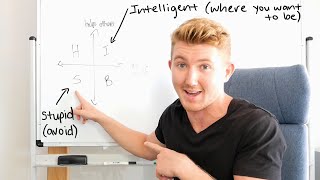
A 2-by-2 graph from The Basic Laws of Human Stupidity sorts people into four types: Intelligent (helps self and others), Bandit (helps self only), Helpless (helps others only), and Stupid (helps neither). The creator maps himself and friends onto it, then suggests you do the same and aim to move toward Intelligent.
Chapters
Future's looking so bright, we're gonna have to start wearing sunglasses indoor. Oh, what? We're on? Oh, well, hello there! Happy New Year, happy 2020. I hope your, uh, 2019 was incredible, and I hope the same for this, this brand new decade that we're in. You know, it's an exciting time, right? What's happening in the world, all you have to do is just look online and you just see So many new things going down from data science to machine learning to deep learning to all kinds of different technology to renewable energy to biotechnology to insert something here technology. It's an exciting time and that's not really what this video is about. It's about— oh, better get rid of that. I read a book recently. It's called The Basic Laws of Human Stupidity. It's quite funny actually. And there's a, there's a little graph in there that, that is, it's very simple and often the best things are simple. And I've been thinking about it ever since I saw it. And so that's what I'm going to talk about here. It's probably be, I don't know, let's try to keep this video nice and swift. Let's keep it under 10 minutes. You know, I have it. If you've been on the channel before, I have a tendency to ramble upon things and I just start talking about things that don't matter, but let's dive into this graph. First, I'll draw it up and then I'll explain it. So it's actually just an x-y axis. You can go here, here, here, here. And there's 4 quadrants. Up here, we have I, B, that's a B, H, and then S. And so what are the, what are the axes and what do these letters stand for? Well, over here we've got helps oneself and up here we got helps others. And you might be wondering, what do the I, the H, and the D and the S stand for? And one of the funny things right at the start of the book— man, this chair is creaky, and I apologize if there's construction noise. Uh, one of my neighbors seems to want to use power tools every single day. I think they might be building like a spaceship or some kind of underground bunker because the construction has been going for that long. Like, seriously, it's every day. But no complaining, that's rule 2, no complaints. But these quadrants here This is why I've been thinking about it because it's, it's, it's a change of year. It's 2020. I don't have a resolution or a goal or anything like that. Actually, the only probably goal that I have is to keep myself employed. So I need to, to work towards that, to do things to keep myself. Uh, end of last year I employed myself, started my own business and, and then that's, that's the goal for this year. Just keep myself employed. Keep, keep working on the things I want to work on, but pay attention to this, this graph here. So the quadrants: I stands for Intelligent, B stands for Bandit, S stands for Stupid, and H stands for Helpless. Now if you have a look at this, you can probably figure out why they're named what they are. One of the premises of the book, The Basic Laws of Human Stupidity, is that the average person severely underestimates the number of stupid people in circulation. I love how they use the word circulation. And so that is in this bottom left quadrant. It's not where you want to be. And so I did a little experiment with this. This is— it's my thought experiment is how can I spend 2020 or the next decade, you know, cause it's a, it's a shifting year, right? It's, it's like everyone's thinking about, oh, what's my New Year's resolution? Oh, can I make a change? What, what, what can I do differently this year that, that I've, that I haven't done in the past? And I'm thinking about that too, but truthfully, this is, this is probably my only guiding principle. And I think it's simple enough that, that you could adhere to it too. As long as you're not in the S category, but I mean, everyone says that they're not in the S category. It's alright if you are, I've been there before. So this is what I'm thinking about. The top right quadrant is an intelligent person and their actions, of course, we're talking about actions here. It's a different thing between thoughts because everyone has stupid thoughts. Let's be real. Intelligent person, what do their actions do? Well, at the same time as helping themself, They help others. So that's the ideal place you want to be, right? We'll just put it in here. Maybe you can't see this on the camera. I don't know if the glare or the angle, but we'll just— what I'm writing here is where you want to be. And because it's a new year, it might be a good, good time to think about making a change, and it doesn't really have to be a new year. I mean, any day of the year is a good time to make a change. Any moment is a good time to make a change. There's this concept in, I think it's Buddhist philosophy or something like that, or maybe not even Buddhist, or just, let's just, this is a concept, and it's a sudden versus gradual realization. And you have a choice. You can take a while to come to a realization, or if you already know it, if you already know it deep down, your instincts, but your instincts are going against thought, you're holding yourself back. Trust me, instincts evolved from evolution. We've only just— you can't change those. You're born with those, whereas thought you kind of learn as you go. So, trust your instincts is a long story short here. But it's the sudden versus gradual change. You can make a change like that. All you have to do is just get rid of the old thoughts that are holding back that new change. So, this part of the axes is where you want to be. If we had lots of people here, that'd be great, but truthfully, even if you know the concept, some people are still going to end up in this S category. Now, let's describe the rest of the graph. The B is Bandit. So, a bandit is someone who helps oneself, but doesn't necessarily help others. And truthfully, that's actually not too much of a bad place to be, right? Because you're not You're not really burdening anyone. It means that your actions, if you're a bandit, it's like net neutral in society and the people around you. So, you're out for yourself and whatever you do benefits you, but it doesn't really benefit many other people. But it also doesn't take away from other people. That's the important port. Important port? Oh, we're not talking about shipping channels, Daniel Bourke. Come on! That's bandit. Helpless is someone who helps others but doesn't help themselves. Now, when you think about it, why would it be called helpless? You could think that's kind of, that's kind of harsh when someone helps others but not themselves. You could call that selflish, self, selfless. Yourself less. But the, the reason why it's called helpless is the same principle as when it's— when you're in an aircraft and you go, the safety announcement comes over and they tell you, put on your safety mask first. The reason being is because if all you're doing is trying to help others and you're not helping yourself, that means if something goes wrong with you, you're You're pretty helpless because all you're doing is just giving away. Now, an intelligent person could help themselves and help others at the same time. Now, a helpless person forgets to take care of themselves. They're constantly thinking, oh my gosh, I need to take care of this person, I need to do that, I need to do this, I need to do that, and all of a sudden they end up as a train wreck because They forgot the most important person to take care of first is yourself. Put your own mask on first. And finally, the bottom left. We've already spoken about this one. Well, this is the stupid, stupid quadrant. Now, this is someone who not only doesn't help themselves, their actions actually degrade from themselves and their actions also degrade from others. This is what you really want to avoid. Now, a fun exercise for this is to introduce this concept to your friends, maybe to your family, or wherever you want, or just think about it yourself and think about the people you spend the most time with. Think about the people you hold in, in high regard, someone that you look up to. Where would they fit in each of these quadrants? And I mean, I'm not perfect. I've spent time here being stupid. I've spent time here being helpless. I've spent time here being a bandit. But my perspective is I want to try and move towards the intelligent quadrant. And so I did an exercise with my friends the other day and we're like, I told them about this concept and they're like, where would you place each other? And it's really tough. I mean, the most valuable opinion on this or thought to consider is is where you'd place yourself. And you have to be really self-critical about this because at any one time you could change if you're not thinking about what's going on, thinking about where your actions could go. And so this, where the ideal place to start trending towards is the intelligence section, where the ideal place to surround yourself with the people you want to spend the most time with is the people who you would place in the intelligent quadrant. And how can you demonstrate? How can you, how can you help someone move from here? Well, the first step is remember, put your own mask on first. Make your actions move towards this. And then truthfully, it's up to the individual themselves to recognize where they are on this, this, this little plot here. And then it's up to them themselves to decide, okay, I'm being pretty stupid this last year. I want to move towards intelligent. I want to help myself. I want to take care of my physical, my mental, my spiritual health. And at the same time, I want to do things that help others. So I think that's a good place to finish off. I just wanted to introduce you to this this fun little concept and fun little exercise that you can try with yourself. Really, be honest with yourself. You could try it with others. You could write it down. I spent some time journaling, trying to figure out what I could do, where I could end up on this. And again, it's an iterative process. You're not going to constantly stumble upon the answer. What's better? Is rather than looking for the correct answer, is asking the question or continually asking the question, how can I move myself more towards that intelligent bracket? But, woo! It's an exciting new year. It's a new decade. And if you're new to the channel, welcome. I'm going to make sort of a lot of videos this year, put it that way. Well, I hope so. I hope to keep making videos. As long as I'm here, I'll keep making videos. And I mean here as in just in this existence. My dogs are starting to go off. They must be getting suspicious of the man next door building that spaceship. Otherwise, I'll leave you off with one more question that I'm thinking about because when I read this, it hit me like a ton of bricks. It's: if you could spend a year working on something that wouldn't— is not so much important But would be really interesting, what would you work on? If you watched it here and you've thought about that question, leave a comment below. I've been thinking about it. It's been the thought topic of many walks. Otherwise, I'll leave some resources in the description that you can read more about. The Basic Laws of Human Stupidity, where I got this chart from, and an essay by Paul Graham where I got that question I just dumped on you right at the end of this video. But otherwise, have an amazing day and I'll see you next time. Where are those sunglasses?
More from Daniel

Small Language Models (SLMs) Are the Future: Fine-Tuning AI That Runs on Your iPhone

Introducing Sunny - A MedGemma-Powered Skin Health Tracking App (Kaggle Competition Entry)


Benchmarking: NVIDIA DGX Spark & NVIDIA RTX 4090 | Part 4 - Comparing the results

Benchmarking: NVIDIA DGX Spark & NVIDIA RTX 4090 | Part 3 - Running LLMs on the RTX 4090

Benchmarking: NVIDIA DGX Spark & NVIDIA RTX 4090 | Part 2 - Formalizing the tests

Benchmarking: NVIDIA DGX Spark & NVIDIA RTX 4090 | Part 1 - Creating a series of tests


Local Multimodal RAG on the NVIDIA DGX Spark | Part 4 - Publishing our demo to Hugging Face


Local Multimodal RAG on the NVIDIA DGX Spark | Part 3 - Putting it all together