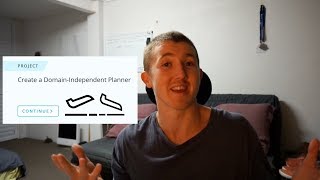
A student working through Udacity's AI Nanodegree shares his approach to Project 3, a cargo transportation planning system. He uses Reddit's ELI5 threads and interactive search visualizers to learn, takes 20-minute walks for creativity, and recently got rejected from an AI role at Superhuman but accepted a teaching position at CodeCamp.
Chapters
What's happening, y'all? Welcome to Learning Intelligence 8. And today's been one of those days, you know, when you get up in the morning and all these things happen that you weren't really expecting to happen and they're sort of running in the background of your brain and you're like, I need to get these things done before I can do anything else. So, that was where I spent most of my morning, but no complaints, got into some studying. It's fairly late here. Well, not late, but late for me to be studying. It's about 8 PM at the moment and I've got about a week or so until Project 3 of the Udacity AI ND or Artificial Intelligence Nanodegree is due. I know I'm trying to reduce that, that massive saying, but I think it's— I gotta get more used to it. So I spent the last hour or so planning. I also spent an hour or so reading this puppy, slowly working through each of the chapters. I'm finding it more and more fascinating as I go through. A lot of dense material, but I want to show you something cool. I got this playlist here that I call Conquer, and it's like my, my get shit done, get shit done playlist, or GSD. Might be a little bit burnt actually. I just realized that I went out and did workout in, in the sun today. It's been raining where I live for like the last week. I put on the playlist, put on the headphones, and punched out some planning here. So now I've got a whole document here dedicated, dedicated to planning Project 3. So as you see there, and this is a Project 3 on GitHub. So essentially I've got to plan out an airport cargo system and then analyze it. I'll link the Udacity GitHub in the description so you can check it out if you want to. I think this will be be the most complex project I've tackled yet. I haven't dived fully into it. I've only got a plan of attack. I like to spend at least a few hours planning so I know I can tackle it step by step rather than just diving in. And something I'm also trying to work on is improving my ability, uh, improving my Python code. I think that's, that's one of my weaknesses at the moment. It's turning the pseudocode in the textbook into functions. So I'm going to be dedicating at least, I think, 15 to 30 minutes per day just specifically on taking a function from a book and trying to replicate it in Python code. I think that's a, that's a good goal to have. I got that tip from the mentor actually, from my Udacity mentor. She said, if you're having problems with that, try practicing it a little bit each day. And that's simple advice, but great advice. I just went through a review of the notes I took last week and the classes that I did last week on the, on search and planning in preparation for Project 3, which is my next major milestone. So I've put things like DataCamp and other coding stuff I was doing on hold to really focus down on getting everything ready to go for Project 3 in the AI Nanodegree. But I have 3 cool things I wanna show you. Number 1, explain like I'm 5. This is a Reddit thread where you can go and find advanced topics such as, well, in my opinion, advanced topics, the A* search algorithm. And you'll have the best, smartest people in the world commenting on Reddit. You gotta verify to make sure their answers are legit. And in a way that's easy to understand. The A* algorithm is quite complex if you've never heard of it before, but essentially it can be broken down and considered to be the best estimated total path cost first. If you have a route finding algorithm, you want to get from point A to point B, A* search will find you the best estimated lowest cost route. That's what I gathered so far from the eli5 thread on Reddit, and I'll link that in the description, by the way. So any topic you're having trouble understanding, search eli5 and then whatever you're looking for, and hopefully that someone's made it on Reddit. If not, if you decide to— if there's no thread on it, maybe you can create your own and help out the rest of the community. Number 2, so you know how I've been doing all these search algorithms, or if you've been watching along the vlogs, I've been learning about different different kinds of search and planning algorithms in artificial intelligence. And so I found an awesome, this is from the eli5 thread, by the way, an awesome visualizer to demonstrate different search algorithms such as breadth-first search and depth-first search and A* search. I'll let the visualization do the talking. Check this out. You start at the green dot, you draw these walls by just dragging the mouse, and then it wants to get to the red dot. And you can choose your search algorithm here and then adjust the heuristics. So if we go, let's start. This is the A* search. This is how it works. A visualization. So I'll link this in the description and then it finds a path to the goal and let's check it out. What did it do it in? Time: 10 milliseconds or sorry, 10 seconds. I thought that was really cool and failure of the day, I'm going to put right here. I applied for an AI role in a startup in Silicon Valley for Superhuman who are building a revolutionary email client mainly because I'm in love with communication and I'm in love with AI. And I didn't get the role. So that's all right. I get to go back to what I'm doing. And I think I'm gonna try to do that at least once per week, have some sort of failure, at least something that I've tried and failed at. Might not be a job application, but we'll see what happens. Have I told you guys before how much I love walks? I just went for a 20-minute walk to clear my head. I've been working on my project all day. Let me show you what I've done actually. I love walking. It clears my head. I was in a bit of a rut with this project I'm working on, and I decided it's time to get moving, get the subconscious working on the problems. And now I've come back, just been gone down down to the water, amazing area down there. My head is so much clearer, ready to take on the next stage. This is where I'm at. I've been going through the GitHub page and just writing out all the things I need to do. Even the next function I need to implement, I started it, I've left it here to come back to, to implement with handwriting before I implement it with code. So I'm gonna do about another hour and a half of study before I call it a day. My goal is to have a rough outline of the next functions I need to implement in part 1 of the project. And then after that, gonna do some reading because I need to do a report for part 3 of the project. On the history of AI in planning, in planning. So the project is on. I've got to develop a planning domain language or some planning functions to plan transportation to and from certain airports with planes and cargo. But I'll fill you in more when I've learned more about it and made more progress. Side note, next time you're stuck on something, try going for a walk for 20 minutes or so. You know, Harvard published a study recently that I read that said walking for about 20 minutes or so promotes creativity. I guess that's why Steve Jobs had all these meetings on walks. Hacking into the database. We can do this. He's on the run. We got it. Track him down. Where is it? Did we do it? Fail. Errors. Plenty of errors. I always feel like I'm an elite-level hacker, like one of those ones from the movies when I'm working in the terminal. I just spent the past hour and a half or 2 hours or so implementing a few functions into my project 3 for the AI Nanodegree, and I had my noise-canceling headphones on and I was in deep coder mode, and I think my mom came into my room came and said something to me and I must have replied like a zombie. But I don't know about you, but when I'm in coding mode, like, that's all I'm doing. Like, I still got a— still got an error coming. Gotta fail you here. That's all right. I'm gonna call it a day for the coding portion of things. I got to still— let me take these off. I'm still going to be reading the history of AI and planning in the artificial intelligence textbook that I have. But otherwise, really cool news. I'm excited for, for later this year, and actually in a few weeks' time, I got offered a role at CodeCamp. Which is an equivalent of like a school holidays kind of boot camp coding session for kids where I can go along and teach kids how to code. And I'm really, really keen for that. So I'll see if I can film there. Probably, probably not because there's kids involved or whatnot. I'll bring the stories from there to the vlog. That won't be for a few weeks. I'm thinking, I think it's about December or so, just before Christmas and after Christmas on the school holidays. I'm really excited for that. Like, if you can't tell, I know I got a smile on my face. I read the email and they, they offered me a role and I'm like, yes! I could teach these kids how to code. So it's a few days a week, essentially starting from the ground up and getting kids upskilled with the most valuable skill in 2017, in my opinion. I'm biased, of course, because I'm learning it. But I think anyone— everyone can gain value out of coding. And it's not just coding, it's the underlying skill that comes along with programming, and that's problem solving. So I think that's good. That's gonna be it for episode 8. Thank you so much for watching. Next week's video is gonna be more of project 3. That's due in a few days. I'm gonna crunch it out. And we'll get it submitted, and then I'll show you when it's done. As always, keep learning, and we'll see you next week.