Upgrade your decision making using these 4 boxes
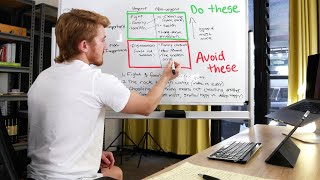
A speaker shares a four-box decision matrix that plots tasks as Urgent or Non-Urgent against Important or Non-Important. The core idea: focus on the Important-Non-Urgent quadrant by cutting distractions, turn off notifications, and align daily choices with your long-term mission rather than chasing short-term pleasures.
Chapters
I sat there crying. Yeah, real tears. Tears were coming out of my eyes onto my study notes. You see, it was like November 2010 or something like that, and here I am sitting trying to study for the final maths exam, and I realised, getting all my papers together, trying to read the textbook, I realised, oh, you know what? I haven't really been paying much attention this semester. I've just been taking it easy, cruising, playing with my new iPhone inside, popping bubble wrap actually, inside my pencil case. And lo and behold, teachers hadn't realised that you could do that then. So, I felt really great that I could hide the fact that I was using my phone. But then felt pretty terrible the night before an exam crying to my mother to go, "Mum, please tell me it's going to be alright. Please tell me it's going to be alright." And let's be real, I didn't pay attention to this little square here. Now, I hope you can see it, of what's going on. If not, I can talk to it, but it's a— it's something that— oh wait, you might want to know what happened to that exam. I'm pretty sure I ended up getting some sort of barely scraping through passing mark, but I don't think I deserved it looking back. I think it was just because I was fairly, on fairly good terms relationship with the teacher. Like, he was, he was probably too nice to fail me, put it that way. Which is, at the time seems like a good thing, but in hindsight, maybe he should have failed me, then I would have got the message a bit sooner. Anyway, it was because I wasn't adhering to this little square that I'm going to introduce you to, and it's, it's not new, right? It's not like I've thought of this, but I heard of it the other day and I remembered, it clicked. So if you do have the reference of where this square actually comes from, of course, hopefully you can see it. If not, I'll talk through it. If you do, leave it in the comments, it would be much appreciated. But essentially, it's just thinking of how, or approaching each of your decisions in day-to-day life by thinking about where they put, where they fit into one of these 4 boxes. And so what we've got here is we've got urgent and non-urgent on the x-axis. We've got important and non-important on the y-axis. And so, when you break it down, you get, you get 4 different boxes here. And I've intentionally left these 2 boxes blank because we're gonna, in this video, we're gonna fill them out. And so, I heard this, someone mentioned this, this box the other day, and I remember reading it a few years ago, but I didn't really pay much attention to it. Then. But now I've kind of figured out, I've kind of inadvertently, inadvertently been doing this just over the last couple of years, but this kind of really makes it more concrete than just me sort of blabbering on about how I think about things. So, that's what we're gonna, we're gonna go through in today's video. And I've got a few points here that we're also going to discuss. And so, the reason why I'm going to talk about this box is because I want you to, to feel the benefits of it. Because there is nothing in life that is more beautiful than someone fulfilling their potential. And this is if you— and of course, every decision that you make doesn't necessarily have to funnel through this, but if you have this tool that you can apply to different ways of living, well then you have the opportunity to fulfill the potential within you. And there is— and it's a selfish reason because if I see someone else fulfilling their potential, it makes me want to do the same. And so let's get through this. Now, point number 1 is a man's role in life is to what? Are you ready to receive your arm ring and become a man? Yes. What does a man do? He fights. And? He looks after his family. Now, of course, you might be thinking, and oh, you can substitute man. When I say man, I'm talking about humans. You can substitute fighting doesn't mean necessarily going fisticuffs with someone, punching someone in the face or kicking them or wrestling to the ground, but you should at least have some sort of training in that. That's why I think everyone should do at least some sort of martial art. The fight is, I've got the Warrior Poet here. Now, whether you're a warrior or an artist, you're going to have to fight the same struggles, the same fears. For example, when I turn the camera on, a little fear inside me starts up and goes, "Ooh, I'm putting a little bit of my soul out there. I'm putting my thoughts out there." You know the first law of thermodynamics, don't you? Is that you can use that energy to create. And so the fight may be getting up in the morning. The fight may be taking care of your family, even though you'd rather be doing something else. And now, the other caveat here is that your family may not just be the immediate family that's around you. Of course, you should always seek to look after those closest to you, but at the same time, you're not going to be much help to those closest to you if you don't look after yourself. And I'm talking about the 8 to 23 personalities that, that are inside your head. Now, don't pretend like you don't have them. And so you might start there. It starts at the individual. Remember, all of these things, it's best when whatever problem you're facing, whatever fight you're battling, whatever battle you have to battle, It's best to break it down into its smallest entities. We'll get to that in a second, why, um, it's easier in terms of choosing your decisions day by day and planning for the long term. But you're not going to be much help to those around you if you don't take care of yourself. So, that's the first battle you have to solve. You need to take care of yourself. You have to think about what is important and urgent. These two Fight and family go in there. So let's put in that. Fight. Family. And I'm going to add in one more here. Health. But realistically, you might be thinking, "Oh, is it always urgent?" Well, it's not always going to be urgent, of course. Of course, different things in these different boxes can go in different places. But think about health in the context of fight and family. How many things does a sick person want? A sick person wants one thing: to not be sick anymore. A healthy person wants 10,000 things. They forget about the important and the urgent, the fight, the battle that we have to face every day. That is existence. That is the 3:30 wake up, you have to go urinate. That is a battle. Family, taking care of your family, that's a hard job. But again, starts from the individual, then goes to your extended family, those closest around you, maybe your parents, maybe your children, maybe the small little community that you visit. Every day. I was working out with a friend this morning and we talked about this and there's a piece of trash on the ground or whatever and it feels better to clean up your community. You don't have to be paid for that. That's, that's a, that's an example of something that's important but non-urgent, right? Where family can go important non-urgent would be to clean up. This could be room and could be park, right? The reason why I say non-urgent is because, okay, I've got a few things misplaced in my room, but it's not like it's affecting my existence right now. I will get to clean it up, it is important, but it's not dramatically urgent. And so, when I come back down here to the Warrior Poet, as I said before, whether you're a warrior, you're a fighter, or you're an artist, you're going to have to face daily battles. That is your primary role, is to fight and look after your family. That's— when it comes to this box, we're going to spend most of our time up here. Spend most time. Alright? So, now, point 2 is the rock through water. Now, if we said this, if we want to say, if we said that we want to spend, you're like, yes, Daniel, I want to spend most of my time working on things that are important rather than non-important. I want to get better at differentiating between what's urgent and non-urgent. For example, another, another quick one is your health can move over to here, non-urgent. You might ask, why? Well, if you've been taking care of your health, Well, then it's, it's rare, unlucky, a sort of sign of faith that something may come about and ruin that. But the best treatment is prevention. So, that's why it's important if you prevent ailments from arising, suddenly, even though health is still important to take care of, It's non-urgent. That's the, this is doing the simple things every day. It's eating well, getting enough sleep, moving. Done. But let's get, let's get on to point 2. What you want to be, the easiest way to spend, you want to make this easy for yourself is to spend time up here in the important zone. There's 2 boxes up here. You want to be like a rock through water. What I mean by that is, I got in brackets, yeah, make it easy for yourself, but this is the, the monk-like discipline. And the reason why I filled out these two boxes down the bottom here, the not important first, was because a lot of the time you might not know what exactly is the best path for you, but it's probably more likely that you do know what's not the right path for you. And so there's some robustness there in that knowledge, is that knowing is the knowing of what's not important. And so in my case, again, I'm giving you this tool of this box to make your own decisions, and we're talking through these points. I only share stories from my own experience because that's the only real stories that one can share. And so for me, I figured out that Distraction, basically all distraction is non-important, except it acts, it masquerades itself, it's really, it's got this little appearance, it puts itself in a red bubble and it says, "Excuse me, click on me please." And you know what, being the sucker that I am, I used to spend a lot of time clicking on those red bubbles. Maybe you're the same. So, I had to get rid of them all. No notifications on any of my devices, permanent do not disturb, no social media, all that. Had to get rid of them all because I knew that they were in my non-important box. And remember, I want to spend most of my time up here. So, that's how I became the rock through water. Now, I forgot to say, I forgot to paint the picture in your head, but I believe you can imagine it. Is what happens with a rock In water, if you throw a pebble, if you're standing on the side of a lake and you go, "Pop!" Or maybe you want to skip it because that's way more fun than just going, "Pop!" That's a bit lame. What happens to that rock eventually? Well, it starts to fall through the water, but what is it doing? Remember the most beautiful thing that I said? Well, at least for me, the most beautiful thing in life is is seeing fulfilled human potential. That's why I cry at Olympic Games medal ceremonies and hearing beautiful stories and whatnot. It's because that's true human potential realized. Like, you don't know what— we still don't know what we're capable of. It actually— I'm feeling excited right now about it because far out. Anyway, the rock through water. I'm getting distracted here. I'm getting too much in the clouds. The rock through water. It's fulfilling its potential, its gravitational potential. It's traveling to the bottom. It's gradient descending for all of you machine learning nerds like me. And so, that's what you want to be. Once you've figured out what is your most important task, maybe it's to find. Maybe it's your family, maybe it's your health. You want to— the way you can be the rock through water is to remove all of the non-importance. You just go, yep, you know what? Anything in this non-important, that's just fairy dust, out of my mind. You got here as well, non-important, non-urgent, fancy clothes, like a lot of people might try and buy fancy clothes to look good, to impress others, rather than just being good, being a good person. Now, of course, I'm not going to deny the fact that looking good makes you appear good, makes you appear as a better person. It can, in fact, have the psychological effect on you is that if you look good, you become better. It's not always the case, of course, but the best way for clothes, the best way to look good in clothes is to First of all, take care of your health is to be fit and lean. And then, rather than brand name clothes, you just buy clothes that fit, like this beautiful white t-shirt that you can see. I look pretty good, don't I? And now, the new iPhone, technology 2.0, these things come out every year. They're great, of course, but if you're just using them to fuel this, well then, it's not urgent and it's not important. And then finally, of course, the endless scroll. I don't think I need to talk too much on that, but the endless scroll is the endless feed of social media. Connecting the world. So, that brings us on to part 3, but yeah, the rock through water. Make it easy for yourself. Use this box, figure out what's not important to you and just remove it, remove it out of your life. Number 3, choosing one thing means not choosing another, and then in brackets, the battle between— now, this is where the fight comes in. So, this is why I have this point here, the fight. There is a battle between the things that you want and the things that you want most. And there is always a battle between the shallow happy and the deep happy. So that is that, that fight, that is that fight that is urgent and important. Well, the fight can go in here in this just important battle. The thing that the face, the battles that we face every day that you and I face every day, for example, want. Now I stopped looking at all the metrics on, on all of my YouTube videos and a whole bunch of different things that I create. Now, of course, I know that they have their place, but to me, they'd be in this non-important bucket. This is me using this matrix. I stopped looking at these things because want most is to— something that I want is for those metrics to go up. Something that I want most is to be true to myself, is to create the things that I'd like to see in the world. And do they always coincide with like the thing that I want most with the thing that I want? Of course not. But if I'm being honest with myself, I'm being true to myself, I'm thinking about what is it that the thing that I want most, I have to choose that thing instead of the other. Whereas if I choose this, what I want, like the worst thing, one of the worst things that you can do in life is optimize for the wrong thing. Same with building a machine learning model. If you choose the wrong evaluation metric and you optimize for that evaluation metric, well, it's not going to be a great outcome, is it? And so if I'm optimizing for the things that I want in life, it means that the things that I want most are going to miss out. I'll give you an example with shallow happy versus deep happy. A simple one is you want to, you want to be fit. You want to take care of your health. Very important. Very, very important. If you're not doing that, take care of that first. The shallow happy is, yes, I want to have some delicious ice cream, but the deep happy is, oh, and you get happy, you eat the ice cream, yum, yum, yum. Ice cream is delicious, I'm not going to lie. Cookies are my favourite. And the shallow happy is, yeah, you get that, you get that 10-minute mouth feeling of, yeah, this tasted beautiful. But the deep happy is the missing out on, on the ice cream or forgoing it because you know that your longer-term mission. Now, this is the most, this is one of the most important boxes here. I'm going to put it up here. It's the non-urgent and the important, the long-term mission. Now, of course, that's going to be different. For each individual. That's why I want you to be thinking about these things, because whatever I say, of course, is always going to be biased by my own experiences. So that's why I want to provide— rather than just telling you what to do, I want to provide you with the tools that you can use for almost all of eternity. Like this, this little box, whatever you fill it in, is not going to change over time. But the deep happy is a long-term mission. We said that the short-term happy or the shallow happy is the eating the ice cream, but the deep happy is being shredded. We're keeping this channel PG, by the way. It's being shredded, it's being fit, it's being able to use— being able to rely on your body to take on different challenges. And so in order to win that battle, of shallow happy versus deep happy, you have to understand what is most important to you, whether it's urgent or non-urgent. Anything below this line can basically be wiped off the face of the universe. Now, of course, we're not robots, we're human beings, but the way I like to think of it is that we're, we're like programmable mush. So, if you treat yourself, your brain, as programmable mush, these are some of the rules that you can program into your brain to start looking at things differently. Now, one final example is that every morning, just to get real tactical, I create two lists. Sorry, once a day I create a list because I try to keep— I like writing things down as much as technology helps out. At the start of the week, I write down a bunch of things that I want to do. And day to day, I write down things that I'd like to do based on the things I'd like to get done in the week. The things I'd like to get done in the week are trying to contribute towards my long-term mission, which are things like build things that bring value to others. These can be non-specific things, by the way. You don't have to be very specific. It's just that, for example, my long-term mission is to create to learn and learn to create. And so, that's, that's very broad. So, whatever kind of fills in, fits into that bucket at the moment, it's machine learning. I'm really obsessed with machine learning and writing and spoken word. I know I have to do these videos to practice my ability to talk about different things. And so, when I'm writing things down of what I have to do during the day, what I have to do during the week, what I have to do to try and fulfill my long-term mission, I'm thinking about it in terms of this box here. It's really easy to make the decisions because I'm a rock through water because I understand what's important to me. So, basically everything in this bracket of non-importance doesn't go on the list. So, maybe that's something that you could try. I found it really simple. And the beautiful thing about having a— I know I only take up about half the page. For example, this morning was read. Write. Workout with Justin at 5:30. Shoot important versus non-important video. That's what we're doing here. That's going to get a tick after this video. The beauty of only using half a page is that you're limited to a certain number of things because at the end of the day, there are only so many fights that you can take on. Now, let's wrap this up. Probably gone too long as usual, but The exercise you could do is in the comments, leave, leave down what's most important to you. What's important and urgent to you? What's important and non-urgent to you? What's not important to you? Maybe you're different to me. Maybe you've got some things that I've said are not important but are important to you. So, maybe you could leave those in the comments. That's one of the really ways to improve your knowledge is to talk to someone who disagrees with your point of view. But in summary, a man's role in life is to fight and look after his family, to be the warrior poet, to battle, but still create art. Two, you want to be like a rock through water. Make it easy for yourself. That doesn't mean that it's going to be easy, right? That comes back to fight. You're still going to have to, even if you know what you have to do, you're still going to have to fight sometimes to take on that challenge. And number 3, are you going for shallow happiness or deep happiness? Now, of course, I said we're human beings, we're not robots, we're programmable mush. So, of course, there are going to be times where you're going to eat the ice cream and bloody enjoy it. And so you should, but just remember the difference between shallow happy And deep happy. Now, that being said, it is Saturday and it's pancake day for me, so I'm going to go cook some pancakes. Actually, I just cook really one big pancake. It's really delicious. Pancake and berries and some yoghurt. But I hope you enjoyed this video. If you've got any questions, leave a comment below. As always, keep learning, keep creating, and I'll see you next time.
More from Daniel

Small Language Models (SLMs) Are the Future: Fine-Tuning AI That Runs on Your iPhone

Introducing Sunny - A MedGemma-Powered Skin Health Tracking App (Kaggle Competition Entry)


Benchmarking: NVIDIA DGX Spark & NVIDIA RTX 4090 | Part 4 - Comparing the results

Benchmarking: NVIDIA DGX Spark & NVIDIA RTX 4090 | Part 3 - Running LLMs on the RTX 4090

Benchmarking: NVIDIA DGX Spark & NVIDIA RTX 4090 | Part 2 - Formalizing the tests

Benchmarking: NVIDIA DGX Spark & NVIDIA RTX 4090 | Part 1 - Creating a series of tests


Local Multimodal RAG on the NVIDIA DGX Spark | Part 4 - Publishing our demo to Hugging Face


Local Multimodal RAG on the NVIDIA DGX Spark | Part 3 - Putting it all together