What I Learned From Creating My Own Radio Show - TDBS 101
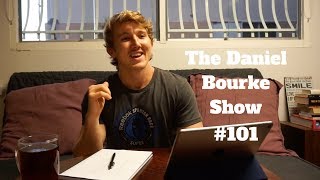
Daniel Bourke reflects on 100 days of daily podcasting. He learned that resistance never disappears, momentum builds through habit, asking questions deepens conversations, and modern tools make creation easy. He ends with a challenge: make and share something small.
Chapters
What's good, y'all? Welcome back. Your boy is back. Episode 101 of the Daniel Bourke Show. We are here. Thank you all so much for joining in, whether you're on YouTube, whether you're on the podcast. I hope you're all having an amazing day. As it's been about 10 days since I finished up, or maybe a bit longer, almost 2 weeks, almost 2 weeks since the 100-day experiment finished up, and I'm finally getting around to doing episode 101. So, you know, we did this all in one take and I haven't had really any practice to do this. So, I'm going to test myself and see, see if my skills are still up there, see if I can still talk for a whole episode without, I don't know, boring you or without choking up too much. We're going to go over— actually, yeah, what's the topic of today's episode? Today, we're going to go over an article I recently wrote on Medium or my blog. You can check it out. Mrdburke.com/blog or medium.com/@mrdburke. I'll put all the links in the show notes and whatever. But I recently wrote an article of some of the things I learned after creating my own radio show. So, you may or may not know, I did a 100-day experiment from February 21st to whenever the end day was of making a podcast every single day. And I had no excuses. I just made one every single day. There was no plans of the show. I'd get on, I'd hit record, do everything in one take every time, not edit it whatsoever except for the back and the front, cut out the white space, then upload it to SoundCloud and push it out to all of your lovely devices. So I'm going to go over that article of what I did. I figured I could easily read the article word for word, but that would be boring. So I'm going to— and I figured you can, you can read it word for word yourself if you really wanted to, but I'm going to do a short fire 1 minute per point. There was 8 points in total, so I'm going to test myself and see if I can give you an example of each point. I will give myself 1 minute for each point so the total time of this podcast doesn't go for too long. That way you get the maximum information possible. And for those of you watching on YouTube, how good is my new setup? I like to call this show Between Two Cushions. These are my co-hosts, Lefty and Righty. But let's get into it. So what is point 1? I'll set my timer. I'll show everyone on YouTube that I'm being legit. So we'll get the timer going. I don't know if you can see this, but if you can, time's running out. So point 1, the resistance doesn't go away. Yes, that is true. What is the resistance? Well, if you've read the book The War of Art by Steven Pressfield, I'll put that in the links as well. He talks about this resistance, which is anything that— I got a runny nose. This is not good timing. Anything that sort of holds you back from doing something that you know you should be doing. So, whenever you've got that feeling in the back of your head where it's like, I know I should be doing this, but instead you do something else, like you're scrolling through social media or you're, you're, I don't know, clean your room 4 dozen times in one day, or you bake a whole bunch of cakes, otherwise known as procrastibaking. But yeah, the resistance doesn't go away. For every single episode, I had to sort of get over this little milestone of actually doing it. Like today, I was procrastinating all day. It's now 5:10 PM. I'm only getting to do episode 101 right now. So, the resistance doesn't go away. For every episode, for every time you do something that puts yourself out there, there's always going to be resistance. So, you just get better at dealing with it over time. That was longer than a minute, I lied. So, we'll go to the next one. Point 2, the power of momentum. So, why, what, what do I mean by the power of momentum? Well, the reason why I did the podcast every single day was so that I didn't have an excuse. I would make it every single day and I set myself the challenge of 100 days because I figured, okay, 2 weeks is easy, 30 days is alright, but 100 days, that's— once I finish up, I'll have 100 episodes. That's cool. So, that's really why I wanted 100 days. And I didn't have an excuse to not do it. I was just like, every single day, I do it without fail. And then if I miss a day, well, I broke the chain. Then— and I made sure I put myself out there. I told people that I was going to do one a day for 100 days. And they're like, really? Every day? I'm like, yeah, every day. And then once I got into about 40+ episodes, people were like, "Oh, he's doing it every day." And it became much of a habit. And so, I find if I do something every single day, like, it's really easy to turn it into a habit. Minutes over. So, number 2, power of momentum. Do something every day if you want to build it into a habit. Alright, we're going to number 3, really fast. Ah, one of my favourites, asking questions. So, out of the 100 episodes, I Interviewed probably over a dozen people. I can't remember the exact number. I really should know this. I'm totally unprofessional, but I found my interviewing skills got better and better with each one. Like, the first time I spoke, it was with one of my friends, and it was— wasn't even an interview really, it was just a conversation, but— Oh, I nearly stuffed up. I nearly stuffed up. I nearly lost my train of thought. No, we're going to get back on this. So, it's just a conversation, but What asking questions, what doing a podcast taught me was that if you're thinking of something, just ask. You can spend all day dancing around the point, but when you've got a limited time, when you're only concentrating on a question, sorry, on a conversation with one person, and if you have a question, just ask because you're going to let that chance get away. And so, I've started applying that to different scenarios in my life now. Time is up. I mean, it goes a lot quicker than you think. Start applying that to different scenarios in my life of where can I just ask a question. So, whenever I'm in a situation where I think, "Oh, I really wish I knew this from X person," well, I just go and ask, because otherwise that opportunity is going to go away. You never know. All it is is just a question, right? Alright, that went longer again. Number 4. Putting yourself out there is scary. Yes, it is. So, when I first started, I was actually afraid to hit submit. And same with when I started writing on medium.com and my blog. I was really afraid to hit that submit button. And when I started a Facebook page for my brand, for my name, my brand, as an artist, as an artist, lol. It was scary putting myself out there. Like, I was— what was I being held back by? The whole— all it really is, is the fear of what other people would think. And it's so, so silly to imagine because if I look at people who are doing similar things to what I'm doing, I have nothing but respect for them. So, why would I be having this anxiety attack over the fact that other— I'm afraid of what other people will think? So, The fear is still there every time I click submit or publish on a new piece of content, like a video or a post or a podcast, but you just get better at dealing with it over time. So, putting yourself out there is always going to be scary, but just like the resistance, it's— you just get better and better and better at dealing with it over time. Point 4, putting yourself out there is scary. So, number 5, the making part is easy. Yes, 100%. If you're thinking of making something, all these platforms that are coming out these days for, for writing, where you got WordPress, blogging, Medium, all those, all those platforms for writing, podcasts like SoundCloud, Libsyn, GarageBand, or for YouTube, YouTube, iMovie, whatever. Actually, the making of it is incredibly easy. So, you have a smartphone now, which I'm recording on, that you can open the YouTube app push record, record yourself doing whatever it is that you're doing, and upload it to YouTube, and all of a sudden that content is shareable across millions and millions and billions of people. Same with the podcast. I record the podcast on my phone, I send it to my Mac, I edit it in GarageBand quickly, like an intro and outro, put it on the front and the back, and then upload it to SoundCloud, and because of the RSS feed link, it comes out to all different podcasting apps. Like Stitcher, podcasts on the iPhone. Google Play Store is not in my country yet, so I can't do that yet, but the actual making of it is incredibly easy. Alright, that was number 5. So, number 6, let's go. Conversing in a new way. 100%, yeah. So, I didn't realize that this would happen. That's weird. Okay. I didn't realize that this would happen, but when I was talking to people, I would find the fact that the microphone was present, I would try to keep it as natural as possible, but the fact that the microphone was present really allowed us to dive deeper and talk about things I would talk about with people that I'd never even touched on before. So, and going off the principle of my "just ask" motto or catchphrase that I was using for asking questions, I think of conversations like with my dad. I hadn't had a conversation like that with my dad in a very long time, but the fact that the microphone was there and we sat down and we worried about nothing else except talking to each other, that really allowed a different level of conversation and really opened up some valuable time with not only my dad, but every single guest that I had on the show. So, it's definitely a new way of conversing. So, that was number 6. We got number 7. So, the power of thinking out loud. What, what's an example? I began like doing these 100, like, sorry, everyday challenges or everyday habits by writing, writing 750 words every day on 750words.com, and I'll also link that in the description if you want. But I found, like, the process of journaling, of writing something down, and as you can see here, I've got some important documentation. But writing, writing your thoughts down, writing your problems down really shows you how insignificant they actually are. The same goes for thinking out loud. So, most of the episodes, I couldn't tell you what they were about. It was just, honestly, it was me talking out loud and thinking through different processes and thinking about different problems and working them out by just hearing my voice. And it was like a self, I don't know, psychiatry session or psychiatrist or— I don't know the right word, but very powerful. And you can do this in a number of ways, writing it down, actually saying it out loud, or sending it in a message to someone, something like that. You realize how small like these problems actually are. So, that was point 7. And then we got the final one. Making podcasts is fun, right? So, I started the 100-day experiment with 3 main goals: to get better at public speaking, to practice my interviewing skills, because before the podcast I've never interviewed anyone ever, and to have fun. And I definitely hit all 3 of those. I recorded something like 40+ hours of audio and it's going to get even larger as I start to do more episodes like this. But I officially started my own radio show. You couldn't do that like 25 years ago, but now I click a few buttons and my radio show is out to the world. And now I've got my own TV show, which is on YouTube, and I get to have awesome conversations with people from overseas. Like, I talked to a girl from Denmark, I talked to a girl from Bali, I talked to Talk to some of my best friends in a way I'd never done it before. And I've actually made something. Creating something is really fun. It was— that's another one of my goals of— you've heard this a lot before— was to consume less and create more in 2017. But I'm finding it's so much fun to make stuff. The resistance never goes away of like putting yourself out there, but I wouldn't have it any other way now. Creating is definitely the way to go for me. But that was it. That was 8 points, 8 minutes. Some of them went over time. So, let's go from the top. Number 1, the resistance doesn't go away. Still there every day, every episode. The power of momentum, the power of doing something every day, creating that habit, right? Asking questions. So, just ask. Number 4, putting yourself out there. It's scary. It's still scary every single time I do it. Number 5, the making part of the podcast is easy. Making of YouTube videos is easy. Like, it's— they're all 3-step processes now or less. Conversing in a new way with people. That— wait, that was number 6. The power of thinking out loud. So, when you think out loud and when you write down your problems, they're really insignificant. And actually, it depends on what they are. I'm not trying to play down on anyone's issues or whatever, but if you want to deal with them, try writing down or speaking out loud. Number 8, making podcasts is fun. Same with making YouTube videos. But that's it. Episode 101. We're back. There's probably not going to be an intro to this show, and I know I'm saying that too late. Maybe I'll record something now. But thank you all for listening. I hope you're having an amazing day. What's the daily challenge? Oh, I don't have a daily— it's not a daily challenge anymore because I'm not recording them daily. But we can have a challenge. Hmm. The challenge can be What's something that you can create? What's something that you've been wanting to create? I challenge you to try it out for 10 minutes, whatever it is. When you write something or you want to write or you want to record yourself talking or you want to start a podcast or you want to start a YouTube channel, I challenge you to try it for 10 minutes, whatever it is. And it's got— you've got to actually make something at the end. So, you've got to really like have something that you can share with others at the end of 10 minutes. It could be 100 words. It could be a 10-second video recording or it could be a 5-minute audio recording. So, you got 10 minutes. Good luck! Share with me if you want, anywhere. All my socials are @MrDBurke, M-R-D-B-U-R-K-E. And that's it! 101! We're back! I'll catch you next week. Peace!
More from Daniel

Small Language Models (SLMs) Are the Future: Fine-Tuning AI That Runs on Your iPhone

Introducing Sunny - A MedGemma-Powered Skin Health Tracking App (Kaggle Competition Entry)


Benchmarking: NVIDIA DGX Spark & NVIDIA RTX 4090 | Part 4 - Comparing the results

Benchmarking: NVIDIA DGX Spark & NVIDIA RTX 4090 | Part 3 - Running LLMs on the RTX 4090

Benchmarking: NVIDIA DGX Spark & NVIDIA RTX 4090 | Part 2 - Formalizing the tests

Benchmarking: NVIDIA DGX Spark & NVIDIA RTX 4090 | Part 1 - Creating a series of tests


Local Multimodal RAG on the NVIDIA DGX Spark | Part 4 - Publishing our demo to Hugging Face


Local Multimodal RAG on the NVIDIA DGX Spark | Part 3 - Putting it all together