What’s it like inside a $600,000,000 tech company? | Inside realestate.com.au - Part 2
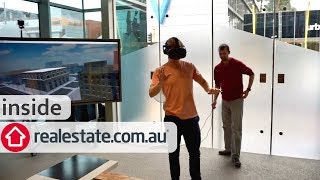
Nigel tours REA Group's $600 million headquarters, showing how eye-tracking labs and VR rigs test property listings, machine learning sorts billions of photos, and a village-like office modeled on Toyota's lean system keeps 50-person squads aligned on matching buyers with trusted agents.
Chapters
So we haven't been asleep at the wheel thinking about Australian consumers and how we can match those in the future. You know, so the biggest question in this company across that whole lifetime, what do you reckon that's been? What do you reckon our research lab every single time comes back with? This is the question.
The biggest question.
Yeah, in real estate today, in digital real estate, what's the number one question?
I don't know.
So people suggest, how much is my house worth?
Yeah.
So you look at the amount of money. Is that the number one question? That's a red herring, not the number one question.
Yeah, no, it's— yeah, because people are going to do something like that.
Millions of dollars in startups around what is my house, what is it— Yeah, well, that's—
there's Kaggle competitions for that.
Precisely. And it's a really interesting behavioral economics problem, but it's not the problem. Yeah.
It's where do I want to live? No.
You got that figured out as well. The number one problem in real estate today is what is the name and phone number of the best real estate agent in my area, a real estate agent that I can trust. You want— yeah, you want a match.
With the best real estate agent. And that's what they're chasing down. That's what the endpoint is.
Now if you want to know who's got that data, that's us. Okay.
I love it.
So this part of the building here is really important. It's got the R&D lab on that side, which is all about tech in the kind of 2 to 10 year horizon.
Yeah.
And behind you is our research lab. So this is called the observatory because we basically practice a form of anthropology in here in terms of serving consumers of all kinds. They come in and we seat them at these places, we can put headsets on them and we— in this day and age consumers are pretty sophisticated in Australia. We can go in there and have a good look. Access all areas. Now consumers are getting very smart, so too many of them have got marketing degrees and if you're just doing plain survey-based research you're missing out on a huge amount. Of observational data.
Well, that's it, right?
So we use various forms of glasses to eye-track you. So you might say you're looking at this and you're concerned about that. And in fact, you're looking at the photograph of the real estate agent trying to work out if you can trust them or not. Ah, we have to be kind of pretty open in our research and it's much more social science than any kind of just pure statistical survey.
Well, that's, it's like a combination, right? It's the crossover between the the technical techniques and the social sciences and psychology.
I've got so much data coming from those sites. Yeah. And we've had that for years. It's about what other insights can you get? So that crazy headset there is the fact that over in the other lab where we're doing work into virtual reality and property, we're from day one, we're interested in the data. What are they looking at actually? Because once you lose someone inside a headset experience of a property tour, you've got no idea what they're looking at. Yeah. And it's been fascinating because that is Toby's HTC Vive adaptation which tracks actual sight inside. So we're preparing a bunch of white papers on this in terms of what you shouldn't have in your 3D tour of a home.
What you shouldn't have?
What you shouldn't have.
Okay, okay. Because people get bizarre with this practice. Well, that's the thing, it's not so much what you should have, what you should take out.
So here's secret clue number 1. Don't have magazines on your table.
Because people straight to the magazine cover. That's what magazine covers are made for, right? It's to lure the eyes.
So we watch the little heat, the hot spots.
Keep the table blank.
The hot spots inside the 3D tours. Yeah, we're just looking, and then we have a go ourselves, and we are distracted by them. You go, yeah, it's solid.
That's, well, that's, that's what they're made for, right?
So this is the lab for that, and it includes all sorts of tools, fun technology. We've missed a little bit in terms of the kind of the emotional stress that people are going to suffer. So it's like a headset. It is a headset. So it's measuring cognitive load. So how much work are we forcing people to do with the website that we have? And it's based on a brilliant piece of research reported by this American UX product person, Kathy Sierra.
Yeah.
And she wrote this article saying, "Your website makes me fat." Okay, okay. This research is quite simple. They asked two groups of people to go into a room this size and sit down and do math problems.
Yeah.
I lived in America, you can tell I go math, maths problems.
Maths problems, yeah.
Put the S on the end. And they gave some of them relatively simple ones that they get through and a bit of memory, those kind of things. And some of them were like year 12 hard shit.
Hard stuff, yeah.
So they then get done, they're finished, they have the papers set, and they go outside the room to the next room along. And this is secretly where the research actually begins. So the math problems were nothing to do with it. Was just to—
okay.
On the table outside the room, they have healthy snacks and food, and they have a table full of chocolate cakes and other things.
Okay, okay. I get you.
100%. If you were given the hard math problems, straight to the sugar.
Because yeah, you've used your cognitive capacity to solve the problem.
So you're making the problem that much harder.
Yeah, your ability to resist.
So people design websites and apps that are incredibly cognitively loading to get through. Yeah, you're actually driving them down a poor diet.
Oh yeah.
Man! But that's—
I haven't thought about that. That's incredible.
So these are the kind of tools. That's an early prototype of it.
So you'd use that, so We want to see what's lighting up in the brain. Put this on someone's head while they're using the website to see how— if it's cognitively intense.
Is it harder than it should be? And that's long been a thing that UX researchers have chased, is how hard is my website? How hard to access my website?
Where should this be? Where should that be?
So we've got some science on that.
Yeah, I love that. I love that.
In the life of our company, the mid-'90s through to today, now in the mid-'90s people were dealing with film cameras. Yep. And they were getting their shots at the house, taking them to the pharmacy. This is— you would not— you're just— no, no, no, no. I'm—
yeah, instant upload, livestream even.
It would be delayed because a 36-frame film costs so much money.
Yeah.
That you didn't— you know, I'll finish the film off before I take it up to the pharmacy to get developed. They'd handwrite the description of the property, get the photos printed, and post them into realestate.com.au to make a listing. Wow. That's 1995.
1995. Yeah.
If you were the greatest real estate agent in the city, you had one of those Motorola StarTAC.
That's no iPhone. 1996 calling.
Now we've got— there we go. Pretty similar size, but one thing's changed completely.
What's that? The fact that this has apps and access to the internet.
Look at that screen. It's tiny. It's just miniature. And you want to be able to, you know, we clicked buttons and the screen was just about the size of this.
You can still make phone calls, which is almost— that's the most important thing.
We're awesome at phone calls, which is incredibly important for that people contact. And then, you know, this is an indulgence on my part, the Palm Pilot. So you had a diary, notes, and your contacts were listed inside here, linked to an app.
So that's the original iPhone.
Yeah, it's an OG iPhone. It starts to explode. We got '98, the year that Steve brought in this incredible app. Deleted 21 models of a Mac computer and came down to this and a laptop.
That's it.
Yep. They had dozens of models. I didn't know that.
I worked for Apple, I didn't know that.
So this is it, this is the memorable, most incredible. All of these things work, that's my pride and joy. And you know, that deleted this, which was a really interesting dead end, the Newton. So this is—
Oh, I remember, that was one of Apple's biggest failures.
And just couldn't get it to work reliably, so a pen-based tablet.
Yeah.
But you look at the similarities between that and an iPad today.
Yeah.
The difference was you could store the entire internet on this one because it had, you ready? 2 megabytes of memory.
Flash storage.
Just incredible. You get the entire web on there. That is died about the same time this was brought in going, you know what, we've got to kill some lines. We've got to simplify our business.
I love that. That's the fact that I didn't know that they went from 21 to— that's probably why they're where they are today.
That is exactly. And it's about focus. And then all of us who make a lot of products, that's a really important lesson. Yes.
You don't want to be 80% in 20 different things rather than 101 or 2.
When you're very young, you might have been a few of these internet appliances left over. That's a 3Com. That's how you connected to the internet in a world of, um, not having web browsers and those kind of things. It's very— it's basically a— that's your pen.
That's such an interesting design.
That's a beautiful design. Yeah, it's got that— that was the early web.
Reminds me of the Apple Pencil now.
It's like something out of the Jetsons, isn't it? I love it for that. Yeah, these were all yours. A lot of these are all mine.
Wow. No, that's incredible.
The whole team pitched in. Yeah. Early 2000s, the Macs. Probably this is possibly the most beautiful Mac ever made.
Yeah, I think so.
That's how it is designed. Especially how fluid that is. It's just a real architect's machine. We're starting to see digital, you know, we're starting to see Pages, which weren't only for drug dealers, they were also for real estate agents. So you get alerted to it. I remember doctors message those kind of things as well. And phones started becoming— Nokia was very, very dominant in this period of time.
I think I had one of these similar to that.
Yeah, that's my mum's actually. It still runs. Snake.
It's got Snake on it. Yeah, I remember, not even kidding, we had— I had a phone like this and we were playing catch with it because it was just so robust.
So solid.
So yeah, you could throw it.
Battery ran out after 3 days though.
Yeah, exactly. So we were throwing it and just playing, like hitting it and then hit the ground, it would bust into pieces, rebuild it.
Truly amazing, aren't they? You know, that And that started to grow into these kind of Windows-based devices.
I think I remember seeing one of my primary school teachers had one of them.
It was never great, but it was okay. Digital cameras, and then this probably represents another era of design again now.
That was my first iPod.
It's, you know, thousands of songs, storage in your pocket. And what people don't remember about this era is this was hooked to your own collection. So there was no store in the beginning.
Ah, so you put all your own songs on there.
Yeah, and that was all we thought it was for. No understanding of the iTunes Store and being able to download. That was another generation again. That's coming through these generations where, you know, Macs are starting to look fantastic compared to IBMs.
It's still that case.
This is actually a critical juxtaposition in the whole thing, is the keyboard and the phone. So this was an amazing amount of tech.
Now, why would that first come out? 'Cause you needed more input.
What's the thing you want to do online that's gonna make you have a keyboard?
Email. Email.
So now the ability to get an email client onto a small device becomes quite critical. And, you know, the hell we live in today of connected 24/7 is largely because of that.
Yes, it is. It is a blessing and a curse.
Nicer cameras, higher megapixels. And then this is the pivotal year. So this is 2007.
Yep. I remember this.
I've still got mine of that. This was the hottest phone in the marketplace. Big screen. It had navigation through a mouse, so not touchscreen.
Is that the N95? Yeah, it is. Yeah, I remember that.
You know, you clicked it and it worked and it had this very satisfying clunk.
Yeah.
So imagine coming out with that and—
At the start of the year.
The headlines from this was, "1 billion customers. Can anyone catch Nokia, the cell phone king?" Wow.
And that was—
And then— piece of junk hits the marketplace. My precious one there. In June 2007. Wow. That was pretty poor at navigating the internet, had no apps. Yeah, 3G.
Wasn't even an App Store till iOS 2.
Yep, and the phone's just terrible. It dropped the calls. The phone chip in it was acknowledged to be terrible. Worked on Wi-Fi, the screens low res, and a lot of people made a huge mistake that that wasn't going to be a thing, me included.
Really?
So I, yeah, at the time I worked in a company called Lonely Planet.
Yeah, travel guides, travel guides.
Yeah, I say Lonely Planet to your generation, you look at me like, what, I've seen the blue books, some sort of dating site, right? Yeah, no, it was a thing. And we, yeah, we were kind of trying to go, what's digital? What does travel look like in a digital future? Yeah, and the one thing we were certain of was that nobody was going to travel to London with a $1,500 computer in their pocket and get that out of their pocket in Soho and look for a place to find a coffee. Is that ever going to happen?
No, they want to refer to the book.
Yeah. Wow, how wrong were we? We were totally wrong.
And yeah, and now people are buying homes through that.
And it is the innovator's dilemma. Classically for us was going, well, what can you get? Oh, you can get a Google Map, but it's rubbish. Yeah, you can look at TripAdvisor, but it's confusing.
Yeah.
And this thing, I mean, you're in a pub quiz and you looked up who was the kind of the premiership team in 1996, cost you $2. 3G plans cost a fortune.
Back in the day, yeah. It's crazy to think that that's only 10 years ago.
So the important thing in the lab is to go, no matter how crazy or crappy this thing is, allow yourself to think what might be possible.
I think, yeah, that's That's where I'm with Alexa and the smart speakers. Oh yeah. I think at that, where they are at the moment is where this was in 2007.
Correct, correct.
So there's practically no apps in there. They're all basic functionality, timers, etc.
And probably the key thing to note of this was our sudden comfort with not keying everything like it was a typewriter, but a touch interface.
Yeah.
Now, when that was one of the objections of it, oh no, who wants to touch the glass? Yeah. Nokia's greatest fail was their climate. So in Scandinavia, so cold, everyone's got gloves on, don't work with an electric screen.
No way. And that's California, so it's warm.
Yeah, and Nokia going, well, how can that be a thing? Nobody can use the phone. So eventually Nokia did a pressure-based touchscreen. It was just nothing like an electrostatic screen.
Yeah, it's terrible.
So we so quickly moved from wanting to type everything to being swipes and touches and those kind of things.
It's so much more of a, I don't know, like an intimate interaction, the touch.
And look, here's the explosion. You know, you've suddenly got the 4, the 5, that's the original Android. Watches start coming out and kind of devices and wearables. This is now in your pocket the whole time.
Yeah, you never leave home without that.
You soon enough see the iPad. So again, Classic thing, people going, "Well, what use is that? It's like, is it a pretty crappy computer?" Even I thought when the iPad first came out, I was like, "That's just a big iPhone." Well, you know someone described it quite famously, should remain nameless. It's Hagrid's iPhone.
I remember when that first came out. I love my iPad now. When that first came out, like, who would buy that? That's a waste of time. It's just a big iPhone. Because I had an iPhone at the time. Yeah. I was one of the lucky ones to get one.
It's quite weighty too, you know.
Line or something. And yeah, I was like, who would need that?
That's just classic. So we're now entering a modern state where these things are as powerful as a damn supercomputer. And we started several years ago to become interested in what happens next. So we started to understand that the 3D experience of property was going to tap into people's innate need to save time, to build trust, and get transparency on things.
So that's That's 3 T's. I like that. Trust, transparency, and time.
Those are the 3 rules of REA Labs. Bring me devices that change one of those things.
Ah, I like that.
So for 3D, it became a matter of, you know, cameras of all kinds from 360 cam. Yeah, the Theta, the Ricoh Theta we've got.
That's a big unit.
That's a Matterport. That's a very high-resolution software base, runs with an iPad. Spins around, creates very sophisticated models of your property.
Far out.
And so we became very interested in capturing environments. Again, it's clunky. It's back where that screen used to be in 2007. Same story. Not going to get caught again.
Not going to get caught again yet.
Exactly. And then, you know, this is our first VR headset. Now, a team made this at one of our infamous hackathons.
No way.
And had to download it. It's a dive. Download the model from the internet. 3D printed. So had to get it 3D printed, you know, get lenses from some other—
That's 3D printed?
Yep, 3D printed. And, uh, well, they won.
Do you have a 3D printer here?
Oh God, yeah. Your laser cutters, 3D printers.
Because if people want to make stuff, yeah, you can't get in their way, you know. No, yeah, you need to, yeah, reduce the barrier to entry.
And 5 minutes later we had this, you know, Google Cardboard.
Which is—
wow, that is so much—
almost free online.
Pretty much. Yeah. Never solved a bunch of the problems that came with it in terms of the quality of the lenses.
Okay.
So it was always going to have a limitation, but it was a great introductory tech.
Yeah.
And then bam, we had this. We have suddenly, we're into Oculus. Full-blown. Special way. That's one of the very first shipment. We were very lucky to be partners, and that's kind of part of our joy One of the greatest adventures is being part of the News Corp family. All the doors are open.
Yeah, because you've got all the partnerships.
Steam, Google.
Facebook just announced the newest Oculus, hey?
We may have seen that. Oh. You know, they're starting to get— so they go from this to this. That's an incredible leap forward in quality. But this didn't survive testing in that lab we showed you.
Oh, in there?
So this is really interesting. I'll show you the problem with this one. I'll take an iPad and—
Let's do it.
So what we're interested in is discovering, will people do 3D tours in this device?
Yeah.
And this environment's deliberately built because I'm on a couch, we're watching My Kitchen Rules or whatever it is.
Yeah.
And I've got all these gadgets, right? So this is how people watch and consume our stuff today, is they have their mobile phone on the arm of the sofa. On the side of the lounge. Yeah, that's good. And that's buzzing the whole time. They've got realestate.com.au open on this and they're watching telly and they're having a conversation.
So it's like 6 different things happening at the same time.
And that multi-screening is common as. So this is all good. They're going through this. Really interesting observation is they're possibly doing this socially. So they're connecting to their sister and talking about kitchens on the Gold Coast. At the same time while watching, using a messenger type app on here.
While watching people in the kitchens.
Yeah, completely. And going, "Oh, have you seen number 62 Smith Street? What a ridiculous kitchen. What do they use the black for? What are they thinking?" So that conversation's going on here, right? Yeah. So we were then asking them to sacrifice that conversation and pop it inside a virtual reality headset. Ah, the same device. Now it's not the physical, because that gives them the highest resolution. A thing. But what's going on here is sociological, nothing to do with mechanical. Yeah, what did we just cut them off from?
From the conversation, from their sister. Yeah, you're asking to replace a sister with a headset.
That's not going to happen.
So no matter how fantastic that tour is, yeah, the headset could have been the best in the world, like you could have been—
you had to use this microcomputer to make it work. Ah, so these are the kind— this is what you get by being anthropological in your approach to research as opposed to just purely logical.
Exactly, you need to.
So, funnily enough, Google found the same thing. So, what Google have done, if you look at the next Daydream, it's standalone. Yeah, that's what they did. So, the phone can still stay there. Now, we're still going. We've got to work out how to get the sister inside there. Ah, add it in. So, social and sharing that experience becomes really important. So, how do we get a pop-up within the app? So if they're having this conversation, they can at least kind of be looking at it and the conversation comes up. They'll sacrifice my kitchen rules, but they won't sacrifice their sister.
So, what a crazy world we live in. It's funny, like I was saying this last night to people I'm staying with, is their TV, I know the user interface is terrible.
Yes.
And it's like, did someone try to use this before they shipped it?
No way. I've just literally got the business case I had to cross the line at home to get the new Samsung. Yeah, 6 buttons. It's the most unbelievably beautiful interface.
TV remote?
Yep. Oh, yeah, unbelievable.
This thing had like, it was like a TV remote, but it also had a mouse, but you point it and it just, the lineup, it was, yeah.
So I've replaced 4 remotes.
Yeah.
With one TV that's connected to the internet and a single 6-button remote.
That's it.
That is it. This is about time Time, trust, transparency, boom.
When this came out, it had one button.
Yeah, I know. And we thought that was crazy. Now it's got no buttons. Yeah. The tin, no buttons. No buttons. Anyway, that's the story of the things we've learned about VR.
Is, yeah, you can't interrupt. As good as the technology experience is, you can't interrupt the social aspect.
So this is where we're at, you know. There's our AI symbol. Machine learning and AI, they're very interesting. Interesting because just the scale of what we have, you know, we have a billion photographs in a database.
Really?
What can we learn from those?
Yeah.
And what simple things like some people are kitchen obsessive, should we be presenting the kitchen photos first to them?
Yeah.
Ah. How do you decide if it's a kitchen? What are the rules? What are the machine learning rules?
What are the, yeah, the object detection.
So you go, well, it's got tiles, it's a kitchen. Yeah, because the tiles are very easily machine—
like patterns.
Yeah, it's got edges. Yeah, turns out bathrooms have tiles as well.
Mmm, so you need to differentiate.
And the hidden truth about machine learning and AI is that it takes a ton of training, and it needs training by experts.
Yeah, so this is where a lot of our projects are at.
If you want to know the difference between a Victorian house and a Federation house, well, the local— you know, your property expert—
I don't know that.
Well, your mum would know that. Exactly, yeah. I need someone who's actually engaged in it. I can't put that onto Amazon Turk and have a whole bunch of complete amateurs try and decide based on rules. I need experts to spend 40 hours doing it.
40 hours? Like labeling images?
Then it learns off itself.
Yeah.
But you've got to get it set up.
You need the labeled data.
This is the giant—
the supervised training.
AI and ML and property.
It's because there's a lot of data exists, but it it's not necessarily good quality data.
This computer here, this 3 inches at the top of your body, is a supercomputer. Its ability to infer and join dots on one of these things is unmatched.
Unparalleled. Even with all this stuff. All this stuff combined.
We do this one, you know, I said time, trust, and transparency. This is my trust thing. So what we'd love to do, and we have a lot of kids through, because observing kids with these things are great. If we turn it on, Oh wow. And it's actually the arm off a very large Android model that's open source that someone's built. You can see it in the Singapore Art Science Museum. We kind of— Daniel ran out of energy after the arm because it's all 3D printed and hand constructed, right?
Really?
And it's not robotic in the sense that it doesn't have a brain. It's purely mechanical.
Yeah.
But what we ask kids to do is put their hand in the hand and how do they feel about that.
Is it going to grab me? Oh wow.
And it just creates an interesting emotional state.
Yeah, it does. As to how they're going to deal with robotic cars, with, you know— Like, I could tell, I could tell it was, uh, plastic and a robot. I can see that it's a robot. Yeah, but I just the feeling of having fingers clasped within fingers, it felt strangely human.
What if I had giant motors here that could crush your hand? It's like, do you know, do you trust me to do that?
Yeah, only, well, I trusted that enough to, to just grab it. It could have—
I haven't had too many injuries, but kids are a lot— I love their naivety and their willingness to give that a go, those kind of things. Adults are very conservative about that.
Yeah, because the kids, they have no fear.
They haven't had their Yeah, but let's get a coffee and I'll show you a little interesting aspect of our culture as it plays out in that intersection between people and technology on how we're gonna buy us a coffee.
Okay.
This is a winning Hack Day project. So what we have is people with a love of changing the way the world experiences property. We have some pretty smart engineers. So this is a 3D-printed case over an $80 Raspberry Pi and a Raspberry Pi screen. And what we do here is people wanted to give So we thought, what better than their coffee habit and giving to charity? We have a number of homelessness charities ranging from the Orange Sky Boys. I mean, they're one of the most innovative charities I know. The app we co-wrote around with Google and to help people have a directory on their mobile phones for what happens when you're homeless. The big issue everyone knows, the International Red Cross, Launch Housing, amazing group who work to help people who are fleeing the scene of domestic violence. If they spiral out of the main system into the, the kind of the welfare system, they're going to struggle to find a place to rent.
Yeah.
So we've got a large fund that puts up a bond for them and keeps them out of that system. They're just ordinary families, you know. That's the thing Australia has to wake up to. Ordinary families suffering from homelessness, domestic violence. It's the number one cause.
Number one.
120,000 people who are homeless tonight, the number one cause is domestic violence.
I didn't know that.
Sleeping under a bridge, they're sleeping at your place. Yeah, on the couch, you know. And that's why we're so passionate about that. White Ribbon is, uh, violence against women, particularly domestic violence, not standing for that. Now, what's the problem here? How much cash have you got?
Zero. I never carry cash.
Cash?
Yeah, where's my wallet?
Let's have a look.
This is my wallet.
Oh my God. It's got no cash in it.
It barely fits enough cards.
But I'll tell you what everybody here carries is their employee card.
Yeah.
So what if you could hook their employee card to their wages? Ah. Deduct the money and then choose where you send it. So with $1,400 in the last few days, I can put that there. It's going to— Oh, we don't know who you are. Oh no, the Universal Card. Come on, you know me.
I need, I need one. Oh, there we go.
There we go. It's IT. Beautiful.
Yeah. All right, so it works.
What we decide is how much do we want to pay for our 2 coffees and which, which is our favorite charity. I'm gonna let you choose today.
I, I like Orange Sky. Oh, I'm an Orange Sky. Yeah.
So let's, let's give them 2 $2 coffees at $4. Boom, boom.
Thank you, Nigel. You've gifted $4 to Orange Sky. So that's, see, that's them.
That's cool. That's digital. It's going to deduct it for me.
Yeah, we're going to walk over here and get our coffee.
That's amazing.
Good morning. Can I get a half-strength long black, please? Oh, that's a tester, huh? A tester? Yeah, I know, I'm caffeine sensitive. This stuff puts me through the roof.
Huh?
Um, I'm just here visiting for 2 days or so, and I'm just— I make YouTube videos, so exploring the space, learning the technologies, and shooting some footage. Yeah.
So these guys work here in the mornings. They're from Four Rascals.
Oh, there we go. Four Rascals Ethical Coffee.
They roast it, they source it.
I love it. The coffee, the coffee culture, I was saying before, is insane. I'm from Brisbane and we're trying to catch up, but it's nothing, it's nothing of what's going on here.
These are the kind of things that we're— this is our innovation. It's like from those things we start to understand renter problems.
Oh, OneForm, there you go.
Renters have pets.
Yeah.
But none of us are supposed to know that. It's a secret that renters have pets. But of course everyone has pets.
Yeah.
So we thought, what if we actually made that transparent? Well, you know, those 3 Ts.
Yeah.
Put that out there. 24 hours, we've got 4,000 dog and cat profiles put onto these. Which is an indication of our scale. I mean, yeah, 2 million applications a year.
And that's just an indication of how much, how much people love their pet.
They're going to make it home.
Well, that's the same with me. I have 2 dogs. Shout out to Bella and Seven.
Beautiful.
Amazing. Thank you very much. Cheers. Excellent. Beautiful.
Our coffees are themed with the coffee barista.
Thank you. This is, uh, very hot. Yeah, I'll just, I'll just film them walk us Whatever.
So there's 3 elements to how realestate.com.au, the REA Group works. They're all thought about quite deliberately to give us a sense of resilience and organizational health. Those are key words. One is the way we work, the system of work, like how does the factory actually operate. One is the people who work here, and that's our org structure which is years people work in multidisciplinary small teams sitting at a desk together solving problems on a daily basis.
10 people?
Yeah, up to 10.
Up to 10.
And then the third piece is the architecture of the building, so that's very deliberate.
Yeah, you were saying it's, yeah, built off the humanistic design.
It is, and it came from a group of architects who— two brothers who escaped Germany after World War II and had this philosophy. You can imagine Germany after World War II was a disaster They like to rebuild more utopian-type societies.
Yeah.
And they have this thing called Bürolandschaft, so which is offices as a landscape. You deliberately architect according to how you would like your society to build. Interestingly, Facebook's new office is built on Bürolandschaft principles.
So you think forward and then what do we, what do we want this space to look like in the future? Yes. And design that from the ground up.
And very humanistic, what are the people and cultural values you're trying to get. Yeah, this building is designed to be a village. Yeah, a 5-story village. We're on this flooring material here, you see, that is the piazza in the middle of the village. It's the double bonus of being sound deadening. So really interesting.
So this is—
it breaks the sound waves as they hit just the floor.
Yeah, I was gonna say, it's very— people are talking, but it's still quiet.
Ridiculously expensive. Concrete would have been a lot cheaper. The poor guy had to lay it. They lay this by hand.
Hand?
Yeah, and it's an incredible material.
You wouldn't think about that just walking over it. No, no, but it's the devil's in the details.
Turn into gravel. Yeah, like sweeping the gravel at night. Yeah, that's what the piazza down the middle of the village on this level. Yeah, has little shops and offices and café spaces and meeting spaces and drop-in spaces, just like you would have in the piazza of a small Italian village if you're traveling there.
Yeah, little nooks and crannies.
And so that's the piazza, these are the neighborhoods. So the larger, where you see a group of desks like this, is, this is a neighborhood.
So this, this, this area, this is what's with the marble on it.
And some of them even have street names. That's kind of part of the thing.
Oh, there we go.
Because we're into, uh, geography and cities and yeah. How it works from there is that our entire organization is divided up into about 50 squads, we call them. They're multidisciplinary squads.
Squads, yeah.
Building things for customers and consumers. So we have those roll up into lines of business. So we know that the way residential real estate works is different to commercial real estate.
Yeah.
It's different to property developers. Yeah. And it's different again, the needs of those customers to to the world of media. So we have tens of millions of dollars worth of advertising on that site because if you want to connect with young to mid-aged Australians with a bit of money looking to find a home, we're the place to come.
Yeah.
We have our international and then we have a couple of little startup type of lines of business as well.
Yeah. So your mind—
It's massive. It's massive.
How do you get them all together?
Multidiscipline money. So it's just made up of squads. So how much money do you need to run commercial real estate? Well, how many squads can you justify and afford? What's your ambition? Are you building new? You're running old? Now, it's funny rules here. Yeah, if you're in a squad, you build it, you run it.
Ah, okay.
You build it, you run it.
So 50 squads for it. Ah, okay.
Envelope of money Yeah, not an old chart with a headcount. Here's your envelope of money. Yeah, you have to maintain quality. Customer satisfaction is the number one metric.
Number one metric.
Okay, and you have to figure out how to both maintain it and upgrade it over time.
Wow. So that's the 50 squads, they're each in charge of that?
Each in charge of a—
entirely custodian, like custodians. Okay, so there's like each individual bucket. Yeah. And you— wow.
So in a traditional organization, yeah, People who run IT ops are downstairs. Yeah. And you never see them. So if you make something that's a bit crap, that breaks at 2 AM at the end of every month.
Yeah.
You don't care in the same way if it breaks and you're sitting next to a bleary-eyed new parent whose pager went off at 2 AM because the service went down. So the human element of caring for each other and caring for the team starts to come into play. Wow. This is all about productivity.
And quality.
So those two things, they're not unrelated.
Yeah.
And so in here we've got three squads.
Three squads, so it's one, two, three.
You can see people working in teams and collaborating and talking. The critical factors to that system of work— so remember the three things we've got: we care about the people, we care about system of work, and we care about the architecture. Yeah. The system of work thing is five rules: visualize, the work. No secrets. Yeah, prioritize the work.
Visualize— is that what you've got there? You've got the whiteboard there.
Yeah, TVs over here.
It's everywhere.
We've got an amazing example here of a group of people who are basically building self-service capability that will be world matching. You know, we will have as good a self-serve capability as any website in the world. Yeah, that hasn't been a business issue for 15, 20 years.
It's a new issue.
It's a new one because there's some great sites like, I don't know if you've ever bought advertising on Facebook, for example. Pretty simple to self-serve a boost. So we need to do the same level of thing. Whereas traditionally, we've always been about having an amazing account manager or phoning our call center and those kind of things.
You know what?
Next generation.
You gotta go self-serve.
So that's a group there. And so visualization, prioritization, a clear owner. Of the work. This is not some hippie commune where people are voting on what the easiest work to do tomorrow is. People clearly own the results of what's come out of that research lab downstairs. They come up with a hypothesis going, I think this will increase customer satisfaction by this much. It's probably worth spending 2 weeks exploring solutions to that problem. So we've got visualization, prioritization, ownership, daily conversation. So that's the thing I notice around here, is there are people talking to each other.
Yeah, communication.
Fixed times for stand-ups, so people will get together and talk about what work they're going to do today and what's blocking them.
Yeah.
And the last piece is just reviewing the factory. How is the system of work going? Is it working? Do we need to change the way we do stuff? Has something changed in the marketplace?
Yeah.
And this is just a constant evolution, so we're never done. We're 5 years into this journey of working this way, which is very much akin to Toyota's lean thinking processes.
They, yeah, they changed, didn't they?
It's continuous improvement. So this is hard for people to accept. Yeah, because everyone goes, oh, I want to make a transformation to a new way of working. Yeah, but I want to, I want it to be done in 6 months and then we're set forever. We don't believe that's possible.
No, this is constant.
Customers are changing, technology is changing, markets are changing. Yeah, I never thought we'd have in 6 years 3 years ago, did I think we'd have customers from China looking at 3D tours on our sites?
No.
Science fiction, it's Black Mirror.
How do you account for that?
You've got to be resilient to that kind of change, which is those 3 things: the people, the way you work, and the architecture of your office. Look at the way these are not square. Nothing in the marketplace is square, which I've driven a few kind of people crazy with. They go, "What didn't you just think about getting a nice square office?" strapped line down. Yeah, look, was your ruler messed up? What's going on? This is very— it's akin to life, because look, it creates these little nooks and crannies which are great little places to feel safe in and trying to figure out what it is you're doing. Now, that's a good example. You can see everything about that project there. You can see the team, you can see the squads, what are they working on, where are they up to. It's the whole nine yards.
We've got the three squads there. And that is, that is, that's visualization and communication.
So we have, you know, visitors from Toyota from all over the world coming to see this because this is the grandchild of their production systems from the '50s. Ah, whoa, this is— you're not making cars, but you're working collaboratively in teams, you're automating some things, keeping it human on other things. Yeah, and that's, that's kind of what we built. A lot of stuff stuff gets built in pairs, for example. Like, you look at these two guys over here, they've basically got one screen with code on it, and there's a driver and a co-driver, a pilot and a co-pilot.
Yeah.
This increases the quality of what you build and reduces the cost of what you build. Because the cost of building software, say a new page on an iPhone app, isn't getting it into market. 80% of the cost is once it's gone to market and you have to maintain and change it over the next 5 years.
Wow.
Yeah. So if you can build quality up front, you'll halve the cost of ownership over the life cycle.
Yeah, you need to start with a good foundation.
2 pairs of eyes, different skills.
Because one person will miss something, the other person—
One's great at writing test cases, one's great at, you know, really creative thinking around solving problems with code. That's a really powerful pair. That runs throughout the business in all sorts of different places. You might get an accountant sitting with a product manager. Like a designer sitting with a software developer. That's pairing, and that's really vital to the quality of what we build. So we'll take a walk down, we'll get to see the rinse and repeat of our factory operating model, just with squad after squad after squad.
Look at this. So all of these are individual squads?
Yeah, yeah. You've got over here, you've got a stand-up happening. Yep. So a group of people working out Well, what are the priorities? The work's already visualized. It was there from Friday. They got some work done.
Yep.
It's what happens next. So one of the challenges of this workplace is people come in and they go, "Oh, it's like, it's a, everyone's so happy. They're smiling. It's just a bunch of hippies voting on what the easiest work is to do." Couldn't be further from the truth. Everything's come out of that lab with a hypothesis, with a number, with an idea of what is it going to change.
Data behind it.
It's pretty hard-assed in terms of its management methodologies.
Yep.
But we have such a humanistic workplace and such amazing people, uh, they just, they make it work.
This is phenomenal. Standing desk as well. I'm a big fan of that.
Yeah, we're about 30% on a standing desk. Yeah, that's pretty good for your health, having that variety.
Oh wow, you're right, it keeps going. Yeah, yeah.
So here's another aspect of our workplace architecture, is the connection between the levels. So we've got these half levels, you know, that's level 2.5 there. Nobody gets a fixed desk.
Oh really?
So if you're within a set of teams like residential real estate, you have a neighborhood, but you'll go— there's enough desks there every single day to find one, but you clean it off at the end of the night and put your stuff in Wah, really? So this allows incredible flexibility of how people work. They can, if they want to work side by side for a day, that's great. If they want to work at the big table or in some soft furnishings or in a small room for the day, they can do that. And there are no wasted desks. You can have a little independent kind of focused thinking zone to work in if you want to. And that's called activity-based working. You do the workplace according to the activity you're doing. So you don't have to be in your neighborhood to do that. You can go and sit down here, be anywhere accordingly.
And that's what the neighborhoods are?
That's what the neighborhoods are. So it's incredibly flexible for when people need to move around and change accordingly. So we can see down here is another group of people from the mobile team having a stand-up around a board with prioritizing the work for the day. And you can see the number of squads organized.
Little rooms here.
Yeah, some of them are pavilions, some of them are non-bookable.
Yep, just drop in, spend some little group meetings.
Yeah, collaboration, working on stuff. You can see we're pretty heavy on metrics. Over here is this TV, so that's measuring some, uh, more physical hardware networks.
And all of that stuff's on Linux services. So that's all AWS, all scalable.
Massively. So we're one of the earliest customers for AWS, of our transition of things to that platform. And it just gives us a set of tools that keeps us right up to the minute.
Yeah, so you don't have to have it— the hardware infrastructure locally.
There's, there's very few people here putting any boring patches on Linux systems because that's taken care of. We take that same human brain and have it focus on performance on getting ahead of their team because there's no ops department.
Ah, really? They have ops, yeah.
You finish your code and you send it off to ops to deploy?
Doesn't exist. It's just deployed.
Nobody at these desks deploy. Now they will have an ops, like an internal consultant, an expert on the team. It's a methodology called DevOps.
DevOps, yeah.
Integration of developers and operations people.
Yeah.
And those two things starting to blend. So much more efficient. Nobody's waiting.
Exactly. It's just pushed.
It's just completely—
it goes live.
A very strong rhythm accordingly. We'll head down through the middle.
I love AWS.
Oh, look, it's been a revolution in my lifetime. It's sort of— yeah, probably.
See, I know nothing different to it. Yeah, I kind of— when I use it, I kind of imagine how was it not like this almost.
You spend a lot of money and time building servers and ordering So yeah, growth in the service, you would wait 3 months for the Compaq to provide you with a new service.
Really?
IBM or whoever. Wow.
Where is it now? It's just scale on demand, on demand, on your credit card, per second billing.
Uh, this is our hub. So if you think of this building, remember we talked about the architecture?
Yeah, being a village.
This is the town square.
So this is a VR setup. Check this out. We're gonna walk the plank of some sort. There's 2 2 scanners here, one there, another one there, and what I see should come up on the, on the TV. Got the headset, look into that, some controllers. I'm excited, I've never really played with VR. You built this, how many people? 2 people on a hack day.
3 of us.
3 people. Yeah, 48 hours to build it. That's insane. And I mean, but it's— you've been using it for 3 years. Let's see how it goes.
Goes.
That is insane how real that is. I'm like shaking. That's so submersive. I was in it, I was in it. Like when I came towards the end, it shook a bit. That's when I was like, oh my gosh. Oh, I'm back on the— I'm 1.5 inches off the ground in real life, but 5 stories off in this headset. You can probably see it on there, I'm sure. Okay, I'm on solid ground. Look at this, in a virtual world. Oh, there's another plank over there. Okay, back over. There's sound effects as well. The wind is blowing me. Oh man, coming back into the room is so surreal.
You come back into it and it's on I'm going to close my eyes. Oh, I'm going to fall over, aren't I?
I couldn't jump off. That means you're not a psychopath. That is— I was—
So that's the most effective hack day project we ever did.
Yeah.
5,000 people have done it.
Yeah.
That is—
it's so surreal.
What do you see right now?
Um, there's like two flying robotic minion things in the—
ah!
I'm trying to shoot one. There was two robots like just flying there. Now there's a big one. There's a boss. There's a boss robot, which is like an evil droid looking thing. Sort of Star Wars-esque. Oh, 3 shots. That took 3 shots to kill. There's a hole in the wall over there. Oh, this one's closed. Winner winner, chicken dinner. Oui, thank you. I mean, thankful. My brain is fried at the moment. Thank you, Joe.
Very welcome.
Nice to meet you, mate. See you. Have a good night. See you. You're right, it's half broken. What a day. My brain is, is officially almost at its, at its peak in terms of information overload. I've learned so much. I'm so thankful for the experience. From everything from VR, playing with HoloLens, to playing with Vive, to building avatars for real estate, to exploring houses from the inside. It was, it was incredible. I got to talk with data scientists, and I've got some tips actually from one of the data science, the lead of the data science team in charge of about 12 people or so, about some ways or what he looks for in a data scientist. So I'll probably put that into some form of article or actual video because I've got so much footage. Not entirely sure how I'm going to edit this all together. Maybe the video will have to be in a few different parts. Now I'm about to head on the train again. I'm going to the other side of Melbourne to meet with another company about writing ideas for a machine learning book, which is really exciting. So I'm not entirely sure how that'll go, but But we'll check in after I finish that. It's been a big day on tour. I've got a confession to make.
More from Daniel

Small Language Models (SLMs) Are the Future: Fine-Tuning AI That Runs on Your iPhone

Introducing Sunny - A MedGemma-Powered Skin Health Tracking App (Kaggle Competition Entry)


Benchmarking: NVIDIA DGX Spark & NVIDIA RTX 4090 | Part 4 - Comparing the results

Benchmarking: NVIDIA DGX Spark & NVIDIA RTX 4090 | Part 3 - Running LLMs on the RTX 4090

Benchmarking: NVIDIA DGX Spark & NVIDIA RTX 4090 | Part 2 - Formalizing the tests

Benchmarking: NVIDIA DGX Spark & NVIDIA RTX 4090 | Part 1 - Creating a series of tests


Local Multimodal RAG on the NVIDIA DGX Spark | Part 4 - Publishing our demo to Hugging Face


Local Multimodal RAG on the NVIDIA DGX Spark | Part 3 - Putting it all together