What's the most challenging skill you needed to learn in your career? | 69,420 Subscribers Live Q&A
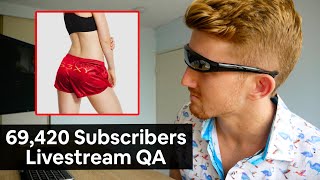
Daniel Bourke answers rapid-fire questions at 69,420 subscribers. The hardest skill he learned wasn't technical but mindset: prioritizing the most important task. He covers machine learning careers, freelancing, whether a master's degree matters, and why he takes long walks and does jiu-jitsu.
Chapters
Ah, looks like we're ready. All right, who's ready to go live? We're on. Now I need the first update. The first update from everyone is to let me know if you can hear and the video is okay. So that is the first update I need in the chat. We are here to celebrate 69,420 subscribers. Thank you. Thank you. Thank you so much. If you've been with the channel for a while, Well, you know the drill of what we do in these live streams, but if you're new here, first of all, welcome. Uh, it's a very exciting time of year. We're getting to the end of the year. We're getting to holiday season. I mean, it's Christmas depending if you celebrate that or not, but I'm certain you celebrate the New Year, so that's always exciting. So let me know in the chat if you're joining in, have we got good video? Have we? I'm wearing the fancy glasses here too because It's celebration time, right? And it's fun to dance up. It's fun to dance up, to dress, to dance up. Do do do do do do. Well, 900 kilobytes per second. Uh, we recommend you use 4,500 kilobytes. But can you see me? As long as you can all hear and see this, well, we're going to keep going because you know how I like to do these live streams. If you've been around, it's just planned. Whatever happens happens. That's the fun of a live stream. Okay, we're getting some hello to everyone that's here. Zay, hello to Salty. Hello to Vishwesh. Um, yo Henry, what's going on? What's happening? Okay, if people are saying that the stream is good, we're going to continue on. I'm going to get rid of my— actually, I'll show you my screen. Here's what we've got. Boom. So I posted a YouTube post the other day. I wonder if this link will still work. You can see it going to do a livestream Q&A when the channel hits 69,000 subscribers. I mean, we're over that now, but there's a whole bunch of different questions here. So thank you so much if you did leave a question. I'm going to get to as many as I can. I do have to pack later today, so we'll probably We'll hang around, who knows how long, as long as we're having fun. So I've recorded a lot of these in Notion. Now what I'm going to do is I'm just live streaming chat. So if you have a question as well, ask it in the chat. I'll try to get to as many as I can. Um, all right. Hello. Hello. Hello. All right. Apparently my stream status is poor, but We're going to push on. Let's jump in right to the live Q&A. I got some tasty tea. Now the first question we're going to get to is Philip from Indonesia via email. So thank you so much Philip for this question. The number 1 is, does learning— oh, actually before we get into this, the quick Q&A, I need to preface all of these answers. As always, the answers are going to be biased by my own experience. And my own viewpoints. I will always encourage you to create your own. So take the best information that you gather from around the internet, from people like me, clearly in front of a camera or write really well, take the best from everyone and create your own answer to things. So whatever answer I give, it may or may not relate to your current situation. So you're smart enough to adapt it to your own situation. Now let's go. Hello. Hello to everyone in the chat. Thank you so much for joining in. From Indonesia asks, I'm going to zoom right in on this one actually, so you guys can see as well. Does learning data science or machine learning have promising jobs in the future? Well, a quick answer to that is I hope so, because I've spent the last about 3 years learning machine learning and I'm going to continue for the foreseeable future. However, what I always like to say for this in terms of the future is that First of all, we can't predict what's going to happen. You can only sort of notice trends and what society is doing. And then second of all is what were human beings built to do? We were built to adapt. And I might eventually take these glasses off actually because I can't see shit out of these things. But does machine learning and data science have promising jobs in the future? I can't predict the future, but I would say for the foreseeable future is in the next couple of years, you're probably pretty promising there. Are data scientists or machine learning engineers working on a permanent job or working as a contract job? So you would have lots of— I've done both. I've had a permanent job and I've had a contract job. So it really depends on what your scenario is. I personally worked for a company for about a year and a half in Brisbane. That's where I live, Australia. That's where I'm coming to you live from. It's actually really hot here too. And I was there for about a year and a half. It was a permanent job. And since then I've also done contract jobs for, for other sort of companies here and there. However, right now I'm working for myself, which is how I prefer things to be. So Philip from Indonesia, big shout out, selamat pagi to you. I believe that's good morning. Um, now Brett asks from YouTube, Chad, are we on all right? Brayboy says, am I on Instagram? No, I don't have Instagram. I don't have Facebook. And why don't you do more RL? And I'm assuming RL means reinforcement learning. Also like the Elon reference. Yes, I knew someone would pick this up. So I'm going to address the second half of this first. And that's because the 69,420 is— I'll get a new window here. 69, uh, actually Tesla hot pants, Tesla short shorts. I really wish I bought these. Maybe they're still in stock. I could definitely rock a pair of them. Oh, we're going to get done for, uh, provocative images. Look at those. Look at those hot shorts. I could definitely rock a pair of them. But I promised I wouldn't shake my booty on, on YouTube for money. So they cost $69.42. In other words, 9,420. So that's where we're at. We're at 69,420. We're actually a bit more than that, but, but it doesn't matter. This is a 69,420 subscriber livestream and also probably the last one for the year. So it's to celebrate all of you amazing people for tuning into my videos, asking great questions. Now, why don't I do more RL? That is a great question. RNL— sorry, RL, reinforcement learning fascinates me. However, I'm kind of biased to things that I can use in practice. So the experience that I've had with reinforcement learning has mostly been around, let's say, agents learning to play games. And I kind of had the idea. I used to love a game called RuneScape. I actually still love it. Of training an RL agent to play RuneScape very well. I thought about, hmm, actually, I still think it would be a great project. However, I have other things to work on. So as much as RL fascinates me and as much as I think, who knows, RL might be the key to unlocking everything that we're— I mean, you've seen the advancements of DeepMind, right, in different fields. But when I was working at my machine learning engineering job and still doing it now, I was— we didn't really use much reinforcement learning in production settings, which is where most of my interest lies. But however, that being said, there was an amazing paper the other day that I put out in Machine Learning Monthly, which was Reinforcement Learning Data Valuation. I really liked this paper. So to see how much a single piece of data— where is it? I want the Google blog post because it's got some pretty pictures. It was Estimating the Impact of Transfer Reinforcement Learning. So recent work suggests that not all data samples are equally useful for training, particularly for deep learning neural networks. I'll let you read this, but that's one of the coolest use cases of reinforcement learning I've seen in a while. As for why I don't do it, I don't have a really great reason. I've just been working on other things, but thank you Brett for that question. Chat, how we going? I will sew you a pair for that with custom unicorn patches and everything. Beautiful. Welcome everyone from, from India. It's 6:30 AM there. Get dark mode on Notion. I prefer, I prefer light mode on Notion. Dark mode when the, when it's dark. When it's light outside, I don't mind my computer being light. Anyway, we're back to another question. Is Arkadip from YouTube. The YouTube comment says, how open are you to collaborate with a project, on a project with anyone? So I had to think about this one actually. And right now I'm not open to collaborations because I'm working on enough things. I've actually had to, I've got a few emails of different companies reaching out and offering me to work together. However, I've had to say no because it's kind of, you get to a point, it's kind of funny where you sort of, when you're first starting, you don't have basically any opportunities cause you're learning things. But then when you get some momentum, you start to share your work online. As long as it's, it's quality work and it's good, the opportunities start to overwhelm you. You start to get more opportunities than you can actually take on. So a very important point or a very important thing to think about in life in general is what do I want to work on? And it's unlikely that I'm going to create anything worth, worthwhile if I'm working on about 8 or 9 different things. I have to condense that down to one, maybe two. And so I'm still not very good at that. I've got, I've got almost too much going on. So Um, at the moment collaborating on a project with anyone, I'm working on one currently with my business partner Andrej, the Zero to Mastery. I've got an upcoming TensorFlow course and that's basically the only thing I want to be working on at the moment aside from doing fun videos like this. Uh, but in terms of future collaborations, who knows? How do I like to collaborate with people? I like to have completely my own schedule, um, because I like to design how I like to work on things and the person I'm working with has to be very similar. So they have to be driven as well. They have to sort of seek out their, um, their own next steps if you know what I mean. So I don't want to be constantly going, hey, are you doing this? Are you doing that? Um, I'm more of the person who goes, hey, let's work in a team and let's both move forward. Um, but right now I'm saying no to basically all collaborations. For the foreseeable future. However, if the right opportunity comes along, you never know. So thank you, Arkadip, for the great question. Have a think about that in your life. Ask yourself, you could even spend a whole year asking, asking yourself this question. What do I want to work on? And if you haven't tried anything of those amazing ideas that you have, you should try it. Now we are at Samantha from YouTube. How to get overseas opportunities in machine learning engineering? Well, put it this way, I've never worked overseas as a machine learning engineer, so I'm not the best person to answer that question. However, here's what I would do if I wanted to get an overseas opportunity for machine learning engineering. First, I would figure out how do I move to this place, or actually even before that, I would make sure I have skills in that, in that whatever it is, machine learning engineering. And then I would make sure that I've shared my work. So these are the two things that are going to be basically consistent without whatever you want to do. Have skills, share your work, whatever that means to you, you can decide. So if you want skills in machine learning engineering, build skills in machine learning engineering. If you want to share your work, build something that uses machine learning engineering skills, share it. Then if I wanted to get an opportunity overseas, I would either move to the place that I wanted to go. At the moment, that's not an option because of coronavirus and all that jazz. However, if you want to work in the digital world, I would relentlessly start to apply to these different companies or start to communicate with people who work there or send them your work. If you've worked on something similar to what they're working on, hey, go, hey, I've worked on this. You may be of interest. Now job portals get a lot of spam and other people applying. So that's why I would go direct. I would find the people, I would find the right people to talk to. Um, so that's how I would do it. Get skills, share your work and go direct. Either move or get in contact with the people who work at the companies you want to work for. Um, Samantha also asked Kaggle versus end-to-end projects. I'm a big fan of end-to-end projects, but you could do the same thing with Kaggle. You just, if you're doing the data science competitions on Kaggle, which are phenomenal, just do the data science competition and then make your project end-to-end. So put it in a location that someone can use, deploy it, figure out— that's a, that's an expe— that's a way to get machine learning engineering experience is once you've built a model with Kaggle How do I access that? Don't just leave it in a notebook. But yeah, I'm a much bigger fan of end-to-end projects. All right, let's tick that one off. Sipping on a little bit of tea, doing a little bit of a dance. All right, here we are. Um, oh, this is a great question. I'm going to copy it from the chat. Thank you, Danilo. Now I'll put it here. And who else is Danilo? YouTube chat. Let's go this one. And by the way, I'm not selecting these, um, uh, in any order. They're just whatever's, whatever's come up and catches my eye. I'm not trying to just maintain the chat the whole time. I'm just trying to bounce between as many questions as as possible. So if you have something you want to ask in a live stream, ask in the chat. I may be able to get to it. And Carolina asks, what tea am I drinking? This is a Pu'er tea, P-U-E-R-H. So if we go this Pu'er tea, it's a Chinese black tea. White tea addicts go crazy for Pu'er. I don't believe in anything that makes you go crazy. I think you should just be inherently crazy yourself. I don't trust anyone who's not that crazy. So, or who claims they're not crazy because everyone's, it's a good thing to have a little bit of crazy in you. Um, so Danilo asks, what is the most challenging skill you needed to learn in your career? Now I'm going to go very meta on this because I believe basically once you love of learning how to learn, you can learn any skill. So if you want to learn any skill, first of all, learn how to learn. And probably the biggest barrier to that is just mindset. Now you're going to hear this over and over again, but I truly believe it's just like, just make a simple decision. Once you decide I'm going to learn something, whatever skill it may be, machine learning, uh, math, DevOps, web development, or something like that, you're going to be the only one to hold yourself back. And this goes with anything. No one's going to care as much as you about whatever it is you want to learn or create. So the number one thing is just develop the mindset of, "I can learn this," or, "I can do this." And then tell yourself that anything worth learning or anything worth creating is going to take a long time. So it's the same principle as, uh, this is what I, someone asked me the other day is like, why don't I use social media very often? It's like I want to condition my mind to not be just constantly interacting with small snippets of information. I, for the work I do, for what matters to me, requires the skill of long periods or long stretches of concentration. And so in fact, this video is probably distracting you from what you need to work on. So I would, I would always recommend to not watch any of my videos, but to just work on the thing that matters most to you. What's the most important thing? And look, I say this as if I'm perfect. It's like, no, I have to basically every day just remind myself, okay, I have this list of things that I want to do and all of them seem important, but there's definitely one up there that's the most important. That's a very important thing that I've tried to— I'm saying important a lot here, but It's to emphasize the fact that it is important to be able to decide what's most important and what's just important. So not most important, but just has to get done eventually. And so the most challenging skill that I've learned so far is the mindset to go, you know what, I'm going to decide what's, decide what's most important to me right now and focus relentlessly on that. And when I do that, Amazing things happen and I'm not really that special. I mean, I'm wearing these fancy Cyclops glasses. I mean, you might not have these Cyclops glasses. Uh, so that's probably step one is get Cyclops glasses. I bought these in a market in Tokyo, by the way, and then develop the mindset of I can learn this, I can create this, whatever you want to create, whatever you want to learn. But great question, Danilo. So we have Lam from YouTube asks, is singularity come? AI will increase wealth inequality. So I think this is, this is two questions here. Is singularity come? So singularity, let's define what the singularity is. What is the singularity? Just to make sure we're all on the same page. Technological singularity. Have you all heard of this? The technological— I can't even say that word. The technological singularity, also simply the singularity, is a hypothetical point at which technological growth becomes uncontrollable and irreversible. Like, I mean, technology just explodes. So will this come? I have no idea. I'm not going to even pretend to predict the future. I mean, 15 years ago, uh, I was just starting to learn about mobile phones. Who would have known that I would— people would be going out buying iPhones like they are now, acting as if— like, 20 years ago, cell phones basically didn't exist, and now everyone has one as if they've got a third arm. Um, and so for the technological singularity, it's like, how can you predict these things? Like, every time there's a new advancement in AI, the the prediction timeline for AGI gets adjusted. Is it in 50 years? Is it in 100 years? I have no idea. I'm pretty sure people like Christian religion have been predicting that Jesus is going to come again like dozens of times over the last 2,000 years, but he hasn't come. Who knows? He might. He might. I don't know. But this is where you get very— anyone who makes predictions about the future, including especially predictions that are long forecast in the future. I mean, I don't even know what's going to happen in an hour, let alone 50 years. So will it eventually happen? I would say if technology keeps increasing at the rate it is, if you just draw out a long enough timeline, it's only a matter of time before we have the compute power and software to be able to basically just have technology replicate itself. When will that happen? No clue. So although it sounds fun, my answer is pretty boring. I have no idea if it will come or when it will come. Uh, AI will increase wealth inequality. Oh, I don't know if I'm, uh, qualified to talk about this question because I don't think I know enough about it. And that's another important point is I'll let you know when I don't know enough about questions and can't really answer it. But will it increase wealth inequality? I believe AI To me is, is another like technology— techno— I can't even say the word— technological, uh, tool, right? So we can use it for different things. And so we've had many of these technological revolutions over human history. I mean, the book— you could have thought that the book— where's my One of my favorite new books. Big shout out to Machine Learning Engineering. Sorry, Andrey Burkov for writing this masterpiece. But the book, right? This is a piece of technology. I'm sure when the book came out, people were like, well, it's going to decrease the wealth equality across scribes and across writers and across people who talk for a living. Well, I mean, what did human do? What did we do as humans? We adapted. And I think the same thing is going to happen with, with, with AI. Don't bet against humans. Humans can figure out things unless we wipe ourselves out, which is a perfectly valid opportunity. But how many of the challenges have you come up in your life? How many of them have gotten the best of you? I don't think very many. I mean, I've faced a lot of challenges in my life. I mean, they're relative, some small, some big, but I've managed to, to get through them every time. So in terms of wealth inequality, I'm sure we will figure out how to, uh, will it be a perfect system? Probably not, but I'm sure we will figure out how to adjust. So, Lam, Thank you very much for the question. Let's go back to the chat. All right, what do we got? Oh, there's a ZTM channel. Do anyone have the Discord? Uh, I have a Discord, but it's only for, uh, students of Zero to Mastery because otherwise there's just too much going on. Have you ever been in a Discord server where there's just too many people? Yeah. So, um, I do talk in Discord, but it's to mostly answer students' questions of my machine learning course. This is where I do Q&A for YouTube. So Shravani asks on YouTube, which companies are making great progress in terms of machine learning? So many, but it depends again, how do you define great progress? So I would say one of my favorites is obviously Tesla. And then comma.ai. This is probably my favorite AI company just because I love George Hotz. Comma.ai. Boom. So I just really like— this is a small company, right? They're like 16 people or something like that. And they're probably— if Tesla are the iOS of self-driving, comma.ai are the the Android. And then of course you've got Google and Facebook and whatnot, but it all matters. Like, what is it relevant relative to? So in terms of progress, it's like, how do you define great progress? I mean, Google and Facebook are probably publishing the most papers, but is that necessarily, necessarily progress? It depends on what optimization function you want. So You could argue that all the large companies are making great progress in machine learning, but I think there should be like small companies make up the majority of the world. So I'd like to see more small companies get in on machine learning. And that's actually, that's part of my mission is to help more people get into understand machine learning. Because when I first saw it, it was like 2017 and the news is basically saying Terminator robots are going to take over. And then once you get into it, you realize that it's just, oh, it's just someone's writing Python code to turn data into tensors, and then a neural network's finding patterns in those tensors and then outputting some prediction, and then they're using that prediction in a human-interpretable way. So that was a very brief overview of what AI actually is. But, oh no, we haven't finished that question. But great progress. Um, I've got a few of my favorite companies, but it really depends on what you define progress. Will Python or R programming languages be relevant for machine learning in upcoming years? Say after 6 to 7 years later. What did I say before about making predictions about the future? I have no idea. Python. I use Python, so I hope it's relevant in 6 to 7 years. That being said, what do we do? What do humans do when they face a challenge? We adapt. So if another programming language decides to come up, which, I mean, there always is, we could learn it and then use that for whatever we need. So I personally have never used R, so I'm not going to talk about anything I haven't personally had experience with. But again, Python's been around for, what, 20+ years now, around about that. So a great little heuristic I like to use is the longer something has been around, the longer it will continue to be around. Does that make sense? So, if book, if the book, just the book as a technology, not this book itself, but the book itself, the book as a technology, has been around for 500+ years, chances are it's going to stay around. Do you remember how many people thought that when digital e-readers came out that books were not going to be a thing anymore? Well, turns out people, including me, actually like the physical feel of a book. So the longer something's been around, chances are it's going to stay around. So that's what I think about Python. Which IDE do you recommend running machine learning algorithms using Python? Vim, VS Code, or Google Colab? Stop caring so much about what IDE you use and just write more code. How do you wind down at the end of the day when you are done working, studying, etc.? Don't want to talk. About machine learning anymore or think. I go for long walks. That's probably the best, one of the best habits that I have aside from writing every day. I go for long walks, no phone, with my family or in nature. I'm very lucky to live close to the water. I like walking along the water and I just, they're below stressful, not timed. I just walk and look at trees. And birds and water. I mean, I feel like humans are walk deprived. Science isn't there yet, but I believe strongly, very strongly, um, that walking is as important as sleep. So you can quote me on that. Walking is as important as sleep. I will stand by that to the day I die. Um, so that's probably the number one thing. Otherwise, I also train jiu-jitsu. Speaking of which, I will be back in a second. I have something exciting to show you. Woo-hoo! Look at this. Now this is a jiu-jitsu blue belt. Boom! So, I'm going to put this on. And what this signifies is that I've been training for 2 years and my skill level has improved to a level where I'm no longer a white belt in the eyes of my black belt instructor. And I— this is probably one of the proudest things that I've achieved in the past 2 or 3 years. Right? Anything you're given in life doesn't count. But if you've worked for something, if you've earned something, then it feels amazing. This feels amazing. So I am phenomenally stoked with this and I'm probably going to wear it for the rest of the stream because why not? And it looks cool. It's a really cool color. But anyway, how do I wind down at the end of the day? Walks, jiu-jitsu, spending time with my family, turning all of the screens off, right? Screen time in general is to me not ideal time. And I say that as someone who loves creating things with, with a computer and writing code, but I'm trying to limit how often I look at a screen. I want it to only be like 4 to 6 hours a day. So I have to be very ruthless with what I actually do during that screen time. The rest is out in nature or with people that I love. Now, great questions, Shravani. So let's go to Chris. I'm going to take a sip of tea. Cause my mouth is getting a bit dry. So if anyone on the, on the chat does jiu-jitsu and, uh, once COVID stops and, or if you're in Australia and you want to roll in Brisbane, more than happy to. Um, had a jiu-jitsu competition the other week actually, and I came second, really pissed off. I lost in the final. I lost. Um, no excuses for that, but I won 5 straight fights by submission before that and then lost on points in the final. The one match that counts. Damn it. But anyway, Chris says, um, how can one start going straight from understanding research papers to recreating and implementing The proposed neural network. The papers are really dense and technical, but to make the best neural nets, we have to somehow translate the papers into practice. This final word is going to reveal— oh. Test. Are we back on? How the hell did my mic mute itself? Hello? Are we back on? What the hell? Hello? I have no idea how my mic muted itself. What the fuck? Um, one second. Testing. Hello? Alright, we're back. How's it sound now? I'm back to this mic. The perils of live streams. I should be back to this one, which is the good mic. Okay. Yeah, I should be back to this mic. Beautiful. Okay. I think I'm back to this mic now. I was on the camera mic and that's terrible compared to this. Okay. All right, we're on. Thank you. Thank you to everyone who let me know that the mic was dead. I have no idea. It just, it removed itself basically from, from the sources here. So we're on. Okay, we're back. Thank you everyone. I really appreciate your help there. Um, where did we cut off? Did we talk about Chris re-implementing papers and it takes a lot of practice? So basically what I said, Connor, I love it. No problem. Too big for our big, for our boy. Okay, so deep learning's most important ideas. What Chris's question was, just a quick rehash of the past minute. Thank you for putting up with the technical difficulties. Chris asked, how can one go straight from understanding research papers to recreating and implementing the proposed neural network? My basic answer was to that is there's no secret, just practice doing it. And so I gave the great example of you could spend 3 to 6 months just replicating all all of deep learning's most important ideas. So check out this, this blog post and replicate all of the most important ideas with pure PyTorch or TensorFlow. Who knows, I might do this in 2021 and just share it out, but no promises. I've got a lot of things to work on. This is exciting to me though. And then add this to your GitHub. If someone asks, what have you worked on? Just say, I've replicated all of these. That would be cool. All right, back to the chat. Hopefully the mic is good. But yeah, here's this little screenshot. Machine learning engineer, download a paper, implement it, keep doing this until you have skills. The important point is keep doing this. I mean, I have to keep doing this myself. I find replicating papers hard, extremely hard, but it's only that I've done it a couple of times that I feel the confidence that I can keep doing it. All right. So Chris, thank you very much. Now, um, we're back on. So Varun asks, what projects do you recommend for machine learning as beginner? I am following your machine learning roadmap currently at beginner level. So Varun, I would suggest basically anything that, that sparks your curiosity. Seriously, this is what a lot of people hold themselves back. They keep trying to think of the most ideal project they want to work on, the most ideal project that you want to work on is the one that you're excited to work on. So that's— there's no secret project that you should do as a beginner. It's just what interests you. It amazes me at how, like, seriously, if I could have one, like, switch to make someone, like, uh, do one thing, would be to create what inspires you. It would be to learn what inspires you. I want to live in a world where more people do that. So Varun, there's no secret for machine learning beginner projects. Find something that interests you and just keep working on that. Great question. And Paul asks, how's the project going for the app you wanted to build for health? Zero progress, Paul. Thank you for checking in on me on that. I have been working on too many things to work on. So Paul's referring to I wanted to, or I've referred in the past that I would like to combine technology and health in some way. I haven't quite figured out how. I'm not even following my own advice. So look at me being a hypocrite of working on things that interest you. I've let too many things which are important get in the way of my most important. However, people change. People change their ideas. Um, I'm not going to say anything about that because it feels like when you talk about your ideas too much, it feels like you've done them. So I'm not going to say too much about that. All I can say is no, that's it. I'm not going to say anything. Um, Paul also asks, do you plan on making a fitness course? Meal prep, beginner, intermediate, advanced workouts, workout routines, no, um, general advice about health, et cetera. Now, so I've thought about this. I've had a few questions as well. I think there's another one down here on building muscle and whatnot. So before machine learning, health was my first love. It still is. Health is actually my first love, full stop. Uh, every, every individual should be responsible for their own health, taking care of them. Of course there are events in life you can't control. You get some disease that you can't control, but for the things that you can control, the basic pillars of health, movement, sleep, what you put in your mouth, and that's, that's about it. Movement, sleep, and yeah, what you put in your mouth, you should be responsible for that. And in terms of meal prep, workouts, workout routines, I feel like there's, there's enough information out there. What I'm wondering is what actually stops people from doing it. So in terms of nutrition, like you could break nutrition down into like two dot points. It's eat close to what your ancestors would have eaten. So very simple and eat less often. That's it. You can be a very healthy individual just basically eating like a caveman. That's, that's like nutrition in a nutshell. But for some reason people want the complicated answer. The, oh, eat at this time or eat this many grams of protein or whatever. No, it's if you're hungry, eat. Don't eat just out of habit. And if you, and I mean, I say these things and I like, um, I go against that. I eat when I'm not hungry and I eat like chocolate and I don't eat much candy actually, but I eat sweets and all that sort of stuff. But it's at the same time, it's like develop your own balance. If you think you're eating too much, I mean our body, we don't remember, we don't have an off switch. So we've evolved without an off switch. So when we found food in the wild, we would eat until we're sick, but then we would also spend like 3 to 4 days not eating anything. Whereas I feel like too much today, so our nutrition was more random. Actually, that's a cool idea for a health app is random nutrition. I feel like one of the curses of modernity is too much consistency. Like we're eating the same thing day in and day out when for most of human history we basically had almost zero access to food or a lot of access to food because we hunted something or we found a, um, a honey hive or we found a fruit tree or something like that. And when you found that, you would eat yourself sick because you knew in the back of your head, I might not eat for a while, so I need to just get all the calories I can. So nutrition to me is eat less often and eat when you're hungry. And well, which is just, they're basically the same thing and, uh, eat close to a wild animal as possible. So if you're in the wild, what would you eat? You're not eating like refined crap. You're eating what you would find. So do your own research on that. And then movement is just get your heart rate up, go for long walks. My personal movement at the moment is at both extremes, so I like to treat it as balances. I'm doing walks which are below stressful, right? So Uh, not timed, just really long walks and I'm doing very intense weightlifting or fighting. So I've got my jiu-jitsu belt here. So that's how I, I move. And then the final one is probably the most important, even more important than, uh, uh, nutrition or, um, movement is sleep. Are you getting enough sleep? I'm probably not even getting enough sleep and I try to get as much sleep as possible. So take those 3 pillars. That is health to me. Um, the reason why I got out of health as well and into computers is because you tell a computer what to do and it does it almost every time. Whereas health is very dogmatic. I like to keep my health philosophy as simple as possible. It's the habits that matter over the long term, not the individual days that you did this amazing workout one day. It's, What can you, can you move every day? Can you eat in a respectable manner every day? And of course you're going to have times where you party. I mean, Christmas is coming up. I'm probably going to eat myself sick. And then sleep. Are you sleeping well enough every day? And of course you're going to have those times where you stay up and you party and you groove. I mean, New Year's is coming up and who's going to be up dancing on New Year's, right? Maybe get a special midnight kiss from your special someone who knows, or maybe someone you've just met. It's up to you. But Paul, great questions. Now back to the chat. Um, what are your favorite YouTube channels on ML? Uh, oh, Paul, well done, mate. Great timing. Uh, one of my favorite YouTube channels on ML. I, so truth be told, I don't watch much YouTube. I watch talks. If I'm watching anything on YouTube. So obviously I watch Lex Fridman. You can probably see my recommendations. Lex, Lex is one of my favorites. Comma AI. So this is George Hotz basically just coding stream. I want to do some more of these. So let me know if you want to, if you want to see some coding live streams. Look at this, 10 hours straight. I don't know if I could do 10 hours straight. But this is probably one of my favorite channels at the moment because those are the type of videos I like watching. I like watching like not, not, um, sorry, not over-edited crap. I just like either watching someone talk for an extended period of time in a podcast or something like that, or, um, code for an extended period of time because those are the things that I'm interested in. So these are probably the two that are my favorite at the moment. Lex Fridman, Amazing and comma AI archive. Because these are just reposts of George Hotz's live streams. Yeah, there we go. Look at that. I'm sweating. Oh, working up a sweat. I'm keeping my eyes closed because I need to wear— I need to start wearing sunglasses more often because the future is looking bright. Put it that way. And so great question. Danilo. Jack Arnold says, Daniel, congrats. Thank you so much, Jack. I really appreciate it. I remember, I think Jack, you might've even been in one of the first livestream celebrations. I think it might've been 777 and no doubt I'm going to do another livestream celebration for 77,777. My favorite number is 7 by the way. Casper says, how to get paid for ML work by getting clients. Hi, how to get clients? So of course we're going to back to the basics here. Step 1, have skills. Step 2, share your work. This is how to get clients, right? If your work is online, make the work come to you. As I said before, I'm not trying to brag, but this is what actually happens. I get emails of people asking if I would like to work with them. And by no means— there are probably people you're watching right now who are better machine learning engineers than me. I just have uh, my strength would be combining skills that I have with being able to communicate. Um, so if you want to get paid by clients, first of all, they have to trust you enough to work with you and you have to have the skills to be able to do what they require. So that's why step 1 is skills. Step 2 is communicate and share your work so that your clients can see that you actually have the skills that they require. And then step 3 is either apply to them or wait for them to come to you. Now, I'm not the best at the applying front. I prefer things to come to me, which is why I have to, uh, share a plethora of what I'm working on. Um, and then of course, once you start working with them, charge them and discuss what your rates are and whatnot. So I'm actually— a thing to beware on is, uh, is large companies tend to take a while to pay you. I did a contract for a company in, I think it was August or maybe even July, and they still haven't paid me yet. So what is it, December? What's the date? I don't even know. December 18th, December 17th, and they haven't paid me yet. So that's, that's almost 5 to 6 months. So that's, that's something to be aware of when getting clients. But anyway, build skills, share your work, either apply or wait for the work to come to you. Toby says, any tips on getting into blogging? Toby, as you might've guessed, oh Toby, by the way, I see you on the comments and I see you in the live stream a lot of the time. So, uh, I really appreciate your support and I love seeing your comments. So thank you so much. Toby, any tips on getting into blogging? Really, I'm going to keep this one simple. Write the things you would like to read. That's it. That's it. I, I, that's how I started and that's how I still— because I write the things I would like to read first and foremost. And the second one is eventually if you do get people who ask you questions and whatnot, how how, what we're doing now. You can potentially turn those into blog posts to answer people's questions, which is what I've kind of done on my blog. I built the momentum by writing things I would like to read. And then once I had a fair few questions, I would start to write articles which answered the ones, the questions I got most often. So this is how I'd start machine learning again because people were asking me that. I get this question a lot. How can a beginner data scientist like me gain experience? So I wrote an article on that. And then, yeah, you can just go through a few more examples of that. But start by writing things you're interested in. What's something you wish you knew when you were 17 years old? Oh, I wrote this one down because this is actually only something I came across recently. I'm going to highlight this. Where's highlight? Um, how do I highlight? Look at this. I can write machine learning code but can't highlight text. Where's— oh, there we go. Color. Boom. Green. So what's something you wish you knew when you were 17 years old? Oh, how fun would it be to know all the things I know now back at 17? Probably would have invested in Bitcoin. Um, but, uh, no, probably the main one is that what I want to try and do with my kids and what I want to try and do with, with anyone I sort of have the, uh, the privilege of being able to influence would be how many options there are with life. And that means you don't actually have to do anything. And so a lot of the time I feel like and you won't, you'll think that you don't know the answer. Chances are there is an answer out there somewhere. However, it's in the thought space of things that you can't imagine. And what I mean by that is think about how the circle, if you imagine we have two circles, one small circle and one larger circle. The smaller circle is inside the larger circle. The small circle is the things that you know. The larger circle is the things you don't know. And so just on a pure probability basis, The— if you're looking to the answer to some sort of challenge that you're working on, chances are it's going to lie in the circle of the things that you don't know. And the same goes with life, right? When I came out of high school, I thought there was like 3 things that you could do in life when in reality there was an unlimited amount of options. And so I want to remind myself of that every time I feel like I'm stuck. I'm stuck between 2 things. A lot of the time, how many times do you hear your friends go, Oh, I have this option or this option. Well, you know, really you have, you could, you could be a fisherman in Vietnam if you really wanted to. Like if I wanted to just quit YouTube, quit machine learning, quit everything, I could go fly to Vietnam right now, make friends with the locals at a village and become a fisherman for the next 50 years. And that's, that's me. That's my life. You seriously have that option. So if I was 17 again, I would like to have that mindset of remind— reminding myself that there are literally limitless options of things that I could learn and things that I could create. You have the internet now, Toby, and the internet has given rise to a new kind of hunter-gatherer. So get hunting. Great questions, Toby. Again, thank you. I really appreciate your comments and, uh, participations in the livestream. Saeed from YouTube says, how are you doing? I'm doing amazing, man. Look at these glasses that I'm wearing. Look at this shirt. Look at this belt flipping around. Oh man, I love jiu-jitsu, but I'm going away on a family holiday tomorrow, so I'm not for 2 weeks. So Saeed, I'm doing amazing. Thank you for asking. And I hope— all right. So Gupta asks, can you discuss the importance of doing a master's degree in the field of data science and how it has impact on job opportunities? Gupta, I do not have a master's degree in data science, so I cannot answer this. Um, but just as you can imagine, some job opportunities will list having a master's degree as a requirement. But I believe a lot of companies are shooting themselves in the foot asking for people to have master's degrees in these things. Like, look, let's be real. In the last like 5 years, um, data science has exploded, right? So the demand is much higher. At my old company, when we were working with data science and machine learning engineers, I think, how many? One. One out of like 10 engineers had a master's degree and they didn't even have it yet. They were still studying to get this master's degree. And I taught myself through online courses and online code and whatnot. And I remember, of course, they were way smarter than me. It's sort of like the, the, like the technical jargon and whatnot. But I believe if you ask them what I was better at, I was better at the full solution, like in terms of interacting with a customer, diagnosing what their problem actually was, and then building out that, that problem itself with code. And a lot of it was— it actually blew my mind that the data science master's degree that he was doing had a very small component of writing any code. So I mean, of course there's, there's a lot of math with data science and machine learning. However, if your goal is to work at a large company or work at a small company or whatever and actually build things that get into people's hands, you're going to be writing a lot. Actually, before you even write a lot of code, it's about figuring out what problem you're actually trying to solve. And this is kind of left of field, So, um, data science of doing a master's degree. If you want to do a master's degree, go ahead. If you want to learn skills yourself online, showcase them by working on different projects. To me, that's the— if I was hiring someone, I would almost prefer them to have done that. Or actually, no, I would have preferred them to have gone, hey, I've worked on these things myself because they're the type of people I want to work with. Figure out how to solve a problem. I remember when I was at university, you kind of get hand-fed all of these different projects that have some sort of criteria, good marks, whereas real life has no criteria. So can't comment on having a master's degree, but, uh, my friend Kenji, actually I think I have a video on this. Um, studio, YouTube, watch this video. Ken G has a master's degree. Daniel Bourke, Ken G. There we go. What does a head of data science look for in a junior? Go watch this one. All right. And we're tied at 11K views each, so make sure you watch mine more so I can beat Ken. All right. Thank you. And come back. Where are we at? Notion. Gupta. Great. Great question. And, Sarav, prerequisites for learning deep learning, how to start learning deep learning? Be curious and look up on Google, "What is deep learning?" That's it. Now do this for another 9 months or so and then reflect on what you've learned. That's how you do it. Great question, Sarav. Um, Bhagrav says, how to gain muscles fast and any other course coming? Uh, gain muscles fast. I've tried to do all the tricks. There are no tricks to this. Muscles take a long— pythons like these lift heavy weights for— I've been doing it now since I was 18. I'm 27 now, so almost 10 years. This is how I build pythons. If you're going to be coding Python, you need to be rocking pythons. Number one rule. So no secret to gaining muscles fast. Just lift heavy weights continuously. Um, and any other course coming? Yes. TensorFlow Deep Learning. Go star this GitHub or go watch it or whatever you want. But this will come out early 2021. It looks like an absolute trash heap right now, this README. But trust me, over the next month or so, this is going to look beautiful. It's going to be a work of art. Um, I've recorded about 70-odd videos. It's probably actually going to be 300+. So yeah, stay tuned. But let's go back. I think we have one more question. Uh, Sunil says about getting freelance clients in DSML. Uh, we have discussed this one actually, so that is get skills, share your work, apply to lots of potential roles or wait for them to come to you because you've shared amazing work. And can I get heart? Yes, you can. Thank you, Sunil. There's a big heart to you. Um, so boom, look at that. Let's go back to the chat. Where are we at? All right, I just switched back to the full screen camera. Let me know in the chat. Um, Can you still hear me? Is this microphone working? I'm gonna take another sip of tea. How long we've been going for? Just about an hour. One or two questions from the chat and then I got to rock and roll. I'm starting to work up a sweat underneath this belt, underneath this shirt. It's just all sweat. That's what happens in Australia. You get, uh, you get sweaty. Okay. Haha. Dan Robinson, apply for work. Yes, my boy. Or the D'Arce choke. I got a great D'Arce choke in my last jiu-jitsu competition. That was how I won my first match actually. So what are we at? Who's got a question? Do we have any question? Dan Robinson says, "Burke, you might came for a roll?" Yes, I'm very keen for a roll, mate. Just moved up to the blue belt. Stephen Ong says, "Do I still do jiu-jitsu?" Yeah, Stephen. I went to blue belt just this past weekend. I'm very excited about that. Very stoked about that. I had a competition the week before. Um, it was very hot. It was like competing in a sauna, but, uh, yeah, it was great fun. Um, Rohan, ask your question. I'm going to do one more. Oh, what was more difficult, learning Python or blue belt? And Steven, I would say learning Python. I still haven't— there's still so much more for me to learn Python. But this was really fun. I mean, learning Python was fun too. It's hard for me to separate them. This is kind of like a— this is physical and mental. Whereas Python is mainly mostly mental. I would say 95% of code is just thinking about how to do something and then writing the code for it. Whereas jiu-jitsu is like very, very hands-on. It's like 100% just hands-on, very minimal thinking. Shabir, thank you for the kind words. Steven, oh, you must be a blue belt. So, It's good to, it's good to be here. Um, all right. Andres says, oh, sorry. Ozzy, Ozzy says, what language you know? Um, do you mean computer programming language or talking language? I mean, well, this is an easy question. I speak English. Uh, Nihongo. No. Nihongo. Eh, no. Watashi no nihongo jyozu janai desu. My Japanese is not very good. And zhongwen bu hao. It's like my Chinese is also not very good. But in terms of programming, I only know Python. I've done a little bit of web development, so a little bit of JavaScript, but Python, I'm straight up and down Python. Is that a weakness? Potentially. But as I said before, we can adapt to things that we need to learn in the future. So, um, Rohan says, I don't know where to learn machine learning. Currently I'm doing a data analysis course and Khan Academy maths courses. That sounds perfect to me. Just keep, keep doing that. There's no best, like, best resource. The best resource is the one that you use. That's it. So learn from wherever you want. We're going to wrap this up. Thank you so much for joining in. If you've been watching this live, thank you so much to the amazing people who, who left questions. Uh, remember you can always send me a question here, daniel@mrdbourke.com. That's my email. I'll zoom right in on that. If I don't reply fast enough, send me an email saying, hey Daniel, you haven't replied fast enough. I won't be able to respond in the next 2 weeks because I'm, I'm going away. I'm not going to be checking emails, but if you do send me one, I do try to get back to as many of these as possible. If you do have a question for a future livestream that you would like answered, you could send it here and just say, hey, can you answer this in your next livestream? And I'll save it to a document like this. But otherwise, this is a big thank you to everyone who has been with the channel. I really, really appreciate it. Um, we've got some massive plans for 2021. I don't really make plans. I just do things that are fun. So that's what you can expect on the channel in 2021. Lots of fun, but Merry Christmas if I don't talk to you until then and Happy New Year wherever you are in the world. I love you. I love you. I love you. And as always, keep learning, keep creating. I'll see you next time. Peace.
More from Daniel

Small Language Models (SLMs) Are the Future: Fine-Tuning AI That Runs on Your iPhone

Introducing Sunny - A MedGemma-Powered Skin Health Tracking App (Kaggle Competition Entry)


Benchmarking: NVIDIA DGX Spark & NVIDIA RTX 4090 | Part 4 - Comparing the results

Benchmarking: NVIDIA DGX Spark & NVIDIA RTX 4090 | Part 3 - Running LLMs on the RTX 4090

Benchmarking: NVIDIA DGX Spark & NVIDIA RTX 4090 | Part 2 - Formalizing the tests

Benchmarking: NVIDIA DGX Spark & NVIDIA RTX 4090 | Part 1 - Creating a series of tests


Local Multimodal RAG on the NVIDIA DGX Spark | Part 4 - Publishing our demo to Hugging Face


Local Multimodal RAG on the NVIDIA DGX Spark | Part 3 - Putting it all together