You're Never Too Young to Start Learning AI - Learning Intelligence Talks with Shaik Asad
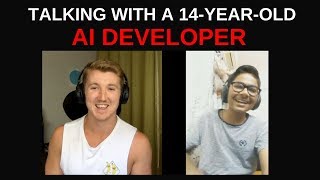
Shaik Asad, 14, taught himself Python, deep learning, and GANs through Udacity and fast.ai. He's building a crime-detection system with CCTV footage and plans to launch a YouTube channel as developer404 to share tutorials and code.
Chapters
What's going on, guys? Welcome back. So today I have a very special guest on the show today, and we're going to record our conversation and we're going to put it up on the YouTube channel eventually so you guys can hear what we're talking about. But if anyone else would, would like to have one of these talk-ins as well, leave a comment below or reach out to me via email. You know, my email is daniel@mrdbourke.com, and we can organize this. Nonetheless, I'd love to introduce you all to Sheikh Asad, who's a 14-year-old.
Hey guys, today, uh, I'm going to be talking to Daniel Bourke.
Okay, welcome Sheikh, thank you so much for coming on. And I'll just— Sheikh, tell everyone a little bit about yourself. Where do you come from and what are you currently studying?
I'm from India and I'm studying, uh, GANs right now.
GANs, generative adversarial networks. So what makes you interested in— what makes you— and you're 14 years old, right?
Yeah.
And you're an artificial intelligence developer. I wish I started that early. That's, that's amazing. And so what, what excites you about AI?
Yeah, we can do almost anything with it.
Yeah.
Like possibly anything, like, you can even make crime detectors. With CNNs if you want. Yeah, so that's, uh, really exciting to me. And we, uh, humans don't need to do everything. Uh, yeah, see, yeah, it's simple. It simplifies our life.
So that's really cool. I remember you were telling me yesterday you had a really good idea, actually, uh, crime detectors with CNNs. And so what was it you would say? Start off by, you, you'd need data from video cameras recording crimes. CCTV cameras, exactly. And then you'd use that and get the ones that have crime in them and find out so you can sort of predict in the future.
Yeah.
What's that? Have you seen that show before? I'm not sure what it's called.
It's—
oh, I forget what it's called. Person of Interest. Have you seen that before?
What?
It's a TV show called Person of Interest, and there's, there's a big AI, and what the AI does is, uh, or big computer, and what the computer does is it predicts crime and then sends like a James Bond type character out to fix the crime before it happens.
I didn't see it, but, uh, that's cool.
That's cool. And so are you in high school?
Yeah, 8th grade.
8th grade? And where at? In India?
What?
In India?
Yeah, in India.
In India? Wow. So how many people are at your school?
2,000, I guess.
2,000? And do they teach computer science there? Do they teach AI at school?
No.
No? What have you been learning? What have you been learning at school lately?
History, kings' names, you know, Tamil kings' names. They're just so big, you have to recite all of them and write it in a test.
In a test? And what, do you like learning kings' names or do you prefer learning about— No.
Yeah.
Because I remember you saying before when you reached, you emailed me and you said, School teaches a lot of useless and boring stuff. Is that part of the useless and boring stuff?
Yeah, absolutely.
And so how are you learning AI? You sent me through a screenshot of some convolutional neural networks that you've built. That was really cool. So did you— you made that on your own?
Yeah, but I also took Deep Learning Nanodegree Term 1. That's it. Oh, so, uh, there was only, uh, term 1 available, so I have to— I had to take only term 1. There's no, uh, full Nanodegree. I have to take it, uh, you know, I wanted to take it, so I took the term 1.
Term 1, the Deep Learning Nanodegree with— is that the— from the Foundations one?
Yeah, yeah. Wow.
Wow, that's incredible. So how long have you been programming for?
About a year.
A year?
Yeah.
And where did you learn how to do that? Was that at school or were you teaching yourself?
Yeah, I was teaching myself through the internet.
Through the internet?
Treehouse.
Treehouse. Oh, me too. I use Treehouse as well. And was it always Python?
No, C, Java, and last Python.
Oh, wow. Okay, so is there anything else that you, apart from deep learning models, that you've built or that you've coded?
Yeah, machine learning through scikit-learn.
Through scikit-learn?
It was easy. Yeah.
No, tell us about that. I find scikit-learn hard, so if you're doing that, that's amazing.
So I took Machine Learning Nanodegree as well, only term 1.
Yeah.
And Sebastian Thrun and a girl, I don't know her name, but they both were teaching machine learning. Yeah.
And okay, so how did you find out about artificial intelligence?
So yeah, I was playing chess on the computer. So I don't know how, how that works. So I thought, how does— I googled it, how does chess work? And then an article about AI came. I didn't even know about what deep learning was. So I thought deep learning was learning advanced deep concepts.
Yeah, well, me too. I didn't know what it was until recently as well. It's sort of a strange name once you start to actually learn about what it is. Okay, that's really cool. So you're playing chess against your computer, and was the computer winning? Is that why you wanted to find out? Or were you beating the AI?
No, no, no. Every time I'm the one.
Because there's no chance for— For me, I think I still fail on level 1 of the chess computer engines. They're too good these days. They're making them so good. Like, have you seen AlphaGo Zero, is it? Or yeah, AlphaGo Zero.
Yeah, AlphaGo Zero. Learning to play chess. It's not chess, it's Go.
Oh, Go, yeah. But they also use that same engine, the same algorithms to learn chess. And so now, now AlphaZero has beaten the best chess engine as well.
Yeah, that's good. Cool. Reinforcement learning.
Reinforcement learning, is that what you said?
Yeah.
Yeah, that I think that combined with deep learning is going to bring out some really cool things in the future. Who's your favorite, or what's your favorite resource to go to to learn about AI?
Yeah, just some blog posts.
Yeah.
And Udacity Nanodegrees if you can pay for it.
Yeah, Udacity Nanodegrees are great, that's true, but of course they They do need to be paid for, but it's— I think it's really good as well. There are a lot of, uh, free resources online and whatnot. Um, have you heard of fast.ai?
Yeah, yeah, yeah.
That's something I want to try in the future, and it's, it's totally free. And of course, um, Siraj Raval, all of his videos are really, really good, and that the links he puts to code. Yeah.
Check out my YouTube channel for more tutorials and GitHub.
Oh, yes. Yeah, I'll put the link in. What's your channel and what's your GitHub?
GitHub is developer404 and channel is also developer404.
Okay, I'll make sure I put the links in the description so everyone can check them out. Because what you were telling me before, what do you want to do? You want to start making videos and posting code on GitHub of the AI models you're building?
Yeah.
And so where, where did you start learning that the convolutional model that you were building?
Yes, actually, I emailed you saying that I had a hard time learning convolutional neural networks. So that was a long time ago. And I got a reply on New Year, I think.
I'm sorry, I was slow replying, I'm pretty sure. So thank you for your patience. I think I was on holidays when that happened.
Yeah, that was December. So I learned from a blog post, and Suraj Javal has some nice videos on it.
On convolutional neural networks?
Yeah.
Yeah, I'll have to check them out.
Introduction to Convolutional Neural Networks Part 5, I mean Introduction to Deep Learning Part 5.
Part 5? Okay, I'll link that in the description as well so people can check that out. I'll need to watch that because that's what I've been learning about in the Coursera course recently was about computer vision and convolutional neural networks of course are the best for computer vision. I think Facebook were trying to use convolutional neural networks for translation.
Tagging.
For tagging?
Yeah.
Oh, really? Like photo tagging?
Yeah.
Because they're really quickly at— you upload a photo now and it knows instantly who's in it, even better than I do. It knows my friends better than I do.
Yeah.
So what are your— do you have any favorite AI companies or favorite or people that are building AI?
Yeah, Geoffrey Hinton and Yann LeCun.
Oh, yes.
And also, who's like inventor of GANs?
Ian Goodfellow?
Yeah, Ian Goodfellow.
Yes, they're all very smart people, aren't they? And what makes What makes them— why do you look up to them so much?
Because, you know, they never give up.
Yeah, that's important, right?
Jeff Hinton, he was told that neural network, it will not work, but he proved them wrong, right?
Yes, there was an interview actually with Jeff Hinton.
Yeah, I saw that.
Have you heard of Andrew Ng? Andrew Ng? You've heard of him? Yeah, the interview between him and Geoffrey Hinton is really good. That was a part of the Coursera course. I saw that. I really like that.
Deep Learning through AI.
Yeah, have you checked out that one yet?
Yeah, I'm planning to take that course.
Take that course? And so do you think it would be good for schools to teach people about AI and deep learning?
Yeah, but I don't really like school because I like self-education, you know, me sitting in room instead of meeting in person and studying.
Oh, you prefer that way?
Yeah.
Sometimes it's good when you're alone and quiet and you can work on those models. So what's your learning process at the moment? If say you wanted to learn something, how do you go and do it?
So, first of all, check out GitHub.
GitHub?
Yeah, and, you know, search for 9 lines of code in Keras or maybe TensorFlow.
Yeah, what's 9 lines of code? What do you mean?
Yeah, I mean, Keras is pretty simple, right? Yeah, I like Keras. Yeah, so you can code up a convolutional neural network in 9 lines.
9 lines of code?
Yeah.
In Keras? So if you search in github.com, 9 lines of code convolutional neural network. And how did you find that?
By searching.
Searching GitHub, yeah, that's true. I need to start using GitHub more. I think I'm still trying to work out how I best learn. I think I'm very visual, so I imagine things in space and I compare it to other things like using analogies. And so, what do you want to do with— once you finish school, because you're in Year 8 now, does it go to Year 12 in India?
No, till 10th.
Year 10?
Yeah.
And then do you go to university or do you have something after year 10 before you go to university?
Yeah, something after the 10th.
After the 10th?
Yeah.
And do you want to go to university to study AI or do you want to keep learning on your own?
Keep learning on my own.
Yeah, good idea. And then you can You can start an AI company and build convolutional neural networks to detect crime. Crime, yes. And what about, what other projects are fascinating you at the moment? Is there anything someone else is working on that you've seen and you think, wow, that's really cool?
Yeah, that one, you know, with GANs, you draw something and it generates a Picture of something.
Yeah. So you mean like you just draw lines or outlines of something and it turns that into an actual picture?
Yeah, that one.
Oh, that's really cool. I think, um, is it Google that are doing that or is it multiple people?
Uh, multiple people, like OpenAI beat Atari game, not Atari game, but some game. I don't know.
It's— oh, OpenAI. I think that's the one I read about that. It was Dota 2, was it?
Oh yeah, Dota 2.
Dota 2. Have you ever played that?
Yeah. No.
Do you play any games at all?
No.
No? So what do you do for fun? Outside of, or is making AI models fun for you?
Um, ah, yeah, making AI models is fun, and I sleep.
You sleep? Yeah. So what, what does a day look like in, in Shake's world? Is it, uh, you, you get up and you go to school, come home and code?
No, I, I have to do lots of homework.
So you go get up, you You go to school, you get home, and you do your homework, and then you start to build AI models.
Yeah, sometimes, you know, like maybe I will start at 11 o'clock or something.
11 PM?
Yeah.
Wow, you're staying— what time do you start school in the morning?
8 o'clock.
8 o'clock. And so you have to stay up quite late to, to, uh, to build models.
But sometimes I don't.
Sometimes you don't? Yeah, of course, you need sleep. That's, yeah, that's important. You're a hard worker at 14 years old. You're doing, you're doing the right thing. You're doing, you're doing some good things. And so do you play any sport?
No.
No? Do you like cricket?
Cricket? Some, yeah, I watched it when I was, I think, 11 years old.
11 years old? Because cricket, yeah, India I think is the best in the world at cricket, I'm pretty sure. Yeah, yeah, I like playing cricket. I think the cricket— my Australian team is playing at the moment on TV, so, so that's why I asked. Okay, and so do you have any brothers and sisters?
Yeah, I have a sister.
You have a sister? And are you— is she into AI as well? No, no. What about your, your parents? What do they— do they like that you're that you're coding or they want you to keep going with school?
Yeah, sometimes, you know, my father and mother say keep balancing with school life and AI.
That's a good idea. That's important, I think, because school— keep paying attention to school, do enough to pass, but I think what you're doing outside of school is really good, working on your own projects, because if school— they can't— they teach a lot, but they don't teach you everything. So that's where it's just really good to develop that habit of going out and finding what you want to learn about. So in the future, do you want to work for an AI company, or do you want to start your own?
Start my own.
Start your own? I like that. You can start young too.
Yeah.
So do you have any questions for me?
Yeah, I do. Uh, how do you maintain your health? And, uh, yeah, my health.
So as in like fitness?
Yeah.
Yeah. Okay, so it's— for me, it's an, it's an everyday thing. So like if you wanted to learn about AI, you try and do it as much as possible, or at least try to do a little bit every day if you can. And so that's the same, same with me and health. And so I try to, to eat well every day, and eating well for me is, is a diverse diet, which means plenty of different foods, mostly single ingredient foods. And what I mean by that is, is foods that don't, don't come in a packet. Don't come with multiple different ingredients making them. So, most of the time I'm cooking my own food, which is plenty of vegetables and fruits and greens and whatnot. I know you said before you're not the biggest fan of greens. But that's alright, you got to start small, you start small. And of course, exercise for me is like a— it's a meditation and it's a way for me to break up the study periods because at the moment my schedule is study Monday to Friday and I drive Uber on the weekends and make YouTube videos on the weekends. And so, every day I exercise about an hour or so in between that to— as a kind of a break to let my mind have a rest and I work out my body. And so, once you— it's just a time thing, right? Once you get that habit and you keep doing that, doing that, it just becomes—
It becomes an habit.
Yeah, exactly right. So like coding, right? I still need to work on my ability to build models. Like, you're doing the right thing. I should be doing what you're doing and getting into a Jupyter notebook and starting from scratch. So it compounds over time. So once you start doing it every day, little bit by little bit, it gets easier and it becomes a habit, as you said. And so I think if you wanted to start with improving your health, you start small, you start with something little every day and then build that over time. And then it just becomes one big recurrence.
Yeah. Yeah. Well, do you have any questions?
Do I have any more questions for you? I think what's— so we're in January. What is your— what's your goals for this year?
Yeah, this year, preprocess the— preprocess any data set that is given to me and apply it to deep learning because, you know, we can't really make the world better. A better place by classifying handwritten digits, right?
Yes, that's true. Yeah, that's, that's where you start, right? That's it. That's the first— you start with that as the first bit of practice. And then you use that, what you've learned from there, and you have to, as you said, preprocess any dataset that's given to you because data in the real world doesn't come in, in beautiful little tables or labeled stuff like that. That's really cool. So that's what you want to be able to do by the end of the year.
And yeah, and you want to start a YouTube channel. I mean, start making YouTube videos. I've already started. Yeah.
And again, it's, it's Developer 404, right? I'll put the link in the description. And so you want to, on your YouTube channel, start building these, start showing people how you preprocess datasets and and apply them to deep— apply deep learning to them?
Yeah, eventually, but at first I'm going to be starting from zero. I mean, I— and then we're going to be going into it.
Ah, wow, yeah, that's a really good idea. I like that. That's going to bring a lot of value to people. I'm going to definitely be checking out your channel. I've got a lot to learn from you. And so how— thank you. And so how do you know what steps does it take to do— how much do you know about preprocessing a dataset at the moment?
Um, actually, I have to learn that. Yeah, me too.
I don't know. I don't know much either.
Yeah, but But yeah, I can work with them next and, you know, other datasets which are labeled and yeah.
The MNIST dataset, is that the digits, right? Just so people know what it is. And where can people find the— is the MNIST, is that— am I right? Is that the one on TensorFlow with the tutorial? Yeah, you can learn how to use TensorFlow. And what's For people watching, what's TensorFlow to you? What do you think it is?
It's a library to build things easier. You know, you can't code up every single thing. We don't have that much time to look into math, and people are not interested in math that much, dude.
Yeah, that's true. So of course you don't want to be building it from the ground floor up. You can use the same same code that Google use to build deep learning models. I think it's really great and there's plenty of great tutorials on there for anyone who wants to start learning deep learning.
I love TensorFlow, by the way.
Me too. I love TensorFlow and Keras. They're really, really cool. Okay, so if you could tell everyone watching one thing about what you think they should do in terms of learning AI, what would it be?
One thing to do to learn AI?
Yeah, so say someone, they're watching this and like, I want to learn, I want to learn AI like Shake, and I want to start building, help Shake build a crime detection model. What should they start doing if they know nothing about AI?
Yeah, first they have to They have to read some blog posts and then they have to code up GitHub repos. Yeah, just recoding them.
So practice recoding existing models. Yeah, that's really helpful.
Yeah.
And go on.
All right. And then you have to— before that, actually, you have to search for some Andrey Kapati's blog post and you have to understand it, yeah. And CNN, I was having a hard time learning it. I took CS— no, no, no, I just check out their website and then it was great, yeah.
And so CNN is convolutional neural network, right?
Yeah.
And convolutional neural networks are mainly used for computer vision.
Image classification.
Image classification. So if someone— yeah, someone doesn't know AI, they're watching this, they're seeing you, 14 years old, building AI models, which is amazing. They want to start out, they need to first of all look at blog posts like Andrej Karpathy and then practice building convolutional neural network models. From, from GitHub repos. And does your GitHub have a convolutional neural network repo on it?
Not yet, but I'm going to be making it soon.
Making it soon. Okay, well, you better— for everyone's watching, you better keep an eye on, on Shake's GitHub because it will have some convolutional neural network models on there in the, in the future. But you have your GitHub My GitHub? Oh yeah, my GitHub is Mr. D Burke. All of my socials are Mr. D Burke, M-R-D-B-O-U-R-K-E. Yeah, that's my internet name. So thank you so much for calling, Shake. We'll be in contact in the future and we'll probably do one of these calls again in the future. So thanks so much for reaching out. It's been a pleasure talking to you and meeting you. And thank you for your support on my videos, and I'm definitely taking a lot of inspiration from you, so keep doing what you're doing. And just lastly, one more time, where can people find your stuff, watch your channel, and watch your GitHub?
Developer 404.
404? So, you heard it, ladies and gentlemen, the link will be in the description. We have Shake, who's a 14-year-old AI dev. Thank you so much, and We'll see you soon.
Bye. That's a wrap.
Good work. That's a wrap.
Thank you.
Thank you. How was that? Did you have fun?
That was nice. Yeah, that was fun.
More from Daniel

Small Language Models (SLMs) Are the Future: Fine-Tuning AI That Runs on Your iPhone

Introducing Sunny - A MedGemma-Powered Skin Health Tracking App (Kaggle Competition Entry)


Benchmarking: NVIDIA DGX Spark & NVIDIA RTX 4090 | Part 4 - Comparing the results

Benchmarking: NVIDIA DGX Spark & NVIDIA RTX 4090 | Part 3 - Running LLMs on the RTX 4090

Benchmarking: NVIDIA DGX Spark & NVIDIA RTX 4090 | Part 2 - Formalizing the tests

Benchmarking: NVIDIA DGX Spark & NVIDIA RTX 4090 | Part 1 - Creating a series of tests


Local Multimodal RAG on the NVIDIA DGX Spark | Part 4 - Publishing our demo to Hugging Face


Local Multimodal RAG on the NVIDIA DGX Spark | Part 3 - Putting it all together