Exclusive: Brandin Podziemski on his journey to the NBA, learning from Steph Curry | Dubs Talk
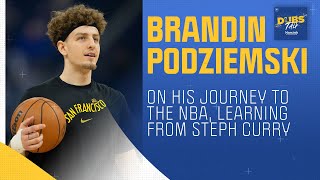
In this Dubs Talk interview, Warriors rookie and first‑round pick Brandin Podziemski sits down with hosts Dalton Johnson and Monte Poole to discuss his unconventional path to the NBA. He recounts growing up in Greenfield, Wisconsin, playing baseball and football before picking up basketball in eighth grade, and the work ethic that stemmed from his family's competitive upbringing. Podziemski details his high‑school experience at a military academy, a brief, limited stint at Illinois, and his transfer to Santa Clara where he flourished and caught the attention of NBA scouts. He describes the draft night experience, the Milwaukee connection with fellow draftee Patrick Baldwin Jr., and his excitement to join a Warriors roster featuring Stephen Curry, Draymond Green and Gary Payton II. The conversation shifts to the mentorship he receives from Curry and the defensive guidance from Green and Payton, including learning to guard in space, taking charges, and mastering the swipe‑down technique. Podziemski explains how confidence and competitiveness were forged by his dad and grandpa’s refusal to let him win easily, and how that mindset translates to his daily routine—lifting, ankle taping, listening to rap music, and watching teammates in the locker room. He shares his basketball influences (Manu Ginóbili, James Harden, European styles) and his favorite left‑handed NBA players. Throughout, he reflects on the challenges of transitioning from a ‘rookie’ label, his desire to improve constantly, and his love for multi‑sport competition.
Chapters
Welcome to Dubs Talk. I'm Dalton Johnson, joined as always by our Warriors insider Monte Poole. Today we are lucky enough to have Warriors first-round draft pick and quick fan favorite Brandin Podziemski. Brandin, thanks for giving us some time.
Yeah, thanks for having me, guys. I appreciate it.
Yeah, of course. I think right away you've really, you've been really open and honest about really kind of picking Steph Curry's brain, being around him as much as possible. I got to ask you right away then, over/under 30 questions a day for number 30?
I would say probably under. I do ask him a lot of stuff, but I do understand that he has a lot on his plate and a lot of other things besides, you know, helping the young guys that he has to worry about. So I try to limit it, limit it as much as I can, try to get out only the good questions. So probably under.
Right, right. And then, I mean, obviously I'm sure you've been watching Steph from afar for a long time. As a fan. Now you're his teammate. So I got to kind of ask too, then, going into being his teammate, draft night, first time meeting him, what was maybe your first impression like compared to maybe your expectations going into that when it comes to teammate and player as well?
Yeah, well, obviously you kind of, uh, just from afar, you know, you look at all superstars across the league, you kind of feel like they have some like entitledness to them because they are who they are. But I remember I had my press conference at Chase Center, and then I got back on the plane to go home for a little bit, and he FaceTimed me on the plane and was just a really down-to-earth and really cool dude. And he's been like that ever since. Nothing's changed. Nothing's wavered through his success, through some games where he hasn't played as well. And so for me, that's really cool to be around to see, you know, a star MVP, best point guard in the league, have that about himself because at the end of the day, I want to get to that level and, you know, I want to stay humble just like he has.
Brandin, you're, you're 20 years old, you're in the NBA, but I'm wondering now, where did your journey start? Because, you know, every player has their story. You know, they dribbled a basketball when they were 6 days old or whatever. When did your journey start? I mean, how far back can you go in terms of your basketball, your connection to the game?
Yeah, I would say for me, I went back to 8th grade, so maybe 7 years ago. Was a baseball player all my life. My dad was a really talented baseball player. And I played that, I was really good. If I wasn't playing NBA, I'd probably be in a minor league somewhere right now. It was just one of those things where I was just natural at it, I could pick it up whenever I wanted to, and it just kind of came easy to me. And for me, I got too slow at one point and I wanted to try something more up-tempo and maybe something I wasn't as good at because I think from that experience of picking up basketball in 8th grade and, you know, all the way till today, I got to work on it every day to be as good as I am. And I think baseball was something that came natural to me where I didn't have to and I didn't have to work as hard. So I kind of look at it that way as it was kind of a blessing that I did pick it up because it kind of drove my work ethic not only in sports but— Yeah. In all-around aspects of life. And then obviously for high school, I'd go to a military school, play really well there, and then get the opportunity to go to Illinois. Didn't really get recruited heavily out of high school. When I did, it was late during COVID so I didn't get to take any official visits to any colleges of my choosing. So I chose Illinois. It was closer to home. They just had, I had assumed, picked the Chicago Bulls in the second round, and it just came off winning the Big Ten Championship, so it kind of just all seemed right at that moment. You know, fast forward, my assistant coaches that recruited me left, went to Kentucky, and they're still there now. And then two of our fifth-year seniors came back for their COVID year at my position. So I was kind of stuck just in the fact that I wasn't really going to leave, not knowing where to go. So I kind of just stuck it out. Obviously, as you guys know, didn't play much. Freshman year, had 17 DNPs out of maybe 30 games. When I did get in, it was usually garbage minutes, but I learned a lot. And I always shout out my guy, Trent Frazier, who's overseas now in Russia, helped me a lot my freshman year. He was a point guard that started for us and taught me a lot about the game that I didn't know. And I took that. Santa Clara recruited me out of the portal right away. Got to take my first official visit to Santa Clara. [FOREIGN LANGUAGE] And ever since then, that felt like home to me, and they kind of gave me the keys to the car, say, kind of do what Jaylen did, and the team is yours. And so I took that head on, and for the last, you know, year or so now, just really focusing on how I can get to be the best player I can be. And obviously in June, I got drafted to the Warriors, had a poor summer league. You know, everybody's like, oh, he's a bust, he can't do this, that, and the third. You know, now I lead the team in 3-point percentage. So it's kind of like I always knew that I'd be fine, just a little bit of an adjustment period. But it also is kind of nice to look back sometimes and sit back, like, 2 years ago today, I wasn't playing at all. A year ago today, I wasn't on any draft boards. And now here today, I'm in the rotation of a team of 4 Hall of Famers. So it's kind of nice to look back on at my journey. It's never been easy for me, which I think is— [FOREIGN LANGUAGE] for the benefit. So, yeah.
That's a hell of a journey, man. You think about that. But at some point, did basketball just surpass baseball for your— in terms of your love of the game? Or how did that process go?
100%. And I forgot to mention, my junior year, I played football as well just to, like, get stronger, more physical. But, yeah, it definitely surpassed it. I obviously still have a place in my heart for baseball. And for football. Anytime, you know, during the summer I can get out there and play baseball or throw a football around, it's something I enjoy. But, yeah, definitely my love for it, my love to get better at basketball every day, seeing other guys and the moves they do, just trying to be like them, I would say, yeah, it surpassed maybe junior, senior of high school.
Most guys, as they come up, before they get to college, as they go through middle school, high school, AAU, whatever, they run across certain people that are influential, whether it be coaches or, you know, just, you know, people who watch you and kind of take an interest in you. Um, who are the people who sort of like influenced you, whether as you made your way up to before you got to college?
Yeah, before I got to college, uh, for sure, Manu Ginobili. Uh, watched a lot of European basketball just because I knew kind of from where I was in high school, I wasn't going to be the most athletic best player really ever on any team I was on past high school. So just seeing the way Europeans, how they move the ball, how they play a team style of basketball was something that was very influential to me. But in high school, as crazy as it may sound, I watched a lot of James Harden back in his prime Houston Rockets days. Just the way how he got into the paint, facilitated, shot the floater, threw lobs a cappella. And then obviously, you know, that was, I think maybe 16, 17. That's kind of when the Warriors were, you know, just starting their dynasty of winning championships. So you got to see how they played and it was really cool to see. It was more passing it seemed than dribbling. And I kind of think that that fit my play style and you kind of always were like, oh, maybe I could play for them one day. And, you know, now here we are.
Were there like a couple of coaches you played for along the way that you felt were impactful?
Yeah, I think all my coaches that I got to play for have had a little bit, at least, influence on my life in a positive way. Eighth grade, I remember I picked it up, my church league coach, that was my first team I played for. A bunch of me and my kids from the middle school played together. We ended up winning the Padre Sierra, which if you don't know, is like the largest Catholic league tournament in Wisconsin, like 77 schools. And we ended up winning it for the first time in our school's history, which was really cool. And then high school, still really close to the Milacinik family today. They did a great job kind of like developing and grooming the fundamentals of the game of basketball to me. And then obviously, AU-wise, Antonio Curro with Phenom University Team Hero did a great job of putting me out there, getting me noticed by some schools. Mm-hmm. And so I think each and every person through high school did their part and helped me develop into what I needed to be. And then in college, obviously, you can look at that and say I have bad blood with Coach Underwood, but he definitely helped develop what I was at Illinois. And obviously, Coach Seneca and the staff at Santa Clara did their part as well.
Brandin, when it comes to, like, AAU and stuff, I mean, obviously, you put up some monster numbers in high school, but AAU with Phenom as your teammate, you brought up, who are maybe some of the guys that you either played with or against that you think that maybe made you better as well?
Yeah, well, obviously you guys are familiar with Patrick Baldwin. We were AAU teammates for one year, grew up around about 15, 20 minutes from each other. Very influential. He doesn't say much, but, you know, I think his actions on the court definitely speak louder than His words. Tyrese Hunter, who's at Texas, was my backcourt mate. Kobe Johnson, who is at USC right now, was also on the squad. And then guys, in terms of guys I played against, Paulo Banqueiro, obviously, Rookie of the Year last year. Nolan Hickman, who's at Gonzaga still. Chet, who's in OKC. Jalen Suggs, who's in Orlando. Chet. So just playing against a bunch of those guys, I'm probably missing a few guys that I've played against before, but definitely have helped me just see what it's like to be— what a top dog looks like. And by no means am I anywhere close yet, but that's definitely a goal of mine.
Yeah, recruiting-wise, I mean, it looked like Wisconsin, that most places had you as the number 3 guy in Wisconsin for your class behind just Patrick and Tyrese, two guys you brought up. What was kind of, I guess, the draft process like talking with Patrick Baldwin Jr.? And obviously when you get drafted to the Warriors and originally he's part of the Warriors, later on gets traded that night. What was all of that like maybe for the both of you?
Yeah, so it was kind of, kind of crazy. Obviously he went to Milwaukee for one year and at that point I was at Illinois. I didn't play and he got to play, you know, a lot. And to see him get drafted by the Warriors was super cool. His dad was obviously still the coach in Milwaukee. So when I did hit the portal, I was kind of, you know, looking for a school besides Santa Clara. So our relationship with his dad was super, super good. But then I remember, I think it was maybe May. Yeah, May, I came to do my pre-draft workout with you guys, and he was obviously— doing spring or summer workouts, whatever you call it, and we kind of talked a little bit about it, what it's like here, how it fit, and then fast forward to draft day, I get drafted, he's still on the team at that point, and then, you know, an hour or two later he gets traded to Washington, which was kind of sad to see because if you think about it, we could have had 4 Milwaukee guys, me, Jordan, Kevon, and Patrick all on the same squad together. Yeah. But I think he's going to flourish in Washington. I think once everything figures itself out, he'll be, he'll be good.
Was that Milwaukee connection as far as you, Patrick Jordan, and Kevontae that you knew about coming, coming into the Warriors? Because a ton of Milwaukee talent obviously right there. And then do you still keep in touch with Patrick to this day too?
Yeah, I'll check in on him every once in a while. We chatted at Summer League for a little bit. I got to see him there, and before the season started, I just kind of wished him luck on whatever his journey may look like, whether it's with the G League squad down there or it's with the regular team. Just wish him the best of luck, you know, being healthy and everything like that.
So question now, I understand that, at least I heard that maybe at some point Kentucky did sniff around, uh, show a little bit of interest in you. Did that really happen? And if so, what did and didn't happen about that.
Yeah. So I was in contact with Kentucky for a couple months. Coach Joel Justice, who's at NC State, I believe, now, and obviously Coach Calipari recruited me to go there. They extended an offer in October of 2020, and they were— it was kind of an offer just to see how it played out through COVID. Obviously, I couldn't come on campus. To take a visit or anything like that, and they couldn't come see me. But then after I made my decision to go to Illinois, the assistants went to Kentucky, kind of tried to re-recruit me to Kentucky to go with them. But at that point, when I haven't took any visits, it was kind of like, hey, do I go there and try to test it out, or I just know I have something here that I can stay solid with for a year? And I ended up just staying at Illinois.
What— go back to the recruiting process. I mean, when you first were introduced to it, whether it would be the first letter or whatever it was, um, what was that like when you started getting interest, when other schools started showing interest in you when you're still, you know, 15, 16 years old or whatever?
Yeah, I think I remember, I think it was maybe my sophomore year, um, before COVID a bunch of like mid-major schools would come to school. We had 5:30 morning workouts all the time. They would come, like Texas A&M, I remember came, Loyola Chicago, DePaul, UWM, all those types of schools had came to my school to watch me and some of my other teammates play. So that was really cool. But at some point you were like, dang, why aren't they offering me? Like, what do I got to do more of? And then fast forward to my junior year before COVID a bunch of mid-major schools had started offering. Valparaiso, Loyola Chicago. I remember DePaul was my first ever offer in October of my junior year. And that was super cool, surreal moment for me and my family. I really didn't know what to think. It was just super cool to see. And then obviously, as I progressed through my senior year, more of the high-level schools had came around.
I got another quick one here. And this is something that I've talked to a lot of players with about over the years. You come out into the court to play basketball, you're a teenager, you're 15, 16, or whatever. And, you know, brothers want you to earn respect. They, they sometimes they look at you like, can you really play? They want to show. How did you earn your stripes? Because obviously you did at some point.
Yeah, I think it's just not backing down from nobody. Uh, as crazy may sound, just like no matter the color of your skin, I'm gonna go out there and play the way I play. Like, like I told you yesterday when we talked, I don't fear anybody on the court. Um, because I knew when I picked it up that I wanted this to be my dream. And if you're going to make it to the NBA, you're going to have to face that challenge at some point in your career. So for me, it's just going out there and hooping. I think when you hoop and you show people what you can do, I think that's how you earn your stripes.
So at some point you knew you belonged because they let you know you belonged. Yeah.
Yeah. I mean, I grew up in Milwaukee or just outside of it in Greenfield, which is a very diverse area. A lot of African American, a lot of Mexican, a lot of Indian. So I kind of went to school growing up around kids like that. So my background has kind of, you know, been around that. So I kind of know how things operate in that sense. So just being around that growing up and then having a chance to play basketball with those same people, you know, taught me a lot about, you know, having that confidence and swagger that you need to be successful.
Thank you.
Brandin, that kind of brings me back to the confidence that everyone has brought up with you. Draymond Green has said irrational confidence. You've even agreed with that. And I kind of go back to confidence versus competitiveness because you have to have some kind of irrational confidence to even make it to the NBA, to even make it to college basketball, obviously. Right? So how do you kind of balance confidence with competitiveness? Because I feel like the competitiveness is really the root of that? And where do you maybe get that competitive edge from?
Yeah, you've said it. Competitiveness is where it stems from. Growing up as a kid, there was, you know, we played washer toss as a family, bags as a family. My dad and my grandpa would never let me win at anything, no matter how old I was. And I would always cry because I would lose. And obviously they're, you know, 30-some years old and I'm 6 or 7. And so I'm obviously going to lose, but at that point it was just like it was so frustrating because I couldn't win. So credit to them not letting me win at anything when I was young. You know, some parents like kind of give in to their kids, like, "Oh, he feels bad, so let's let him win." My parents never did that for me. So I think that's kind of where it stems from and just always wanted to win because you don't want to feel that feeling of losing. And then the confidence part is just I know what I put into it. Off the floor when, you know, nobody's really around. I know, you know, how much effort, how much sweat equity that I put into it. So it's kind of like, you look at shooting, for example, I know I've shot the same shot X amount of times, so why wouldn't I take it? Why wouldn't I shoot it with confidence? And then, you know, after I do make it, why wouldn't I, you know, talk shit, right? So—
Yeah.
It's just something from the competitiveness where it stems from, then the confidence of knowing, like, I've already done this, so I know I belong.
You remember that first time maybe that you did beat Dad in whether it might be bag toss, basketball, baseball, whatever it might be, what that feeling was like?
Yeah, it was probably 7th, 8th grade where I started beating him consistently, and it was like, "Okay, I can do this." And then, you know, from that, learning how to get better at that and not just be satisfied with a win, but how can I beat him by more? And I think I kind of look at basketball the same way. Like, yeah, it's cool to win, but how can we get better and win by more? How can I, you know, like yesterday, how do— how can I play better than I did?
Dude, you wanted to hammer— you wanted to crush your dad.
Yeah, I mean, it's competitive in the household.
Now, from what I can tell, your dad is your biggest fan.
100%.
Yeah. And so what's that relationship like in terms of, you know, as you're going along from 13, 14, 15, 16 to where you are now, what's he meant to you?
Yeah, I think with being my number one fan, I think, you know, he's one of, if not the hardest critic on me as well. He's going to tell me what it is regardless of how it may make me feel. But it's cool to see that he didn't play basketball growing up. And so his perspective, you know, I have a lot of people already around me that have played basketball that try to give me, you know, tips, tricks, insight on what I should be doing. But it's cool to see like my family's perspective on things just because they haven't gone through something like I'm going through, haven't played basketball, don't know anything about the game of basketball. To see their perspective on things is cool, and it's cool to see it from a different end than what I'm getting all the time. Mm-hmm. And so him, my mom, my stepdad, my grandparents have meant a lot to me just because, you know, they always put their best foot forward growing up of making sure I'm good, making sure my sister is good, and always putting me before themselves. So, you know, when the time comes, I think it's just only right for me to pay it back to them.
It kind of brings me back to, the baseball that we talked about, when it, when it comes to kind of wanting to get a new challenge and finding basketball to be that challenge, you played a year of football as you brought up too. When it kind of comes to wanting more challenges, is that kind of how you maybe attack things outside of basketball too? Attack life as well, where you're trying to find something that might actually light your fire and find a new challenge on a daily basis?
Yeah, I think for me, You know, going into this season, I wanted to progress so much to the point where it's like, okay, he doesn't play like a rookie. Because the worst thing for me I could hear is like, oh, he's a rookie, he's allowed to make that mistake. Like, I never want anybody to say that. Like, I don't want Coach to be like, oh, he's a rookie, we kind of expect that. Like, I don't want— like, I want to be past that point where it's like, okay, he's progressing into more than we think he can be, and he's not playing like a rookie. And so— Yeah. I think sometimes, I think Steph said this to a fault, like I'm always asking him like, what can I do better, what can I do better? But it's through, you know, the reps and being in the moment is where you can see like, oh, I need to get better at this. So for me, every day, whether it's basketball or it's not, I'm always looking for something that I can get better at. Prime example, probably video games. I play 2K a lot and I created my own player. So I'm always looking like, okay, What are other people doing that I'm not doing that I could make myself better at? So it's just things like that, just competitiveness in every aspect of life. That kind of is where it stems from.
So you're not just gonna make— go make it a 99 overall creative player like I used to when I was 9 years old or something like that?
Well, my guy is 99 now. But just in terms of, like, how can I get open shots? How do I make open shots? Just all little things. That have helped me.
Everybody has their, their welcome to the NBA moment, whether it's in summer league or whether it's in the actual preseason or in the actual game. What was the moment? What was your welcome to the NBA moment?
I don't know if I've had one. I will say that, like, dealing with the referees, um, the foul that I got called on Kawhi at home last Thursday, And they challenged it, and obviously we won it because it wasn't even, you know, remotely close. But just to see like, wow, like that's the kind of calls they get, even though it was that not even close. It's something cool to see like, okay, maybe if I can get that low, now I can start getting calls. Or like the little stuff James Harden does when he comes off screens or when he bumps you and how they get those calls. So— Yeah. It just makes me more hungry to get better and to get to that level. Because I think I tell Steph all the time, like, if he played more like that, I mean, he could average 40 points a night because he shoots 15 to 20 free throws every night along with, you know, the shots he already makes, which are very high skill.
Brandin, I'm trying to think about too, when we talk about finding that next step. I think that a lot of people obviously knew about your offense coming into the NBA, but I think maybe where you've exceeded expectations is on the defense as well. Where do you think that maybe you've taken the biggest jump from Illinois to Santa Clara to the Warriors on that side of the ball?
Yeah, I would just say, um, learning how to guard in space. Obviously the court size is very different than college. The way teams play is very different than college. College, you can almost guarantee one or two guys can't shoot on the floor at all times. It's really usually how it goes. But sometimes in the NBA, everybody can shoot. So for me, over the course of Summer League, pre-draft process, and training camp, just kind of learning how to guard in space, taking on that challenge. I told Manny yesterday, you know, the earlier I can set that tone, that narrative that, okay, he's here, he can play defense, I think the better it suits me down the road. Because then, you know, when those 50/50 calls come about, the refs in the back of their head like, okay, he plays defense, he plays hard. He's not just, you know, faking it out there. I think I might get the benefit of the doubt some of those times.
You obviously play with an all-time great defender in Draymond Green. You look at what Gary Payton II brings to you guys. I mean, you can see a little bit of GP2's game in your game defensively, especially too. Whose brain maybe do you pick the most when it comes to defense like that? You got Steph obviously on the offensive side, but the defensive side, who are you talking with the most and what might be a little thing that's gone a long way for you when it comes to that kind of advice?
Yeah, I would say I talk to Draymond and GP both about different things. When it comes to just one-on-one on-ball defense, and navigating through screens, I talk to GP. But when it comes to like off-ball positioning, talking, I usually rely on Draymond for that. And I think a big part of defense, like obviously I'm not the most athletic guy out there. I think it's just being in the right position because it sets you up for everything else that you got to do. But for me, listening to GP, listening to tendencies, I think that's the biggest thing. And then I— this is crazy, but I talk to Klay a lot about the swipe down on jump shots. And I got one on James on Saturday. He's obviously gotten a couple of them already. So I talked to him about that. I've watched Iguodala do it for years. And I'm like, okay, well, now if I got guys like Kevin Durant, I'm not athletic enough. I can't jump high enough to contest it. So how can I get to the ball before he can get it up? So just stuff like that, those little things that may help me not being the most athletic, but can influence the shot.
Yeah, I was going to bring up Iguodala actually, because the swipe down, I mean, that looked like vintage Iguodala, obviously, right? So many Warriors fans have seen that. Last defensive question, because I think the one thing too that's really stood out that Draymond's really good at, and so is actually Moses Moody, is taking charges. I think that you've taken the most charges by any rookie right now. And you're at the top of the league, top 5 when it kind of comes to charges per game. Has that been something that's always been in your bag defensively, or has it been a skill that you learned? Because it's both kind of a skill but also kind of a will, obviously, too, when it comes to that competitiveness within your nature.
Yeah, well, one, it just comes down to winning, how much you want to win. And I think it's a part of the game. But at the same time, I think I have a good feel or judgment for when it's time to take a charge versus when it's time to jump vertical. Obviously, I'm not the best athlete, so my vertical contest may not be the same as a Draymond or like Andrew Wiggins or Jonathan Kuminga. So I kind of just, just really read the play. This is kind of an instinctual thing. I don't really think about it. If I'm there, I just do it. And like I said before, it all kind of stems from positioning, just being in the right place, and then you don't have to do much.
I have one more question I have to ask you because a lot of guys have their pregame routines, and I don't mean just the warmup. I mean in the locker room, you know, whether they listen to music or something to get them going. Do you— what's your routine, and do you— does it include music?
Yeah, I love music. Definitely something I can't live without. But after my time on the court, I usually just go downstairs, I'll do my lift, get my ankles taped, and then listen to some music. If Santa Clara is playing, I'll watch them play. If Illinois is playing, I'll watch them play. But I listen to music, then I go out there and watch Steph and Klay do their workouts, and then I come back for about 15, 20 minutes, get my— get dressed, shoot some shots down on the warm-up floor. I listen to music down there, and then— Okay. It's go time after that.
Who are you listening to?
Gunna, Lil Baby, Future, Drake, Travis Scott. All rap music for me.
Is there a specific song that you like? I gotta have this one.
Nah, there's no, there's no specific song. Just I like hearing the flow, the beat. That just gets me going to play.
You've already brought up some big-time names. I know that you're a big Manager Noble guy, but Brandin, give me your Give me your top 5 left-handers of all time in the NBA, your favorite lefties.
The NBA lefty, I'm gonna go Manu, Chris Mullin, James Harden. Um, believe it or not, I like to watch, for shooting the ball, Utah Watanabe from Phoenix. Um, a lot of people when I was younger compared me to Luke Kennard. Um, and I don't even know where is he, Memphis. Um, and then I would say I kind of play like a skinnier version of Joe Ingles.
I was waiting for a specific name and it didn't come out. Given where you came from, Bucks, Mike Redd, You think? I mean, Mike Redd was nice.
I like Brandon Jennings.
Yeah, another one.
Yeah, yeah.
I thought Brandon Jennings for sure.
Yeah, Mike Redd was nice with that jump shot though. He was nice.
Yeah, Jalen Brunson for sure. We watched, me and Everett, one of the guys that do skill development work, he was with the New York Knicks last year. Now he's obviously with us. So he got to work with Jalen Brunson quite a bit. And so a lot of the stuff they worked on, we started to implement in our skill development stuff, which has been good to see.
Well, hey, if you ever need to go left on left over, you know, down to the Giants Stadium down the street, just tell Raymond, me and you can get a little something set up too.
Hey, I'm all for it.
Oh, oh, oh! I saw that 86 up the mound, man. I saw that. You still got the heat coming?
Yeah. Honestly, if I had the opportunity to play in MLB, I wouldn't hesitate. I'd play both. I'd try to pull an MJ.
I like it. I love it. Hey, thanks so much, Brandin. We appreciate you giving us some time today on Dubs Talk. I'm Dalton. He's Monte. That is Brandin Podziemski.
Thanks, guys.
Take care.
Thanks, Brandin.
More from Brandin
Warriors' Brandin Podziemski reflects on his improved play, confidence level | NBC Sports Bay Area
Dubs Talk: How Brandin Podziemski's future contract fits into Warriors' plans | NBC Sports Bay Area

Dubs Talk: Brandin Podziemski discusses hopes to become Warriors household name | NBC Sports BA
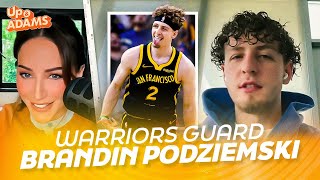
Brandin Podziemski on Steph, Giannis, Going Viral, Drawing Charges & NBA Finals Predictions