Interview: Brian Dewey, CEO of Koloni | Host: Mike Townsend
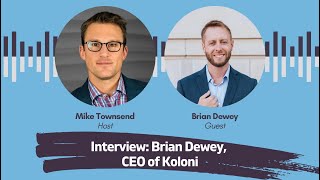
Brian Dewey built Koloni from a gym access problem into a platform integrating smart locks for delivery and storage. The company targets cutting lock costs from $550-600 to $30-40 per unit, working with 5-6 lock vendors and drawing parallels to how micromobility scaled.
Questions this video answers
2014
About two years
About 5–6
$550–$600 per compartment
About $30–$40 per lock
Chapters
All right, Brian, so welcome to Behind Company Lines. I'm excited to dive in. Why don't we kick it off? I love what you're working on with Colony. I would love to hear the sort of impetus for the company and specifically what you set out to achieve when you first started the business.
Yeah, so.
It all kind of started back in 2014. I started a gym. I purchased a commercial building and started using access control and started a gym in my hometown in Iowa. Initially, I realized that the gym was only going to be financially viable and successful with that.
Key card access and really minimizing my overhead with not having people employed. So that was really kind of the aha moment for Colony. Once that was up and going and was kind of on its own, I realized how many other businesses, and not just businesses, but other access points could be enabled by using kind of a more modern version of the access control system I was using in my gym. So, yeah, that's how initially that started. We started in Byteshare, actually before the whole micro mobility craze. And then we started listening to our customers and realizing that they wanted to provide access to basketballs at basketball courts, tennis rackets at the local tennis court, vacuums and apartment complexes. The list really kind of goes on and on. So we realized at that point that we should focus our attention to access control with utilizing lockers. And here we are today.
And so, yeah, you've been at this for about five, six years and the primary focus now is these is it give me a scope of what the company does, what they don't do. Are you guys manufacturing the lockers and then allowing people to digital access to those?
Yeah, so we actually do third party integrations with different smart lock companies around the world. They're integrated into our platform. So businesses big or small can purchase anywhere from 10 lots up to 10,000 and from any of those integrated products and then use our software to manage all those assets, control points, set pricing, manage their users. And we also have front end user applications for delivery, storage and rental that they can customize and manipulate on their own to fulfill those different applications.
So help break that down a little bit for me. So you're allowing other people to build other software vendors to build on your platform. So you're maintaining the standard protocol for access control. Is that the right way to think about it?
That's right. That's right. So we essentially enable each of the partners in our software to set the.
Application so they can customize. The locker is going to be used for delivery, storage or Rental application and then that configures the lock and the user experience kind of templated out for their user to go through those series of steps to access a locker, whether they're picking up their food or renting a vacuum in the apartment complex. We also have other API layers and stuff that they can even get further down the rabbit hole of integrating existing applications. So we really have tools for technical and also non technical teams.
Yeah, I dig it. How did you set it up? So are you owning a gym? I'd imagine you weren't spending the majority of your time building software. It's a fairly. To me it seems like a fairly intimidating business to start having a background running a gym. Did you have a co founder, do you have a co founder at that time who was really leading the technical development or how did you guys build out early product?
Yeah, so we actually outsourced from the very beginning. My co founder and I were both non technical. We started wireframing things out, had kind of an idea. I have a little bit of a background in kind of product, but not so much no technical background. So we started laying out the user application and the management software and the features and how the design elements we wanted. We hired an outsourced team and went through our MVP and our version 1.0 and 2.0 and then we actually started bringing in our own in house development team with.
Actually started with internships and then brought those people in full time. And so now we have a collection. We actually have some. We have four or five full time developers and then outsourced development teams as well.
So overall, would you say it was a smooth experience or was it really quite bumpy?
Absolutely not. No, it was terrible. It was terrible. Yeah. I had no idea what I was doing and you know, a lot of failures initially and it was very unstable, you know, quite stressful because we were, we were selling our, you know, we're based on a SaaS model. So we had people paying us subscription fees for a while for software that didn't even work. And so, you know, that was a stressful time. But you know, after those first couple years and bringing in some technical people in house really kind of helped stabilize everything.
Yeah, yeah. So how long was that when you were purely outsourcing? A couple years.
Yeah. Like the first two years.
Yeah. And it was at least effective.
We really never had a. Yeah, I mean it was effective enough to acquire, you know, the first five to eight of our early customers.
Something like that, yeah. And those five to eight, what were the early Customers like who are those people?
So they were local entrepreneurs, local city leaders that were looking to deploy some type of shared product in their community. So you know, they weren't anywhere close to our ideal customer now, but they were kind of low hanging fruit people that had five to $10,000 that they could, that they could spend on this. But yeah, they were small town people in Iowa.
Iowa, Minnesota. Yeah. Illinois. Very close, very close to home.
So is it businesses primarily? So they're thinking like what would be, what's a use case of a. And it doesn't have to necessarily be an early customer, but what would be a kind of typical use case.
Yeah, yeah. So our typical use case. Now.
We have those early customers that we kind of fit in our local group. But going forward, what we have now is we have what we call a lot of our creators, which are those technical, non technical teams that are, have developed an innovative solution.
That has potential to scale. Right. So one of the cool customers we have is this gentleman named Albert in Austria that he is a mechanical engineer and he developed a system called Ski Sheriff where people at the bottom of the ski slope can securely store their snowboards or skis in this using a smart lot that we provided in our platform and then their user application. So now he's deployed those Ski Sheriff rats throughout Europe and he's scaling quite rapidly actually.
Got it, got it. So when he came to you, he said, hey, I have a front end mobile app that I want to. Does it technically work where their software say in this guy's case, he's building the secure ski lock system. Would his app hit yours with an API and say, validate this entry and then you're kind of the middle layer and you're sending it to the the lock and saying open up.
Yeah. So we have that capability that's quite popular in his case, we actually have a white labeled app that he can customize on our software so he can upload all of his colors. Almost like creating a squarespace account. Right. You upload your logo, your color scheme, what you want your butts to say, do you want memberships, do you want affiliate programs, you want pricing? All those things can be customized. And then our development team, our project manager will put that to the app Store and there's a new Ski Sheriff app in the App Store. So he can do that because he was non technical or at least non technical on the software side or if he was a technical founder, he could integrate via some of our API layers.
That's awesome. On the other side of it. The hardware layer, how many different lockers or locks do you work with?
I think right now it's, we're integrated with like five or six something, something along those lines.
Yeah, it seems, I would think that the market's pretty consolidated. Like 5 or 6 is 80% of what people actually use. Is that about right?
Yeah, I mean, yeah, I mean it's.
I don't know if it's quite 80% but it's probably a good, it's probably a good, good chunk. So yeah, there's, there's some interesting lots that are, you know, in India and some of those countries that you know, we haven't been able to integrate yet. But that would, that would add to it.
Yeah. And so from the beginning do you feel like it was, was it a pivot at all or was it directly what you set out to do? Is what you're doing today?
No. Yes and no. I mean we knew early on that we wanted to provide.
A new way to access goods using a smart locker.
That was inevitable. We saw that from more or less day one. But for a while it was on the back burner mainly because there.
There was a lot of barriers for us from a hardware standpoint, from a few things and people were already doing byte sharing and you know that hardware is already easily accessible. What we found was there was a lot of smart lots at that point for lockers, but they didn't have STAs, they didn't have APIs to even integrate those things into our platform or they didn't have.
The ability for us to check the status of is that door unlocked or is that door locked? So a lot of those barriers existed early on that didn't exist in micromobility. So we initially focused in micromobility with the idea of developing the software to be agnostic across whatever, whatever product were that would be on our platform.
Interesting. So today there's a lot of lockers out there and a lot of developers or people non technical that have built on top of those. Where do you see? I mean when I think of today, my personal experience with smart lockers, I think of maybe at a gym, maybe at a ski resort, maybe at an Amazon locker where I'm like picking something up which could be in a grocery store or Whole Foods or something. Are there other obvious and significant use cases that you think are, that are either happening today and I haven't seen them or that are coming down the pipeline that are going to affect a lot of people?
Yeah. So going back to the shared access to certain Goods we see that continuing to grow quite significantly, especially in urban areas, especially as we come out of the pandemic.
One of the reasons that we identified that smart lockers, while they exist, and we might have got something from an Amazon locker, but one of the reasons that it really hasn't scaled and hit the potential that we would probably all think that it should, once you start thinking about all the different applications, that it could make life easier for us to access those goods. It hasn't scaled because of a variety of reasons, but primarily that industry has been ran by very hardware heavy people that the Capex is quite expensive. So.
To give you an idea, our goal was to reduce the cost per compartment, per locker compartment by essentially, you know, close to a factor of 10.
So each smart locker right now it, it costs on average, you know, if you were a business and putting a smart locker in your, in your facility, it would cost between 550 to $600 per compartment.
The lock, you know, the lots that we're focusing on are now getting down to a price point that, you know, in the next 12 months we'll be hopefully at that 30 to $40 per lock that can attach to any existing, you know, what we call dumb locker or lock or dumb locker, basic locker system and make that locker smart with all the capabilities of a smart locker, which is like $45.
Okay, that seems like a big deal. So when it's very cheap, it's rolled out, there'll just be more of them. So do you think they'll be like lockers on every street corner for delivery or exchange or.
Yeah. So take, take the, you know, going back to actually a competitive advantage I think we have at Colony is, you know, we had dabbled a little bit in micromobility and micromobility actually has a lot of those same characteristics before Lime and Byrd and you know, all of those, you know, dockless bike and scooter share companies, they were all docked, right? I don't know if you, you all, everyone remembers, but you had to go to a keypad system, swipe your credit card at this keypad that was connected to maybe 20 or 30 bytes. It would unlock, you would drive it to the next station. There was a lot of factors that prohibited that system to scale. The Capex was very high per bike, about $5,000 per bike. You could, it was limited in terms of where you could drop it off. You had to go find another hub and then the user experience was quite poor. You had to go to this kiosk system and swipe your card and use a kiosk. All those same factors right now are the same thing that we're seeing in smart lockers. You have to use a touch screen at the locker. The capex is rather high or extremely high and they're quite limited in function right now. They're mostly used for parcel delivery. When it comes to a smart locker, they're mostly used for parcel delivery. So.
All of those characteristics or those principles that we've identified, attacking them the same way the micromobility industry attacked and scaled the total available market of micromobility. I think we're going to do the same thing at smart lockers.
Yeah, that makes a lot of sense. It's a good analogy or corollary.
What are the technologies that are used? Is there a Bluetooth layer or passive RFID or WI fi or some combination, depending on the setup?
Yeah, so it's a combination. Typically there's some that are just Bluetooth only, some that are connected via a Bluetooth mesh network then turns into a WI fi signal. So, yeah, it really depends. You know, obviously those different lots and different communications provide different levels of security and access and price points. But yeah, we kind of have all of them on our platform.
Yeah. I was thinking earlier about driverless cars, the impact that that would make certainly on transportation of shipping goods. Do you think there'll be a Tesla or some other company that rolls out with a purely transport effectively, like Smart Locker on wheels, where I'm ordering something, where I'm shipping something across town and I throw it in this car and then it goes where it needs to go and then somebody comes out and unlocks it with their phone, just like Smart Locker style. To me, it seems like that would be massively useful both for intercity transit, probably more so for inner city transit, just because it's shorter and you can make more runs. But you could have a car with like 20 lockers in it and it just, you know, it's just like a logistics robot where it's just, you know, hey, I want to ship these, you know, these headphones across town to my buddy or something and you just throw them in there. Like Uber actually has on their app. Uber has a transit option, you know, because there's been, there's been like probably 10 times where myself or my wife or a friend forget something like, oh, I forgot my laptop at your house or something. So we'll just put in an Uber. They I saw this just last time I opened up Uber. They have the transit option which is like a, you know, smart locker on wheels effectively. And. Yeah.
Do you think. Do you think those little robots that we see being demoed on campuses that, you know, they're on the sidewalk?
The one thing that always stuck out to me was you're only. From what I understand, you're only doing one delivery at a time. Maybe you're doing two or three. But what you just recommended makes a lot more sense potentially, logistically, of multiple products in one autonomous vehicle that then is just creating efficiencies on the ground.
Yeah, I've thought about this. I actually saw those little things in Santa Monica last time I was down in la, and I think they're currently being run by somebody behind the camera. So there's a camera and somebody's just steering it somewhere. And so it's. It's not quite delivering on the AI, but that's fine. I do think that the. The model there is pretty flawed because you're effectively relying on the transit routes of sidewalks, which can be full of people and bumps and things you can't get over. And you can push the things over. So they're just not. They don't seem feasible to me. For long term, they seem like they might be a stopgap. But to use the existing roads that are in place and with assuming fully autonomous cars, it just makes sense. Like, I'm picturing a van with maybe one door and it just has in the back a bunch of sliding rails where it can just move the object in place, gets a destination, calls you, texts you automatically you come out. Maybe it does a facial recognition or fingerprint or passcode. Probably passcode is all you need. And then it's like, bam, open up. And I'm sure it could even have the ability to like, extend an arm and drop it on your.
More from Brian

Why Software-Hardware Decoupling is a Game Changer with Brian Dewey and Andre V

Lockersfirst podcast with Brian Dewey from Koloni, hosted by Andre Veskimeister