Energy Dominates: 1st Quarter In Review
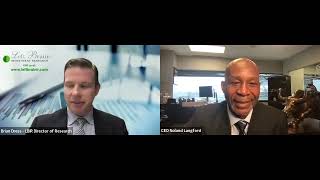
In this weekly Jarvis update, Brian Dress, CFA (Director of Research at Left Brain) and CEO/CIO Nolan Langford review the volatile Q1 market environment. They note modest index gains (S&P +0.2%, Nasdaq +0.6%) amid sharp intra‑week swings, a 9% drop in crude oil, and 10‑year Treasury yields moving from 1.7% to 2.56% before settling at 2.33%. Energy and materials ETFs (UNG, OIH, XOP, XLE, SLX, XME) were the quarter’s top performers, while ARKK, homebuilders (XHB), financials (XLF), and Chinese internet (KWEB) lagged. They discuss the decoupling of energy stocks from oil price moves, especially after the Biden administration’s Strategic Petroleum Reserve release, and conclude the market sees energy as a durable profit engine. The bond market is under pressure, with municipal bonds down ~6% and long Treasuries (TLT) down >10%, prompting a look at alternative income securities (5‑9% yields) to be covered in an upcoming April 3 Zoom webinar. The episode also promotes the weekly Jarvis newsletter and invites viewers to the webinar for deeper income‑security analysis.
Chapters
Markets aren't far from where they started this week, but this week's action's been anything but tame. We tackle this subject and many more on this week's Jarvis Weekly Update. I'm your host, director of research here at Left Brain, Brian Dress, joined as always by our CEO and chief investment officer, Nolan Langford. Nolan, welcome to the program.
Hey, Brian, always exciting to be talking stocks, especially on a week like this.
Absolutely. Let's get into it. First, we'll start with a couple of announcements. As always, we have the Jarvis newsletter, which comes to your inbox every Saturday if you get on our mailing list. So go ahead and click the link in the description below to make sure you're getting that every Saturday. And then of course, we have our April 3rd Sunday This Week event. A free Zoom webinar. We're going to be talking about fortune makers income securities. We're in a world where income— interest rates are rising, so it's difficult to find suitable income securities. And we're going to detail 4 that we found in our research. So look for that. Nolan and I will be with you on Sunday. With that, we'll get started with our market recap. So this week, index— indexes were, were mixed. They were both up just a fraction of a percent. S&P was up around 0.2%. NASDAQ was up about 0.6%. But there was a lot of action, a lot of volatility. We had a huge rally on Monday and Tuesday, but was met with a lot of selling on Wednesday and Thursday. We also saw quite a bit of oil volatility once again. Oil, crude oil, put the chart up for you here, was down around 9% this week. But we had 4 different moves of $8 per barrel up and down this week. So quite a lot of volatility there. The 10-year yield has been a big, a big talking point in March. It started around 1.7% at the beginning of March, got up to almost 2.56% this week, and then drifted back down to 2.33% at the end of the week. So a lot of movement in interest rates. And then the last point we'll make before we bring Nolan in is economically sensitive sectors like homebuilders and financials really struggled this week. We'll throw up the chart of the XHB for home builders and also the XLF for financials so you can see the action there. So all that being said, Nolan, what are your general thoughts on this week's market?
So it's more of what we've been seeing for the most part all year. Two things come to mind. One is the absolute volatility of everything. And, you know, we've seen it oil, you've seen it in stocks, you've seen it in bonds, where something gains and then quickly retraces that with losses. So, uh, that would be the first thing. Uh, and then the second thing that, um, that strikes me is, you know, like most investors, we're kind of in the same group. We're looking for something that we think will work, you know, something that— where the fundamentals look pretty good, business conditions look good, the outlook looks good. The prices make sense and they're moving in the right direction. And so it's more confusion because we haven't seen a lot of that in a lot of the— you know, we've seen this bottoming March 14th, earlier this week, and then we've seen the retracement of that. So I think like most investors, we're trying to wrap our heads around how much of this is fool's gold, how much of this is positioning into the end of the quarter, and where are the opportunities.
Okay, well then we'll just dive into our topics. Topic 1 is our end of quarter recap. Nolan, today marked the end of the quarter, March 31st. It's been quite an eventful quarter for markets. Year to date, S&P is down around 5.6%, the NASDAQ's down around 10.2%. Seen a lot of losses across the board, but we'll start with the good news. Um, so winners, we went through and, and looked at some of the winners in our everything list, in our ETF list. Among those were UNG, the natural gas ETF, OIH, which is oil services, XOP, which covers exploration in petroleum. And then we also saw XLE, another, another energy ETF. And then we had to dig a little bit deeper to find something that wasn't energy. So we saw SLX, steel, XME, miners, and TBT, which is the inverse of the US Treasury bond. So, Nolan, what are your takeaways on the winner side for the quarter? What stands out?
So at least we do have consistency here, and we've been saying this for months about energy and it being a very attractive place to be and place to make money. That has continued, and it's interesting because oil spiked a couple weeks ago because of the, the Russian-Ukraine situation when we thought it was threatened that we would cut off the Russian oil supplies and what those barrels taken out of the system would do to oil prices. And you've seen a big spike And then you've seen a big giveback. And throughout, throughout it all, oil stocks have continued to remain strong. So that tells me that, um, there's a lot to like there fundamentally. Most of these oil companies are wildly profitable above $50 a barrel. And even if you look out to strip pricing next year, it's pricing well over $70 a barrel. So, um, sometimes investing is really, really easy. And I think oil is not only working— that was the takeaway, um, it is going to continue to work. So that would be one. The other one that you mentioned, I think, is more interesting in materials. These are areas that sort of are related to oil and touch oil because they're associated with them. I think that's interesting. Steel, I think, you know, we've just passed that infrastructure bill. But not only that, you know, we've looked at the business models of several of these steel companies, and we really like the self-help action that they've taken. We're just looking for things in addition to those where we think there's some money to be made.
Yeah, a lot of investors probably wondering why we can't just own nothing but energy and materials right now, but, uh, from a portfolio perspective, doesn't make a ton of sense. In terms of the biggest losers of our ETF list this quarter, we saw the ARKK fund, ARKK. We also saw homebuilders, as I mentioned, XHB, measures of risk-on, which would be the IPO index, IPO, PNQI in the internet space, KWEB we've mentioned as well. Chinese internet stocks have been poor early this year. From the losers list, what jumps out and do you see any candidates for bounce back out of that list?
Yeah, so out of everything that you said, there's a few things that struck me. One that I am watching that you didn't mention is the Consumer Discretionary XLY. I know it didn't show up on any of our lists as far as worst performing, but the reason that it strikes me is there's a lot of companies that are in this index that are down this year double digits, and there's some surprising names that you would consider quote-unquote blue chips or names you'd be very comfortable owning. You consider them to be very stable, um, and they are just falling flat, uh, and there's a lot of names we like in there, and it tells me that the market may be pricing in tougher economic times ahead for the consumer. I think that makes sense. Interest rates are up, so mortgage payments are going to be up, which is why the home builders are struggling. Gas prices are up, rents are up, inflation at the grocery store is up, my Netflix bill is up, my Amazon bill is up. And so what they're saying is the consumer is going to have less money to spend in other areas except for travel. I think we still believe that there's a pent-up demand, so travel is going to be strong. But the consumer discretionary sector has been very weak, and we wonder if that's telling us if maybe the market's pricing in tougher economic times ahead.
Definitely the question on a lot of people's minds. And then the other question on a lot of investors' minds is sifting through this wreckage, you know, where are opportunities, um, for beaten-down stocks? I'll just name a few. We've got EPAM Systems, EPAM, You got Shopify, SHOP, which is down over 60% from its high, and you got Roku, ROKU, which is down more than 70% from its high. Do any of those strike you as bounce-back candidates?
Well, first we should tell for anybody that's listening, uh, here at Left Brain, we do run individual separately managed accounts, and then we also run a couple of funds. One is a mutual fund, another one is an eminent partnership vehicle. So some of these names that we discussed, we do own in some of these other areas, so we want to fully disclose that. Those names are definitely interesting, and what we've been doing is putting together this, what we call a list of bounce-back candidates. These are companies that, you know, they generally fall into one of two categories. One is they were expensive, and now that interest rates are up, the market's sort of treating them more harshly. So the businesses are fine, business model is fine, they're going along their business, It's just the market isn't giving them as high evaluation. That's category 1. And then category 2 is, hey, the market has brought down the valuation and there was something that happened with their business and/or business model. And so we spend some time trying to determine whether that thing that disrupted them is temporary or rather it's permanent. And, uh, there is the opportunity for significant upside potential. And so bounce-back candidates are a theme that we've been spending a lot of time thinking about. And the 3 names that you mentioned are certainly interesting candidates for the bounce-back list.
Thank you, Nolan. And we're putting together a bounce-back list. They'll have it ready at some point in April. So if you want to learn more about some bounce-back candidates, contact us directly. With that, we'll move to topic 2. So topic 2, we're going to talk energy. I've got here a different relationship between energy stocks and the actual commodity price. So we've been watching in amazement as oil prices have gyrated all over the map the last month. Energy stocks kind of were following suit right when the war in Ukraine began, but they're starting to tamp down in terms of their volatility. And again, today we saw more news in the oil market with the Biden administration announcing a release from the Strategic Petroleum Reserve of about 1 million barrels per day for the next 6 months. So that's making oil move. Dial in on this XLE versus oil price relationship. You know, the fact that the oil stocks aren't responding one for one for when oil prices move. How do you take that? What does that mean for oil stocks? And is it constructive?
I think it is constructive. A big tail. You know, we came in this morning with the announcement of the Strategic Petroleum Release. And they get the worst of it. At least when I turned on the screen, oil prices were down, you know, 5% at $5 a barrel or something. And interesting, the next thing I wanted to look at is the oil stocks, and they hadn't budged. And within a couple of minutes, they were actually green. And so that tells you that the market doesn't believe it, or it understands that the size of the Strategic Petroleum Reserve, you know, if they started releasing them in the morning, you know, we'd be used up all the oil by lunchtime. So I think the market sort of saw through that. And the other thing that the market could be seeing is maybe that's an act of desperation when nothing else is working. Fact of the matter remains, there's a supply and demand issue, but supply is capped. You know, if you start today and you want to start drilling more oil, even if you knew where the oil was and it was a drilled but uncompleted well, you're talking months before you get that oil out of the ground, and even many more months before it gets to the gas pump or the refinery or wherever we're going to use it. But we do know the demand is up. And as economies continue to uncork from being corked for 2 years because of COVID we're going to be using more oil and energy as we fly more and as we go back to the office. So I think the decoupling, I think it's a really good sign. The energy complex is not very expensive because a lot of people think that the spike in energy prices are going to be temporary, not permanent. I think it's still interesting, and I think it's a still place that's going to work.
I agree, Nolan. I think these companies would be profitable if oil was $30 lower, so, um, anything up here is just gravy for them. But that will move to topic 3. So topic 3 is the bond market update. Again, with quarter end, I thought I'd bring out a few, uh, statistics in terms of bonds. And as we've been teasing the last few weeks, it's been difficult to find bonds that are performing That's obviously a big challenge for people who need income in retirement or near retirement. So municipal bonds, which we usually consider quite safe, are down around 6% in the first quarter. TLT, which covers the United States Treasury long bond, is down over 10% in the first quarter. We've seen outflows from investment-grade corporate funds this week. So, you know, there's really hardly anywhere to hide in bonds. What can investors do to combat the challenge here?
Yuck. That's my thought reaction. Yucky. And what you can do is sort of duck and hide. Until the Fed and the Federal Reserve Board stop raising interest rates, bonds are going to be a really tough place to make money. Who knows when the end of the cycle is going to come, but at that point, they'll be interesting again. What can an investor do in the meantime? Because a lot of clients still need to eat. They still need an income stream. One of the things that you can do is look at alternative income securities, and a lot of these, or at least 3 or 4 of them, we're going to be highlighting on our April 3rd Zoom event. We've gone in, taken a look at securities that pay really interesting income or attractive income numbers, 5 to 9%, what we've evaluated. So I think investors are going to have to roll up their sleeves and look for other places to find income because the bond market's going to be tough for a while.
It's hard to argue that, Nolan, and the proof is in the, in the performance over the last 3 months. So with that, we'll again invite you to come join us on April 3rd. We're going to discuss 4 opportunities we think are good alternatives for bonds, again, in a very challenging environment. We also like to thank you for joining us once again this week. We'll ask you to like, share, and subscribe the video. It helps others find it. And also hit that bell for notifications so you can know right away when the next video comes out. Well, thank you, Nolan, for being with us today, and we'll see you again next week.
Yes, have a good week. We look forward to it.
More from Brian

3 Tax Buckets Every Wealthy Investor Should Know #retirementplanning #TaxPlanning #wealthmanagement






