"Fortune Makers: Income Securities" - Recording of our April 3 Live Zoom Event
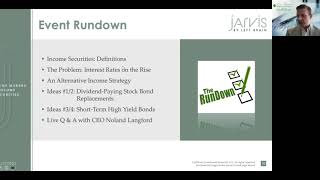
The recording captures a live Zoom presentation by Left Brain Investment Research on "income securities" – assets that generate most of their return through regular cash payouts. CEO Nolan Langford opens by describing the firm’s background, its Jarvis research platform, and the current macro environment of rising interest rates and high inflation that erodes traditional bond returns. The team defines key concepts (income securities, default risk, interest‑rate risk) and explains why high‑quality bonds have underperformed. They then outline an alternative income strategy that combines dividend‑paying stocks (Rio Tinto and Hercules Capital) with short‑term high‑yield bonds (Dish Network 2024 bond and Genesis Energy 2024 bond). For each idea they discuss business fundamentals, dividend yields, valuation, risks (commodity price swings, default risk, refinancing risk), and how the securities fit a cash‑replacement role. Throughout the session the presenters promote Left Brain’s Jarvis newsletter, subscription tiers, and portfolio‑review services, including a limited‑time $99/month promo code. Interactive polls gauge audience expectations for bond yields. The Q&A covers soda‑ash uses, the performance of Left Brain’s mutual fund LBCGX, and cash‑balance concerns. The event concludes with reminders to subscribe to the Jarvis Weekly and the Left Brain podcast.
Chapters
So thank you, everybody, for, for joining us today. We're, we're excited to have you. This is our— we've been doing this Fortune Maker series here, seems like a couple of years, and this is the first time that we're focusing on income securities. And here we're focused on income. So we do think we'll highlight a couple of securities that have both characteristics, both upside potential and income. But this is a little bit different for us. So again, thank you for taking your— thank you for taking time out on this Sunday to join us. And, uh, hopefully you've recovered from that thrilling game, uh, the Final Four game last night. That Duke-Carolina game came right down to it, and hopefully this allowed you time enough to, uh, to recover. So happy to have you on the call. Um, so thank you and, uh, and welcome. Uh, again, I am, uh, I'm Nolan Langford. Uh, I am a CEO here at Left Brain. Some of you could be familiar with some of the other ideas that we publish. Brian and I are actually— we do a weekly YouTube. Some of you guys have seen us on. Brian publishes the Jarvis Weekly. He'll talk about those in, uh, in just a second. But we spend a lot of our time looking for, uh, evaluating securities. Uh, most days every week we're looking for securities. This year it's been a little bit different, the market, the economic environment. And part of what we look for, we know what we look for when we're looking for stocks. That's not very difficult. A lot of our clients also need income for whatever reason. It could be portfolio stability. A lot of our clients, particularly ones that are retired, look for their portfolios to replace the income that they were earning when they were working. And so we have this other part of the portfolio that we do need to generate some income. And going back years and years and years, we've sort of developed, uh, a specialty in looking at, uh, corporate securities from an income lens. Typically these have been corporate high-yield bonds. These are corporations that issue bonds. Um, bonds have credit ratings. We'll see them a little bit later. Um, but generally we've focused on high-yield corporate bonds as a way to get attractive income. In the current environment that we're in, where interest rates are so low and we do have inflation that's running rampant— we'll hear about that in a second— and interest rates are finally starting to move up. It's been a couple of decades since we've seen a sustained rise in interest rates, but the time is upon us. And so it makes it a little bit challenging from an income perspective. Yes, we want income, but we also want appreciation, or at least we don't want depreciation in our fixed income or our bond side of the portfolio. Portfolio. So it's somewhat challenging in this environment, so we've had to widen our lens to other securities that we can replace the income with, but also we'll have an opportunity for not only stability but hopefully some appreciation. So we spent a lot of time looking for these, and we look forward to sharing those with you, uh, in the moments to come. So happy to hear your feedback and excited for your questions and answers at the end. Here's part of the Left Brain Investment team. Those of you who are clients, I'm sure you're familiar with, uh, with Freddie. Freddie's our first vice president of investments. He's been in the business for a couple of decades and does a wonderful job. He also is very helpful on the investment relations side of it. He had family obligations, so he's not able to join us today presently, but he's here in spirit. Uh, Brian Dress is our director of research. He does a lot of heavy lifting. We do a lot of publishing of materials, both YouTube uh, for visual, uh, but Brian also writes a, uh, a weekly for us where we take our, uh, our thoughts, our view of the market, the data that we're seeing, we sort of translate that and put it in our own words and share it with the investment community. So we're excited to have Brian. He's working the controls today, and you're going to hear from him in just a second. And then we do have investment analysts. We're showing Mandu here. For those of you who are subscribers for Left Brain Investment Research, you notice we publish roughly 8 to 10 research reports per month. Madhu writes a lot of them. Garvit, who's not with us, he also does a lot of our writing of research reports as well. So that's the Left Brain Investment research team. And finally, who is Left Brain? Well, we have a few different entities. Uh, Left Brain is based here in Naperville, which is where I am today— sunny 40-degree Naperville. This qualifies as a beautiful day in early April. We also have a second operation in Miami, which is where our executive assistant, China, is today. But we're founded back in 2014 as a registered investment advisory firm, and we're very proud to be independent, objective, and unbiased. And we're very proud to be joined today by some of our, some of our clients. And we also run a private fund with our research, Left Brain Capital Appreciation Fund. And so we try to find other ways to distribute our work and to gain new eyeballs on what we're doing and new investors. So for those of you who aren't familiar with us, welcome to the Left Brain environment, and we hope to be interacting with you a lot more in the future. All right, um, here, uh, what we're showing is our investment securities evaluation application that we use, uh, that we constantly develop and monitor. So Jarvis is the tool that we use to evaluate securities. We have a lot of data that goes into Jarvis. It's a platform that we use, um, that's cloud-based that the investment team uses, and it does a lot for us. There's a lot of data —on a lot of securities, you know, publicly traded security stocks. There's close to 10,000. We follow about 1,000, and there's many more bonds, but we follow about 500 to 600 at any one time here in Jarvis. And then on a weekly basis, it certainly allows us and helps us evaluating what's moving, what's not. A lot of those thoughts are distilled in the Left Brain Weekly that Brian writes. So it's definitely helpful for us, and a lot of these securities that we're going to be talking about today, all of the data for them is hosted in Jarvis. So with that, I'm going to welcome in our managing director, who most of you who are clients know, and that's Ann Marie. She's going to share a few words, and then we'll toss it over to Brian and get us started.
Okay, thank you, Nolan. I did want to mention that on June 25th— mark your calendar— Saturday, June 25th, Left Brain Wealth Management will be hosting our first in-person client event in nearly 3 years. So we are all looking forward to regrouping and seeing so many of you in person. Be on the lookout for your personal invitation to arrive in the mail in May. With more specific events, details about the June 25th event. So with that, I'm going to turn it over to Brian.
Thank you, Annemarie, and I want to thank everyone for joining us, both clients, future clients, and, and other guests. We're happy to have you and share with you our thoughts on income securities. Before we get into the meat of the presentation, I just want to Show you a couple of things about how you can get involved with Left Brain. First of all, as Nolan mentioned, we have the Jarvis newsletter that comes out every Saturday morning. So you want to get— go to our website leftbrainir.com, and on the top there's a banner where you can click right through and get signed up for that mailing list. So go ahead and do that. We have a subscription service. We have a basic subscription and a premium subscription. You can get on the website as well and there's— you can see the difference between the two. But we, as Nolan said, we put out about 8 to 10 full-length, usually stock reports every once in a while, a few bonds mixed in there. And then we put out the chosen list, which is our best stock and best bond idea each month. So, you know, definitely a lot of perks to being a member of the subscription service. And also finally, the newsletter, which we are going to start charging for at some point. In 2022, that's going to be part of the service if you are a basic or premium subscriber. So keep that in mind. And then finally, we have portfolio reviews. So if you're not a client, you know, if you have a portfolio you're looking for, either if you work for your own, you know, manage your own money or have someone manage it for you, we're here to give you a second opinion. So again, on leftbrainir.com, there's a place where you can sign up for that. And again, as I mentioned, with the basic subscription, we want to extend a quick offer to those of you who are in attendance today. And that is, it's usually $299 a month. We're going to put it out to you for $99 a month if you enter income99 at checkout to receive that promotional price. So if you're looking, if you've been looking at the Left Brain subscription service and price has been a barrier, we want to make it a little easier for you to pull the trigger there. So Take a look at that on the website. Again, here, the, the basic and premium subscription. This is just the site, the page on the site where you'll see, you know, the difference between the two subscriptions. The main difference being we put out model portfolios, a couple of stock portfolios and a bond portfolio every month for your premium subscriber. So we think that's a pretty high value asset. Again, just take a look at the website to learn more. And with that, we'll get into the rundown of what we're going to be talking about today. First, we're going to have Nolan talk a little bit about income securities, give you the definition of what that is exactly. Is— I know a lot of people think just bonds, but we've been looking for alternative ways to gain income given the situation out there, as Nolan said, with high inflation and interest rates that are starting to move higher. So that's what we're looking at today. I'll talk a little bit more about what the problem is with the interest rates being on the rise and the effect that has on bond prices. Then Nolan will tell you more about our alternative income strategy. He and I and Freddie and the rest of our investment team have been spending a lot of time the last few months looking for alternative ways to participate in income securities, given that, you know, a lot— not a lot of bonds look great at this time. And then we'll get into the meat of it with ideas 1 and 2. Nolan and I will each present one dividend-paying stock, which we think is kind of a bond replacement security. And then ideas 3 and 4 will be short-term high-yield bonds. And then finally, we'll follow that up with the live Q&A with Nolan and the rest of the team here. So if you have any questions on income securities or any other investments, you know, put them into the chat box. We'll hopefully have some time at the end. To address those. So with that, we'll kick it back over to Nolan, and he can give you some of the definitions here. Nolan. Thank you, Brian.
Uh, nice work and, uh, very helpful on the, uh, on the rundown portion of it. So, so thanks a lot. Well done. A couple of definitions before we get started and get into the weeds. What, uh, the first one is income securities. Most of the time when we think of income, uh, we may think of bonds. In this case, we're looking for really bond replacements. And just as a general term, we're thinking any securities or the securities that, that we're going to highlight that generate most of their return through their income that they pay you. A little bit different than, for example, growth stocks where you can get most of your return if we buy it at 50 and it goes to 100. In the case of income securities, you know, if we buy something at 50 and 3 years later it's still 50, but it's paid us on average 7 or 8% per year, then that's what we mean by income security. Default risk— this is interesting. This is almost an income security only term. You generally don't have this in the case of stocks, but default is some company makes a promise to pay and they don't pay, therefore they default. The most obvious case of that is in the case of a company filing for bankruptcy, and you see this generally when you look for bonds We do a lot of evaluation of high-yield bonds. They tend to have more debt, and so the chance of default is higher. So very interesting when a company defaults, what ends up happening. That's a discussion for another day, but that is the definition of default risk. And then the final one, the one that we're most often faced with, or at least the one we're faced with this year, is interest rate risk. And that is somebody, some company, some government has promised to pay me on my bond 4%. They make that payment to me as promised and on schedule. How can I lose money? Well, in the case that new bonds that are issued pay 6% and I'm stuck in one that pays 4%, that's sort of the classic definition of interest rate risk, and that's generally what's been moving things this year. So here's a visual to illustrate the point. So here's a seesaw, and you can see the direction. They're the opposite. So interest rate rises and bond prices fall. Brian's going to give us some examples and some numerical data of what bonds have been doing this year, but it basically all goes back to this graphic. The Federal Reserve Board has raised rates. Believe it or not, they've only raised them one time so far this year, at their last meeting, March 14th. By the bond market, you wouldn't know it's only been one, but they promised a series of upcoming rates. And the market doesn't wait for the rates to actually happen, at least on the long end. The market adjusts as soon as it anticipates they're going to happen. And that's why you've seen the action that we've seen in bond prices. And then finally, here's a chart that we look at. All bonds come with a rating. To them, and it's just like high school, um, the highest class being AAA, uh, and then the lowest rating being single C, which means you're on the doorstep of default. And what we put is a bright line or somewhat bright line right in the middle, and that denotes high yield— well, investment grade and below investment grade, um, is the line. So very interesting. Now that interest rates are up this year, which category has been most impacted? All bonds have been impacted, but the safe bonds, the ones that are above the line, those have been impacted more than those below the line. And so very interesting there. Generally, we follow high-yield bonds, which are below the line. And they have performed somewhat better, so you'll still get opportunities there. Those move by credit risk and not so much interest rate risk. All right, so with that as a preamble, I'm going to turn it back over to— I'm going to turn it back over to Brian, and he's going to sort of discuss where we are with interest rates in this environment. Thank you, Doland.
So, you know, a lot of people have traditionally looked at a number of these securities that are on the screen right here. As you can see, CDs, U.S. Treasuries, high-quality corporate bonds and municipal bonds. And we've been watching them and we just did our quarter-end review for the Jarvis newsletter. So, you know, if you want to check out, I put some of the statistics in there, but U.S. Treasuries fell something around 10% in the first quarter. And municipals, and these are bonds that everyone considers pretty safe. Municipals dropped about 6 or 7%. So that's kind of the illustration of the problem is, you know, we intend to, you know, buy a quote-unquote safe investment. But, you know, in the current situation, as rates rise, we're seeing that, you know, it's not safe in every situation. And so that's the problem with folks who are looking for income securities that are going to hold up in value. We're not seeing that. Here's just a quick look at Treasury rates over a 1-year period. And as you can see, you know, they were quite low for a long time. We were really below 2% up until maybe 6 or 8 weeks ago. And as, as you know, with the Federal Reserve starting to make a move to raise rates, the market has reacted and the market's done a lot of the work for the Fed and starting to tighten credit conditions and interest rate conditions. So as you can see, we went from 1.7 in the US 10-year at the beginning of the month. It got almost, almost a 2.5 this week and pulled back down to the mid-2.3s. But that's a pretty fast move and that's making bonds fall in price. Just to give you some context, this is the Treasury curve since 1980. And we're starting to see a bit of a blip higher. But what we're trying to illustrate here is there's actually a long way for these rates to go. I'm not going to call it— we're not going back to 1981 and 18% mortgage rates. But just to give you some context, there's definitely some way for this to go higher. And if you're holding bonds, it's definitely a risk. Let's break it down a little bit more for you here. These are corporate bonds. AAA. This is the lowest investment-grade bond out there. And the chart looks very similar. You know, rates have moved downward over time. And again, just trying to illustrate for you, you know, corporate bonds are trading in the 3% range right now, 3, 3.5. They've got a long way to go higher. So if you're holding investment-grade, you know, quote unquote, safe corporate bonds, again, that interest rate risk is really the biggest risk that we're facing right now. And then I wanted to break down just a few individual bond positions and how they've done. And so here we have TLT, which is kind of a proxy for the US long Treasury bond. So something like a 20-year bond that in price has dropped almost 9% since December 1st. So again, Treasuries have not been a safe place to hide. We're looking at AGG. AGG is just an investment-grade corporate bond ETF. So a proxy for corporate bonds, high-quality corporate bonds. That again was down 5.5%. So again, high-quality bonds have, have really taken a dive early in the year here. HYG is municipals. Again, there are a lot of reasons why people might like municipals. They have certain tax advantages. And generally quite safe in terms of repayment. But again, we see a large drop in price. Nothing may have changed in terms of the creditworthiness, but again, as interest rates go higher, the price of these bonds certainly does fall. HYG is high yield bonds. It hasn't fallen quite as much because these have, you know, two real drivers of their price. The first, again, is interest rate risk, and then the second is credit risk. The credit risk piece has performed pretty well. So that's why this has done better than the high-quality bonds, but there's definitely an interest rate risk piece as well. So something to keep in mind. And then the other context, and I think we're all pretty aware of what's going on in terms of inflation, but in terms of the actual, you know, government data says that we have 7.9% annual inflation and we'll look at risk— I'm sorry, real return. Of any asset is the nominal return, the actual return that you receive, but you have to subtract inflation to, you know, get a sense of what your purchasing power is up or down based on how high inflation is. And this next slide, this is Treasury yields, real Treasury yields over the last 5 years. As you can see, if you're holding Treasuries and you subtract inflation away from that, you're actually getting a negative yield in real terms. And at the end of the day, what we spend is our real, real return, just because inflation has a— has an impact on the price of everything that we buy. So that's definitely something that we have to understand and keep in mind if we're investing in income securities. And I'll kick it over to Nolan. He's going to talk about, you know, kind of we're developing an alternative strategy here to cope with the— with the issues that I just laid out over the last few slides. So I'll kick it over to Nolan and he can tell you about the type of securities we're looking for as an alternative.
Thank you, Brian. Nicely done. I think you did a really good job of sort of setting the stage for the challenges we all face. I think everybody on this, on the Zoom today has an understanding that the markets are off to sort of a really rough start so far this year. And there really hasn't been a place to hide. You know, bonds have not worked. Stocks have been rocky, to say the least. We think there is optimism, but we certainly have challenges as well. Inflation is the real big driver of really everything. Brian mentioned the 7.9% CPI print. That's a really big hurdle. So, if you think of an investor and you have cash, you're like, "Oh, well, the market's down. I feel good about this money at the bank." Well, the money hit the bank is depreciating like an ice cube at about 7.9% per year. And so we need to earn at least that amount to even keep up. And so it gets challenging. The question becomes, interest rates are rising, what should interest rates be? I think that's sort of the ground that's shifting beneath our feet because it changes with the, uh, the new incoming data, uh, as it shows up. Typically when interest rates start to rise, they rise about 3% from where they were. In an interest rate cycle, and then they sort of stop. I think what's kind of, um, has everybody on edge this year is they're rising from such a low rate. You know, they were already low, and then we had COVID a couple of years ago, and then the Fed, um, really stepped in with their emergency powers and, um, and took interest rates to zero to really get the economy going and off the mat. And it worked. They spurred inflation just like they wanted to. The problem is now we know that the economy is firing really on all cylinders. And so we know that they're not only going to take away the accommodation that they gave us a couple of years ago, um, but they also need to move rates up even more to counteract inflation and get it back from 7.9% to somewhere around 2%, which is where they're comfortable with. And what everybody's trying to figure out, well, what is that number? How much— how high will rates need to go to really bring inflation back down? So That's what we're all grappling with at this point. And the other thing that's really important to remember is all assets are based off of interest rates. Your house is impacted by interest rates, stock values, loan values, your credit card rate that you pay. Everything's based off of interest rates in this country. So it is a really big deal, and it's sort of challenging. We think we have some attractive securities today. to present in ways to do well, but we wanted to definitely highlight and let you know the challenges we face. Historically, um, we have looked at high-yield bonds. So when we buy a bond, which is a loan, generally we're looking at corporate bonds, which is a loan to some corporation. We get to determine how long we want the loan out to be outstanding. We're going to do a 1-year loan or a 2-year loan, a 5-year, 7-year, 10-year, 20-year, in some cases even longer. Depending on how comfortable we are with whatever company's promising to repay us. And then the terms of the bond, how much they're actually paying us in rates, and then how much we can, we can, we can buy, we can lock it in for, and how much they're going to give us in terms of a yield from the coupon that they're giving us. Today we're going to look at two ideas. Our idea today in this environment is if we can get corporate bonds that mature and repay us within 2 years, We think the interest rate raising cycle will be over in about 2 years. And if rates have gone up at the end of 2 years, then at that point, we'll have all our money come back to us. And then we can go out and find new bonds that will have reset to much higher interest rates that will exist if rates keep going up. So that's the one thing. And then the other category that we're looking at is what we call bond-like stocks. Generally, stock returns are a combination of two things. One is the appreciation. Hey, I bought it at $20, it went up to $25 or $30. And then the other part of that is excess cash that companies have. A lot of them, not all of them, but a lot of them do give it back, the excess capital or cash, back to shareholders in the form of a dividend. And that's where we've gotten some of our return over the course of time. So in this case, we're looking at Securities are a little bit different where the majority of the return that we're going to get comes from the dividend and it'll be less from appreciation. So again, what Brian has here on the slide, dividend-paying stocks, historically, you know, a lot of investors have purchased these because they provide both income that investors can spend now and then appreciation for later. We also have been evaluating dividend-paying stocks, but we're not only just looking at the amount that they're paying us, What we really love is the increase— companies who have the pricing power and business models that are sustainable enough where they not only can start giving us dividends, but they can continue them and then hopefully increase them to us annually. There are risks with all strategies, and with these two types of securities we're going to be talking about today, the big risk is default risk. Okay, if we loan some corporation money in terms of a bond, and they in turn aren't able to honor those terms and repay us, then we're stuck with default risk. That is a risk. Uh, the other risk that we have is we're going to be talking about bonds today. I think 5 to 7% is the, is the number. But if rates rise much more quickly than what the Fed has, um, telegraphed, then that could become an issue. If we lock in rates at these numbers and in 6 or 9 months they jump a lot, then we could be stuck in that bond for another 12 to 18 months. Earning less than we could have if we didn't enter the bond. And then the other thing, remember, anytime you're dealing with stocks or anything that trades in the market, we do have the risk that they could fall in price. And with that, I'm going to turn it back over to Brian, and he's going to tee up our first poll question of the day.
Thanks, Nolan. So I'm going to launch this poll here. We're asking, what do you think is an acceptable income rate for a bond? So go ahead and lock in your answers and we'll end the poll in about a minute here and see, see what it looks like. Looks like nobody wants to get 0.11% on their money. So that's a good, that's a good signal.
I think Freddie put that one in there. Is that like money market rates? I believe. I think you're right. Yes. Yeah.
All right. I think everyone's had a chance to lock in if they are going to. So we'll go ahead and end that poll and we'll share the results with you here. Seems that most of you have chosen 4.39. You know, we agree. I think that's what we're looking to do in terms of, in terms of an income security. The problem is how do we find that? And the reality is that most most bonds are paying still in the 2s and 3s and it's difficult to keep up with inflation. So I think the answer, none of these, is probably looking for a little bit more. And that's what we're looking for too with these, with these ideas that we're going to share with you here. So I'll, I'll go ahead and get started with idea 1. So idea 1, this is a company we've been following for a number of months here. It's called Rio Tinto Group. This is a mining operation. They're involved with copper mining, aluminum, iron ore, and a number of other base metals and other small specialty metals. But, you know, there are a lot of headwinds for a business like this as the economy starts growing. You know, it's an economically sensitive area and companies tend to be investing more, building factories, building products. And Rio produces the type of raw materials that are needed to do those things. That's why we like Rio. And I wanted to just point out to you here, the dividend yield on Rio is around 10%. That's really what— not only do we like the business, but that yield is really attractive in the situation now that we face. Here's just a chart of Rio over the last 5 years. As you can see, it's up around 212% over 5 years. That's cumulative total return. And I put down here a little schematic that breaks it down between price change return and total return. This is, we're trying to illustrate for you kind of the way that dividend stocks work in a portfolio. The stock's up around 100% in 5 years, so it's doubled, but you've more than tripled your money. And that's because this company pays a large dividend. It has a strong history of raising dividends. Not lowering dividends. And so holding the stock, you're gaining a lot, a lot of the return just from the dividend side of things. As I said here before, it is the second largest iron miner in the world, produces a lot of other minerals that are used in construction and other applications. Commodity prices have really risen over— since 2021 started. Really coming out of the pandemic and we had such a shutdown of the economy on so many different levels. This company doubled its dividend in 2021 and it's paying out around 80% of its profits or free cash flow rather in dividends. So it has a little bit of room there. They're not, they're not putting out everything they make out to a dividend. So they have a little bit of levers to pull in terms of the business if things get a little bit slower. Um, but even if the dividend were to return down to 2020 levels here, uh, you'd still be able to yield 6% off this stock. So we think there's a lot of cushion for holders here. Again, inflation is a big component of what's going on in the markets these days, and that's actually a boon for a company like Rio Tinto because their fortunes and their free cash flow is directly proportional to the price of copper, aluminum, and iron and all these other materials. And those are all soaring in the last few years. We also have— and this is something we don't hear a lot about in financial media, but we passed this huge infrastructure bill here in the US. And we know that the reality is that a lot of these materials are going to be used in terms of building bridges, roads, tunnels, and all the rest of it. Again, like we said, Rio has a good history of raising dividends and paying out most of their profits in dividend. They've got more cash on hand than they have long-term debt. So there really is no debt to speak of on a net basis. And this company yielded 30% of their revenues went to the line of free cash flow. So that's $19 billion they generated in 2021, and it's going to be a higher number in '22, more than likely. As always, there's risks in all these, these ideas. Um, and this is a company that we've written up, so if you're someone who subscribes to the service, you can go and read Matthew's work on Rio Tinto. Uh, really good report, really illuminating. Um, but of course, for a company like this, if commodities prices fall, that's the biggest risk for a company like this. So anytime you know, say copper or iron prices are going to fall, their profits will certainly fall in accordance. Also, there are a number of mining projects. These companies are— companies like Rio are always trying to find new mines. These assets deplete quickly. So there's a risk that any of the new projects won't yield what they thought. And then finally, as we say it here, and this is really the most germane to you if you're looking at this as an income security, There are issues with sustainability of this dividend if things are to fall apart from the commodity price point of view. So that's Rio Tinto. We really like this business. We think it's pretty fairly valued. I think it's got maybe a 6 price-to-earnings ratio, so quite low. And especially with that 10% dividend, we think it's a really attractive opportunity. With that, I'm going to move it over to Nolan. We've got another dividend stock here that he's going to tell you about. So, Nolan.
Thank you, Brian. Uh, and then before we leave Rio— so first off, a wonderful job summarizing Rio and what we like about it. And, um, we should just tell the listeners, Left Brain runs, uh, separately managed accounts for high net worth investors. We run a mutual fund, and then we run a private limited partnership. Uh, and, uh, we do have positions in, in Rio in that. Actually, all of these ideas we have positions in, so we just want to make that known. The other thing I'll mention just about Rio, you know, it's interesting. We look at a lot of businesses, and as those of you who followed the weekly know, pretty much the last, I don't know, 12 weeks, all we've been talking about is energy companies and how much we like them. But it's not just energy companies. There's this whole other group of companies related to energy. I'll throw Rio in that category. And it surprised us when we went back and looked at valuations, is that one of the qualities that we look for in companies before we take a position is acceleration. Hey, they were growing at X number, 5%, 6%, 7%, and for whatever reason, now they're growing above that number. That's something that really attracts us. So Rio was one of those companies where it's always done pretty well, but now in this environment, for some of the reasons that Brian mentioned, it's actually doing better. And one of the things that surprised us is the valuation. It's not more expensive today than it was 10 years ago. It's actually a little bit cheaper, even though the business is better. And that really, really surprised us, but also made it very attractive. If you go back 10 years, Brian showed that chart and interest rates basically have been going down for about at least 20 years, but it's really been 40 years. And so most of us have been investors in a low interest rate environment or interest rate environment that has been going lower. That's been boosting all sorts of asset prices over time. So what you've seen is valuations have gone up, you know, where maybe we were paying 15 times earnings before, and now we're paying 20 or 25 times for the same business. That's not the case in the commodity sector, not with Rio and not with the energy companies. And that's why we keep talking about them. So I just wanted to point that out here. The idea too, we have a different type of business. This is a financial company. The name of the company is called Hercules Capital. They've been around for a couple of decades and they are a lending company. So think, think of them almost as a non-bank lender. And what they do is they specialize in just one sector. And then the sector is technology, primarily life sciences, more specifically biotech. And so if you're a biotechnology company, uh, it's really hard to borrow money. Generally, these companies are going to be on the really the cutting edge of drug discovery. And what they do is it's widely important for humanity, but it's also very, very risky. Um, you know, their probabilities of success are very, very low. And because of that, you know, them raising capital is, uh, is really difficult. The business models tend to be they go out, they raise capital, uh, they try to do drug discovery, uh, and as they go along in the life cycle and go through the FDA, uh, trials, eventually where they're trying to go is to make, uh, to make it public, uh, and then the issue of stock, get an influx of cash, and then at some point generally they're going to be bought out by some bigger pharma company or a bigger bio biotech company. But throughout their life cycle, they do need to borrow money, and Hercules Capital is the go-to for these life sciences and technology companies, uh, particularly before they go public. Most of the companies are sponsored by some venture capital firm, but Hercules loans money. And what they do is, in addition to getting, uh, pay in terms of interest rate payments, Sometimes they take warrants on the business as well, so they get upside if the business does well. So the company's been doing it for a couple of decades. The default rate on their loans are unbelievably low, and the return to the shareholders is just in return, uh, in regards to the dividend. It's set up and organized as a business development company, and by definition they have to pay out about 90% of their net income. In the terms of dividends to shareholders, and that's why the dividend has been high. We like this business, and we, and we like it a lot. Obviously COVID has given them somewhat of a boost, but with growth stocks falling here lately, this has actually been a boom for Hercules Capital. When the stock market is booming, they still get deals done But a company has a couple of alternatives. They don't have to borrow money from a lender. They can actually just go public and just get growth capital. But when the markets get a little skittish, they actually have to put IPO plans on hold. So for example, this year the market's off to a sort of a rough start. The IPO market has really stalled. We haven't heard about a lot of big IPOs, and the ones that were teed up, these unicorns, have really been pushed off. And it's the same, same way in the biotech area. This is really a tailwind for Hercules Capital, because all those companies now that are waiting to go public, what they do is they have to borrow money for longer periods. And so that's really good. It helps Hercules buying power. So historically, over time, they've had about a 14% annualized growth on their returns. And the dividend has always been high. What we like about Hercules is, you know, they went through a period from 2014 to 2018, so about a 5-year period where the dividend was steady at about $1.24 a share after having risen from about $95 a share in 2012. But starting in 2019, the dividend was on the rise again. It rose in 2019 2020, 2021, and now the yield is over 10% with the special dividend that they pay to shareholders. So they just produced a wonderful quarter. Their business trends are accelerating, and this company is set to benefit, um, from a stall in the economy. Of course, with any company, there are also risks. One of the risks here is Hercules. So they specialize in the life science and technology industry. There are other lenders So, they do have to compete for deals. The other thing is they do borrow money and relend it, so they are leveraged financial institutions, sort of like banks do, but anytime you have leverage, there's risk. And then again, they concentrate their money in two sectors, tech or life sciences, so we do have risk there. And a lot of their companies are pre-IPO companies, So sometimes it's more difficult to value private shares instead of publicly traded shares. Coincidentally, if you're interested in Hercules, this— we're talking about the publicly traded stock that trades, but they also have a series of publicly traded bonds that trade. One of the ones, uh, they, they were one of the first companies that issued what we call baby bonds, and they trade like a stock, but you can actually buy them for $25 a share. So if that's something you have an interest in, let me know, would be happy to share the ticker with you. All right. So thanks a lot for that. We're going to turn it back over to Brian with our next poll question.
Thank you, Nolan. Great job putting HTGC out there. Another interesting opportunity. We're going to launch this poll just asking everybody kind of how did you find us? There are a number of options. You know, non-clients may have found us through Eventbrite or LinkedIn. Or Stinky Alpha. And then we also have Twitter. And then of course, I think a number of these are folks are our Left Brain clients. We're happy to see you all again. And yeah, this just helps us kind of determine our best way to market these events in the future. All right. I think everyone's had a chance to weigh in on this one and looks like, you know, 2 or 3 from LinkedIn and Eventbrite. And, you know, mostly clients and a couple of referrals. So we appreciate anyone who's referred anyone over to see us today. With that, we'll move on to the third option, the third idea. And I will speak a few minutes on Dish Network. So Dish Network, I think we're all familiar with Dish Network on this in terms of their pay-TV service. And that's been around for a while, but they're all start— also starting to get into 5G, spending a lot of money and taking on a lot of debt to build out their 5G network. And they're going to become one of the big players there in 5G, already have done. This company has a 5.875% bond in 2024. This is kind of along the lines of what Nolan mentioned is we like bonds like this at this time, buying a 2024 bond And then when it matures, we'll receive, of course, the coupon or interest payments, but then we receive our principal back at that date. So hopefully in November 2024, interest rates will be higher and it'll be a more favorable environment for people to take on new bond positions. This is just to take a look of how this bond has traded over the last year. As you can see, it's a pretty stable bond. Again, as rates have, have risen, The bond has fallen a bit, but it's right at par. So par meaning 100. Most bonds are priced at par, 100. And when you get to the end of the term of the bond, you're paid back again your interest payments and then 100 cents on the dollar of your principal. And so basically what you're doing is buying the interest payments at this point, if you buy it at 100, $100, basically. Again, pay TV is a big part of this business. They got the Dish Network and they've got the Sling TV, uh, kind of a new streamer that's out there. That's three-quarters of the business. But again, wireless is becoming a bigger segment of the business. That's why they've got so many bonds outstanding, because it is very expensive to build out this 5G spectrum. You gotta buy a license from the government, and then you gotta do a lot of actual construction of of assets. In a situation like this where, you know, of course we want to know how's the business doing, I wouldn't tell you to go out and buy DISH stock. I don't expect it to do well necessarily over the next couple of years as well as many of the other stocks that we might follow. But what we're, what we're more concerned about is how do the books look, how does the balance sheet look. And things look pretty solid for DISH. As I said here, Interest coverage is a measure of how much EBITDA or earnings power you have relative to how much debt interest you have to pay. And so they have more than 200 times coverage, which is a really high number. So they've got the wherewithal to pay, to service their debts. Free cash flow has been in excess of $2 billion the last 2 years. And this is another point that we really focus on, capital market access. So A company has to go and refinance its debts when its bonds mature, come due. They've been able to do that over the last few years. In 2021, they refinanced like $7 billion of their debt at the rate of under 6%. So they're able to access lenders at favorable terms, which makes us think the market out there is likely to refinance debt positions going forward. And so we expect that in this case, in November '24, when it's time to refinance these bonds, they'll have access to the capital markets. That's really the most important point on a business like this that carries a lot of debt. And finally, they have enough cash on the balance sheet to cover it. They have a number of bonds between now and 2024 when this particular bond matures. They got enough cash to cover all of that. So there's two ways that they can pay off these bonds, and that makes us feel more secure. And then, of course, as we've said on all these, on all of these ideas, there's always risks. The number one risk we're looking for is a loss of access to the capital markets. Again, we feel pretty comfortable that they're going to have access for refinancing, but that is the number one risk that we'll be paying attention to. Customer churn is an issue for a company like Dish that's kind of in the legacy business of satellite television. So we'll be watching that. That in the short term, I think that won't make a huge difference. They may have long-term issues, but that won't matter to you if you're holding 2024 bonds. And then again, they hold a huge outstanding debt. So that's something you have to pay attention to when you watch a bond position like this. So that's DISH. Again, we don't love the stock by any means, but we think 2024 bonds are a good place to park money. And then hopefully be able to put that money to work at a higher interest rate when we kind of get to the end of the Fed tightening cycle. So that's DISH, and I'll put it over to Nolan, and he'll give you the fourth idea, fourth and final idea for this, for this event.
Thank you, Brian. Nicely done. Nice work on DISH. They are spending a lot of money to build that network, but it'll be good. I think it'll be good for consumers once they get it once they get it built. I don't know what it'll mean for investors, but for consumers, I think it'll be good. So our next idea is an energy company bond, Genesis Energy. It's a company that we followed for quite a long time. We followed the stock, we follow the bonds. Genesis has several different issues of bonds. This, similar to Dish Network, it's a 5 5/8 bond. It matures in roughly 2 years, almost exactly 2 years. We think these ideas are really good cash replacements, meaning that a client has some cash, some money to put to work. And if the investment situation doesn't call for stock, but you can't just sit in cash, we think both of these ideas are good enough. We have a very, very high degree of confidence of getting your money back. But it's going to be a very long time before cash rates and money markets get anywhere approaching even 3%, and it doesn't look like they're certainly not going to do it over the next 2 years. So Genesis Energy is a company that we follow. They have really— they have 2 businesses that they operate in the energy business. One of them is they have the largest soda ash trona mine in the US, and they're the low-cost producer actually in the world. And so that's the first business. The ex— the next business that they have is in— they operate in the Gulf of Mexico, the largest pipeline in the Gulf of Mexico, um, and that's for traditional oil wells. And so generally people think of, uh, the U.S. pumping a lot of oil. We pump about 10 or 11 million barrels a day. Most of that comes from the Permian and Shell drilling. Uh, but we do conventional drilling here as well, and our lowest cost conventional drilling here in the U.S. is the Gulf of Mexico. But if you're drilling in the Gulf of Mexico, you still have to get that oil that you pump back to the U.S. mainland, and you do that through this pipeline that Genesis Energy runs. So those are the two main, uh, two main businesses. Um, we like that for, you know, Brian mentioned earlier infrastructure. Uh, so Genesis does get a play on infrastructure, but the other thing is just for oil, it's just sort of a supply and demand issue. And even when oil prices were really, really low, um, they still generated free cash flow, uh, from the pipeline out in the Gulf of Mexico. It's just not financially feasible for somebody to come and build a competing pipeline. So they get these long-term contracts, uh, and then they just get paid based off of the volumes that go through. With soda ash, it's very interesting. Most soda ash comes into the— if you're using it, they have the largest natural soda ash mine, but China is a high-cost producer and they produce artificial soda ash. So they have a competitive position here that we really, really like. We also like the fact that financially they are getting stronger. They paid down about $400 million of debt. Last year, and then they had some divestitures to pay off more debt. And what we really like is both end businesses are getting stronger. So we like that the business is improving. We like the end markets that they're in. And this is a business that we think is going to do well. You can actually make an argument for the stock, but in this case, we really like the secured area of the bond. On the first slide, I know Brian had a price of the bond. It's just below par, which is 100 cents on the dollar. So, we're not buying this for a lot of appreciation. You can buy it just below the maturity value. These will mature at 100 cents on the dollar. We can buy it at 99.77 cents on the dollar last week. And that would give you a yield to maturity of about 5.7%. Of course, Genesis Energy, like any other security that we're evaluating, does have risk. The big risk here is commodity prices. You know, oil prices do fluctuate. If they fluctuate down severely, then volumes could be impacted, which could impact their revenue and earnings. And then the same thing with soda ash. It is a commodity, and so Genesis has some sort of economic sensitivity to it. If we run into a worldwide recession where economic activity decreases a lot, then that could impact its financial well-being. Uh, the other thing is Genesis does have debt, and so anytime you have a company that has debt and leverage, if things go wrong, um, and they have trouble servicing their debt, that's also an issue. So, uh, that's it for Genesis Energy. Uh, at this point, I'm going to turn it back to Brian for the wrap-up, and I'll remind you, for all those that have questions and questions and answers. We've allocated a lot of time for Q&A. Queue up your questions in the chat box and we'll plug right through.
Thanks, Nolan. So before we get to that wrap-up and everything else in the Q&A, I just wanted to ask one more question, and that's how is your cash balance done over the last year? We kind of want to just get a sense, you know, our, um, you know, money you're holding in cash, has it gone up, gone slightly down, stayed the same? Or is it too frustrating to even consider? Looks like too frustrating is the winner, as well as gone slightly up. But I think it's kind of— it makes sense. It's really, you know, cash balances haven't done much really for the last 10 years. And as we saw in that previous poll, it's about, you know, 0.1% you're getting on your money. Just frustrating. We got to look for alternative ways to manage our cash. And these are, you know, 4 ideas that we think fit the bill. With that, I just want to wrap things up. Again, we've got the Jarvis newsletter. Head over to leftbrainir.com. Make sure you get on the newsletter list to receive that every week. We talk about, you know, 2 or 3 topics each week that we think are the most pertinent for the investing week and cover those. As well, YouTube, we have that weekly update. We encourage you, everyone, to go over there, check that out. Really help if you could like, share, and subscribe the videos. It helps other people find it and drop a comment on there. If you have a question that comes up after watching the video, my— I will personally go in there and answer the question, continue the conversation. And then again, like we said, we've got the basic subscription and the premium subscription. So if you have interest in those, head over to the website. And again, remember we have the coupon code INCOME99. If you wanna pull the trigger this week, you can get it for $99 a month on the basic. We also have a podcast. We've been doing this for a little while. We're gonna change up the format. You know, if you, if you don't like to watch YouTube, we're putting the YouTubes on there in an audio format as well. So you can check that out there. And next week I've actually booked our first guest. For the podcast. So we're going to start having guests on there. I don't know if it's going to be maybe twice a month or once a month, but we'll do some experimentation. But we'd love you to check that out. And it's on iTunes. Just, just search for Left Brain Thinking. You can easily find it. And finally, just the wrap up. You know, we talked about interest rates are rising. That means bond prices are falling. We're looking for alternative income strategies in that rising rate world. Short-term high-yield bonds and dividend stocks are where we're looking. Remember, Rio and HTGC were the stocks that we recommended, and then DISH and GEL bonds for 2024 are the two bonds we're looking at. And if you want to learn more about our investment philosophy, whether you already work with us or not, leftbrainir.com is the first place to check. And if you want that portfolio review, go ahead and click on the button again on Left Brain IR. Pretty easy to set that up. Um, with that, I think we'll go on to the Q&A, and I'm going to go into the chat box. I'll start asking some of the questions, so throw that out there. Um, so, uh, the first question we get is, uh, what is soda ash used for, Nolan?
Yeah, so that's a really good question. I guess I should explain that when I was talking about Genesis Energy. Soda ash is a sodium carbonate The two, uh, which is an input or chemical, and the big ones that it's used for is, uh, glassmaking and electrolysis is what soda ash is used for.
Okay, and then we got a couple of questions here about LBCGX. For those of you who aren't aware, that's our mutual fund that we manage in-house, the Left Brain Compound Growth Fund. Um, so a couple of questions there, Nolan. First one is, since the mutual fund's down around 17%, how will these strategies impact the fund? And then more of a generic question, can you take a moment to comment about that current holding, LBCGX? Doesn't seem to be going anywhere so far in 2022.
Yep, so thanks for the question. So those of you who aren't aware, Left Brain launched with its strategy a mutual fund, LBCGX, about 10 months or so ago. We got off to a really good start. The NAV started at $25 a share, and we hit our high-water mark, I believe it was October, I believe at about $29 a share. So off to a really good start. And then starting in November, we started to actually not do so well. What impacted the LBCGX fund and the reason that's sort of in a downtrend, the strategy of the fund is we're looking for stocks with substantial upside. These are typically characterized by growth stocks, stocks we think can double over the course of 2 to 3 years. It's about 80%. The other 20% that we own opportunistically is high-yield bonds. And if you go back and take a look at a chart, growth stocks have really been, uh, negatively impacted the last 3 to 4 months. Some of it has to do with the interest rate rising in growth stocks stocks because of their cash flows generally don't happen today, they happen in the future. You have to discount those by interest rates. So that's a part of it. And then some stocks benefited greatly during the pandemic. Now that the pandemic is over, the business models have been somewhat more challenged. And, um, so a couple of growth stocks that have worked in the prior years have come out with earnings and, uh, have been reset somewhat lower. So we are working hard to get LBCGX back into the green. We have made some changes. As far as the number of holdings, or the numbers that are the holdings that we discussed here, which ones are in the fund, uh, one of them is Rio is in the fund, um, in the LBCGX fund, um, which is the first stock that we, uh, that we highlighted. The rest of the stocks that we own are generally, uh, going to be growth stocks, although we do have a good weighting in energy. Because we do think the energy markets are poised to continue to accelerate not only this year but in the years to come.
Thank you, Nolan, for that answer. I hope that answers the question, um, in terms of LBCGX. And then also, uh, we don't have any other questions in queue, but you know, we have the investment team on the line. Love to leave it open for you to ask any other questions that you have before we bid you all adieu. Thank you for the information. We appreciate that very much. We appreciate all, all of you taking the time out on a Sunday to speak with us and take a look at some of our ideas that we have for alternative income investments. And I hope this has been helpful for you and we hope to see you on the next event and then any other— any of the other content that we put out. Nolan, any last words on your side?
Yeah, I'd also like to echo your sentiments. You know, I know you guys could be anywhere doing anything on a Sunday afternoon, so thanks a lot for sharing the time with us. We welcome your comments and feedback. You guys know how to reach us, and we look forward to, um, hearing and talking to you soon. Also, if you guys are not on the list to get the Jarvis Weekly, we spend an inordinate amount of time sharing our thoughts with you in a very easy— what we think is an easy to digest format. So definitely get on the list and make sure that you're getting the— make sure you get in the Jarvis Weekly.
Thanks everyone.
Thank you. We'll talk to you soon.
More from Brian

3 Tax Buckets Every Wealthy Investor Should Know #retirementplanning #TaxPlanning #wealthmanagement






