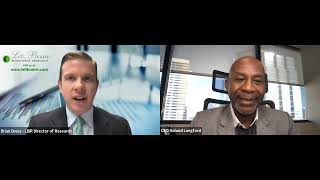
In this Fundamentals of Investing video, Brian Dress, CFA, Director of Research at Left Brain, interviews CEO and CIO Nolan Langford to compare individual bonds with bond funds. They explain that individual bonds are direct loans to governments, municipalities, or corporations with fixed coupons and set maturities, while bond funds are managed portfolios that continuously buy and sell many bonds, providing variable income. The hosts argue that rising interest rates after a decade of near‑zero rates create a unique opportunity to lock in higher yields through individual bonds, especially via strategies like bond ladders. They highlight tax advantages of buying discount bonds, where the price appreciation is taxed as long‑term capital gains rather than ordinary income. In contrast, bond funds lack a fixed maturity, can lose value when rates rise, and offer less predictable income. Throughout, they encourage viewers to contact Left Brain for a portfolio review and to consider an enhanced bond portfolio strategy that leverages individual bonds for fixed, tax‑efficient income and volatility reduction in a portfolio.
Chapters
Hello and welcome again to our Fundamentals of Investing series. These videos are designed to explain important concepts you need to know as you work to grow your retirement nest egg and build your personal wealth. I'm Brian Dress, Director of Research here at Left Brain, joined by our CEO and Chief Investment Officer, Nolan Langford. Nolan, thanks for joining us.
Glad to be here.
All right, Nolan. While interest rates sat at basement levels over the last decade after the financial crisis, with central banks fiercely committed to maintaining economic growth, through loose monetary policy. As a result, finding bonds that yielded anything interesting was a fool's errand over the last 15 years. However, with rates finally starting to rise, we are seeing opportunities developing in the bond market that we haven't seen since the Bush administration. With that said, we feel most investors should be looking to take advantage. Now, there are two ways to own bonds. There are bond funds and there are individual bonds. Right here today in this video, we want to discuss the differences between the two, the pros and cons, and which way we think is the best in order to get exposure to some fixed-rate securities. So first question for you, Nolan, can you explain the difference between individual bonds and bond funds?
Sure. So an individual bond— bond is synonymous with loan. So when a bond is issued, you as the investor is actually loaning money to someone. If I loan money to the government, the US government, that's called a Treasury note, either a bill or Treasury bond. If I loan money to my local city or my state, that's called a municipal bond. Now, if I loan money to a corporation, it's called a corporate bond. Bonds work very similar to the way a CD works. There is a start date and then there is an end date, and in the meantime, I get my promised interest rate. So as an example, bonds are issued typically in $1,000 lots. So if I buy a corporate bond from ABC Corporation and it's promising me 5%, coupon is 5%, it's issued at $1,000, it's going to mature at $1,000. Let's assume it's a 5-year bond and at 5% I'm going to get $50 per year in interest payments. And so it's very simple. I loan the company money, $1,000. They're going to pay me back my $1,000 in 5 years. And in the meantime, they're going to send me $50 per year. Very straightforward, fixed transaction. That is a bond. A bond fund is very different. A bond fund is a portfolio of bonds. Bond funds generally own hundreds of bonds, not just one. Bond fund has a manager that constantly buys and sells bonds. And I'm generally going to get a dividend from that bond once a quarter or once a month, depending on the terms of it. But it's a portfolio of bonds managed by a manager that distributes the income from the portfolio of bonds.
Thanks for that, Nolan. So we like individual bonds here, Nolan, at Left Brain. That's a core competency of ours since we started the firm back in 2014. Can you tell us a little bit about the characteristics of individual bonds that make us like that more than, you know, say, getting exposure to fixed income through bond funds?
Sure. So let's start at the beginning. Bonds are synonymous with loans and fixed income, basically because you can get income that is fixed. If I purchase a bond, it's a 5% bond, I know I'm going to get on a $1,000 bond, $50 per year. I can sort of go on vacation, take a nap, and I know that that money is going to show up in the mailbox as long as there's not a default. And so, we like that. We can do interesting things when we have a portfolio of fixed income. One of the things that we can do is create a bond ladder. So, imagine I take $10,000 and I want to create a 10-year bond ladder. I can buy a $1,000 bond that successively matures every year, one per year over the next 10 years. And every year from a liquidity standpoint, one of my bonds is going to mature. Sometimes rates will be low when they mature, sometimes they'll be high, but I can reinvest at the then current rate. But I know what my income stream's gonna be. I know when the bonds mature and things are fixed. And if you're in retirement or you're counting on your income to support your lifestyle, the fact that you can fix it is a very important concept and it can help support a retirement or your income needs. And so that's one of the reasons that people buy fixed income. And that's one of the reasons that we like buying bonds. There's other reasons too. You can evaluate them, and if you think one bond is cheap, much cheaper than it should, then you can also have capital gain appreciation. So on top of my income, I also have an opportunity for my bond to go from $900 back to $1,000, and that gain is taxed differently if it's long-term versus ordinary income that the bond pays. So a lot of things to like in bond world when you're buying bonds. And that's very different than the action that shows up when I buy a bond mutual fund.
Sounds like we can really fix exactly what we want in an individual bond. There's tax efficiencies that come along with it and a number of other advantages that just aren't there for bond funds. You know, if you're invested in bond funds and you want to learn more about how individual bonds work, make sure to contact us. We can have a conversation. So we're doing this video here in October of 2022. Interest rates are finally starting to rise. And so we're starting to think it's time to lock in some income streams in that environment. Nolan, can you talk about the importance of locking in some passive income streams while rates are high?
So imagine 2 years ago during COVID interest rates went to zero because our Federal Reserve Board cut interest rates to zero to stimulate economic growth at a time that we were all really just coming out of the pandemic. And if you were an investor and you were looking for bonds back in 2020, you know, maybe if you were buying a 10-year high-quality bond, maybe you could get 2% interest or 2.5% or 3% interest if you were lucky. You fast forward to today, and on a 10-year bond, you could probably get 6%, somewhere closer to 6%. That's an attractive income stream in today's environment. Especially compared to where they have been over the last 15 years that you mentioned. And so the ability to be able to take $1 million and create $60,000 a year in interest income passively, we think is very attractive in today's marketplace.
Very much so, Nolan. And if rates do end up dropping in the next couple of years, if you've got those 6% bonds in the quiver, you're going to be well ahead of the game than if you tried to buy bonds when rates were lower. So Definitely some urgency. And again, get in touch with us if you want to learn more about how you can get individual bonds into the portfolio. We also wanted to talk a little bit about the tax benefits and the breakdowns here, Nolan. So we're talking about discount bonds in a lot of cases. Again, corporate bonds are really the focus of what we're discussing here. Can you talk about the breakdown of interest income and capital appreciation, how they're taxed differently and sort of the advantage of maybe for investors to purchase discount bonds? As opposed to purchasing bonds at par or at a premium?
With bonds, there's two ways to get return. The one way that investors typically think about first or top of mind is just interest income. So again, going back to my original example, I bought a $1,000 bond. It pays me 5% or $50 per year. At the end of the year, I have to add that $50 interest income to my income on my 1040. So if I made $100,000 this year and my bond paid me $50, my income that year is $100,050, and it's just taxed at ordinary tax rates. So there's really no tax efficiency there. However, imagine I bought this bond that matures at 1,000. I was able to get it at a discount and I bought the bond for $900. I held the bond for over a year. It doesn't default, it matures at $1,000. So that $100 difference between the $900 I paid for it and the $1,000 it matures at, that $100 is taxed to me differently. It's taxed at capital gain rates. And long-term capital gain rates for most people are going to be much lower than ordinary tax rates. I can either be taxed at 0% on long-term capital gains, 15%, or the highest is 20% depending on my ordinary income. So it can be very favorable, particularly for higher income earners.
Very much agree, Nolan. We love the discount bonds. We're talking about the enhanced bond portfolio strategy. We'd love to talk to you about it. We think it's a novel strategy. We would love to discuss it with you if it's a fit for your portfolio. Finally, Nolan, let's, let's wrap this thing up. Talk about in the context of everything we discussed, Let's speak to investors who are holding bond funds and what, what they might be able to do differently going forward.
Yeah, I would encourage investors, if you're investing in your 401(k) or an IRA or some sort of mutual fund portfolio, and you look at your, your mix and you're 60/40 and the 40% is bonds and it's bond mutual funds, we would really encourage you to give us a call, let us do a portfolio review. In this environment where interest rates are going up and are volatile and very uncertain, it gives you the opposite of what you want. We really want to fix our income stream. We want to fix our return if we can and fix our maturity date. And the bond funds are 0 for 3. You know, if I own a bond and it's a 10-year bond, even if I would have bought it during COVID and it was a 3% bond and bond rates today are at 6%, If I look at my statement, my bond value today is down. So if I were to sell it today, I could get less for that bond today than I could have 2 years ago when rates were lower. However, I also have the option of just waiting for another 8 years until its natural maturity. And as long as there's no default, I'm going to get all of my money back. With the bond fund, there is no such maturity date. So it's the opposite. It is not fixed. The other thing, if I buy a bond today, and I buy a 6% bond, no matter what happens, as long as there's no default, I know my return is fixed. I'm going to get 6% on my money. However, if I bond— if I buy a bond mutual fund, the income's anything but fixed. And if you look at the dividends you receive, they probably change monthly. And because the bond fund really keeps buying and selling bonds forever, They're called a perpetuity. There is no natural maturity date. So they're the longest of long-duration investments, and they are the ones that fluctuate most wildly when interest rates rise. So you're probably going to be somewhat disappointed in a rising interest rate environment if you own bond mutual funds. We'd love to talk to you about it and discuss alternatives.
Thank you, Nolan. We really like the opportunity to fix some passive streams of income going forward at nice rates of interest on high-quality companies and also with some tax efficiency along with that. And then the other thing we like about bonds is if you've got stocks, you've had a volatility in your portfolio, we think this is a way to maybe tamp down the volatility going forward. So lots of things to like about bonds. We'd love to discuss it with you. With that, thank you, Nolan, for being with us. We want to thank the viewers and we welcome you to join us again next time on Fundamentals of Investing.