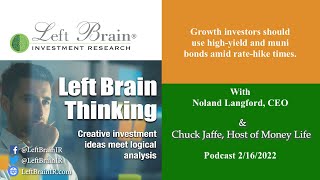
In this episode of the Left Brain Thinking podcast, host Chuck Jaffe interviews Nolan Langford, CEO of Left Brain Investment Research, about fixed‑income opportunities in a rising‑rate environment and practical tax‑season moves for growth investors. Langford explains how the Federal Reserve’s expected rate hikes have pushed most bond returns negative, but highlights two attractive segments: corporate high‑yield bonds and tax‑free municipal bonds. He notes that short‑to‑intermediate maturities (around three years) can lock in yields before the tightening cycle ends, and that municipal bonds could offer near‑4% tax‑free yields if rates settle. The conversation covers risk factors—credit risk for high‑yield issuers and interest‑rate risk for both sectors—and suggests building a bond ladder to manage cash flow and duration exposure. Langford then shifts to tax‑season advice, reminding listeners of IRA contribution limits, the benefits of Roth conversions (despite the tax hit on conversion), and the potential for future tax‑rate increases given the nation’s debt situation, making Roth accounts a hedge. The episode concludes with standard disclosures and promotional information for Left Brain’s research, newsletter, and mutual fund.
Chapters
Welcome to Left Brain Thinking, where creative investment ideas meet logical analysis. That's the hallmark of Left Brain Investment Research, where the analysts are looking for growth companies with the potential to double in 2 to 3 years and high-yield bonds with the potential for dramatic price appreciation. And today we're looking at where to go to get some yield without generating a tax bill, and we're going to talk about other tax season considerations too with Nolan Langford, chief executive at Left Brain Investment research. You can learn more about the firm and its research at leftbrainir.com. You can also check them out at YouTube. And they, of course, have their Jarvis newsletter, which gives you more of the insights of Jarvis, their proprietary research system. Again, it's all available for you at leftbrainir.com. They're on Twitter at Left Brain IR. Nolan Langford, great to chat with you again.
Hey, Chuck, it's great to be talking to the listeners. And great to be talking to you here on the show about stocks, the market, and taxes.
Now, Nolan, we are getting into tax season, but we also have been dealing with, well, just a general rising rate environment that has made things tricky. And one of the places where you excel at Left Brain is looking at the high-yield market. So let's start there in terms of the opportunities you're seeing now and why they exist at this time.
Yeah, you're right. I think you nailed it. Rates have been on the move. I think all the listeners and every investor in the world knows that rates have been on the move here in the US. Our own Federal Reserve Board has announced very publicly and loudly that they're going to raise rates. We expect that to happen at the March FOMC meeting. And the only debate is how much is the rate increase going to be and how many will we, will we get? This year. The answer to those will certainly help to determine for bond or income investors what the net result will be. And so, yes, we're watching that. We do follow bonds. We specialize in not only high-yield bonds, but we follow a lot of bonds. What has our interest right now is corporate bonds. You know, most bonds year-to-date are showing a negative return because rates are on the move. But there's a couple of categories of bonds that really have our interest. One is corporate high yields, and then the other one is tax-free bonds. Bonds. And we think there can be some interesting action there this year.
Those are not necessarily areas where people go thinking action, right? I mean, you're not thinking tax-free bonds, let's get in on the action there. So explain, like, give an example if you don't mind, in terms of what you're looking at and what kind of yield we're getting. What is the action there?
So interest rates do affect bonds. It's generally, for most bonds, a negative correlation, meaning that interest rates up, bond prices down, and the opposite is also true. And what has happened this year is rates have priced up across the yield curve. It's affected the price of all bonds, but what the two areas that it has really impacted, one is long-term bonds, so anything with the maturity date, you know, longer than 10 years, and The further along past 10 years you get, the more impacted the bond has been. And then the other one are interest rate sensitive bonds, which are what we call SAFE bonds. And municipal bonds, which are issued by local states, local governments, and municipalities, are considered really, really safe. The default rate is very, very low. So they price off of government Treasury bonds, which are also SAFE bonds. But as rates have moved up this year, both categories of bonds are showing negative price returns this year because they had to adjust the interest rates. So we're following them because generally it's a safe place to invest. And it could be interesting if the yields go up enough, those bonds that we really haven't considered for investment for a long time because the yields haven't been very attractive could become very attractive at the right time should rates settle down. So that could be the action that we're talking about. And from a yield perspective, the 10-year Treasury right now is still below 2%. That's the area that most people are watching. And tax-free bonds price off of that. But if we got into an area where we could lock in rates close to 4% on tax-free bonds, that would be really interesting. And then, of course, for high-yield bonds, which are corporate issuers, which tend to be more risky, they fluctuate a little bit more. So you have to be sort of careful about the issuer you're tagged to. But even those rates, you generally, for the coupon, you're generally getting compensated for rates rising. But this year, those bonds are also showing somewhat of a negative return. So in that case, we're looking for bonds with maturity rates of 3 years and in. And if we can lock in those bonds at less than their maturity value with those good yield to maturities within 3 years, puts us past the rate tightening cycle. And so we think that's an interesting place to be as well.
What is the risk in this strategy? And the bonds we're talking about, we're talking about bonds where you're going to be tying up your money for a relatively short time. Not— they're obviously not long bonds, but they're not super short. They're somewhere in that intermediate range, correct?
That would be correct. Now, of course, we follow all of them. We follow the long bonds that mature 10 years or more. And then we follow everything that matures monthly, actually. And you're right, I think for an average portfolio, you're going to have a mix of all of them. Ideally, you'd like to create some sort of bond ladder where every few years or every couple of years you'll have some bond that's coming due. And it'll be a mix of all of them. But the markets have been moving, they've been moving fast, Chuck. So to the extent, you know, you get exposure to a really attractive bond and rates have settled down, Some of them will price lower. And so you could get an attractive opportunity on a long-term bond to lock in a really good yield to maturity for quite some time once we get past this interest rate cycle.
It's an interesting play. What's the downside risk for anybody who's looking at this and thinking, okay, high-yield bonds at this time with rate sensitivity, is there, is there something that is a risk that you're watching out for or, or particularly keeping your eyes open towards?
Yes, all bonds do have some risk. In this case, we're talking about tax-free bonds, which generally you're not worried about getting paid back. I mean, every bond you have to evaluate because you could lose if you don't get repaid, but local cities and local governments have a really good track record of repayment. There you're just looking at interest rates. You know, if you buy a bond with a 3% interest rate, bonds go up to 4%, your bond isn't as attractive. So you're going to get a lower yield to maturity, holding to maturity. In the case of high-yield bonds, these are, economically sensitive. And so for whatever issuer you're buying that bond from, we need to be really careful that we're going to get repaid by that issuer. The downside there is if the issuer doesn't repay us and we don't get our money back. And you generally want to watch that in case of high yields. Historically, you generally have received enough in interest and coupon payments to sort of make up for it, but that is a risk with, with high-yield bonds.
Let's also talk about tax season because that's where we're getting into this year. And growth investors really want to make sure they're thinking about their asset location and not their just their asset allocation, because taxes take a bite and can play a role. So what's your advice right now to folks who are looking at the tax season coming up?
Yeah, we're in the thick of tax season. Most people now are getting their 1099s and those tax documents, the W-2s, over to the accountant to file taxes. So it is top of mind for a lot of investors. I'll remind people, this is IRA contribution season. Most people can still contribute to an IRA, either pre or post-tax. The contribution limits are $6,000 this year. If you're lucky enough like me to be in the 50 or over group, then there's a catch-up of $1,000 and then the limit goes to $7,000. The other thing to remind investors that I would like to is the Roth IRA. Even if you cannot contribute based off of income to a Roth, most people still qualify to do a Roth conversion, that is to move money from a normal— to an after-tax Roth. I remind investors, you do— when you convert, you do have to pay income taxes on the amount you converted. So if I move $10,000 from one IRA to the other, that $10,000 hits my tax return. So you have to be careful about that. But once the money is in the Roth, the money grows and qualified distributions are taken tax-free in the future. And the reason that we mention this so much during tax season, most people will remember, you know, we're running a huge deficit here in this country. Governments have, you know, over $20 trillion in debt. And even last year, at the end of the year, the Biden administration tried to get through the Build Back Better plan. Part of it had income tax increases in there. And I think, you know, with these stimulus programs that we funded the last several years since COVID the government's going to need to generate more revenue to sort of pay off some of this debt and live within its budget. And so we could see proposals for tax increases coming in in the future. And if tax rates do go up in the future, those investors that have money in a Roth IRA that's sheltered from taxes are going to be smiling when it happens.
Nolan, great stuff as always. Really interesting. Thanks so much for joining me to talk about it.
Always great to be on the show. It's always be great. It's always great to be talking to our listeners and, uh, stay safe.
Left Brain Thinking is a joint production of Left Brain Investment Research and Money Life with Chuck Jaffe. Our conversations are not personalized investment recommendations but are designed to engage your brain. Please do your diligence before making any financial transaction. I'm your host, Chuck Jaffe, and you can learn more about my hour-long weekday podcast at moneylifeshow.com or on your favorite podcast app. Thanks to my guest, Nolan Langford, Chief Executive Officer at Left Brain Investment Research. Go to leftbrainir.com to learn about the firm and to sign up for the Jarvis newsletter to keep tabs on their latest research. The firm's new mutual fund has its own website at leftbrainfunds.com, and they're on Twitter @LeftBrainIR, where they're now tweeting about their new YouTube channel. So you won't miss any of their content there. Follow along on Twitter. Left Brain Thinking is available every other Wednesday. Subscribe via your favorite podcast app. And until we don our left brain thinking caps again, happy investing, everybody.