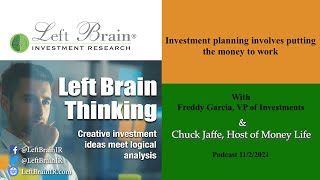
This content was created by Brian Dress, Cfa. This content was uploaded by Brian Dress, Cfa. This is a YouTube podcast episode titled "LB Thinking podcast: Investment planning involves putting the money to work." Recorded/published November 3, 2021, it is a hosted interview/conversation (Left Brain Thinking, a joint production of Left Brain Investment Research and Money Life with Chuck Jaffe). Host Chuck Jaffe talks with guest Freddy Garcia (Vice President for Investments, Left Brain Wealth Management) about the role of financial advisors in investment planning and execution — covering expectations setting, the difference between planning and active investment management, effects of indexing/ETFs and robo-advisors, when to bring in CPAs or attorneys, and how advisors should communicate returns and conviction to clients. The episode includes show notes and promotional references to Left Brain Wealth Management and the Jarvis newsletter and contains a standard disclosure that the discussion is not personalized investment advice.
Chapters
Welcome to Left Brain Thinking, where creative investment ideas meet logical analysis. That's the hallmark of Left Brain Investment Research, where the analysts are looking for growth companies with the potential to double in 2 to 3 years and high-yield bonds with the potential for dramatic price appreciation. Today, however, we're talking about the role of an advisor in deciding what kind of investments you're gonna go for. And we're having that chat with I'm here with Freddy Garcia, Vice President for Investments for Left Brain Wealth Management, which you can learn about at leftbrainwealthmanagement.com and on Twitter @leftbrainir. Freddy Garcia, great to have you back on Left Brain Thinking.
Well, Chuck, thanks for letting me come on. I always enjoy coming on the show and continuing our discussions.
And we are continuing a discussion we had from a couple of weeks ago when you were on the show last, where what you were discussing was advisors who maybe wanted to avoid stocks. But today we're going slightly in a different direction, which is kind of making sure you get what you want from your advisor, because some advisors offer planning without actually giving much in the way of investment advice. Explain how people need to understand what services they're getting and what they really want to buy here.
Well, thanks, Chuck. And, you know, as an advisor, it's something that I feel very passionate to talk about. I'm involved in a couple different committees with different advisors, and I hear a lot of the speak throughout the country of what the focus they feel should be when it comes to advisors or wealth managers. And I know my colleagues Nolan and Brian, when they come on the show, they always try to discuss different stocks because, you know, that is our niche. We like picking individual stocks for our clients. But the reason we do that is because we feel our main focus, the reason why people hire us, is based on investment management. You know, the reason I have advisor in my title is because I'm a financial advisor, which means that people are entrusting me because they need help with picking out investments for their accounts. Now, when I go around and I chat with other advisors, or I jump on different chat rooms, and the discussions are, well, we don't feel like the investments are the most important thing when a client comes to work with me. When a client comes to work with me, it's because I offer planning. And when I hear that statement, it kind of makes me think, well, what do you think planning is? You know, when someone says, I'm going to go hire an advisor because I want investment planning, well, yeah, I've heard that statement before, but what is investment planning? And to me, you have to focus on the investments as a primary because as an investment advisor, that's why people are going to you as part of their investment planning.
Well, it's interesting to me, you know, I've written two books. On choosing and working with financial advisors. And in fact, one of them, The Right Way to Hire Financial Help, was originally going to be a book about assembling a financial team. And if people want to do that, that's okay. And then you say, okay, I've got my guy who plans my investments and my guy who manages the money, and I got my CPA and my attorney, et cetera. But that is something that works really well if you've got a lot of money and the ability to vet those people and know who's good. For most people, they would rather have somebody be, if not necessarily one size for everything, it's at least my primary conduit to the two things that are most important. And one is coming up with that plan. Yes. But the other is executing the plan. How do people overcome that disconnect between planning and execution?
Well, I think it's an important aspect. And Chuck, the only thing I would change with that is that actually, I don't think you need to be very wealthy to have that team of people. Because one of the things that we do here at Left Brain is we don't try to be experts in every category. We will tell people to go get that attorney to draw up the trust documents, or we encourage people to work with CPAs. I don't believe you need to be a wealthy person to do that. You can find very reasonably priced CPAs, especially if your investments become a little bit more complex. And when I speak to advisors and they tell me, well, when we meet, when we talk about planning, they say, well, because we like to focus on tax planning or we like to focus on estate planning. They're neither attorneys nor CPAs. So, you know, they have financial advisor in their title, so the main thing they should be providing to their people that they're working with is the actual investment aspect. Now, they shouldn't neglect, you know, obviously taxes and estate. You know, as CFPs, that's one thing that we are briefed in to look for those areas, but we're not actually drawing up, again, trust documents. We're not actually filling out people's taxes. So that's why it's important as an advisor to know when that person needs to bring in that extra person, but not just make your primary focus to tell a client, well, it's because I'm gonna do tax planning with you. Well, what about the investments? Go to the accountant for the tax planning and then stick with me for the investments.
That's also something that has to be sorted out at the beginning, right? We would hope that everybody finds the right match. That's what my two books were about. There's a financial advisor out there for you someplace, no matter what style you want, et cetera. But the big thing that I've learned over the years is that people go looking for a financial advisor or a financial planner because they want to take control of their assets. They're not saying, oh, I need to go get 15% or 20%. They're not looking at returns, but they fire their advisor because returns don't meet whatever those expectations are. And so ultimately, doesn't that mean that if you're going to have the good relationship, you must have the investment discussions? And the expectation setting right up front, or otherwise just wait for the market to turn bad and the relationship's over.
Yeah, I would agree with you on that as well, Chuck. I mean, you're right. When we have the discussions at the beginning, you know, we lay out that we are going to be doing investment management, but we never actually discuss, you know, percentage returns saying, okay, we're going to— because we can't promise, you know, the investment return is not a guaranteed thing. But the expectation is, is that we are going to try to grow the account. So when somebody goes to you, they're not saying, "All right, if you don't get, say, 19%, 17%, you're going to get fired." But the expectation will be that, "Hey, if you're not growing my account, if year after year you're underperforming, say, the S&P or the account is consistently negative after every year and the market hasn't been, then maybe it's time to revisit that." But many advisors don't have those investment rate of return even discussions with their clients. Some of their statements don't even show rates of return on there because they feel that, "Well, the person's not really coming for me based on investment rates of return." And it's true, some people will stay with that advisor for a long time, even if they're poorly performing. And the advisor takes that as a message, "Well, it's because the investment return isn't important." And the reality is because the client really isn't asking for more, and they really need to start because advisors need to start focusing on that. And again, we know we can't promise returns here, but we can look in whichever form your practice is, whether you outsource, whether you incorporate funds, stocks, or ETFs. Everyone can incorporate looking at returns and try to change and incorporate those into a client's account, because that is part of the investment planning. That is what true financial planning is. And that's what investment advisors are supposed to be providing.
How much is this kind of fallout of the evolution of the investment world with indexing and all the rest, where once upon a time, every advisor, every planner was all about how do I put a portfolio together? And then it became, no, we're going to do it with index funds and just kind of let it all be long-term. And, It's really just about positioning the assets and not worrying about the rest. How much did that change things? Because people were tired of, hey, it's tough to beat the market when that's not really the goal of most people's portfolio. And yet they were getting canned for that. Is this kind of an offshoot of that?
Yeah, it's definitely an offshoot of that. I mean, basically advisors are told over and over again that they're more— and I've heard this term a lot— being like they're more the quarterback, they're the relationship person in this, and they should hand off those investments to somebody else. Well, that somebody else happens to be big large fund companies, right? And then even they're not putting a big emphasis on the investment. They're just putting them in these vanilla index funds because that's easy management, and then they feel that it's a lot better to avoid risk because they're just basically streamlining and just doing a straight index on the investments. So advisors have taken that tune too, and the focus they switched on is just basically gathering more assets and getting more clients rather than spending more time on the individual portfolios. That is a change in the industry that I haven't liked, and that is what we're seeing more and more of with robo-advisors, index advisers. And again, as newer advisers come into the industry, they have no idea that before, you used to actually have to look and research different individual— ETFs weren't around, but you had to research different stocks and different mutual funds. And it's so different than how it started. I have a client who talks about when he first started investing, the broker would call him, and all these brokerage shops, they had a couple stocks. They would pitch those stocks, the clients would buy those stocks. Then, you know, maybe a year or two later, they would have a new group of stocks, right? And they would pitch those stocks and the client would buy those stocks. And that was kind of how it went. And then, you know, as the '80s and '90s came around, mutual funds became more relevant and you started to research those. And then, of course, modern portfolios, actually all packaged products, and then ETFs came. And now we switched from doing any really deep research on anything and just putting clients in these portfolios and thinking, okay, I've done my job because I've gone over and looked at their Monte Carlo scenario and looked at their expenses and their retirement goals. And I've done my job because I review that on a yearly basis without actually looking at the individual holdings of what their own clients own.
And ultimately what you want and what you're saying is that an advisor who is not working with you on investments isn't giving you their highest conviction picks and anybody who's going to try to make things work in this market, no matter what method they take, has to have high conviction about something, right?
Yeah, I would agree. And again, if you are with an advisor right now, ask yourself, why am I working with this advisor? Because I like the person, I like the relationship. I like the fact that they show me a retirement scenario each year, or is it because I need somebody to focus on my investments because I'm not familiar with it, or I'm looking for that expertise.
Freddie, great stuff as always. Thanks so much for joining me to talk about it.
Well, thank you so much, Chuck.
Left Brain Thinking is a joint production of Left Brain Investment Research and Money Life with Chuck Jaffe. Our conversations are not personalized investment recommendations, but are designed to engage your brain. Please do your diligence before making any financial transaction. I'm your host, Chuck Jaffe, and you can learn more about my weekday podcast at moneylifeshow.com. Thanks to my guest, Freddy Garcia, Vice President of Investments for Left Brain Wealth Management. Learn about the firm and its services at leftbrainir.com. They're on Twitter at Left Brain IR. And oh, by the way, they have their weekly Jarvis newsletter all about their stock picks from their proprietary system Jarvis. That's free. And you can sign up at the leftbrainir.com website. Left Brain Thinking is available every other Wednesday unless there's a major power outage at the Money Life Show studios like we had this past weekend. We hope you're gonna follow us on your favorite podcast app to make sure you don't miss a single episode whenever you get out. And until next time, happy investing, everybody.