Left Brain Thinking Podcast: Dealing with a Bond Market Where "5% is the New 8%."
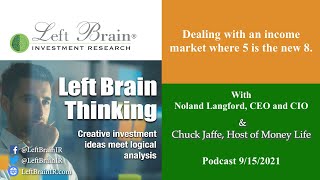
Nolan Langford, CEO of Left Brain Investment Research, explains how retirees can target realistic 5% yields instead of the 8% they once got from safe assets. He highlights specific picks: a 4.5% Macy's bond maturing in 2034, a 4.9% Bed Bath & Beyond bond at 95% of face value, and a 6.125% AGNC preferred stock locked in through 2025.
Chapters
Welcome to Left Brain Thinking, where creative investment ideas meet logical analysis. That's the hallmark of Left Brain Investment Research, where the analysts are looking for growth companies with the potential to double in 2 to 3 years and high-yield bonds with the potential for dramatic price appreciation. And today we're talking about some income generation ideas with Nolan Langford, chief executive at Left Brain Investment Research. But before we get to Nolan's ideas, let's remind you that Left Brain has a lot of ideas, and the firm now has a weekly newsletter, the Jarvis Newsletter, which highlights the insights gained from the weekly outputs of Jarvis, the firm's proprietary research system. You can sign up for the newsletter and learn more about the firm at leftbrainir.com, and you can learn how the methodology and the insights are worked into the firm's new mutual fund at leftbrainfunds.com. Noland Langford, great to chat with you again on Left Brain Thinking.
Yes, it's always great to talk to our listeners and to share what we've been learning, and always exciting to be spending time with you, Chuck.
I'm excited for this one because last week I was talking with some guests on my show about how high-yield bonds are struggling to keep pace with inflation. Yet you guys have some new income generation ideas both in high yield and preferred stocks. So obviously this is an area where picking and choosing is going to be important, but where I think there's going to be a lot of interest because yeah, with that inflation bogey out there, it's tougher and tougher to beat that right now.
Yeah, you're right. Especially what we see with our clients. You know, a lot of our clients are entering the stage of retirement where they need to actually draw on their portfolio to create the income that they were missing from when they were working for a paycheck. And in today's low-rate environment, my goodness, is it difficult. It wasn't that long ago where an investor could have a portfolio of CDs at the bank, and they could have a million-dollar portfolio and generate $50,000 in interest income from CDs and, and sort of safe bonds. Now that same $1 million, my goodness, you'd be lucky to draw $10,000. In interest income. So it's quite the challenge to generate income in today's environment.
How are you addressing that challenge? I mean, where are you turning? What are you doing? And are you having to settle for less or you just having to be a lot more picky?
We're having to do both. The bottom line is we're having to do a lot more work to find these ideas, and they're not as profitable as they were a few years ago. Brian and I, our director of research, were talking this afternoon. Hey, 5 is the new 8. You know, you're having to work real, real hard to find these opportunities, but you're not getting, you know, 8% yields with upside. Everywhere we look far and wide, we keep coming back to the same number, 5. Doesn't matter the duration or the maturity length of the bond. In a lot of cases, it doesn't even matter the credit quality. You know, it seems to be a limit on income at 5, and you're having to look hard to get back. We have come up with some ideas, but certainly we've been working a lot harder to come up with the ones we have.
So let's talk about some of the ones that you have come up with. I mean, I love the idea— well, I hate the idea that 5 is the new 8, but I love the phrase that 5 is the new 8. Let's talk about where you are fulfilling that.
Historically, we've done a lot, a lot of our work in the high-yield bond space. We built a database, we programmed Jarvis, we spent a lot of our time, energy, effort following these securities. And just so the listeners are aware, there's certainly a lot more bonds than there are stocks. There's probably about 5,000 publicly traded, tradable stocks, but there's over 100,000 individual bonds. It is a really, really big market. It requires a lot of work. They're generally still manually traded. So we have to build tools to be able to track and evaluate these. And so that's how we've spent our time— one half on high-growth stocks, the other one on high-yield securities that we think have some upside in addition to paying us income. We have quite a few ideas that we do like in high yield. Again, the yields are closer to 5 to 6%. And then there's a couple of preferred securities that we like and that we think are interesting as well.
Specifically, give us a, for instance, what's something that stands out to you right now?
Well, I'm gonna give you a couple in retail, Chuck. You know, the world is reopening and the reopening play is alive and well. We just got finished with second quarter earnings and a lot of these retail businesses reported really good numbers. So there's two retail credits that we think are interesting. One is Macy's. Macy's came out, the stock did very well when they announced earnings. Business is up. They announced a share buyback actually. So obviously financially they feel in there in a strong position, but they have a bond that we think is really interesting. It's a 4.5% coupon bond. It matures in 2034 and it's been trading somewhere in the mid-90s. And so if an investor were to buy that, they could lock in a yield depending on the day they bought it, somewhere between 4.6 and 4.8%. The other bond that we like in the retail space is a bond from a turnaround play. We actually like the business quite a bit, and that's Bed Bath Beyond. Housing has been strong, specifically retail generally, and Bed Bath Beyond is very, very interesting. They have a new CEO that came over from Target a few years ago, turning around the business. I think this year they have had two increases in the expectations for sales. And also earnings. We follow this one in, in Jarvis and the earnings expectations for 2021 are about 40% higher today than they were at the start of the year. But they have a bond with a coupon of 4.9%, very similar to Macy's. There's a maturity of 2034. So an investor can lock in that yield for the next 13 years. The bond trades at about 95 cents on the dollar. So if an investor were to buy that at that price, The yield to maturity would be about 5.2 to 5.3, depending on the time that they purchased it and the price they paid. So those two in retail really catch our eye these days.
You also mentioned that you're doing this with preferreds. Are there some preferreds you want to talk about?
Yes, there are some preferreds that we want to talk about, and these are in the financial space. So one of the preferreds, just so the listeners are aware, most investors are familiar with common stock, a lot of familiarity with bonds, which are a loan to a corporation, and then there's a security that sits in the middle called a preferred stock. So it has a higher claim on assets than the common stock, but it's not as secure as the bond. The bond, I have a guarantee where the company pledges me their honor that they're going to pay me back. They don't default. They have to pay me back. And the bondholder gets paid before the shareholder. But there is a security that sits right in the middle called a preferred stock, but they also pay income. And the ones that we like, one of them is from a company called AGNC. They're a real estate company. They own mortgage-backed securities. Generally, these mortgage-backed securities are guaranteed by either Ginnie Mae or Fannie Mae, which are the housing development authority which are quasi-government institutions, so you get a government-backed guarantee that these bonds are going to be repaid. But AGNC will own these bonds in a portfolio. They do use leverage. And so AGNC actually has a publicly traded stock that has a dividend attached to it, but they also issue a preferred stock, so it's a safer way to invest. And the preferreds that we like, they have a 6.125% coupon And they're fixed for the next 4 years till 2025. And then after that guarantee period with that income, then they float. So it's a fixed-to-floating rate. But that coupon of 6.125% is locked in for the next 4 years. And the security itself is trading just above par. And par for these securities are about $25. And so if you bought that today, an investor could lock in a yield to maturity of over 6%. And that's a name that we like a lot.
All of this sounds great, particularly in a world where 5 is the new 8, but these things are not risk-free. So let's talk about the risks here. I mean, what are the downsides or potential downsides to both the high yields and the preferreds that you've been looking at?
So let's start with the preferreds and then we'll work our way backwards. The preferred stocks do have interest rate risk. So to the extent that interest rates in this country there was a spike, that certainly could impact the price of the security. And just to remind listeners, right now the 10-year Treasury bond yield's been bouncing between 1.3% and 1.35%. So if we're talking a world where we woke up and, uh, the 10-year yield was 2% or approaching 2% or more than 2%, particularly if it happened suddenly, that would be considered an interest rate spike, this security would adjust the opposite way to compensate for the higher rate that you could get on a Treasury bond. So that's one of the big risks. And then the other big risk is just with the business itself. There is a portfolio of mortgage bonds that it owns that are backed essentially by the government. So I don't think that there's risk there. It's just the leveraging that they do. They do use borrowed money to buy these securities. So if something went wrong there, that is a risk, so that needs to be managed. In terms of the other bonds, these are retail businesses. They all have publicly traded stocks, so we can follow them. It's just going to be dependent on how the businesses do. So during COVID when everybody was shut in, people weren't going to the stores, these businesses, the sales and revenues didn't look great, so the shares sold off. And if we had another situation where we were shut in again, and/or the businesses just didn't perform, then the price of these bonds certainly would be more risky, and then the price would adjust downward to certainly reflect that risk. So those are the primary risks.
Well, now we understand the risks and the rewards. Nolan, really interesting stuff. Thanks so much for joining me to talk about it.
Glad to be here. I was glad to be talking securities, and I can't wait to do it again.
Left Brain Thinking is a joint production of Left Brain Investment Research and Money Life with Chuck Jaffe. Our conversations are not personalized investment recommendations but are designed to engage your brain. Please do your diligence before making any financial transaction. I'm your host, Chuck Jaffe, and you can learn more about my hour-long weekday podcast at moneylifeshow.com. Thanks to my guest, Nolan Langford, Chief Executive Officer at Left Brain Investment Research. You can go to leftbrainir.com to learn about the firm and to sign up for the new Jarvis newsletter to keep tabs on their latest research. The firm has a new mutual fund which has its own website at leftbrainfunds.com, and the firm is on Twitter @leftbrainir. Left Brain Thinking is available every other Wednesday. Subscribe via your favorite podcast app. And until we don our left brain thinking caps again, happy investing, everybody.







