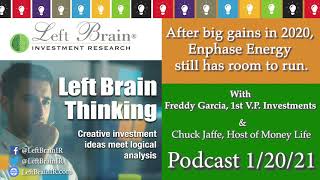
In this Left Brain Thinking podcast, host Chuck Jaffe interviews Freddie (Freddy) Garcia, Vice President of Investments at Left Brain Wealth Management, about why Enphase Energy (ENPH) has moved from a speculative pick to a core holding in their portfolios. Garcia explains that the solar market is expanding at roughly 20% annually, and Enphase’s leadership in microinverters positions it to capture that growth. The firm’s strong free‑cash‑flow generation—about 30% of revenue—allows substantial reinvestment into R&D and new business lines beyond microinverters, reducing reliance on a single product. While the stock’s explosive 500‑550% run‑up last year has moderated, the company’s fundamentals, governance, and ESG credentials (solar‑related environmental benefits) make it a suitable, lower‑risk core holding for a wide range of clients. Left Brain’s investment philosophy emphasizes independent research over Wall Street price targets; they avoid setting explicit targets to prevent missing outsized upside, instead monitoring key catalysts such as microinverter installation trends post‑COVID‑19 vaccination. The conversation also touches on risk management, noting Enphase’s cyclical exposure and the need for ongoing vigilance despite its core status.
Chapters
Welcome to Left Brain Thinking, where creative investment ideas meet logical analysis. That's the hallmark of Left Brain Investment Research, where the analysts are looking for growth companies with the potential to double in 2 to 3 years and high-yield bonds with the potential for dramatic price appreciation. Today we're talking with Freddie Garcia, Vice President of Investments for Left Brain Wealth Management. We're talking about an energy company that has moved from a stock of interest into a core holding. Freddy, welcome back to Left Brain Thinking.
Well, Chuck, thank you for having me. I always appreciate coming on.
We are talking today about Enphase Energy. It's ticker symbol ENPH. And energy stocks, you don't necessarily expect them to meet Left Brain's growth criteria. So explain what your thinking is and how this stock has gone from being something that you look at for folks to something that you now say, hey, you need to own this.
Well, Chuck, yeah, you're probably going to think that this doesn't sound like anything we would do. Why would I come on the show here and talk about a stock that was up 550% last year and we're looking at stocks that double in the next couple years, especially a stock that's grown so much already? But Enphase Energy (ENPH) is a stock that attracted our attention actually quite a while ago. We started buying it for clients that were more risk tolerant last year, and one of the things we always look for is when does this classify for us as a core holding, as a must-have. And Enphase started meeting a lot of that criteria. You know, the solar capacity area is growing nearly 20% now annually. So that's one of the major characteristics for what we look for in an investment. Is it a growing market segment? So it checked off that box. So again, we were excited about it before, but now we truly believe that this is a core holding for us, that now everyone should hold it. And that's why we made the switch and pulled the plug kind of last week and added it for everyone. And with Enphase, you know, their primary core business right now is microinverters, you know, taking that solar energy and converting it to usable power. Now with Enphase, what they did that was very smart, and again made us make that switch to core holding, was they took a lot of cash they made last year and put it into R&D, and they also put it into expanding their business lines. So they're not going to just be relying on microinverter sales only. That was another positive momentum for us to make that switch. And then lastly Their cash flow is fantastic, nearly 30% free cash flow per dollar yield of revenue. So with those types of characteristics, that ended up meeting a criteria for a core holding, and we were excited to make the switch.
This is a stock that, as you pointed out, massive, you know, 500% kind of growth, which is faster even than what you guys are looking for. Is part of the fact that that has calmed down, that in other words, it got through that super explosive phase And even though it's not going back to like, hey, we're just going to become an ordinary growth stock. Is that part of it here that people should understand that your cycle is different? Like most people say, oh, I'll buy a value stock and it will start to pick up and it'll become a growth stock. For you, it's that opportunity, that high-risk stock that as things calm down, it can, and in this case it did, become a core holding.
Yes. So it had massive growth and yeah, even that 500% growth is even a higher something that we're looking for. But the reason it's a core holding now is that some of the high risk has calmed down on the stock. If we look at last year, it's had a high growth, and things did slow down during the pandemic. The installations of microinverters had calmed down. There was actually a cutback, you know, during the last quarters of, of the year because of COVID Now with the vaccine coming out in 2021, we should see that increase back up in the installation of these microinverters. So if the stock did so well last year where they actually had cut back. Imagine this year where they start increasing installations, how the stock will do this time. Are we expecting a 550% return? No, not necessarily, because again, that's not our key thing that we look at. What we look at, it's a growing market sector, they are the leaders in that market sector, and they have good cash flow. They use their cash flow well, and they have good governance. They have a great CEO who's taking the company in very good directions.
This is an energy stock, but it's actually also a social investment, an ESG stock— Environmental, Social, Governance is what ESG stands for. It's for folks who are looking to do well while doing good. And because this is in the, the solar business, it has that ESG component. Is that a bonus? Does that make it more attractive to you? Does that mean that compared to other stocks, if it didn't have that, would you be less interested?
Well, you know, at Left Brain, we always look at, is it a good stock? Does it have growth potential? That's always our primary characteristics. This just happens to be a bonus that it qualifies as an ESG stock. And I know becoming more and more of a hot topic. A lot of people want to get more involved with ESG investing but don't necessarily know how to. And there's going to be a lot of new funds, index funds, ETFs that call themselves ESG funds, but realistically they're just funds that already existed but they just now branded them as ESG. When you actually buy the individual company, you can truly tell if it qualifies as ESG, and Enphase definitely does.
A core holding Does that have to meet any different criteria for you? Is there anything that is different about a core holding than one that you're maybe taking a bit more of a flyer on? Does it change the sell discipline at all?
Well, when it comes to core holding, it means that we feel comfortable owning it for just about every type of client, even if their risk levels are different. That just means the amount that they own may change, but we feel comfortable. Like, if you compare to an Amazon— Amazon's a core holding for us because we know the risk level with it. With Enphase, you know, it was a stock that fluctuated a lot, you know, during that 550% run-up. It wasn't a flat run-up. So this year, because of the fact that they're going to be increasing installation of microinverters, we feel comfortable that trajectory is going to be a little bit more steady. And that's what we look for with the core holdings.
One of the things that I noticed in getting ready to have this chat with you is that plenty of stocks get mixed results from analysts, but I had no problems finding analysts who were saying, hey, I think it could be a $250 or $300 stock. It's a stock that's trading currently a little bit under $200 as we record this. I saw others who were like, hey, I think it's going to be an underperform. That mixed bag of Wall Street. I mean, you guys don't put target prices on. That's not part of what you really want to do at Left Brain. And I know you're doing all your own research, so you're not that worried about what other people on Wall Street are thinking. But does it actually excite you a little bit more when Wall Street's kind of disagreeing about a stock that you're looking at and going, hey, this looks really good to us?
Well, it depends on who you ask here at Left Brain. If you asked our founder and chief investment officer, Noel Langford, he would say absolutely. I'm now more getting into the habit of not listening to the news and all the talk on that stuff.
And so ultimately, if somebody else thinks this company is going to be good or bad, you really don't care.
That's correct. And then that truly is the left-brain thinking, is we do our own research, you know, we do our own write-ups. Some of the questions we get asked by subscribers to our research is, what's the price target you set for some of these stocks? Especially a stock like you mentioned, Enphase, would be a perfect one to set a price target for because they had a nice run-up, you know, what's the max? And this isn't typically how we like doing it because when you do that type of strategy, you can miss out on a lot of opportunity. And last year would have been a good example. Under that thinking, we would have set a price target for Enphase at about, you know, $50 and made a lot of money on it, but missed out on the 550% return on it. And other companies we've covered in some of our past podcasts as well, a company like Square, you know, having over a 200% return. If we would have set a price target for that one, we would have missed out on the growth. And big companies like Amazon, you know, remember Amazon will never get to $1,000, Amazon will never get to $2,000, $3,000. How does a big company like that get to those dollar amounts? Well, they have, and they surpassed those amounts. So with that type of thinking, you miss out on more opportunity, and that's just not a way we're going to switch to. Now, with Enphase, we take a little more caution with it, even though it's a core holding. And again, we were hesitant about making a core holding because it is a cyclical stock, and the fact that again we are depending on the increase of microinverter installations. So we will watch it more carefully, but it's not necessarily a price target that we're going to put on it. We're just going to see if that growth If we're wrong, that there isn't an increase in microinverter installations as the vaccine goes around, then maybe it will be time to move on from that stock. But that'll be the way we determine whether it's time to make a move.
And right now, again, the move is strong towards Enphase Energy, ENPH. Freddie Garcia, thanks so much for joining me to talk about it.
Chuck, thanks so much for having me.
Left Brain Thinking is a joint production of Left Brain Investment Research and MoneyLife with Chuck Jaffe. Our conversations here are not personalized investment recommendations, but are designed to engage your brain. Please do your own due diligence before making any financial transaction. I'm your host, Chuck Jaffe, and you can learn more about my weekday podcast by going to moneylifeshow.com. We're on your favorite podcast apps. Thanks to my guest, Freddy Garcia, Vice President of Investments for Left Brain Wealth Management. Learn more about the firm and its services at leftbrainir.com. They're on Twitter at Left Brain IR. Left Brain Thinking is available every Wednesday. Find it and subscribe on your favorite podcast app and plan to put your left brain thinking cap on every week. Until next week, stay safe, everybody.