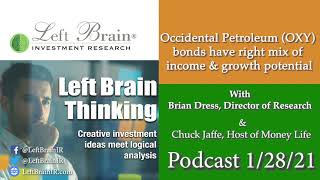
In this Left Brain Thinking podcast episode, host Chuck Jaffe interviews Brian Dress, CFA and Director of Research at Left Brain Investment Research, to evaluate Occidental Petroleum’s (OXY) high‑yield bond portfolio. Dress explains that, although the firm focuses on growth stocks, it applies the same growth‑oriented lens to fixed‑income selection, seeking bonds that offer both income and principal appreciation. He highlights Occidental’s business fundamentals—particularly the Anadarko acquisition, strong Permian Basin acreage, and a break‑even price well below $40—as sources of margin safety. The company’s credit profile is bolstered by $7 billion of liquidity, recent $5 billion of new bond issuance, $1.3 billion of debt paydown, and $1.4 billion of free cash flow, positioning it near the investment‑grade threshold (currently BB‑). Dress discusses the potential for a credit upgrade, which could drive significant price appreciation for existing bondholders. He singles out two specific issues—the 7.95% 2039 bond and the 6.6% 2046 bond—both yielding around 6% and offering long‑term income in the current low‑rate environment. The conversation also addresses the implications of Occidental’s ongoing new bond issuances, concluding that the overall debt stack is being reduced and that the firm’s access to capital markets remains a positive signal for investors.
Chapters
Welcome to Left Brain Thinking, where creative investment ideas meet logical analysis. That's the hallmark of Left Brain Investment Research, where the analysts are looking for growth companies with the potential to double in 2 to 3 years and high-yield bonds with the potential for dramatic price appreciation. You can learn more about the firm and its work at leftbrainir.com, and you can follow them on Twitter @leftbrainir. Today we're talking Occidental Petroleum, but not the stock, rather the bonds, with Brian Dress, Director of Research at Left Brain Investment Research. Brian, great to chat with you again.
Hello, Chuck. Great to be back on the show.
So Occidental Petroleum, I think people think of it as kind of big stodgy stock, but you're thinking high yield bonds with the potential for dramatic price appreciation. So explain what you see in this opportunity.
Sure. I'll start a little bit with our asset management viewpoint and kind of why we look at individual bonds first. As you know, we like growth stocks, and pretty much anything we look at, we're going to look at through a growth lens. But we approach security selection through a wealth management, asset management type of lens. And so, you know, obviously there are a lot of clients that have income needs. You know, you look around and you see the interest rates are so low, opportunities aren't really plentiful in the fixed income and income security markets. But we don't just throw up our hands and say, it's not possible just because there's a need. So we're looking for individual bonds that have the price appreciation opportunity, but also the income opportunity. So we can talk a little bit more about why we like Occidental Petroleum, because we do like sort of the business case that we see there, but also we see a lot of opportunity in the bonds and for principal appreciation. So we can talk a little bit more about that.
Yeah. And let's talk about when you analyze a company, Are you analyzing a stock, a bond, or both? I mean, do you go in looking at a stock and say, hey, what do the bonds say? Do you go in looking at a bond and say, how does that compare to the stock? Are there cases where you own the stocks and bonds of the same company?
To answer the final question, yes, there are times when we will own both stock or bond. But no matter what we're looking at, if we're looking at a stock or if we're looking at bonds, you know, the business case is going to be the most important. So we want to see some sort of growth or turnaround in the business from a margin point of view and to make the business attractive. And then once we see that, you know, we can drill down a little bit further into the balance sheet and then the particular opportunities we see in the capital structure, whether it be through the bonds or through the stock.
Now let's make it specific to Occidental. I mean, which did you look at first and why did you come to the conclusion of the bonds? And then we'll get to what you see in the bonds.
Sure. So like I said, we're always growth-oriented to some degree, even if we're looking in the fixed income world. And then when you look in these high-yield bond type of securities like Occidental, you're going to see businesses that are in distress for some reason or another. I mean, like we say, we're looking at it through a growth lens and we want to see some sort of turning of the corner from either revenue or a margin point of view. For bonds, you know, we want to see management's commitment to deleveraging, you know, and some free cash flow and access to capital markets. So we see a lot of those criteria in Occidental. And you know, we've looked at Occidental, like we said, both from the bond and the stock point of view. The reason there's opportunity in Occidental, they purchased Anadarko Petroleum for $57 billion back in 2019. And a lot of people thought it was an overpay at the time, and they did it at the absolute worst time, right before the oil price crash. Clearly that put the business in some distress, but there's positives that came from that Anadarko acquisition. And Occidental has some of the best acreage positions, especially in the Permian Basin down in Texas. We've seen over the last few quarters production has beat guidance a number of times. So from the production point of view, Occidental is doing well, especially because they have this new asset. And then also with the uncertainty in oil prices, what really sticks out to us about Occidental is that their break-even price is well below $40. So there's definitely a margin of safety in this business considering you know, what's going on in the oil market. We want to see some margin of safety there.
Now let's talk about the specifics in their bonds. I mean, obviously they're high-yield bonds, but why is this not junky style junk?
So Occidental has bonds that are rated at BB- right now, which is just below investment grade. They're right on the cusp of kind of moving back into the land of the living and the investment-grade world. As we look for principal appreciation in bonds, You know, we look for a number of different things. Like I said, we want to see liquidity and Occidental has about $7 billion of liquidity on the balance sheet. We want to see access to capital markets because we want to know as the bonds come up for maturity, are they going to be able to refinance those bonds on reasonable terms? And Occidental has actually been able to issue about $5 billion in new bonds over the last 6 months. So we know there's access to capital markets and they've paid down a lot of debt, $1.3 billion in debt. In Q3. As we talked about, they're kind of behind the 8-ball because of the Anadarko purchase. They've done quite a few write-downs on the balance sheet, but even with oil prices as low as they were in, in third quarter, they still were able to generate $1.4 billion in free cash flow. And that's due to an enhanced cost structure in the business, really well-managed business by the CEO, Vicki Hollub. So we're seeing a lot of the characteristics we look for in, in bond investments. Coming through in Occidental, it makes us think this is a great opportunity not only to clip coupons and get the income from the bonds, but also if there's a credit upgrade and this thing gets upgraded to investment grade, we do think investors will reap the benefit in the principal appreciation on these bonds over the next few years.
How likely is that to happen? I mean, interest rates are lower for longer. That's why companies like Occidental and others are in many cases issuing new bonds to refinance old ones and and bring down interest rates a little bit. But how common is it that you're buying junk and it winds up being upgraded to investment grade?
I don't have any exact statistics on this, but it definitely happens. It's a matter of trajectories on financials. So like I said, we see a positive trajectory in the financials here. We see a company that's committed to paying down debt. We see a company that's generating free cash flow, and we see a company that is on solid footing. And if You know, if we see continued appreciation in the oil prices, it's all the better for Occidental. So, you know, it's kind of a two-way bet. We see a lot of positive signs in terms of how the business is being run, but also, B, there's optionality in terms of the oil price. So as long as we have continued good management here and the oil price wind is at our back, we think there's definitely a great possibility that we will be seeing this company back in investment grade where it once was.
So Brian, that's the general bond issue. Is there a specific bond that particularly excites you here?
Yeah, Chuck, actually, you know, there are a couple of bonds in the Oxy capital structure that we're looking at every month for our subscribers. We put out a list of bonds that we think are great income producers and, and have opportunities for capital appreciation. So these are a couple of the type of bonds you would see on that list. The first is the 7.95%, 2039 maturity. And then the second is the 6.6% 2046 maturity. Both yield somewhere in the 6% range. And again, given the interest rate environment that we see, we think it's a great opportunity to put clients in bonds that would yield in that 6% range for, for 20 to 25 years. Being able to lock in that type of interest is really a great opportunity considering the interest rate environment that we face today.
From the standpoint of investors looking at bond issues generally, one of the things you said was that Occidental issuing a lot of new bonds. They bought back some old ones, they're issuing a lot of new bonds. Do you ever worry about new bond issues? Is there anything that you find off-putting? Because so many times in investments people say, well, it's a new this, it's a new that, you want to wait. But there's not really a reason for that in bonds, is it? I mean, you got the terms there in front of you, you know they could change, but basically if the case is good from the moment it's issued, it's a good case, right?
Yeah, that's a great question. You know, cause you can look at it two ways with new issues. Is this a negative for people who are existing bondholders? But what we look at is kind of what the actual total debt stack looks like. So generally as they issue new bonds, they're being proactive and trying to take care of maturities in '21, '22, and '23 and not getting it to where it's, you know, at the 11th hour, they have to try to do some kind of a transaction that won't be on good terms. So yes, if the total debt on the balance sheet was increasing, we would look at it in a different way. But the fact is that overall debt is being paid down at Occidental, and so we look at it positively, the fact that they're able to access capital markets. And the yields on those bonds have been sort of in the 6% range, so it's not sort of extortionate rates like you might see from, you know, more distressed companies.
Brian, great stuff as always. Thanks so much for joining us. We'll talk to you again soon.
Thanks, Chuck. It's great to be with you again.
Left Brain Thinking is a joint production of Left Brain Investment Research and MoneyLife with Chuck Jaffe. Our conversations are not personalized investment recommendations but are designed to engage your brain. Please do your diligence before making any financial transaction. I'm your host, Chuck Jaffe, and you can learn more about my weekday podcast at moneylifeshow.com or on your favorite podcast app. Thanks to my guest, Brian Dress, Director of Research at Left Brain Investment Research. Research. Learn more about the firm at leftbrainir.com and on Twitter @LeftBrainIR. Left Brain Thinking is normally available every Wednesday. Please subscribe on your favorite podcast app, and no matter when we get out, that way you'll never miss an issue. And plan to put your left brain thinking cap on with us every week. Until next week, please stay safe.