Retail Looks Wrecked; Are Growth Stocks Bottoming?
In this weekly Jarvis Update, Left Brain’s Director of Research Brian Dress, CFA, and CEO/CIO Nolan Langford discuss three main market themes. First, they analyze a sharp deterioration in consumer‑related equities after disappointing earnings from Walmart and Target, noting that even traditionally defensive consumer‑staples names such as Kraft Heinz, PepsiCo, and Hershey have fallen, suggesting a broader reassessment of the sector’s ability to pass on inflation. Second, they turn to the fixed‑income market, highlighting that high‑quality Treasury and investment‑grade corporate bonds are stabilizing while high‑yield spreads remain volatile. They recommend a barbell approach: short‑duration (12‑24 month) bonds to lock in current yields, longer‑duration Treasury and corporate bonds that have become attractive as yields rise, and tax‑free municipal bonds now offering 4‑5% yields. Third, they explore whether growth stocks are bottoming, pointing to an 8% weekly gain in the ARK Innovation Fund and strength in small‑ and mid‑cap stocks as possible early signs of a rebound. They outline criteria for a true market bottom—stabilizing high‑yield spreads, reduced erratic price swings, and the emergence of clear sector leaders—and suggest a watchlist of earnings‑beat growth companies across technology and consumer discretionary that could be bought at depressed prices. Throughout, they acknowledge market volatility, promote their subscription services, and encourage viewers to engage for deeper analysis.
Chapters
Another week is in the books that feels like doomsday, but are things changing in growth stock land? We filter through the muck and mire in this week's Jarvis Update. I'm your host, Brian Druss, Director of Research here at Left Brain, joined as always by our CEO and CIO, Nolan Langford. Nolan, welcome to the program.
Thank you, Brian. It's great to be here. On this Miami Heat Thursday, it's game 2 tonight, and all of us here in Miami are very excited to see fireworks at FTX Arena tonight. So go Heat!
The Heat are hot, hot. Let's keep it going. So this week, the biggest story— that little preview for you— the biggest story this week was weakness in the retail sector, especially after we had weak earnings from Walmart, WMT, and Target, TGT. We will cover that this week. Also, the fact that the so-called safety trades are sliding, taking on water. And we're also going to talk about a segment of the market we think seems to be showing some signs of bottoming. So those are our 3 topics for the week. Few announcements before we get started. We do have our subscription service. We're going to extend our offer one more week since there's been a lot of volatility. I think it would be beneficial for a lot of you out there to try us out. For the next 3 months, for new subscribers, you get $59 a month with— on the basic subscription if you enter the code JARVIS59 in at checkout. We'll put that link down in the description for you below. And, uh, we also have the Jarvis newsletter, uh, that is now biweekly. And this is an on week, so look for the newsletter this week. And finally, on the subscription service, we got one new report this week on an emerging player in the server and storage space, so definitely check that out. With that, we'll jump into the market recap. So the S&P was down just a little bit under 2% this week. The Nasdaq a little bit over 2% down. Certainly felt a lot more— like a lot more than that, Nolan. And then the third, we had the Russell actually up a third of a percent, which I think is actually some green shoots. So that's positive to see. I thought it was interesting. We had ARK, the ARK Innovation Fund that holds a lot of high-growth stocks that are not profitable, was up significantly on the week, I think around 8%. So signs of positivity there. And then we also had more earnings this week. They were certainly market movers. Nolan, what were the general thoughts that you had on this week?
Crazy. Just craziness reigns. The patterns that you think exist go poof in the night. So there's a lot of stepping in quicksand that's been happening this week. Not only this week, but this year. And we'll get to the earnings here in a second, but they caught my attention. Target, the retailers, the inflation trade, and then maybe we're getting some rotation. So, but the volatility of it definitely caught my eye. It's almost like the market can't make up its mind. And, you know, the bonds, the TLT, which is the long bond for Treasuries, which has been in a downtrend all year because of the Federal Reserve Board increasing rates. It's finally looked like it's bottomed, and I wonder what that's telling us.
Absolutely. We'll discuss all that in our 3 topics. So here's our first topic. So Topic 1, we're calling it Consumer Stocks Are Weak in the Knees. Um, I know, I think if you're following at all, you kind of heard about the earnings reports from Walmart and Target on Tuesday and Wednesday. Sort of send investors into a panic on anything consumer-related. Obviously inflation is the story that has really dominated 2022. We saw sales that were up from both of these companies, Walmart and Target, and a number of others like Kohl's, but profits are down sharply. They've got their inventories all wrong. They don't have the right products. They're also not able to pass through inflation to consumers anymore. So I don't know if that means we're coming toward the end of inflation or something else, but Um, that was what was going on there. And then if we looked at other staples companies, I'm going to name a few and throw some charts. We've got Kraft Heinz, KHC, down sharply this week in the last couple of days. Pepsi, PEP— this is a stock you do not expect to, to move like this by any means. And then another staple we've been looking at recently, Hershey's, HSY, the confectioner. They were all down sharply. This is not what you expect out of staples. So, Nolan, I guess the general question I'll start with is, what do you make of all this consumer weakness?
Uh, there's a lot to unpack. Let's start with, uh, the latter, which is the consumer staples, because they have been an oasis of safety really all year. It's one of the two sectors that has really held up prior to about 4 or 5 trading days ago— consumer staples along with utilities. And, uh, the same common theme that we've seen the last 4 to 5 months months is wherever you see strength, it's probably going to go poof at some point as you get this sort of rotating bear market. And consumer staples have really started to sell off the last couple of days. I guess the, the excuse to rip the Band-Aid was, uh, the, the Target and Walmart earnings report. As investors start to question their thesis, can these companies actually continue to increase sales And though they have a higher cost of their input cost, can they continue to pass it along to consumers? And I think investors are starting to reassess that, that thesis. And if that's the case, these stocks aren't necessarily cheap. People would pay up for them because of the dependability of the sales and the dependability of the earnings. But if that gets called into question, yeah, maybe, you know, paying 25 or 30 times earnings for some business that's growing revenue at mid-single digits Maybe that's not the best idea. So that's consumer staples. How far it goes, whether it's a one-week phenomenon, we'll be back to what we've seen all year next week, we'll have to see. Who knows? But that certainly caught my attention. As far as the earnings from the other retailers go, and just the consumer in general, you know, we've noted this consumer weakness, I don't know, Brian, it seems like 6 months.
Yeah, absolutely.
We've been talking about it. If you take a look at like Nike, Disney, companies like Starbucks, at times Target has been weak, and Body Bath and Body Works, excuse me, BBWI is the ticker, Best Buy. These are just some other consumer names that we've noted weakness in. And obviously that weakness was validated this week with the Walmart and Target reports. Even some other names that you wouldn't expect, some stalwarts like Costco, is down significantly from its recent highs. And that's something you wouldn't expect either. How long it lasts and how far it goes, that remains to be seen. I think one of the things, and I know you and I have talked about this, is, you know, the market's pricing in a recession. We've been saying that for a very long time. A lot of these stocks have been acting like it. And we're finally starting to get the violence on the downside. And I think what the market's starting to think is, hey, these interest rate increases are kind of sticky, inflation's kind of sticky, um, housing prices are up, rents are up. There's only so much that the consumer can take, and then they have to cut back places. They haven't been cutting back on travel. I think the market's pricing in them cutting back in other areas like discretionary purchases.
I think that's a great segue into our second topic. So topic 2, Nolan, is what can investors do at a time like this? So a couple of things. We, uh, you know, in the office here, we've said raising cash does seem like a smart idea. We've talked about this whack-a-mole market, you know, strength turns into weakness, and we've seen the pattern happen time and time again. So, um, but the bond market seems to be stabilizing a little bit. The high-quality bonds, US Treasuries, AGGG, which covers investment-grade corporates, starting to stabilize, but we do see high yield. HYG is a good proxy for high yield, has been weak, although it's up today. Can you explain a little bit about our thoughts of what the opportunities in the bond market look like and what could be developing kind of as 2022 unfolds for the rest of the year?
I think if you're a bond investor, you should be getting more optimistic. That is, rates have risen a lot, bond prices have come down a lot. There's certainly a cap mathematically to, I think, well, realistically, how far yields can rise in a short period of time, particularly if the economy gets weak. You figure there's only so many interest rate rises that are going to happen. Particularly if the market keeps falling and we raise the rates enough to cause a recession, those bond yields are going to start to look really attractive at some price. And so, if you're a bond investor, we certainly ask to take a look and consider sort of a barbell strategy or a two-pronged approach. The one is these bonds that mature over the next 12 to 24 months. So if you can put money in those, you can sort of lock in those yields. You know, the prices tend not to move around as much. You do have risk if the corporation doesn't do well and it looks like they can't repay their debts. But a lot of these bonds, at least the list that we're making, we have a high degree of confidence they're going to be able to, you know, pay off their debts and do well. So 1 or 2-year bonds don't move as much, so you get to lock in a yield to maturity for a shorter period of time and kind of ride out the interest rate increases. The thought is when these start to mature over the next year or two, we should be through the Fed rate hike, rate hiking cycle. And then you can sort of come out and look into a bond ladder or other things. The other thing I would say is, you know, of all the bonds that have really been impacted, the ones that have been impacted the most are the long bonds, bonds that mature 5, 7, 10 years or more. The longer it is to maturity, the more they've been impacted, all things being considered. And so if you're a retiree or if you're counting on your portfolio for income or even stability, a lot of these bonds, you know, a year ago that may have been yielding 5% or 5.5% or 6%, right now they're yielding 8%, 9%, a lot of them. And if rates keep going up, you know, you might be able to lock in yields approaching double digits. And that'll be really attractive for retirees. It'll be really good income. So that's a way for investors to sort of look at the bond market. And then finally, there's another type of bond, which are municipal bonds. Most investors would like, they just tend to not pay you enough to hold them. These are tax-free bonds issued by local municipalities, states, local governments. They tend to be very, very safe. And they also, most of them, the income comes to you federally tax-free. And because of that, they tend not to yield very much. But right now they've sold off right along with the other bonds. And so the yields there look— starting to look fairly attractive at, you know, 4% to 5% tax-free. That's enough to get your attention, especially if you're a high-income earner.
It absolutely is all positive signs developing, Nolan. We're making the best out of a bad situation. And letting the market come to us as bond investors. So, you know, definitely keep following us and give us a call. We'll be happy to let you know what we're looking at in the bond market. Before we go to the third topic, again, if you enjoy the content here, make sure you like and share the video and hit the bell for notifications. Subscribe, make sure you know when the next one comes out, and leave a comment. We'll be happy to engage with you. With that, let's go to topic 3. So topic 3, we're saying what would be signs of a bottom? Nolan, um, Nolan and I have been, uh, going through the best performing list this week, this morning, and it was littered with the downtrodden, broken growth stocks. A lot of the ARK names. As I said before, ARK was up around 8% for the week. You know, business cycles do seem to run much faster than they did in the olden days, Nolan. Um, but we also see not a lot of stock picking, picking out there. So it's an interesting environment that's developing. We did see a few beats and raises this week. I don't know if you want to talk about any of those. We do think those businesses will recover first when things do start to shake out. So I guess the question I have for you, Nolan, is have these growth stocks bottomed? And if so, what is the rebound or bounce back list that you like?
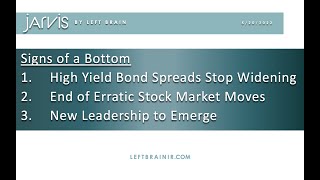
So a couple things you pointed out. The first one on bottoming— have we bottomed? You know, the S&P yesterday was, you know, just devoured. It was down 4% or something yesterday, and I think it's down a half a percent today as we're going to print or press. The— so we can't say that the S&P is bottoming or has bottomed yet, but I can talk about some signs we'll be looking for to determine when we get a bottoming. One of the things that we're going to look for is high yield spreads to stop widening. That is, if you're looking on an ETF basis, the HYG or the high yield bond ETF, once that settles down, stops falling, and starts to regain some strength, that'll be a sign that things have settled down some, uh, somewhat. The other thing is the erratic moves that we've seen in the market there has been no consistency to stock prices at all. And these sort of W-shaped moves, you can look at any market in most stocks and you're going to see the same pattern. That's not a good sign. So, we'll look for that to settle down. And then we're going to look for leadership to emerge. It should be some category of stocks that start to break out and lead the pack. And maybe we start to— you mentioned the green shoots as it relates to small caps, and we've noticed the strength in small caps and mid-cap even. And so we'll be watching that to see if it continues. So we'll be watching all of those areas. But once the market does start to bottom, I know exactly what we're going to be looking for. We're going to be looking for these companies during earnings season who did spectacularly well. Where their business models, excuse me, were proven, where sales and revenues held up, and in some cases we've seen acceleration, and where profits are still buoyant and accelerating. So this is a group of businesses that, you know, hey, their business models are challenged in this environment, i.e., a Target. Then there's these other businesses where their business models are very durable. They have no business issues whatsoever. It's just the prices are down. And those will be the ones that'll be right for buying once things settle down. So we're starting to see those in categories, even there's some technology companies, even everything's not just sort of software and nonprofit growth companies. There are a lot of these growth companies in several different areas of tech and even consumer discretionary that are still doing very, very well, no signs of business issues whatsoever. but the selling's just been so vicious that their stock prices, um, have sort of been caught in a downdraft. So those will be places to look for opportunity.
It's interesting because we've been so, um, bearish on tech pretty much all year, and, um, you know, we started to see something a little bit different emerging this week. I don't know if this is the start of something new or just kind of a dead cat bounce, but that's something we'll be watching. Uh, Nolan and I are sharpening our pencils again, looking for the type of bonds that make sense for an income portfolio, and also the type of growth stocks that we think have a chance to outperform when things start to settle down. So as I said before, definitely contact us. We'll put all our contact details below. If you want to get a portfolio review or hear a little bit more about what we have in store, we'd love to hear from you. So, Nolan, that's it. We've, we've talked about consumer stocks this week. Definitely weakness there. We see some green shoots kind of in small and mid-cap, a little bit of opportunity developing in bonds and in growth. Uh, any last words for our, for our viewers?
Energy. We haven't talked energy yet, uh, but you're right, uh, reach out to us, uh, if you're a subscriber, uh, we'll talk about our bounce-back list. If you're not a subscriber, we'd love to have you as a subscriber, so go to lbir.com and check us out. But we are— Brian's right, we're sharpening our pencils, we're working on our bounce-back list. These will be companies that, um, that we think are great candidates to add to portfolios once the selling subsides. And we've got a long list of companies as we've gone through the first quarter earnings reports that we're really impressed by. And for subscribers, uh, pay attention to the upcoming next month of reports. A lot of these will be companies that impress us during earnings season will we go in and take a deeper dive and to see if they're candidates to add to a portfolio.
Thanks, Nolan. Thanks to all the viewers, and we'll see you again next week.
Go Heat!
More from Brian

3 Tax Buckets Every Wealthy Investor Should Know #retirementplanning #TaxPlanning #wealthmanagement






