Brian Dress and Nolan Langford explain 401(k) basics: why to take employer matching, the difference between traditional and Roth accounts, and what to do with your balance when you change jobs. The three main options are leaving it with your old employer, rolling it to a new plan, or moving it to an IRA.
Chapters
Welcome again to our Fundamentals of Investing series. These videos are designed to explain important concepts you need to know as you work to grow your retirement nest egg and build your personal wealth. I'm Brian Dress, Director of Research here at Left Brain, joined again by our CEO and Chief Investment Officer, Nolan Langford. Nolan, thanks for joining us.
Glad to be here talking 401(k)s and IRAs.
Yes, as Nolan said, we're back talking retirement again. We just recently put out a video that explains the differences between IRAs and 401(k)s, so definitely check that out. That will be linked here on the screen. But we want to talk a little bit more about 401(k)s and IRAs and how you need to orient yourself in terms of investing in those plans. So today we're going to speak about the interaction between the two plans and also some of the nuances of both 401(k)s and IRAs. So, Nolan, first question is going to be about 401(k)s. Should employees participate in a 401(k) that's available at their job? And how much should they contribute? And what sort of investments should they select?
So there's a lot there. Let me see if I can tackle them one at a time. The first one's pretty easy. If your employer offers a 401(k), generally speaking, most employees should participate, particularly if there's a company match. So just so all the investors are on the same page, money goes into a 401(k) pre-tax, meaning if I make $1,000 a week and I elect to put in $50 a week, I'm only taxed at $950. The other $50 goes in before tax. And that's one of the benefits that I get because that money, that $50 that I have compounds over time and I don't have to pay taxes on an annual basis on the growth of that money. The other thing is the match. That would be another reason beside the tax benefit that I get for putting money in. That is, most employers will offer employees a match. So for every dollar that you put in, they'll match you some amount to encourage you and to help you on your way to save for retirement. So it's almost like getting free money. So that would be another reason for employees to participate. So I'm going to say yes, if the employer offers a match. That's another reason. And yes, most employees should participate in a 401(k) plan.
Okay, Nolan. And we hear this question a lot. This has been going around recently. We've got the regular 401(k) and we've got the Roth 401(k). Can you speak a little bit to the differences between the two? And, you know, how should investors think about whether to put some of their money in one and some of the other, all in one or the other? Or some combination?
So first off, I think this is a great development. You know, it used to be that the only way you could do a Roth was in an IRA, and then you had these income qualifications. So if you made over a certain amount, you couldn't. And then there's a— the income cap, the contribution cap, even if I can participate, $6,000 a year. So I think this was great that the Department of Labor and the IRS allows— and these plans have adopted this new side— we can do a Roth 401(k). Basically, the contribution limits are the same for a 401(k) regular, which is pre-tax, and a 401(k) Roth. The difference is my tax treatment. In a regular 401(k) pre-tax, again, in my example, I make $1,000 a year. I put in $50. I'm taxed on $950. Eventually, though, that other $50 that I put in will be taxed. It just will be taxed at retirement. So basically, I'm postponing taxes. Not paying them now, but I'm paying them later. It's a tax me later. The Roth is different. If I make $1,000 and I put in $50, I'm still taxed on $1,000 today, but in the future, as long as the distributions are qualified distributions, that money comes out tax-free. So for each individual investor, that calculation is going to be a little bit different. We encourage you to work with a financial professional to determine which of those are better for you. We're happy to talk to you here at Left Brain to help you make that decision. But those are the variables involved.
Okay, and then another thing that comes up on 401(k)s, Nolan, is when folks change employer. So the question is, should they keep the money in the old 401(k) at the old employer, or should they move it to the new employer, or should they do something else? Should they roll it over into an IRA? Can you speak sort of to that? Decision.
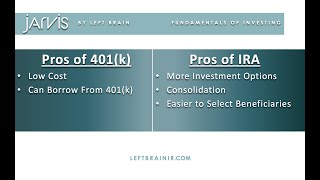
So yeah, so first off, let's just talk about the benefits of having money in a 401(k) plan with your employer and leaving it there. Uh, there's a couple. One is cost, because if it's an employer plan, the rates are generally negotiated as a group. There's buying power from the corporation, and so generally the fees and expenses, um, and the cost in that plan are going to be low and lower. The other thing is, if I'm an active employee and I have money in a 401(k), I can borrow against it potentially if the plan offers that. And so those are a couple of benefits you get when money's in a 401(k). But if you leave and you're an ex-employee, I do have a decision. I can either leave my money at that plan if it's over the $5,000 limit. Below $5,000, they'll probably force you out. As long as I have enough, most employers will allow me to leave my money in the plan. So I have a decision to make as an employee. Should I leave the money in the old plan? Should I move the money to my new employer? Or 3, should I move the money to an IRA account? And they're going to be pros and cons of each.
And again, Nolan, I think this is something we can help folks with if you're changing jobs. And trying to determine what to do with that old 401(k), whether you should move it into the new one, leave it in the old one, or roll over to an IRA. That's the type of question we can help with. So definitely click below. We'll leave our information if that's the question for you as you change jobs. Thanks, Nolan, for being with us. Thanks for explaining those topics. Anything, anything you have left to add?
Yeah, I would just say, you know, when we talk about, hey, moving money and not putting it into the, into the new plan, just a couple of things I wanted to mention. But when I do move it from the old to the new employer, there are some negatives, potential negatives. So the positive is the fees and expenses are probably low, again, because it's a company plan. But my investment choices are also restricted to whatever basket they give me to invest in, in the plan. And the other thing is the new employer isn't going to match the old balance from the plan either. But if you move into an IRA, you do get many, many benefits. So the cost may be more because generally you're gonna— we suggest that you work with a professional and a financial professional. This is part of your overall net worth and your overall portfolio. So you're certainly going to want to track how that money is invested and what you're doing with it. Speaking of investments, one of the benefits you do get from moving it to an individual IRA is not only professional management, but we get to select individual holdings, but the investor may really want to buy Apple stock or Google stock or some other stock they have a high degree of confidence in or some stock with a dividend, and you can do that in an IRA. The other thing is most employer— most employees these days over their working career will have 4 to 5 different careers and untold jobs. So if you have an IRA, as you leave each of these employers, you can put all of that money in one IRA, consolidate it. It's much easier to track and the money can follow you. And then finally, the beneficiary designations. As I get older in life, as I get married, as I have kids, start trust accounts, my estate planning attorney may want me to have more defined beneficiary designations. And in an IRA account, I'm more easily able to do that. So those will be all reasons to think about working with a financial professional to discuss the choices.
All right, Nolan, there's a lot goes into it. So as you said, financial professional is definitely your best bet to try to figure these things out. Thanks again for being with us and, uh, look for the next Fundamentals of Investing. Talk to you soon.