7 Essential Questions to Ask When Choosing a Financial Advisor
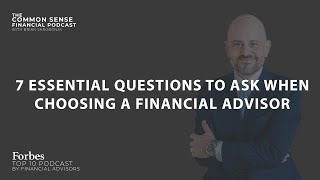
Brian Scribonia walks through seven questions to ask before hiring a financial advisor, covering their experience, licenses, certifications, and whether they're legally bound to act in your interest. He emphasizes that a real advisor builds a comprehensive financial plan, not just picks investments.
My name is Brian Scribonia, and on this episode of the Common Sense Financial Podcast, it's important to know that it isn't just one thing that makes an advisor good. It's the combination of many factors that benefit you as the client. So when choosing a financial advisor, consider their area of focus and how that aligns with your financial needs and goals. Don't assume that you're only looking for investment advice. Yes, everybody wants their money to grow, but investment advice is just one part of the financial plan. Plan. Your financial plan is like the whole wheel. And while investments are an important spoke in that wheel, they shouldn't be your sole focus.
Well, hey everybody and thank you for listening and joining us today. We hope that this podcast can provide you with some insights to help you grow and get closer to your goals this year. But before we get started, be sure to subscribe to this podcast. That way you'll be notified about new content and you'll be able to listen to Brian tackle a variety of different topics so you can subscribe on Apple Podcasts, Spotify, Spotify, Stitcher, SoundCloud, pretty much anywhere that podcasts can be found. And all the links to subscribe, as well as past episodes are available on the website@Brian Scribonia.com so thanks again for tuning in and let's get started.
Opportunities are still there. The attempt at passing down wealth from generation to generation. Consider the outcome, not just popular opinion.
And the whole teaching there is about preparedness and being ready.
There's a difference between what's real and what's true. You're listening to the Common Sense Financial Podcast. I'm your host, Brian Scribonian. Thanks for tuning in and let's get into today's topic. Selecting a financial advisor is a critical decision that can significantly impact your financial future. Understanding the differences between advisors, setting meaningful expectations and resisting the urge to chase unrealistic expectations are really key to finding the right fit. Over the past 30 years, I've worked with thousands of people and have found that there's often confusion between having an advisor who can help you invest money and one who can assist you in living the best life. Some advisors may be capable of selling their investment philosophy, but may not be able to provide viable solutions for more complex decisions investors face. A good financial advisor helps you achieve results not just in terms of market performance, because after all, no one controls the stock market, but by providing actionable steps, steps to move you closer to your desired outcome or result. It is measurable. For instance, it might involve a roth conversion over 10 years, using tax mitigation strategies to not only complete the conversion, but also help minimize the tax impact on the conversion itself. And then once converted, the plan may be to create streams of passive tax free income to fund your retirement. That's different from simply investing and is what most people tell me they really want. They seek a strategy to help mitigate risks, generate income, and implement action steps to tighten up loose ends. So how do we find such an advisor who can help beyond just picking investments? Well, there's a lot to consider here, but I believe there are seven key things to know. These aren't in any particular order, but starting with Experience is crucial. An advisor's experience, of course, is critical in providing sound financial advice. While education is important, it doesn't replace experience. An advisor should be both educated and experienced, of course, to offer the level of service many successful people require. To understand this better, it helps to know how the industry works, at least at a high level. Typically, an advisor begins their career under the mentorship of a more seasoned professional. I have found that it generally takes about five years, maybe about 500 or so appointments to keep the basic skills needed to address clients fundamental needs. Much of an advisor's capability depends on their mentor, of course, and the level of sophistication that mentor provided. If an advisor in training only learns asset allocation methods, that's of course what they're going to know. So, considering their level of experience and whether they focus on clients like yourself, you can ask straightforward questions to gauge their experience, such as how long have you been in the financial advising industry? How many meetings have you participated in? What does your typical client look like? What have you done for your typical client? You should also review their web presence to see what they discuss online and whether their content resonates with your needs. Many advisors websites promise great services and financial planning, but they can sometimes be too vague to really help much with understanding what they actually do. It's equally important to read content they have produced themselves to educate their audience rather than just purchased articles and social media posts. If it's their content, you can gain insight into their approach. Approach Another question to ask is what licenses and certifications or designations do you hold? I've mentioned before that I hold a series 676365 along with a life and Health license. I'm also a Chartered Financial Consultant or chfc, and I hold a Certified Private Wealth Advisor designation or cpwa. For the average person this may not mean much, but for someone sorting through thousands of advisors, these details really do matter. An advisor's License Licenses can reveal a lot about what they can offer. Because regulations require different licenses for various products and services, an advisor with limited licenses may be restricted in what they can provide. For instance, a life license allows an advisor to offer fixed insurance products, and many annuity salespeople operate in this space. A Series 65 license allows for investment management for a fee, but is limited to what can be held at custodians like Schwab or fidelity. A Series 7 license allows for brokerage products to be offered for a commission, which may not be available on the retail side but is limited to the broker dealer's approved product list. There are many designations and certifications advisors can obtain to expand their knowledge on advanced planning scenarios and better meet client needs. Not all certifications and designations are equal. Some require a more of a substantial commitment than others. Many advisors really do choose not to pursue additional certifications because they do require time and money. But while they're not mandatory, they are a plus. When choosing one financial advisor over another, you can ask simple questions like what licenses do you hold? What certifications do you have? What designations do you possess? You can also verify an advisor's licenses and certifications by visiting the FINRA Broker Check website or their professional website to confirm they are properly registered. Research the designations or certifications online through the issuing institution if you want to learn more about the knowledge an advisor gains from completing the coursework. Another consideration is that an advisor is not just someone who gives advice, they also connect you with other professionals and other services. They really are a key resource for accessing their connections as much as for products that you're looking for. The days of an advisor being just a stockbroker to hold investments or make trades, those are really in the past. So the next question to ask is what resources and professional relationships do you have? Who can you offer me? An advisor should have a network of professionals to offer comprehensive support beyond just product recommendation. At my firm we have strong relationships with CPAs, attorneys, functional medical doctors, mortgage and insurance professionals, business coaches, and other specialists. An advisor with this type of network can provide support beyond just investing and can actually assist you in various areas. This is an important consideration because choosing an advisor means not only gaining their knowledge but also accessing their entire network, which can be extremely valuable to your financial well being. You may want to check out their online presence to see what they discuss and how they help their clients gain insight into the areas of concentration. Financial advisors can operate under various arrangements, they can be independent or they could be part of a larger firm or even employed by a company selling specific products. So you'll want to consider whether the advisor is independent, employed by a company, or owns their firm. I have owned and operated my own companies for decades because I believe being independent offers the flexibility to uniquely serve my clients. I also don't think I'd be a great employee if somebody told me what I could and couldn't do. Understanding whether an advisor operates independently or within someone else's firm can provide insight into their level of flexibility as well as the scope of services they may be able to offer you. When speaking with an advisor, you can ask if they own the company they represent or if they are independent advisor or are they a captive to a firm? You can also research this by reviewing the advisor's website and public profiles to determine their business model and the scope of services they can provide. Check for affiliations with special financial products or disclosures that could limit their ability to assist you. Also, ask if they have a particular area of focus or specialize in any specific area of financial planning. At my firm, we work primarily with accredited investors and business owners, helping them reduce tax exposure while guiding them toward a lifestyle supported by passive income. Financial advisors can choose their focus such as retirement planning, tax strategies, or estate planning. This is really similar to the medical profession where specialists focus on specific issues, while generalists may provide a more broader range of services, just not as in depth. It's important to know that it isn't just one thing that makes an advisor good, it's the combination of many factors that benefit you as the client. So when choosing a financial advisor, consider their area of focus and how that aligns with your financial needs and goals. Don't assume that you're only looking for investment advice. Yes, everybody wants their money to grow, but investment advice is just one part of the financial plan. Your financial plan is like the whole wheel, and while investments are an important spoke in that wheel, they shouldn't be your sole focus. So ask about their area of specialization or focus and how that applies to your situation. Review their website marketing materials to determine if their messaging and areas of expertise align with your needs. Also, check if they regularly publish articles or offer insights that relate to their specialization. Speaking of marketing, I include this next point because many people give financial advice, but it's not always clear if they are actually licensed advisors. A person can set up a company and share opinions on money. They can sell books and memberships and programs and not be licensed to offer advice. Meanwhile, somebody like me who is licensed is strictly regulated in how we provide the advice. The way I would suggest approaching this would be to covertly investigate the person or company by searching their website for disclosures. If you listen to my podcast until the end, you'll hear several minutes of disclosures required to meet regulatory requirements. It's like a commercial for a medical drug where most of the commercial is spent listing side effects and disclaimers. It can seem ridiculous, but it's the world of regulations we live in. Everything I say, including the show, is reviewed by our compliance team and requires approval before being released to the public. That's why producing this show can be so labor intensive. This is a process of why I don't just post social media updates or live commentary about markets and current events. It's not that I don't want to. I have a lot to share. I have a lot of opinions, but the production and the review process sometimes delays the relevance of my observations and my opinions. I share this to caution you about receiving information for people who claim to be advisors or worse, financial entertainers who don't follow the same compliance requirements. Because if they aren't following the rules, I'm thinking that it might not be a good idea to follow their lead. As I said before, not all firms are the same, so it is worth asking if they are registered with the SEC or the Secretary of State. It's equally important to inquire if they've been sanctioned by any regulatory bodies or flagged for not following those rules. These questions are helpful, but may not always provide enough meaningful insight. You'll need to do some additional research into the firm to learn more about them and what they stand for and what kind of record they have. A quick look at their website, emails and marketing materials can reveal their disclosures typically found in the footer, and these disclosures should include information on their affiliations, disclaimers, conflict of interest, and much more. If they lack disclosures, it might indicate that they are either not licensed to provide the services you would expect from them, or they are not following the regulations. In either case, this is an advisor I would not be interested in working with myself. You can search the SEC's website to learn about a firm's regulatory standing. The question of whether an advisor is a fiduciary is often discussed, but it's not always very informative. Anyone can claim to be a fiduciary, and while they are required to act in the capacity, it doesn't come with a stamp or a guarantee of service. For example, Bernie Madoff was a fiduciary who orchestrated one of the largest Ponzi schemes in history. They defrauded investors of an estimated $64.8 billion over 17 years. His case demonstrates that simply stating one as a fiduciary doesn't necessarily ensure ethical behavior. When a financial advisor claims to be a fiduciary, it can feel like they're proclaiming that they follow the rules, as if this is a unique achievement. It just seems odd to me because adhering to fiduciary standards is an expected part of their job, not something that gives them something to gloat about. Think of it like a chef boasting I follow food safety regulations. It's important, but not something to flaunt. It's not a personal achievement to highlight, but it's a standard requirement. It's a standard of care. So you can certainly ask an advisor as a fiduciary and they should confirm it if they are. But don't stop there. More weight should be given to other areas we've discussed here. If you're interested in learning more and to understand more about the fiduciary duties, you can check out my Kiplinger article that I wrote called the Fiduciary Standard Explained. I will link to that in the show Notes. So it's important to determine whether the advisor has a process for identifying your unique needs and able to deliver solutions beyond just allocating public market investments based on a risk tolerance questionnaire. That's not planning, it's merely investing. Now, I realize this isn't the most exciting topic to be covering with you, but I have observed a lot over the years and part of my commitment to my audience is to bring you the information I feel will help you in your pursuit of building financial freedom. So as we begin to wrap up here, remember that this isn't an exhaustive list of questions or consideration. When evaluating an advisor, there's many factors that are important, such as the advisor's core values, their family, their faith, their background, their affiliations, their staff, their public profile and reputation, and contributions to the industry and their audience. It's just crucial to build a relationship with an advisor based on more than just name recognition of a company or relying solely on a familiar name without knowing the advisor personally. It's just not enough. For instance, I've been in my current office location now for about 15 years and have observed the corporate office next door to me whose name I won't mention. They rotate a dozen advisors in and out of that office over time, and each time I see it, it's a newly licensed advisor stepping in to manage millions of dollars. It just doesn't make sense to me, but that's my perspective now. There's no way to achieve 100% certainty about which financial advisor to choose. There are pros and cons to every decision, but you can use the insights I've shared to help you make the best decision that you can. And listening to today's show and applying this information can help you choose an advisor based on more than just name recognition, appearance, or charm. None of these factors are inherently bad, but they're not as meaningful when it comes to discussing your financial future than the other points I've made throughout this show. You can visit my websites@scriboniafinancialgroup.com, scriboniawealthmanagement.com buildbanking.com Brian scribonia.com or find my many articles at Kiplinger by searching my name with the name Kiplinger behind it. As of the last update from my team, this show has surpassed over 300,000 downloads and I know many of you listen but haven't left a review. It would mean a lot to me if you'd consider leaving a review. The reason why is the more reviews we receive, the wider the reach of the show and the greater the reach, the more content I can provide and the better guests we can invite. That concludes today's show. I'm Brian Scribona. Thank you for listening to the Common Sense Financial Podcast. Thanks for listening to today's show. If you liked what you heard, be sure to subscribe on YouTube and Spotify so that you can receive notifications when we release new episodes. I'm Brian Scribonia and this is the Common Sense Financial Podcast.
Well, thank you for listening to the Forbes top 10 rated common sense Financial Podcast. Before you go, I want to encourage you to jump over to Brian Scribonia.com to access the full archive of blogs and podcasts. And if you want to be the first in line to get new content, you can sign up for free on the Brian Scribonia website as well. If you're not following Brian on all the social channels, we'd love to have you join in on the conversation. Instagram, Facebook, LinkedIn, Twitter. He's there. Lastly, if you've enjoyed listening to today's podcast, or if you have found value in any of our content, help support spread the word by sharing our videos, podcasts and posts wherever you get them. We greatly appreciate it and are glad that you took the time to join us today.
Securities offered only by duly registered individuals through Madison Avenue securities, llc, Member FINRA and sipc. Advisory Services offered only by dually registered individuals through Scribonia Wealth Management, a registered investment advisor. Tax Services offered only through Scribonia Tax Consulting MASS does not offer billed banking or tax advice. Scribonia Financial Group LLC Scribonia Wealth Management llc Scribonia Insurance Services, llc, Scribonia Tax Consulting and Build Banking are not affiliated with mas. Scribonia Wealth Management LLC is a registered investment Advisor. Advisory services are only offered to clients and prospective clients where Scribonia Wealth Management LLC and its representatives are properly licensed or exempt from licensure. Investing involves risk including the potential loss of principal. Any references to protection, safety or lifetime income generally referred to fixed insurance products, never securities or investments. Insurance guarantees are backed by the financial strength and claims paying ability of the issuing carrier. This podcast is intended for informational purposes only. It is not intended to be used as the sole basis for financial decisions, nor should it be construed as advice designed to meet the particular needs of an individual situation. BILD Banking is a DBA of Scribonia Insurance Services, llc. Benefits and guarantees are based on the claims paying ability of the insurance company, not FDIC Insured Results may vary. Any descriptions involving life insurance policies and its use as an alternative form of financing or risk management techniques are provided for illustration purposes only will not apply in all situations, may not be fully indicative of any present or future investments and may be changed at the discretion of the insurance carrier, general partner and or manager and are not intended to reflect guarantees on securities performance. The term Build banking, private banking alternatives or specially designed life insurance contracts are not meant to insinuate that the issuer is creating a real bank for its clients or communicating that life insurance companies are the same as traditional banking institutions. This material is educational in nature and should not be deemed as a solicitation of any specific product or service. Build Banking is offered by Scribonia Insurance Services, LLC only and is not offered by Madison Avenue securities, llc. Our firm is not permitted to offer and no statement made during this show shall constitute tax or legal advice. Our firm is not affiliated with or endorsed by the US Government or any governmental agency. The information and opinions contained herein provided by the third parties have been obtained from sources believed to be reliable, but accuracy and completeness cannot be guaranteed by our firm. References to Build Banking, private banking alternatives or specially designed life insurance contracts are not meant to insinuate that the issuer is creating a real bank for its clients or communicating that life insurance companies are the same as traditional banking institutions. This material is informational in nature and should not be deemed as a solicitation of any specific product or service. Build Banking is not FDIC insured. Build Banking is offered by Scribonia Insurance Services, LLC only and is not offered by Madison Avenue Securities, LLC nor Scribonia Wealth Management, llc.
The content of this video is provided for informational purposes only and is not a solicitation or recommendation of any investment strategy. Investments and or investment strategies involve risk, including the possible loss of principal. There is no assurance that any investment strategy will achieve its objectives. This presentation does not take into account your particular investment objectives, financial situation, or risk tolerance and may not be suitable for all investors. Information provided is not intended as tax or legal advice and should not be relied on as such. Before acting on any information mentioned, please consult with a qualified tax or investment advisor to determine if it is suitable for your specific situation.
More from Brian



Social Security: Understanding the Numbers and What Happens When One of You Passes?


Make Health Planning Part of Your Retirement Planning, with Regan Archibald - Replay





Different Approach of Financial Planning Addresses ‘the Missing Middle’ - Replay
