Different Approach of Financial Planning Addresses ‘the Missing Middle’ - Replay
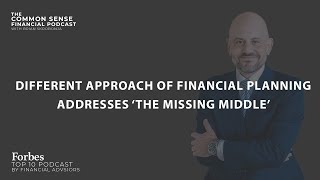
This is a YouTube video titled "Different Approach of Financial Planning Addresses ‘the Missing Middle’ - Replay" published in September 2024. It features Brian Scribonia as the primary speaker hosting the Common Sense Financial Podcast, discussing a non-traditional financial planning strategy called the life cycle model. The podcast covers topics such as managing cash flow, the limitations of traditional saving and retirement advice, and the concept of build banking using specially designed whole life insurance policies as an alternative to conventional banking and investing. The content is educational and aimed at helping listeners rethink their financial planning to better match their life expenses and goals.
My name is Brian Scribonia, and on this episode of the Common Sense Financial Podcast. Sure, the basic idea behind the strategy is logical. Investing early can compound growth over time, but it also kills your cash flow. When you're borrowing money to fund the middle, you're directing more of your cash flow to bank payments because your money is tied up in retirement accounts that you can't use.
Well, hey everybody and thank you for listening and joining us today. We hope that this podcast podcast can provide you with some insights to help you grow and get closer to your goals this year. But before we get started, be sure to subscribe to this podcast. That way you'll be notified about new content and you'll be able to listen to Brian tackle a variety of different topics. So you can subscribe on Apple podcasts, Spotify, Stitcher, SoundCloud, pretty much anywhere that podcast can be found. And all the links to subscribe, as well as past episodes are available on the website@Brian Scribonia.com so thanks again for tuning in and let's get started.
Opportunities are still there. The attempt at passing down wealth from generation to generation. Consider the outcome, not just popular opinion and the whole teaching there is about.
Preparedness and being ready.
There's a difference between what's real and what's true. You're listening to the Common Sense Financial Podcast. I'm your host, Brian Scribonian. Thanks for tuning in and let's get into today's topic. According to popular opinion, sound financial planning advice consists of two main steps, safe for emergencies and and save for retirement after 30 years in the financial services business. I have found this to be slightly misleading. It's a phenomenon I call the missing middle. Just think about how life tends to happen for many people. You get a job, an apartment, perhaps you find someone you want to spend the rest of your life with and get married. You start a family, buy a house, then you need furniture, you take out car loans. You buy the new iPhone, replace water heaters, and then cut the check for tuition. You quickly see yourself with student loans you're trying to pay off, maybe a small balance on a credit card you're working to get paid off while having this idea in the back of your mind that you must have six months of income in a savings account that you can't seem to reach, and you have money going into a retirement account that you can't touch until you're 60 years old. I mean, before you know it, you have thousands of dollars in retirement accounts and thousands of dollars in debt. And according to traditional financial advice, you're right on track. Sounds great. Maybe this isn't your exact situation, but that's not the point. The point is that credo's rules of thumb cookie cutter advice is seldom going to work out. To live up to its own hype. A less traditional, more customized approach allows you to pay for the expenses you incur between now and retirement, in other words, the middle of your life, without entirely losing the ability to build wealth. From my perspective, the Internet, your parents and financial planners alike have all drilled this two part financial planning model into our heads. In fact, the assumption that saving money in a bank and then focusing on retirement is the way to financial security. It's so deeply engraved in all of us that anything else may seem radical and beyond consideration. But this assumption, like so many widely accepted credos, deserves to be questioned. They are not often evaluated against a meaningful benchmark. Rather, they are measured according to generic universal truths. But why not question them? Why is having three to six months of income the right amount of emergency savings? And what's considered an emergency? And when is this emergency going to happen? And what role does insurance play in all this? What is the advantage to sitting on these massive amounts of money in a no growth account until you might need it? The real benchmark should be based on your personal needs, goals and financial situation. When you think chronologically about all the big ticket items that you're going to need to spend your money on or want to spend your money on, the list can get rather long. Cars, home improvements and repairs, medical expenses, your kids, college tuition, family vacation, and on and on. Unfortunately, many people don't account for these expenses in their regular cash flow. So one of two things happens. You continually deplete your savings in order to pay for the things in cash, and as a result, you're constantly funneling money back into your bank account to replenish your emergency fund. Or you finance everything with bank loans and credit cards. Then you work to pay those things off. Either way, it's a zero sum game. There's no wealth being created. There's a lot of expenses between now and retirement that most people are simply ignoring. And to make matters worse, many of these people are handing their money off to the bank or socking it away in a retirement account, potentially reducing their ability to grow their wealth in both short and the long term. For instance, when you store money in a bank, you earn little or no interest, and what you do earn is taxed. Then when you use the money you have stored for A purchase, the money is gone forever. You've missed out on potential earnings while the money is being stored, and then you give up future earnings on the money you spend. And if you're investing in your company's 401k, you're effectively relinquishing control over that money. You're not fully in charge of your investment selections or fully diversifying your risk. You also give up access to your money until you are at retirement age, unless you want to pay a penalty or take out a loan. Sure, the basic idea behind the strategy is logical. Investing early can compound growth over time, but it also kills your cash flow. When you're borrowing money to fund the middle, you're directing more of your cash flow to bank payments because your money is tied up in retirement accounts that you can't use. The older I get, and the more conversations I have with people, the more I'm convinced that you should model your entire financial life around your actual life, not arbitrary concepts or ideas that don't fit into the puzzle of what you're actually trying to create. In our planning process, we call this our life cycle model. I mean, wouldn't it be more practical to model your financial plan around the inevitable expenses you will incur as you live your life? What if you created a system that allowed you to pay for the expenses you will incur between now and retirement? Again, the middle of your life without losing the ability to build wells. If you think chronologically, most young people should not be saving for retirement. Yes, this goes against everything young people are told, but they should prioritize their short term needs and goals before basically doing anything else. That's the point of the life cycle model, in which individuals allocate resources over their lifetime with the aim of avoiding sharp changes in their standard of living while avoiding debt and simultaneously building wealth. Now, of course, this type of system requires a significant mindset shift when it comes to how you store and save your money. In other words, going against the popular opinion of funneling all of your cash into a traditional bank or retirement account and shifting towards a life cycle model. One method to pay for these big ticket items is through privatized banking, or what we call build banking, where you use a specially designed whole life insurance policy in lieu of a bank as both a repository for your savings and a funding source for these larger purchases. This strategy is not quite mainstream yet, but it is becoming more recognized. The biggest challenge for some people is that life insurance is one of the most misunderstood and misused financial products out there. As far as I can tell it's because people compare whole life insurance to other financial services products like traditional or off the shelf life insurance, or even the stock market or other investments. Commonly, when life insurance is sold by salespeople as an off the shelf solution, a large portion of that money the client pays for the first year goes to the insurance company as a form of compensation. As a result, a lot of these generic policies won't show much gain for the first 10 or 15 years or so. That's not necessarily the case with a specially designed whole life insurance policy. It is different, and it uses a design that reduces the cost of the contract and accelerates the buildup of capital. These policies can be paid for and owned because after you've completed the capitalization period of the policy, you never have to make another payment. The insurance company backs guarantees of the death benefit, and no internal cost is removed from the cash value. All other forms of life insurance have a perpetual cost that actually increases over time, and that can lead to not having enough funds in the policy or even forfeiture of the policy altogether. Our build banking designs has a much higher cash value in the first year. That's because we adjust our compensation to allow more cash to be available to the client sooner. And build banking doesn't work unless you have that level of access. So it's easy to see why you shouldn't compare build banking designs to other forms of life insurance or assume that they're the same thing. And as far as comparing this to the stock market, well, put simply, comparing build banking to the stock market is like comparing apples to watermelons. Sure, the stock market could possibly provide a better rate of return, but it could also lose money, which doesn't make it a safe place to store cash. And build banking is not an investment strategy. We aren't talking about competing with the market. We're talking about giving your money a place to grow while allowing access to cash without interrupting the growth of the money. And when you compare a specially designed whole life insurance policy to a traditional bank account, you quickly realize that storing money at a low rate doesn't seem to make good financial sense over time. And one of the potential advantages of build banking over traditional banking is that it allows you to capitalize on money you're going to spend anyway. That's because when you take money from your bank account, that money is no longer available to earn interest. However, when you borrow money from your build banking policy, the entire amount remains in the policy. Now, I've discussed this in great deal in other podcasts. And I'm not going to take a deep dive into this podcast, but if you want to learn more, you can check out other podcasts I've done on the topic. Here's the deal. In order for this idea of the missing middle to resonate, you have to allow yourself to think critically about this idea of matching your finances to your lifestyle. Because the idea of saving in a retirement account and storing money in a bank hasn't prevented many people from having to borrow for auto purchases, college furniture, home improvements. I mean, the list list goes on, right? Some people get so caught up in finding the cheapest saving option while paying interest on loans or disposing of their cash freely, not thinking about the opportunity cost of that mindset. That just doesn't make any sense to me. Here's the problem in a nutshell. People separate their money into two buckets, saving and spending. They silo these two areas of their finances off and they have different rules for each vertical. And they miss out on the potential synergy of having a better plan. So yes, it is entirely possible to carve out a bigger portion of your cash flow for wealth creation if you're just willing to think a little bit differently. And even if you don't change a thing about the way you're saving and spending your money, you might consider taking a closer look. You can learn more about this and more@buildbanking.com that concludes today's Podcast. Thanks for listening to the Common Sense Financial Podcast.
Thanks for listening to today's show. If you liked what you heard, be sure to subscribe on YouTube and Spotify so that you can receive notifications when we release new episodes. I'm Brian Scribonia and this is the Common Sense Financial Podcast.
Well, thank you for listening to the Forbes top 10 rated common sense Financial Podcast. Before you go, I want to encourage you to jump over to Brian Scribonia.com to access the full archive of blogs and podcasts. And if you want to be the first in line to get new content, you can sign up for free on the Brian Scribonia website as well. If you're not following Brian on all the social channels, we'd love to have you join in on the conversation. Instagram, Facebook, LinkedIn, Twitter. He's there. Lastly, if you've enjoyed listening to today's podcast, or if you have found value in any of our content, help spread the word by sharing our videos, podcasts and posts wherever you get them. We greatly appreciate it and are glad that you took the time to join us today.
Security is offered only by duly registered individuals through Madison Avenue securities, llc, Member FINRA and SIPC. Advisory services offered only by dually registered individuals through Scribonia Wealth Management, a registered investment advisor. Tax services offered only through Scribonia Tax Consulting. MAS does not offer build banking or tax advice. Scribonia Financial Group llc, Scribonia Wealth Management llc, Scribonia Insurance Services, llc, Scribonia Tax Consulting and Build Banking are not affiliated with mas. Scribonia Wealth Management LLC is a registered investment advisor. Advisory services are only offered to clients and prospective clients where Scribonia Wealth Management LLC and its representatives are properly licensed or exempt from licensure. Investing involves risk including the potential loss of principal. Any references to protection, safety or lifetime income generally referred to fixed insurance products, never securities or investments. Insurance guarantees are backed by the financial strength and claims paying ability of the issuing carrier. This podcast is intended for informational purposes only. It is not intended to be used as the sole basis for financial decisions, nor should it be construed as advice designed to meet the particular needs of an individual situation. BILD Banking is a DBA of Scribonia Insurance Services, llc. Benefits and guarantees are based on the claims paying ability of the insurance company, not FDIC insured Results may vary. Any descriptions involving life insurance policies and its use as an alternative form of financing or risk management techniques are provided for illustration purposes only, will not apply in all situations, may not be fully indicative of any present or future investments and may be changed at the discretion of the insurance carrier, general partner and or manager and are not intended to reflect guarantees on securities performance. The term build banking, private banking alternatives or specially designed life insurance contracts are not meant to insinuate that the issuer is creating a real bank for its clients or communicating that life insurance companies are the same as traditional banking institutions. This material is educational in nature and should not be deemed as a solicitation of any specific product or service. Build Banking is offered by Scribonia Insurance Services, LLC only and is not offered by Madison Avenue securities, llc. Our firm is not permitted to offer and no statement made during this show shall constitute tax or legal advice. Our firm is not affiliated with or endorsed by the US Government or any governmental agency. The information and opinions contained herein provided by the third parties have been obtained from sources believed to be reliable, but accuracy and completeness cannot be guaranteed by our firm. References to billed banking, private banking alternatives, or specially designed life insurance contracts are not meant to insinuate that the issuer is creating a real bank for its clients or communicating that life insurance companies are the same as traditional banking institutions. This material is informational in nature and should not be deemed as a solicitation of any specific product or service. Build Banking is not FDIC insured. Build Banking is offered by Scribonia Insurance Services LLC only and is not offered by Madison Avenue Securities LLC nor Scribonia Wealth Management LLC.
More from Brian



Social Security: Understanding the Numbers and What Happens When One of You Passes?


Make Health Planning Part of Your Retirement Planning, with Regan Archibald - Replay





Different Approach of Financial Planning Addresses ‘the Missing Middle’ - Replay
