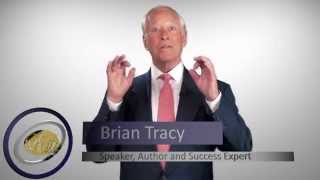
Brian Tracy breaks down how body language dominates sales conversations. Open your hands, smile, maintain eye contact, and stand straight. Dress and grooming account for 95% of first impressions.
Questions this video answers
55%
Tone of voice: 38%; Words: 7%
95%
Chapters
Everybody wants to be more effective. Everybody wants to influence other people better in many different ways. And one of the strongest ways you have is the use of body language. Body language, according to Dr. Albert Mehrabian at UCLA, constitutes 55% of the message that you send in a face to face communication. So what you have to do is you have to learn how to use body language in an effective way. Some of my friends are the world's experts on body language. And you will find, by the way, that body language is the same in many cases worldwide. There are certain differences. In ancient times, when people met new people, especially in strange places at night and other places, they would have to be very careful because you never knew if someone was dangerous. So what they would do is they would open up their hands when they met a new person. Today we shake hands and we shake hands with the sword hand, we shake hands with the gun hand. This is to show the other person that there is no weapon hidden. When we open up both hands, it shows that we have no weapons. This is quite common. So one of the first things you do in body language is you just open your hands. Now, today, people actually embrace each other. When you embrace each other with both hands, it means that you cannot have any weapons and neither can they. Another form of body language which is very important is to smile at people and look straight at them and hold your hands. Now, some people say that when a person folds their arms, it means that they are closed off. Well, this is not always true. In many cases, it's because people are comfortable folding their arms or they're cold or they have an ache or a pain somewhere. So never interpret that automatically. But if you're in a meeting with someone else and you find yourself folding your arms, deliberately open your arms. When you open your arms, what you say is, I am open to what you are saying. I am open to your message. When you close your arms, it can be misinterpreted. Now, another form of body language is nodding and smiling. It's just leaning slightly forward and nodding and smiling. You see, in psychology, we always pay the most attention to people who we most value. You can remember being in a situation where, where somebody says something and you immediately jump up, you immediately lean forward. You're immediately engaged in the conversation that tells you that that person grabbed your attention. So the message that you convey in a sales conversation is 55% body language and nonverbal, 38% the tone of voice, and only 7% the actual words that you use. Remember, Maya Angelou said that People will forget everything that you said in a conversation because. But they'll never forget the way that you made them feel. So a form of body language you can use is to stand straight when you talk. Stand straight, open your eyes, look directly at the person, smile and shake hands firmly to show them that you're happy to be here, that you're happy to meet them. I remember a man in my seminar and he was from India, and he was saying to me that he was really concerned because he really knew his subject well, he understood his product or service. But when he met a new customer, the new customer would lose interest almost immediately in talking to him. Well, when I shook hands with him, his handshake was like a wet fish. His hand just hung there like it was dead from the elbow down. And I'd lived in India for long, long periods of time, and I realized that he didn't understand that in Western culture, a firm handshake means character or honesty, quality, trustworthiness, and a whole bunch of other things. He just thought it was just something that people did. So when he met a new person, he'd just hold out his hand like this, and the person would have to take his hand and he'd just leave. So I taught him how to shake hands firmly. I took him aside and made him practice. And I said, practice this every time you meet somebody. I met him about two months later and his career had taken off. He said all of the initial reluctance he used to get from prospects gone completely. When he shook hands with them firmly and looked them in the eye, he said nobody would ever tell him this was his problem. Another thing, by the way, is that first impressions are lasting. One of the things that I'm concerned about, as you can see, is dress. Many people today have been misled. The fact is that 95% of the first impression you make on other people is dress and grooming. Many people say people shouldn't judge me by the way I look. Well, you judge everybody else by the way they look. Imagine if you walked into a restaurant, a nice restaurant, and the guy who came up to service you was wearing short pants, an undershirt, a tractor cap facing backwards, and beach thongs. In a first class restaurant, how would you feel about dining at that restaurant? Would you think that this person was mentally ill? Well, how do you deal with someone who is trying to sell you an expensive product or service, who looks like a complete bum, who looks like a homeless person? So be very important. It's very important. First impression, sit upright, face forward, and ask a lot of questions. The very best form of body language is to ask really good questions and lean forward and listen closely to the answers and nod and smile and agree. And if you'll do that, you'll make a tremendous impression on other people, especially a first impression. So thank you for watching. What's the one action that you're going to take from now on to use your body language more effectively? Are you going to open your eyes? Shake hands firmly, smile, tell people you're happy to be with them, ask them questions, and listen closely? Leave a comment below and until next time, remember that only you are responsible for your success. Whatever you're achieving is coming from your own actions and your own behavior. Sam.