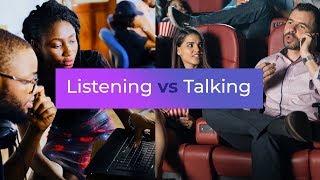
Brian Tracy breaks down how to listen better: face the speaker, make eye contact, nod, and pause after asking questions. Three simple prompts work best: "What sort of work do you do?" "How did you get into that?" and "Then what did you do?" Dale Carnegie said rapt attention is the highest form of flattery.
Chapters
Hello, I'm Brian Tracy, and today I want to talk to you about how to improve the way you listen. Communication is a skill that you can learn. If you're willing to work at it, you can rapidly improve the quality of every part of your life. The most important factor in communicating more effectively is actually the opposite of talking. It's improving your listening skills. You must learn to start asking questions and listen attentively without interruptions. As a rule, you pay attention to people you most value. When you pay close attention to another person when they are talking, you signal to that person that you very much value them and the content of their comments. This is very flattering to another person and it causes them to respond warmly to your attentiveness. The major reason that most people have poor listening skills is that they're busy preparing a reply while the other person is still speaking. In fact, they're not even listening closely to what the other person is saying. They are thinking of other things and formulating their comments to be ready as soon as the other person takes a breath. Effective communication requires that you face the other person directly, lean slightly forward, and hang onto every word. Listen as though there were nothing else in the world more fascinating to you than what the other person is saying. In romantic relationships, by the way, this is incredibly effective. The very best conversationalists seem to have identified the knack of making the person that they're listening to feel as if he or she we're the only person in the world. Good conversationalists can do this in the middle of a crowded room. Dale Carnegie once said that rapt attention is the highest form of flattery. Let me repeat, rapt close attention is the highest form of flattery or paying value to another person. If you want to flatter a person and cause him or her to think highly of you, just pay close, undivided attention to every single word that he or she says, as though he or she were about to give you the winning lottery number and would only repeat it once. You'll be amazed at how much more conversational a person becomes and how much happier they are with you when you show them that you have effective communication and listening skills because you listen so well. In addition to listening without interrupting, you should also nod and smile and agree with what the other person is saying. Be active rather than passive. Indicate that you're totally engaged in the conversation. Make eye contact as the other person talks. Relax your body, and if you are standing, allow your weight to roll forward onto the balls of your feet. Only you will know that you have shifted your weight like this, but the overall impression you will give the speaker is that your whole energy is now forward and focused on what he or she is saying. How do you get this opportunity to listen so well? Simple. Start asking questions that are good and pointed and keep asking questions one after the other. When communicating, there are three powerful questions you can use to control any conversation, to open up the other person, and to get the other person talking extensively about himself or herself. The first question when you meet a new person is what sort of work do you do? By asking questions that are easy and general and that do not demand information on the person's current job or position, it gives the individual the choice of answering you briefly or in depth. Remember, people are fascinated by their own work that takes up so many hours of their lives, and when you ask the question, they love to tell you about something that is central to their existence. Your second question to follow the first is how did you get into that line of work anyway? Start asking questions as though you are absolutely fascinated by the choices that he or she made to get into that particular field. I sometimes joke that most people feel that their personal career paths are among the most fascinating stories ever told on earth. When you start asking questions about how they got into their current line of work, they will usually be very pleased to tell you about the various twists and turns of their lives and career and the factors that lead ultimately to them doing the job that they are doing at the current time. The third question you can ask when the other person hesitates or slows down to check to see if you are really interested or if you're just making conversation is this and then what did you do? This third question can be used to keep almost any conversation going indefinitely, like keeping plates spinning. You can ask how did you happen to move to the city? Or how did you happen to go to work for that company? Or how did you happen to choose this sport or activity? People will be more than willing to answer these questions for you, and when they slow down for any reason, you smile pleasantly, lean forward a little bit, and ask, and then what did you do? You will be amazed at their responses. Try these tips to make any person you're talking to feel more important and improve your communication and listening skills at the same time. One key point is that when you ask a question, the only way that the other person knows that you care about the answer is if you pause and you leave a silence so the other person can fill the silence with their answer. Many people think that they're becoming good communicators by asking lots of questions and but they don't leave any time for the other person to respond. When you leave time for the other person to respond, lean forward and watch the person's mouth while they speak. They will know and feel that you really care about the answer to the question. Now, I love to hear from you. So my question today is what have you tried that's helped you to become a better listener? Leave a comment below and I'll be sure to follow up with you. Thanks for watching. And remember, if you want to change your future, take action. And take action now. If you enjoyed this video and feel that it was valuable in teaching you about communication skills, subscribe to my channel like this video and share this video with your friends. Don't forget to click the button on the screen for a free gift. Thanks again for watching.