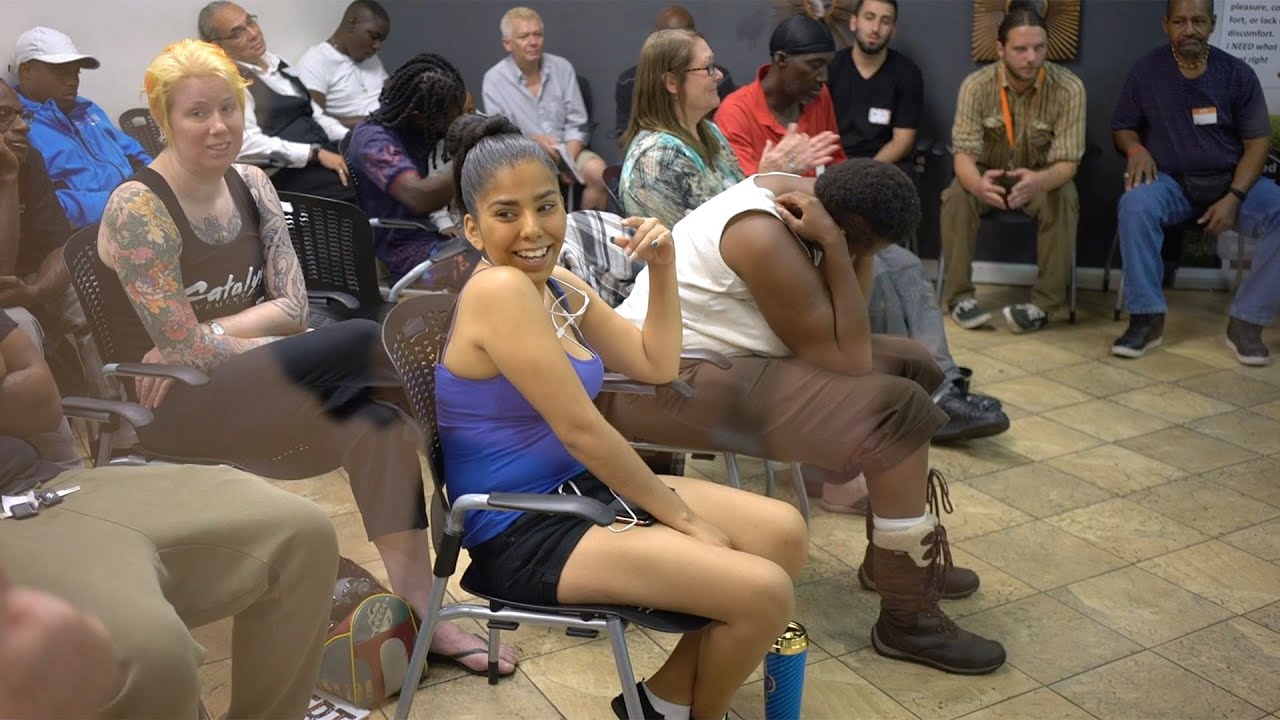
The video is a documentary‑style profile of Above and Beyond Family Recovery Center in Chicago, introduced by philanthropist Bryan Cressey. It opens with stark statistics about Chicago’s size and its pervasive substance‑abuse problem, then moves through a series of raw, first‑person testimonies from five clients (Speakers A‑E) describing decades of crack cocaine, alcohol, and heroin use, homelessness, trauma, and the personal losses they endured. Cressey explains his motivation to found the center: a belief that the lives of the poor and homeless are as valuable as anyone else’s and that high‑quality, evidence‑based treatment should be accessible to them. Executive Director Dan Hostetler outlines the center’s unconventional, outpatient model, emphasizing 22 weekly evidence‑based group sessions that focus on purpose, self‑love, and goal‑setting. Staff credentials (master’s‑level counselors) and specialized programs such as MOVE (movement therapy) and a nutrition component (on‑site garden) are highlighted. Facilitator Terry London discusses the REBT‑based emotional regulation curriculum. The narrative then shifts to client progress: graduates describe restored family relationships, employment, schooling, and renewed self‑esteem. The video culminates in a graduation ceremony, repeated affirmations of “you saved my life,” and a call‑to‑action directing viewers to the center’s website (anb.today). The overall message is that holistic, high‑intensity, community‑driven treatment can transform the lives of Chicago’s most vulnerable addicts.
Chapters
This is Chicago. It's made up of 237 square miles, 2.7 million residents, 5 pro sports teams, over 200 theaters, and one very large substance abuse problem.
I was addicted to crack cocaine. I was smoking $100 to $100 a day.
17 and 18 and 19-year-old girls out there that are thinking that prostitution was the way to live and shooting up was the way to live. I've been raped at knifepoint. I've been raped at gunpoint. I've been—
I ended up in the hospital several times. I was starting to drink a whole large bottle of vodka at a time.
A 36-year run of cocaine use, crack cocaine.
I was selling myself, looking for a fix every day.
Living out of my car, drinking every day, a case a day.
Enter philanthropist Bryan Cressey.
The key thing that got me to start Above and Beyond was The recognition that my life is of exactly the same value as the life of the homeless person, the poor person who's on the street.
It had gotten to a point where I didn't even want to live.
I lost my kids.
I lost my job of 28 years.
While I was using, I was also teaching Sunday school.
Many of these people were good people who had had a series of bad breaks.
I was molested.
As a child, my father had a very bad drinking problem.
I knew I could help them with high-quality addiction treatment that they had no access to and never would have access to.
I was ready for a change.
And I knew they could transform their life if they were brought the right clinical program and the right people to help them transform their life. If they were brought Above and Beyond.
Above and Beyond Executive Director Dan Hostetler rejects conventional treatment methods.
My name is Dan Hostetler. I'm the Executive Director of Above and Beyond Family Recovery Center. We are a behavioral, outpatient, very unique addiction treatment center. We have 22 group sessions on a weekly basis, which is more than just about any place I've, I've seen. The types of group that we— the groups that we offer are all evidence-based. They deal primarily with uncovering purpose and meaning in our clients' lives, helping them to love themselves, and teaching them how to achieve goals. Those are 3 of the groups that we offer, of the 22 that we offer. Our staff looks forward to coming in every day.
Hello, my name is Ashley Lewis. I'm a senior counselor here at Above and Beyond. I love y'all, I promise I do, I love it! This is my favorite time of the day, and right now it's 9 o'clock. We welcome our clients with breakfast. Groups are starting and I'm screaming to the top of my lungs, Maury Covish right here, AA's in the art museum!
Our counseling staff all have master's degrees.
The services that are offered here far exceed many other places that I know of.
And this is Marcelino and his team.
We're here getting ready to start our MOVE class. MOVE is a movement therapy course teaching people how to connect Their mind and body to build strength, build healthy habits. It's really good for people who are suffering from any kind of addiction because there's really no getting rid of your addiction. We're replacing old habits with a better habit.
They come in the door and they don't have any purpose and meaning. They don't understand their reason for existence, and we don't tell them what that is. We give that— we show them the techniques so they can uncover that themselves. So we don't have a lot of talk of suicidal ideation here. This is the area that could be called the waiting room, and we have Alicia here who does the intake, figures out who they are and what they're doing here. Terry London, he's a facilitator here.
We call the ABCs of REBT to control your emotions and your behaviors. It's not just about what you put in your body, but about anything in your life.
We believe that addiction is 70% psychological. Teach them how to deal with their own thinking, how to deal with their own compulsive thoughts.
You still find it Annoying to go through the hassle, but the Janie of 3, 4 months ago would have copped an attitude and made herself quite angry to the point you want to kick this person's ass. You don't do that anymore, so you're thinking rational thoughts.
But we grow food out here, so we have a lot of food that we pull out of these gardens and we eat inside. Diet is a very big part of what we do. We believe that nutrition is very central to complete recovery.
Above and Beyond has helped recover thousands of lives in Chicago, and they're just getting started.
The poor and the homeless getting the best care in America, and we're underway. It's working.
I'm a better father. I'm a better husband. Thank God for that.
I'm not ashamed of me today. You know, those are just the things that I did. They're not who I am.
I started getting job offers.
My way of thinking has changed.
I'm in school.
Graduation at Above and Beyond.
I'm so proud of all you graduates.
No matter how big, no matter how small, I've been told I was gonna be a bum, all sorts of crazy stuff.
But look at me now.
Look at how I look today.
Look at how I'm ready to go and accomplish this.
The people talking to each other, encouraging each other.
When I saw your father's smile.
Congratulations again to all you graduates.
I get real emotional because when I wake up in the morning, coming here makes my day great.
But when I came here and for one thing saw this beautiful facility, it doesn't seem like you're in a clinic or a hospital.
It makes me happy to be able to help somebody or to be able to listen to somebody.
The people on the street who are dying, their lives can be saved.
You saved my life.
You saved my life.
Above and Beyond, you saved my life.
Above and Beyond, you saved my life.
Above and Beyond, you saved my life.
Above and Beyond, you saved my life.
You saved my life.
You saved—
You saved my life.
My life. Saved my life. You saved my life.
You can save a life.
For more information on Above and Beyond, Go to anb.today.