The AI Revolution Call: First Call of 2026! CES 2026, Gemini on the iPhone, and More!
Cody Willard and crew break down Apple's deal to put Google's Gemini on iPhones, Nvidia's new Vera Rubin platform for data centers and robots, and why agentic AI systems will dominate 2026. They also explore the wild idea of AI data centers in space.
Chapters
Hello, welcome to the AI revolution. Call. I'm Cody Willard B Money Self like self nicknamed here. I like it though Bryce. I might keep that. All right. Change your name in my contacts.
I had to log in again and ask me what name I'd like to use. So I was like I'm going with B Money.
All right, I like it. And John Dio, Craig Bryce and I run 10000 days capital. We invest in technology revolutions including AI. And Johnny has been working in AI for decades. Believe it or not it is true.
This is why I barely made it here was in time was because I had to get my, I needed my.
My coffee so you need some caffeine, get the blood. I would think the adrenaline of being on camera would be enough.
Certainly helps. Yeah yeah.
The look AI I mean is amazing how like we've been gone, I think we've been two weeks that we didn't do last week and we, you guys might have done a week even before or something with me gone. But it's just amazing how quickly the news continues to accelerate. I mean it seemed like every week there was some mind blow developments and competitive jockeying and leapfrogging going on for the last, what's it been three and.
A half years now since Chad GPT moment November 2022.
So yeah, three and a half.
Three, three years. A little over three years and. And it is accelerating. We always talk about the Kurzweilian acceleration of technology and that the innovations accelerate and in exponentially over time and it's exactly what like you would expect then mind blowing developments like daily. So like this morning Bryce and Craig and I are doing our weekly Monday strategy set up the week call and in the middle of it like Google is announced as Apple's. Apple announces Google as almost was passive there. Sorry John. Apple announces Google as their AI partner for Siri going forward. Thank goodness because you guys, if you've ever watched this AI revolution call before, you've seen me ask Siri to do something and it never works and it's an ongoing joke. I would think in six months it works. But more importantly it's distribution of Gemini, a viable very good AI platform. And then all of the agents and stuff you're going to be able to put on your phone and I always talk about the probably the probably the single lowest hanging fruit for like operating systems using AI is just being able to communicate speaking what settings you want changed and that will be amazing. It literally is just so archaic in many ways. But to simply be like hey Siri, don't. I don't want Slack to show notifications anymore.
Sorry, I can't do that.
Six months. I think you will. That's just so cool.
Yeah, I think it was a. I mean it's a big deal. It's surprising. I AI the AI trade has. Because it's a little long in the tooth. Like it doesn't get the immediate pop factor anymore. At least it seems that way for like the last three months the stock tried to rally and pretty much gave back its gains early like within the hour. Like the move happened and, and gave back price. Google. Google. Yeah, Google. Like while we were on our meeting, Google rallies and I'm looking at the chart, I didn't see it. And then it had already faded back to where it was trading before that. But I do think it's a substantive and I think it's a big deal for Google and a huge stamp of validation. I mean right.
Obviously partly more priced in now than it was three months ago when the stock was at 250 and now it's at 3:30 and. But that's exactly right. Bryce six months ago really was really prime time. AI and me like announcements would make a stock get jiggy with it. If I may show my age there really.
Craig.
Craig is fun because he actually gets my like 1990s and 1980s references. He's just older enough than Bryce that it like there's like some camaraderie about him. Knowing what I meant by get jiggy with it, maybe Bryce did too. But this morning Bryce didn't know Coolio was.
I'm always there to pick up, you know that slack. So thank you.
But look, I mean it really, it is substantive and six months ago that announcement probably would have popped Google 10 or 15% intraday. It might have given back some of that like always happens with noise. But it is I think over, you know, like Google pays Apple $20 billion a year for the right to be the cert. The default search on the iPhone. If, if Apple like like as AI actually gets helpful on Apple, they will end up generating more services revenues, more app store revenues, et cetera and Google will be paid. Somehow I don't think they disclosed like the arrangement of today's announcement. I don't even think it was a formal announcement. It was like the cnbc one of the. Who's that guy who calls the Tim Cook and gets like inside information before the every quarterly report price, whatever that guy's name is. He said he's a good reporter. Frankly I, I think he does a good job and cnbc, but anyway, apparently he talked to John to. I can't remember the guy's name, but the head of something over there at Apple. And you would know the name if I could think of it. But anyway, he said he just told him that they're using Google and they've been testing a lot of other LLMs, but Gemini was the one they went with. Google. Gemini. So anyway, it's not even formal, so maybe that's partly why the stock didn't really get jiggy with it. But theoretically it. Bryce, do you know who's saying get jiggy with it? John Dio. Do you know saying get jiggy with it? Getting jiggy with it, I think technically is the name.
I could pick it out of a multiple choice, but.
All right.
Craig Will Smith.
Yeah.
Really?
I'm so glad that you actually did know the answer, Craig, since he said you knew the answer earlier.
I was gonna say the guy who. He's best friends with. Chris Rock.
Chris Rock's best friend.
It's the other half of that. That duo. Yeah.
Yeah. How bad an actor was DJ Jazzy Jeff, by the way?
He wasn't trying to be an actor, though.
He was like, what were they putting him in every. The first season. He was in every other episode of. What was the name of the Fresh Prince of Bel Air? I would like to instruct AI, one of the video services, to redo Fresh Prince of Bel Air and make DJ Jazzy Jeff a good actor.
You know, I haven't seen it actually get around to acting, but it's. It's getting close now.
Anyway, guys, it really is amazing. We haven't even hit on that. The. You know, there is a. I haven't read the news. This is two or three months in the making, and it's been around for a while, but, you know, there's like a movie star, AI girl that is, I'm sure, been signed by Creative Artist Agency, my former agency, actually, but in something. Yeah, I don't think she's been. I don't think anything's been released, but, yes, it's coming. She's been signed by the agency and now they're shopping her to studios be the star of a movie.
What's her name?
Tilly Norwood.
Tilly.
Tilly.
The thing about Tilly Norwood. No, first they were going after, like, you know, Instagram influencer type things. So they get the same person looking the same way from whatever angles and whatever clothes. And, like, they don't be like, you know, be like, A model, that kind of thing acting. That's. That's kind of tough.
John. It's. It's here like it's just another. It's all of this stuff gets. Can. Gets solved with more computer. If it were at the stage where they can do it, they just don't have enough compute to turn it on and make it work as quickly as we all want it to. Which by the way, by the way is why Corey was up. Finally today 15 all of the AI neo scalers were moving even in China.
But.
Oh, here. Let's get Craig back. Craig, did you pick up the Starlink?
I did. I am so excited.
Side note, we always hit site space side notes on our AI call because it is the AI robotics and space revolutions that we're living through. I'm trademarking the term. Bryce, I think we should look into actually trademarking this. I like when you threw the TM there on our. I wrote a letter to my, to our investors year and letter and I coined the term the heirs Revolutions AI revolution space A I R S get it airs like also Michael Jordan. It's a reference. Come on guys, work with me here. It's. It is happening and we make side notes on this stuff quickly. And like Starlink is better. It's more reliable. Even in downtown Las Cruces where those guys work. Is it downtown? What do you call where you work?
Right, Messiah.
Messiah close to downtown Las Cruces. And their Internet sucks. And so for months we've been battling bad Internet. You know what the solution is? Starlink.
It's cheaper and better speeds.
I've been a StarLink customer for five, six years now. I don't even know. Maybe I'm exaggerating a long ass time and it's was life changing. I live in rural New Mexico. Middle of nowhere though and we had really bad DSL service and even worse cable service.
Did you get the version with the protection against Ayatollah?
Side note, Starlink turned. Elon turned on Starlink for all of. Yeah.
And they turned it off. The, the, the Ayatollah did.
So yeah, that is true. Yeah.
How did he turn it off?
How did he turn it off?
I don't know.
I don't believe that.
Yeah, I mean the hard part is.
People who have it, they're going around and house to house and finding people who have it.
All right, well I believe that but you can't turn it off. You can go take their receivers but it is beamed from outer space through a, a secure coup band to get There.
How do they get all of the dishes?
I don't think there's a lot over.
There yet, but there's 5,000. But they, they really, they're kind of tracing signals coming and going when the rest, when everything's blacked out. Everything else is, they can pick up on, you know, signals happening while, while the network, while every other network is down kind of thing.
In the name of protecting their people.
Of course.
Yes.
So, but yeah, yeah, Starlight, I mean we were look into that as well. When we're looking at the kind of rural property idea, you guys just happen to live that way year round. But you know, we're city folk who just look, look at that as like a more of a weekend.
That's my point is Bryce is city there. It's, there's 400,000 people in that town that's not rural. There are a lot of fiber optic cords running around Las Cruces.
And trend, it gets to be a self fulfilling prophecy. I was telling Craig, like these companies have been losing subscribers. So they're not investing in their infrastructure and their network, which makes it less reliable, worse speed. So they lose subscribers, you know, and then it just becomes a self fulfilling. I mean it's the meanwhile.
And meanwhile Starlink is doing accelerated launching and better service, better satellites. I mean, you know, that's one of Elon's best traits as a manager. He, I don't know if he has a good trade as a tweeter, but as a manager one of his best traits is constant iteration, constant improvement, constant questioning of first principles. While we're on space, let's tie space and AI together. I don't think we've talked to John about the idea. Potential excitement around data centers. AI data centers in space.
I mentioned it a couple weeks back. We really talk about it much. But yeah, yeah, we've done a lot.
Of work on this for a year now. Many, many months at least. Long before it became like I think Bezos about a month ago sort of mainstreamed this concept when he was on a panel some or you know, talking on a stage somewhere, being interviewed and he said the next big thing will be AI data centers in space. And everybody's like oh my God. But we'd actually been working on this for a while here because the idea is pretty darn good. The, the, the biggest problem with AI building data centers right now is you need electricity. And even if you do a solar AI data center, that's only 35% of the time that it gets powered even in a sunny area over the year. Whereas if you throw a data center. Solar panels on a data center orbiting Earth, it can stay in the sunlight essentially all the time. And so it's 24 hour energy free energy from the sun. Space is extremely cold, but there's no air to dissipate the heat. But if you throw a solar panel array on top of a giant server. Cluster of servers and not giant. We're talking probably. What do you think? Maybe 8 to 10ft will be the actual data center satellite.
Yeah, maybe some rest will be 80.
To 100 square feet of solar arrays. And then you'll pipe water through there and it does dissipate enough as it runs through the solar arrays to cool the servers. And why do you need to cool.
I've heard this and there's like. There are the pessimists about it who say, yeah, it's not as simple as everyone's making it sound. I don't know if it is.
I don't think anybody's making it sound simple.
But I thought the cooling. I mean the simple aspect was it's in space.
It's actually an interesting question. I was. That's one of the things I wanted to ask you and maybe I guess we'll have to go get some Gemini work and figure this out a little bit better. Look at Bryce's Internet.
Yeah, yeah.
Crappy Internet service. That's why we're doing next week. He'll be crystal clear. Like me on Starlink.
I'm like one of the reporters like at the side of a hurricane.
Yeah, it really does. Or it looks like a 1988 VHS tape or something.
You got to stop reusing the same tape for everything. There be money. Yeah.
There you go. Bryce, get a new tape.
There's this new thing called CHAT GPT I'm really interested to talk to you guys about. It just came out.
Back in time.
So what do you guys think about the election? Trump got a chance.
Nixon.
I thought you were gonna talk about Reagan versus yeah, just don't drive 88 miles an hour.
We'll never see you again.
Anyway, the. The John, it seems like, I mean the reason why the chips get hot is because electrons are moving around as all over these tiny little spaces info. You know, infinitely tiny microscopic spaces and electrons are buzzing about and it heats up the wires. And part of that I would think is because there is air. But maybe not now that I'm saying that out loud. No, the. But the reason it is a semiconductor is because it is slowing those electrons down and. Or Blocking them sometimes. And that causes friction on the wire.
So however, you're like one level deeper than I was going to get, which is just. I'm like, okay, chip hot. So the, the, the chip, the. We say the wires, like the wires within the chip. The. You know.
Yes, that's what I mean.
Yeah.
Everything.
The microscopic wires on that chip get hot.
So if I put a chip in space, how cold is that chip going to get? Even just by itself?
Like almost zero.
Infinitely cold. Yeah. I mean, super, super cold. Yeah. And so they're like, I don't know. So now you got new problems of, I don't know, maybe it's stuff that condenses in a way you didn't want or whatever. You know, it was stuff wasn't designed for that. But, but it's a great idea. And also the other great part of the idea is like you talk about this data center taking up like whatever nine feet or something, but however much it takes up, it could be even smaller. It's talking to ones next to it.
Correct.
It's all one big data center at that point.
It's just like Starlink with the. It's a grid and they talk to each other via light.
I'm just picturing they will try to get as much processing, compute power on each of the satellite as possible. And you're right, it might not be that big. They could do, you know, they're good. We're talking It'll be probably 10, 15, 20,000 AI data centers that will be replacing Starlink's current generation of satellites over the next three to five, seven years. One of the things that this does underscore is what I, why I've always been so excited about the space revolution. Over the last, not always, but over the last five to seven years, I've been very excited about the space revolution. And this is a perfect example. As costs to get things into orbit go de minimis. We just can't fathom all the applications that people will figure out to put in space. And one application is AI data centers. It's just one. There will be millions of ideas of things to do with orbit orbiting satellites in space in coming years. A lot of it's centered around AI. All right. We also got to hit ces. We didn't do right. John couldn't do last week's call, but we actually, the three of us were, we were gonna do it, but we were wanted to watch Jensen Wong's keynote at CES in Vegas last week. And it started, I don't know 2:10 or something. Our time, 50 minutes before our call. And when it hit the time for the call, he was maybe two thirds done in the midst in the juice, man. And it was very exciting. But actually it was very exciting, I guess in large part because he revealed the new. What's the name, Reuben? What's her first name?
Vera.
Yeah, Vera Ruben. That was. I trying to remember the first name. The new Ruben chips, the new Vera Rubin platform. And they're two ton boxes of. How many was it like, did he say two miles of copper in each box?
Yeah, each server.
And they're two. They weigh two tons without water. With. With water it's like two and a half tons. They had accidentally shipped the server from California to Vegas with water. And anyway it, you know, another. Not quite order of magnitude better in efficiency in training and in inference and in energy efficiency and in speed as an entirely new platform for every single one of the chips inside of it, they, you know, they, they've put memory ever closer to the actual.
It seems so soon.
What's that?
It just seems so soon. Since the last one, Woodbridge or whatever. It's like they just named. They just announced one of these every year.
That's his plan. Every year.
Was it only a year? Was it.
It's been one year.
A full year passed.
I, I think that's about right. Yeah.
They started shipping. I don't remember when they first announced Blackwell, but they started shipping it like in maybe second quarter of last year.
And so the plan is to start shipping Reuben in this second quarter.
Okay.
Yeah.
So yeah, it just, it is fast.
But I mean, which is also why a lot of the short sellers hate the core weaves and nubiuses of the world. Because like you're going to have to keep iterating and building and getting the new chips and the new data centers and continuing to build and accelerate. But watching his, his program, it also became clear, he actually said it explicitly, that the data centers get more profitable by an order of magnitude with the new platform. And so they'll still be using the old data centers. They're not ripping them out. And they'll still be generating revenue very profitably. And the new data centers will probably have higher gross margins and even thereby net margins and thereby earnings for these companies in the years ahead.
I heard.
Go ahead.
I just heard, I heard it secondhand. But was he saying something about that? It's not just, it's not just the chip anymore. So concentrate more about the whole system around that and you know that be like the data center.
You know, I think John, that was even the Blackwell. He really started wanting us to picture it as a system, not a chip. And it's true. It's almost like a server itself, not a chip anymore.
Nvidia designs and builds everything you need, I mean, except for the plastic box, metal box that it goes in. Dell and HP and those guys assemble it, put it together and sell it as a system. But Nvidia now does it all. I mean, the networking chip, the optical chips, the cpu, the gpu, there's I think there's six chips they designed in the system.
And another point to make that I think is very important was he talked about that it takes two hours to build a Blackwell server. And he showed all of the connections and wirings and things on that individual server and he said, and here is what Vera looks like. And it's just a few, like, it almost looks like hard drives, two or three plugins.
Right.
Sounds like a SpaceX rocket, you know, each time they remake the engine.
And so he said it now takes five minutes to build one of those servers they'll like. It's just wild.
Do you remember was it 5 minutes for like Foxconn to build it or like 5 minutes for HP or whoever to put it all together?
I don't think he said whom, but I would think all of them are, you know, five to 10 minutes each. You know, like they're all specialty, they're all.
Why does it cost less? Does it cost $40,000 still or.
Probably more.
John. Probably more.
Sure. Yeah. I don't think he announced.
It's all about the cost per the efficiency metrics, the cost per watt or the cost per token. Whichever one you want to look at.
Yeah.
And because that's directly correlated to the revenue of the people buying these things. Okay.
So do the, do the math. If they're eight times more efficient, you could double the price and everybody wins.
Yes.
Right.
That's about what's happening, I think. So now you step up a level and you've got the folks that use this kind of stuff and now it's your anthropics and OpenAI's exception. Anthropics using Google stuff actually. Right. But you know, these kind of things, the people who are the real heavy duty consuming of what's happening in these data centers, that's, that's up next. And for them, they're thrilled for having, you know, what Nvidia's making, but they'll use everybody else as well. They'll fill in everything they can to.
Get together, fill in everything they can. But I think that was another point that was pretty evident watching that presentation. About a third of the way through it I turned to Craig and Bryce and I said like the Nvidia's lead over AMD just got bigger. It's instead of three years, it's five years. And yes, people will buy AMD because they can't get their hands on an Nvidia and that's fine, you can at least do some stuff and you know, and AMD is going to try to sell their systems at a price point that enables their customers to win. But I don't know John, I we've been buying Nvidia.
Well then Nvidia also goes and buys Grok as we talked about with a Grok with a Q that you know, could have, would have been kind of a competitor, you know, not at the scale but in terms of just the technology that they offer. And Nvidia's like that's fine, we'll just buy you.
Well right. And Johnny, like that's the thing about a company like Grok with the Q, the semi like a, you know, AI chip company that Nvidia for all intents and purposes purchased a couple, three weeks ago or at least announced the intents to purchase. They'll get approved and everything. And it you that company could, you know, had a five or ten year vision of how they could have actually leapfrogged Nvidia and now Nvidia will incorporate whatever that was, that strategy and those technologies into their own platform. So yeah, it really could have been an Nvidia killer eventually, but it's another win win.
Right.
I don't think amd, I don't think, I mean, you know, I, I look Avago with it's Google builds their AI with both Nvidia and their own internal chips that are designed using Avago technology. And that's not going away. They'll still be doing that. I mean that's, I don't like you know, you're not going to leapfrog Google like you can AMD because Google's, you know, already up there, their TPUs are at least in the same universe already with Nvidia but obviously it's just internal for them.
Any talk about the in how much more emphasis should be now on inference rather than training.
I don't think Bryce did he, I.
Don'T think he's building the model.
How much training, you know, how much training, capability and efficiency they're enabling here.
He talked about both, he Said you could drain. Well, Nvidia as a test trained a 10 trillion parameter AI model. They called it Deep Seq because Nvidia themselves modified it to make it bigger than Deep SEQ really is. And so that would probably be the largest large language model in operation. So they train a 10 trillion parameter model on 100 trillion tokens and it takes one fourth of the amount of equipment to train that model in the same amount of time as it would have with the Blackwell system.
They say how much time that is?
Yeah, they train in a month. So you 60, 64,000 Blackwells could train a 10 trillion dollar 10 trillion parameter model in one month. And with Reuben it only takes 16,000.
They didn't do the whole thing. They kind of did a sample of it to figure out what it would take. Because if they did the whole thing we'd all be taken over by the computers by now.
Yeah, maybe.
That'S it is. But that was, that's the thing is that I, I come back to like, until you can make a 30 minute science fiction episode with a prompt, we need more compute and we are so far from being able to do that. The technology exists, but the compute power doesn't.
That's on the. Yeah, it's on the infant side.
Like if you're gonna like if you were going to take a movie budget of a hundred million dollars, you could make an hour and a half long completely AI generated thing. It would take you forever and it would be very difficult. But three years from now they'll have the compute and the prompts and everything, the platforms, the like, you'll even be like, hey, that character and put it over there. But for this thing. And again I could make DJ Jazzy J good actor. That's.
Yeah, that, that takes longer. Yeah, but that, the. We talked at one point about like Pixar, Silicon Graphics machines and how when they made Toy Story it was, you know, like one second of it or something was this like overnight computing of this big thing and it's like it. So the idea of, of, oh no, I had to wait a minute to get my 30 seconds. It's like 30 seconds. You only have to do 300 of those and you're done with a full length movie. So I mean obviously you do them over and over to get just quite the way you want and everything. But now with vo, with Nano Banana, like these different things, you have the consistency on characters. You have tons of people on YouTube talking about showing how they're like, here's a starting image, here's an ending image. Go make me the thing that gets me from here to here. And it's like very consistent.
And look you, you know, soon there's going to be a breakout hit on YouTube. A 30 minute episode of someone who literally spent the last six months doing what you just described, making 30 second clips at a time, editing them together, refining them, changing one out, putting it back in. And it turns out they're going to turn out some like kid, you know, some 14 year old creative, a genius and his mom's trailer is going to be, you know, billion views.
The last stuff has been matching the, you know, the, when they speak, matching the vocals to the mouth. And they're doing that now and that was like a missing link. And I think, you know, one other is sort of acting, you know, if you will. It's like getting just the expression and timing that you'd want. And they have a thing where the person putting it together can go, I'm gonna say it like this myself. And then boom, they can replace that with whoever they want. And it's got all the same stuff.
You know, I mean I've already seen on Instagram, I've seen this guy who does these National Geographic esque Pokemon videos where he'll go and like follow a Pokemon through its evolution over time. And it's super interesting, it's really fun and people are like, I don't care if this is AI, I would watch like a 30 minute episode of this. And it's about two mix.
This says more about you.
Yeah, I was gonna say Craig, I don't know if you wanted to say it was really good. It's Pokemon man.
It can't be that it's good.
And I mean my brother collects Pokemon cards and stuff is crazy. Like there's so many people into it. It was actually really well done.
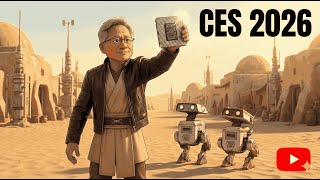
The what's crazy is I actually was gonna say. So we. He spent maybe a third of it on AI Vera Rubin Jensen Wong speaking at CES in Vegas, spent about a third of the time on the new AI servers. But then he was like. And like it's almost Steve Jobs esque. One more thing. Hey, robots, roll on out here. And he had a couple of those Disney robots roll out, interact with him, play with him, do things with him. They he didn't. He could have, I'm sure put a LLM in it and it, you know, could have spoken back and forth, but he was keeping it true to the Star wars genre. He also showed, even before that he showed a, a guy who Took one of the, For Christmas, Bryce got me an Nvidia AI C computer which is just about like this big. And it's a developer's kit. And so we had problems, we haven't been able to tackle it yet. We're not developers. I think we might end up develop hiring a developer at some point. Oh, you know, all right, we might, Johnny, we'll talk to you about that offline. The point of the story, the guy took one of those, put it in a little robot form factor and was like, hey, show me who what's on the bed across the room. And it showed, you know, it pivoted its head, showed a picture, told him what it was looking at and he, you know, and it was like a home built AI interface, a home built compute robot with a complete AI interface that controlled its movements. And it's, you know, it saw through the eyes. It's a computer in many ways. But then the, the, the, the other thing though, he truly shows, here's all the different form factors that these robots are about to start built on Nvidia physical AI platforms are going to look like. And he had a Caterpillar backhoe. What do you call that big old thing, Bryce?
Tracko or excavator.
And then he had humanoid robots, he had industrial robots. They did something with Siemens to wreak, to put robots in every factory that's being built from here on out. And it was all about robots. The next 2/3 of the presentation was all about the Nvidia robot platform and how much AI physical AI training they've already done. They've, they are now using simulated video to train the AI and so they can give it a prompt to be like, hey, put a squirrel on top of the hood and show us how we would, you know, drive without killing the squirrel. And it is just all kinds of random long tail potential events. You run into driving and full self driving. Full self driving, which is a form of physical AI and robots. It's the same platform that Nvidia is using for their robots that they're using for self driving. And it was, it was pretty darn impressive that the Elon was asked after the event how bad that is for Tesla's dominance and lead in full self driving in retail cars. And he rightly pointed out that even if Ford and GM like today were like, yeah, we're all in, let's start designing our cars for the Nvidia full self driving platform, it's three to five years before any of that gets on the roads. And by then Tesla's already doing something else and, you know, dominant, so. But anyway, it was, it was a heck of a presentation. It made me more excited about Nvidia probably than ever. We. I've been an investor in Nvidia for eight, nine years and still hold it. And it's one of our largest positions. It's my personal largest position because it's up like 220x or something since I bought it. But it was very bullish for Nvidia. It was bullish for the AI data centers. It was bullish for robots. We're living in the future. Yeah.
There was a really cool video on, on YouTube. It was 60 Minutes and they had the Hyundai's Atlas and it was using the physical AI by Nvidia to train its robot, like on the fly kind of. It had the guy do jumping jacks and then it simulated it like thousands of times in different ways. And it was super cool just to see that robot do jumping jacks and stuff.
I was like, you're seeing all, you know, the. Yeah, they just like off into every direction in the simulated space and they got them falling down and doing whatever until they're getting. And finally you're seeing them like all just doing exactly right. All with each other. All these separate simulations come back to it and it's like, okay, I can, I can do that. Was I think the 60 minutes thing or something because they, they showed the, the reporter guy. Yeah. Kind of walking down like this and like that, whatever. And then they had it step in and just totally do his gestures.
And I thought that part was, was more cool just because it really did emulate the way that guy walks and points and stuff. Really. I mean, identical, you know, like everybody kind of does a jumping jack the same way, but only that guy walks and points and uses his hands in a certain way.
You know, the biggest point I think one that Cody makes about like the squirrel, you know, which is all whatever kind of, kind of edge cases of what might actually happen some point in the world. You're not going to be able to go and figure them all out in advance. But the more that you can put out there, the more things it can try of like I wonder if this and I wonder if that. However, just working off of oh, I've seen it, which is what this stuff is and trained to handle those. I. I don't know what the level of generalization is as compared to the, you know, Yann Lecun thing, which is like train it to predict the next frames of video. Like here's what's happening now, what's going to go on. And that means it's got to have, you know, qualitative physics understanding. It's got to have real world understanding of all the different things in John.
That was another thing I wish actually you might want to go watch that. His keynote or at least the last third of it. And because he talked about on I don't think he used the word ontological but the ontology of T of the platform itself from the ground up being taught to reason about physics and understanding gravity from the ground up. And it was really interesting because the car would even explain its choices in these simulations and in basic English to you, the programmer or you know, whatever the developer that was looking at that video. But he showed some clips of it and it would be like, oh, I see an animal's trying to step out in front of that car. I need to slow down and slightly turn left to avoid that. And it explains from a very like not, hey, I've been trained to swerve if something darts in front of the car. But literally why it's swerving. And not just that it did.
Yeah.
John, don't you think going to the back to kind of what you're talking about with the on Lecun like he, he criticizes the major companies for being like LLM heavy or whatever, but I think it's. They're also doing diffusion on all those other things, like different types of models. But I was thinking about like the way humans learn and like we see with our eyes, we watch somebody else do it. But like a toddler doesn't understand object permanence. They don't do physics and calculus in their head to determine where objects are. Like you see, you learn, you remember. Like if you can teach a computer to do those kind of basic things, it can figure out a lot more than that because that's the same way humans figure out stuff. They don't ever. They don't have to have embedded world models with physics pre programmed. You know what I mean? If you throw a ball at many times I have to throw it a little bit harder to make it go further. I mean, I don't know.
Like take object permanence. Infants don't have it at a certain age, children do. Do they learn it? I don't know. Or do they. Does it? Is certain brain development a point? I think it's more of a stage in brain development that they reach for it to have it. But yeah, there's, there's to, to go say well, how do humans learn? There's a lot of ways that humans learn that's a lot different than how any of this stuff works.
I guess all I'm saying is that it's, when you listen to those guys, there's other AI naysayers that are like AI experts like that Gary Black. And those guys are like, oh, AI is going to be fantastic. But it's not going to be transformer models. It's not going to be diffusion. It's going to be this mystical thing that maybe I'm working on, you know, but it's like if with LLMs and vision models, you can, computers can see the world and understand the world. They can see text, understand text, repeat text. Enough of that over time gets pretty damn close to the what like those are the same in. I guess my point is those are the same inputs that humans have. They do act, learn.
If I can interject, I, I think that's part, like we're to bridge the gap between what you two guys are saying. It's almost like when we say it's foundational that it understands gravity. I don't think, Bryce, it necessarily needs the equations and all the specifics of gravity, but it's in the same fundamental way that a toddler learns that throwing the ball gets you through some gravity and throwing it harder gets you through more gravity. I think that's what we're getting at. It's like, it's, it's going to like it understands that gravity exists. It can understand that gravity exists and therefore it does, and then it can learn off of that. Maybe we're all trying to get to the same spot of what we're saying. I think, Go ahead, John.
I, I, I'm not sure I, I'm going to take the side that I stopped yet. The word understand even and go. I don't think we have a good understanding of what it understands. It does amazing things and it does it from all these different sensory, you know. Yes, you can do text and images and all these kinds of things, but having an intuition for gravity. We don't see that in these things yet.
We, you said, yeah, that was where I was going to ask. So you just tell me though, is it just a matter of time and compute, like we'll get there?
I don't think so right now. I, but I don't, I, I think we will get there. I don't know that LLMs get us there. I don't think that matters at all. I think that these, the, the frontier companies, if they're smart will continue to innovate at the edges of what counts as LLM or not as they go and do. Take memory for example, right. These LLMs don't have that good memory. You put something in, you get something out and it starts over like stateless, you know. But now they're getting to where you can, can have it, that you put something in, it holds onto something about that even at sort of the chip level that it's in, in the tr, in the model level, in the transformer itself, kind of retaining something so that next time around you know what it can go and do with that or the context they go oh what when you have a 10 million window on context and that it gets to be a decent performing 10 million context window, which is how many tokens or you know, words can it deal with at once? Like all in its short term memory while it goes and does a thing it's like. So it keeps improving. I don't know whether it is by itself the architecture that delivers everything, but like Bryce and I both said before, you could stop right now and never develop another thing and we'd go for a couple decades of innovations off of what we already have.
Yeah, that's right.
Yeah. John, is the, is the fundamental breakthrough of the transformer that it is like the attention, the concept of attention that the computer can decipher like what's important from what's unimportant.
Yeah, right. Yes. You've got your, your kv is it qkv. It's the key value in query to go and say this thing came on the way in this big say this sentence right here that came in. You know, each word is, is a token essentially. And the thing is going well I'm going to look at that one there and say which of the other words around it matter most to that word? Like if it changed that would change this one with it. And it goes through every single thing like that and that say you got this 10 word sentence now make it a 10 million word, it's not a sentence anymore but 10 million words where that attention setting is happening on every one against every other one through that whole entire set. And that just is unbelievable power that the thing then has. I sit here on a daily basis and I'm sitting here working with the Claude doing programming where it's dealing with my very large multi hundred thousand line code base and telling me that hey, I want to make this change here that's going to do this to that and so forth. And I'm talking to it and it's explaining stuff. And I'm like, I have to step back and go, how can it be doing what it's doing?
Yeah, it's. It's unbelievable.
You know, that's. Thank you. That's. Thanks, everybody, for watching. A guy who's been working in AI and programming for 25 years thinks to himself on a daily basis that, how is this possible? That's the moment in time that you're in right now, ladies and gentlemen. Thank you very much. I'm gonna make the prediction that 2026 is not the year of AI and not the year of space, despite SpaceX's IPO. It is the year of the robot. Be great. Space. I think space might actually have some problems ahead. I think space has gotten ahead of itself. It feels rather hyped and bubbled up at this moment.
I think it's not. I think it's the year of the agency, which means the set of agents that can do, like, amazing, can act like a company by itself and stuff like that.
Sounds like a good movie that we could put Will Smith in called the Agency. And it's about AI Agency somehow. And there's obviously some constant threat to humanity that he has to save all of us.
I want to have kind of a Tron aspect to it because it's all happening like, you know, in there. The agency's made up of these artificial AI agents. That's the. That's who works there, you know.
Now you're speaking my language.
Tron.
Yeah, I agree with you on the agent thing. And I thought it was. I thought it was pretty cool not to bring up another back to Google. But, you know, Google just released tools for retailers to put agentic workflows and stuff within their own website. So it's kind of. Kind of different than the OpenAI's approach, where they want people to go to OpenAI all the time to do their shopping and everything like that. You know, Google's putting out these tools for the retailers, and I just think that is super cool and just speaks to the model and how well under the hood it can, you know, integrate with other people, with other people's websites.
That's the main reason why we've been so bullish on Google for the last year. While everybody thought search might get killed from AI, and we were like, but, dude, Google's amazing at AI and it's integrated everywhere in your life. You literally don't get away from it. You search the Internet, you're on Google, you go to Gmail, you're on Google, you're on your Gemini phone or your Google phone, you're on your Android phone. Of any billion. 3 billion people on Android phones, 5 billion Android devices, and now all of a sudden, all of it is Gemini friendly.
I think you're right. You win. I was picking on Google and I still pick on them some just from the standpoint of they need to get good at product delivery in a way where it's not so hard to go find the site I'm supposed to be on to go use this thing. And like, you know, OpenAI, everybody knows chatgpt, you go there, you use it and then they made it easy about sign up and this is what you get. I'm not. Anything is great about it beyond that. But like, Google has all of these capabilities and they've. I've just. Over the years, they keep pulling away the football from Charlie Brown. You know, when it comes to these, like when, like, I'll go back to Google Wave. Google Wave came out. I saw it at a, at a conference. They were showing it off and talking about it. I mean, I barely got home before they canceled the thing. They've got to, like, let stuff, you know, come to life and breathe. And like, who are they as a company for marketing this stuff? Do they go and get somebody else in between because they have so much to deliver on, or do they do it themselves but get better at making simple sites you can go to. They already have the main kind of thing, which is, you know, I go and I log into my Google account and it's got Google Drive over here and, you know, Google Docs and whatever. So if they could follow that where it's just. No, it's just more stuff showing into your Google account.
But, and John, but that's always my point is that we're just going to get to the point where we don't even interface with any of that, you know, using the mouse and stuff. And you just talk to your dang phone and it projects some 3D holographic image up, whatever you wanted to see, manipulate it with your hands in the.
Air and go like this. Like you just don't care.
Well played. All right, last words. I'm bored. No, I'm just kidding.
Oh, man. Now, now you hit me with that.
Because I thought.
Last words or last question, whatever you want.
Last. I'll say my last words. You know, I agree with John again, this, this year is definitely the age of the agent. And again, you know, with Google and what they're doing under the Hood, you know, I, I kind of see a future where if Google's agents are everywhere running amok, it might be a repeat of search. You know, when they just get to the point where their tools are just so good and everybody's picking them for their own, you know, customer service and everything. I don't know man. I think Google's really just working so hard under the hood to make sure that their stuff is integratable and serviceable across the board.
So how far ahead of Apple are they in doing that on a operating system level? On a holistic level. Apple is going to be three years behind here when they try to skirt skate to where they want to go. That being said, it's Apple, it'll probably work out.
Bryce so I, my prediction final word is that I've never made like an AGI prediction before but I think it's 2027 is the year for low end stuff. I built a model estimating how we get there. 2028, it's as good as the average worker. You know like you can do anything the average knowledge worker can and by 2029 it's can do better than any, any worker human worker can. But anyways, the way I did it John, my methodology was I estimated the amount of tokens per second that the global workforce can produce. Like you know, how many words and things can you process in your brain? Multiply that times the number of workers working at any one time and then divide that number by the tokens per seconds of GPUs that you need to get there.
And that makes you conclude what that.
Your global GPU fleet will have the same token output per second as the human knowledge worker fleet. So I like it. Yeah.
Wow.
I mean it's not apples to apples the tokens humans. No. And in some ways way to estimate it, you know.
Right. It's, it's a way to estimate it. It's a shorthand way of estimating it. I mean clearly with that kind of power, but complete access to all written words and all kinds of physical AI is it'll probably be better than the average human being already. But I get you Johnny, last word.
I, I had two but I'll go with the one that I'm more interested in. So y' all heard the, the phrase second brain. It has to do with like people who are into personal knowledge management, PKM type tools like Notion or Obsidian or this kind of thing and basically keeping track of all of what you do and building a knowledge base of your stuff and just by Notes, you know, taking notes in all fancy ways. So Second Brain now is getting to a new level because you can take stuff like Claude code and let it automate the part that it was always, you know, humans had to be doing. You know, it can go and take your little something you wrote and go check this web page and make a summary and stick it here and link it to the other pages and store it a certain way. And it's your whole management of yourself. You're setting up your kind of personal operating system for every little thing you have to do and letting AI play the right pieces of that. So Second Brain, it's where I'm going to get. I've worked at that for over a decade in all little different ways. But now it's getting to an interesting place.
I want a third brain.
You should start with one.
I leave you guys with this thought. Hey, Bryce, can you add this. My camera to the.
All right, Cody, you're on the phone. All right.
My. My robot looks cooler than ever.
Is that a shadow? Yeah.
No, it's black now.
It's black now. I got it wrapped.
Oh, God. Now I can tell this in the sunlight. It was hard to.
Yeah. Oh, you sort of froze. Cody, I'm not sure if you can still hear us.
Yeah, I tell you what, this thing is truly a robot. It let me switch back to really does.
We lost you. Oh, here we go.
Everywhere, it. It opens itself, and I stand in front of it. My wife's new Model X, you walk up to the door, it opens completely. You get in, you put your foot on the brake, it closes. They're robots. It's the year of the robot. That's my final word.
All right.
Peace and love. Thanks, everybody, for showing up.
Adios.
We'll see you.
Thanks, Johnny.
More from Cody


The AI Revolution Call: Tim Cook departs! Robot Marathon? And Amazon's $50bb side gig!

The AI Revolution Call: Mythos Mania! Is Anthropic just doing more hype? Or is this the real deal?





The AI Revolution Call: Anthropic vs. The US Dept of War, Iran, and How Will AI Work With Humans?



The AI Revolution Call: SpaceX Acquires xAI...Will SpaceX Merge with Tesla Next???