From Strategy to OKRs to Projects - How can we implement an Agile Goal Setting?
Carsten Ley walks through connecting strategy to OKRs to actual projects. He covers designing OKRs with actions, aligning teams by value or department, and tracking progress weekly or biweekly. Examples include football, Saving Private Ryan, and product launches.
Chapters
So let's talk about Carsten. Like, OKR, project management, agile, consulting, keynote speaker, customer engagement, goals, podcast host. I mean, he sort of like does it all. But his primary thing is he transforms businesses into focused, aligned, results-oriented organizations, working with employees, getting them engaged, and building out so that customers are extremely happy with what you do as organizations, as an entrepreneur enabler. And, you know, this session is gonna be really interesting. I'm looking forward to it, and we've had quite a big response to it. So Carsten, over to you.
Thank you, Fraser, and thanks everybody for joining today. Let me share my screen first that we see the topic again and everything. Okay, so from strategy to OKRs to projects. Yeah, why this topic? Because we have a lot of clients struggling to translate their strategies. Maybe they can translate it still into goals or KPIs, but then really bringing it down to the people on project or action management is sometimes difficult. And the people on the action floor sometimes even have no clue what they do against the strategy. strategy, or if they even work against the strategy. And we will go into this topic a little bit today, and we will also— we'll be interactive. I have some questions for you, so please maybe use the chat response first, and if somebody wants to talk, we can then also unmute the microphone. Good. Quick introduction. I think Fraser said it already. So my name is Carsten. I'm originally from Germany. I'm since 12 years in Southeast Asia. Mainly in Singapore and Vietnam, and we run Asia PMO and OKR Asia as business transformation and OKR consulting companies. Previously, I've worked for companies like Lazada in customer experience, Citi, Deloitte, Home Credit, mainly in project management, and I also had some time in Volkswagen in Mexico. So I've been a little bit around. And what we do— this is the team. Yeah, these are the topics we do. Some of our clients in Singapore, in the region, sometimes even overseas. I almost have to say thanks to COVID. Sorry for that, but really thanks to COVID, we have a lot of overseas clients lately. Strategy transformation, goal setting by OKRs connected with projects and agile management, and also customer and employee experience. So enough advertisement, let's jump into the topic directly. So the question is always when you ask yourself, and I guess a lot of you are manager and C-level, how high do you fly? So normally when you are C-level or the pilot in a plane and you have a very long view, maybe 1, 2, 3 years ahead, this is what we call strategy layer, or sometimes even the 1-year objective layer. And some of you call it balanced scorecard or or KPIs one year or whatever. This is very long ahead, right? And then what we want to build in between are OKRs, Objective and Key Results, which is more like a balloon which flies from peak to peak. And normally in OKRs, the peak is 3 months away. Some companies do 6 months, which is okay, but normally it's 3 months. And below you have the people working day by day. And this is the action and project level. And I really like this graphic. This is not from us, but I really like this graphic to distinguish a little bit, right? So what we do on a daily basis are not objective and are definitely not key results. And that's one of the biggest misconceptions about OKRs. Doing things is not a result. Yeah. Reaching peaks or climbing up these peaks Yeah, to a certain height are results and objectives. And then maybe doing a lot of peaks and going to the Golden Valley or wherever you want to land later, or on a nice island. This is your strategy and your goals. Now, before we even do OKRs, we have to look into mission, vision, and values. And this is a pharmaceutical example because lately we had a big pharmaceutical company in Singapore and worldwide as a client. And I mean, mission, vision statements are good, sometimes a little bit blurry. Most of the staff really doesn't care so much about it because management doesn't translate to it. But we need them at least to start with OKRs because OKRs have to come from somewhere, right? You have to have a mission, vision, strategy. And then a lot of companies do values, and values are fantastic. But what we don't like about values is that they are normally very abstract. Excellence, integrity. I mean, ask people on your factory floor or in your customer service team if they understand what the value means. Probably they don't. Yeah, but we love to use these buzzwords, right? And a lot of companies use even the same values, which is super boring. Yeah. So the first exercise we normally do with our clients is to translate values in dos and don'ts. And I want you— and very clear dos and don'ts. And I want you now to take the chat and give me, for the values you see here in the middle, excellence, integrity, collaboration, and so on, give me very clear dos and don'ts. And please write them in the chat. So statements, what to do. And statements, what not to do. Yeah, dos and don'ts. Okay, give you 1-2 minutes time. If somebody wants to shoot immediately on the chat, welcome. So excellence, integrity, collaboration— do you have any dos and don'ts which are very clear for people how to behave? One dos and don'ts on the chat is before you drink water, you Otherwise it sounds very funny to the audience. Yeah. Okay, anybody here? Where is the interactive part today? Are you just for listening? Excellent. Have KPI. Oh wow, you must be a very high level. What does that even mean? Have KPI on QA? These are 2 abbreviations in one sentence, so I understand what it means, but let's not use too many abbreviations, right? So if I, if I'm, if I'm in your team having KPI, I don't know if it makes me excellent. What should I do? What should I do? Yes, I think phrase it is a little bit better. It's more direct. If you have an issue with a client, your boss likes it, or it's even not your area, please raise it anytime. This is a very clear do's. Okay. Very down to earth. Very good, Fraser. Anybody else? So you can see, normally the first job we have when we come into a company for transformation consulting is to translate management speech in normal people speaking. And that's a big, big challenge. I go to a lot of C-level meetings and management meetings, and as a consultant, I have no clue what they're speaking about. And then I normally suspect, if as a consultant I don't know what they are speaking about, maybe if I would be a new joiner, I have even no clue what they are speaking about. And then I ask myself why they're even speaking like that. Can they not speak like normal people? anymore. Yeah. Okay, anybody else has a do or don't? If not, I will share my screen. Okay, let me share my screen. So for excellence, stay up to date with the latest research. So you have to, you have to educate yourself, right? Collaboration is about share new findings. Accountability is about Being proactive. DEI. I mean, this is a buzzword now. I mean, you can have hourly sessions here on HGN about DEI, diversity, equity, inclusion. What does it even mean? DEI, accept everyone equally. That's what it means. And that's what people can handle. On the don't side, excellence means don't hide your mistakes or failures. Speak about them. And as a boss, don't slash your people on that if they speak about it. Right? Collaboration is not blaming others, but helping to solve it. This is agile mindset. Later in OKRs, we will come up with, with team OKRs, and we, we will, we consult you normally not to do individual OKRs, even they are possible. But OKR is a team collaborative game. There's no such thing like an individual key result or an objective. Yeah, because we work together and we achieve results together. And do not discriminate. This is the D-A-Y again, right? Diversity. So, and this makes it very clear to people. And normally what we suggest to companies, a lot of companies do that already, don't hang your values as posters in your offices. Hang your dos and don'ts as posters in the offices. then people can really refer to it and also point out to people if they go against it. Yeah. So this is a little bit of start making all this high-level stuff a little bit more understandable in companies. And before we come up with the OKRs, we need to come up with the mission, vision, strategy, 1 to 3 years, value behaviors we had. Now in, in We also have a lot of startup clients. They don't call it mission vision. Do you know how you— how they call in startup mission vision? Anybody has an idea? How do startups call mission vision on the chat? You can even see it graphically here if you have a lot of imagination. How do Startups call mission vision. Anybody? Now, goals and objectives are later. Yeah, they are even below the strategy. They call it North Star. I mean, if you never heard about the word North Star, you are a little bit out of touch, I have to say. You are maybe a very corporate person, but to keep up with the agile people and to the startups of the world, you have to know North Star. So startups are too lazy to come up with an extra mission and a vision and all this corporate stuff, which they pay agency thousands of dollars to come up with. No, they make one sentence, which is the North Star. Like, for example, SpaceX have the North Star. They want to create an interplanetary species. That's why they want to go. That's the only thing they need. They want to create an interplanetary species. Is it a mission, a vision? I don't care. It's their North Star where they work to. Yeah. Or their secret sauce. I don't know. That's, that's a little bit too cooking for me. I'm a German. If I hear sauce, I get hungry. Secret sauce. I mean, it's like a recipe, like recipe people are hiding. I don't know. Okay. But I know it's a very buzz term in English. Secret sauce. Yeah. Good. Now there are a lot of tools, of course, to come up. In our workshops with the, with this, with this strategy and values behaviors, SWOT, those impact. We do a lot of retrospective also. It's sometimes funny to ask companies how did the last 3 to 6 months go, and especially, especially in the corporate environment, they are not very clear to answer. In startups it's very easy because they do that every 3 months, they do retrospective, but in, in In corporate, sometimes it's not so easy to get these answers. Now, once you have your strategy in place, yeah, there are 2 ways to handle a strategy. There's the old way and the new way. And I can tell you immediately, the new way works better with OKRs. This is the old way. You make a general company strategy and then you break it down in silos. Marketing strategy, finance strategy, operation strategy, sales strategy. And if you do that, it's not very advisable to use OKRs because OKRs is an agile methodology where people work together towards common objective and common goals, no matter in which team they work. We have seen companies who do that. Of course, we can also build marketing OKRs and finance OKRs and operational OKRs, but don't complain after 3 months why my people are not collaborative and why they don't come up with new ideas, because you silo them top-down from the beginning. A better way to come up with strategy is a business, or business value-based strategy. So rather than thinking about departments, you think about topics. You want to achieve, or goal areas. Yeah, you can also call them. Yeah. So here in this, in this example, valuing our people is important for them. Programmatic success, sustainability, operational effectiveness. So these are the main topics they want to work on. And then they explain the topics. And out of these topics, we normally can develop so-called strategic layers. Strategic layers can be like 1-year goals, for example, already, right? So they want high-quality education and training experience. They want advanced discoveries. Yeah. And when I have this strategic layer, then I think about who from my— from all my teams can work against what. And in a true agile organization, even people can volunteer for these topics. Yeah, you will not say top-down, um, oh yeah, you are marketing, you have to work for topic 3. You are finance, you have to work for topic 5. No, people can also choose and see where they can collaborate to. Okay, but it's very important not to start to silo on the top because OKR and agile management is about collaboration, and you only can trigger collaboration if you start with inspiring topics rather than with siloed departments. Now, that was the preparation for OKRs. Let's do some OKRs, and I need your help on the chat.
OK.
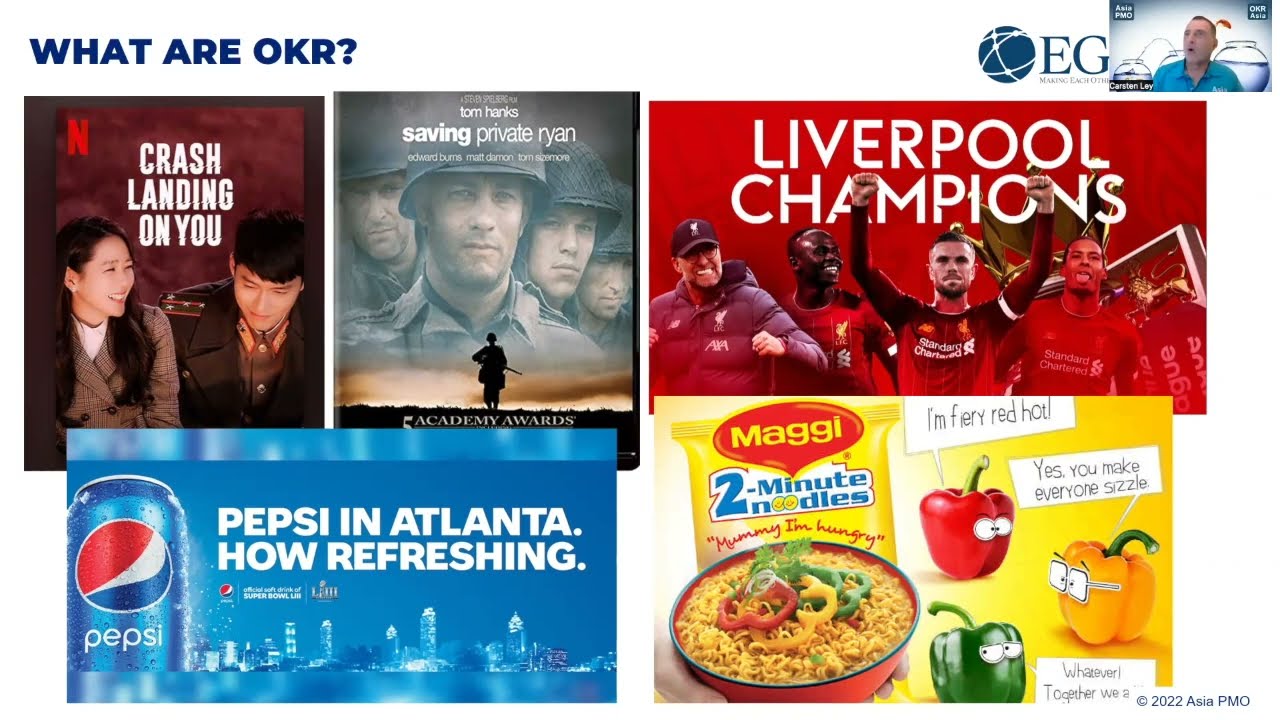
OKR stands for Objective and Key Results, but OKRs have actually 3 layers, not only 2 layers. Objective is What do we want to achieve? Key results is how do we measure it? And actions is what do we do on a daily basis to achieve it? Now, if you look on these posters, we have a South Korean soap opera, we have an American movie, we have football, we have Pepsi and Coke, we have cooking. Does anybody of you see on this poster an inspiring objective? If yes, please write it in the chat. Can you see on this poster an inspiring objective? Okay, Vissoria. Liverpool will never win the World Cup, but it's a team, right? I'm, I'm coming. I mean, Liverpool can win the Champions League. I'm sorry, that's maybe now a little bit, but it's a good, it's a good topic, right? Yeah. Um, but not the World Cup because Liverpool is not a country. That's, uh, sorry for that. Um, yeah. So Liverpool can be champions and win the Champions League, for example. And that's, that's— let's stay with this one. Maybe later we go to Saving Private Ryan if you like that. So Liverpool to be a champion club. That could be an objective. Yeah, and I think some of us think Liverpool are champions. I mean, I'm a German. I was very happy that Bayern Munich won against Paris last night, and Paris will probably never win the Champions League. Sorry about all the French people here. So they are not champions for me because, I mean, just winning the French league doesn't make anybody a champion. So Liverpool champion, let's stay with that. How do you measure if some, if some football clubs are champions or not? How can you come up with a key result, a measurable key result? How can you measure if a club is a champion or not? Yeah, I mean, first you have to win championships, right? So minimum one-time Champions League, one win. Sometimes every 10 years, maybe you have to win the national league, or every 5 years. Yeah, these are very measurable results. In England, you should be always in the top 6 or in the top 4. Yeah, that's consistency. Winning games is more an action for me because that's what you do on a daily basis. For me, winning games is not a key result. Winning trophies is a key result. Very good. You are not only a champion by winning titles, you are also a champion by the number of fans you have in your stadium. Yeah, by the number of fan clubs. I'm so amazed How many Manchester United fan clubs are in Asia? Yeah, that makes you a champions club. Yeah. And then there is another very specific metric in football, how you can see if you are successful and if you bought the right players. Does anybody know which number? It's the number of t-shirt sales. Yeah, that's a key result. If you, if you buy Messi, the number of t-shirt sales for Messi goes up, right? And they buy t-shirts of your club with Messi on them. Yeah, so this, these are, these are key results. And the very important thing is about OKR, the objective is to be a champion, but the key results can be different. There's a key result where the football team works on it because they win, they win games and titles. There's a key result where the marketing and the sales and everybody is working on because they want to sell t-shirts. There's a key result where the whole, the whole Liverpool is working on, the players, the people in the back office, the people in the stadium, because that's how they generate fans. That's why people come to the stadium. So you see, OKRs should be built inclusive, that a lot of teams can work against the same objective. And even share chaos. Yeah. So what you said are chaos. Yeah. Saving Private Ryan is also an objective. Yeah. What they do in the movie is clear because it's an action movie. So what they do on a daily basis is action. Yeah. And does anybody know a key result of this movie? How do they know When they saved Private Ryan, what did they have to achieve? Yes, and Roy, what you said is very, very good. I have a lot of clients who said finding him. Finding him is not good enough because it's about saving Brian O'Brien. So the key result always has to correlate directly to the objective. Finding him dead would not be a good key result because it goes against the objective. So finding him alive, or least amount of casualty— I mean, Kevin, that goes a little bit very specific, I think. I don't know if we should go in this direction. Yeah, but it's good.
Yeah.
Is one key result. Then getting him home to the family and staying alive through the whole, yeah, movie. You and Private Ryan, these are all very valid key results. Yes. And remember, the ultimate key result, and Fraser has it already, is making his mom happy. So there's even what we call, what we call a customer experience dimension, a third-party dimension. So it's not about only finding him and getting out of the battle. It's about why they have this objective when you watch the movie at the beginning. Yeah, because it's the last son of his mom, and getting him out for his mom is the ultimate goal. And we see that a lot in system implementation or product implementation. I have a lot of clients who say, oh, I implement the system So that work is getting easier or that, that we sell more products. Yeah. But the ultimate key result of a product and a system implementation is maybe employee and customer experience. Yeah. You want to make it easier for your employees. You want to have a better experience for your customer. And then you should measure that maybe in a rating as a key result. Not only that you have finalized the product or the system. Yeah, or that the productivity went up or something as well. Knowing his location, I see more like an action, because if you just know his location and you haven't found him, you are not on the way to the objective. So key results have to be very clear, very, very clear on the way to the objective. Okay, good. You can practice with the other examples here. Now, just to give you a little bit of an overview, so We need in order when we come from the strategy layer, we need to build the objectives. So where do you want to go? Yeah, we, we want to do a product launch this year, or we want to go to a new market and things like that. That's good objectives, right? But maybe with a purpose. So you say we want to launch in 3 new markets because we want to expand to Europe, or we want to grow our business. So if you give a little bit purpose behind, it's always better. It's more inspirational. And then you put clear key results below, right? I mean, first we have to find the market, or we have to research which markets we go, and we have to make a decision on that, and so on. Yeah. What are the outcomes we want to achieve? Minimum 3 markets at the end, minimum this amount of sales in one of the markets already if you launch in the middle of the year. And everything you do on a daily or weekly basis Also in your projects, which you call tasks, are actions. Yeah, and this is very important in OKRs. Just by ticking off your actions, it's not enough anymore. We want to achieve key results and objectives. So if somebody goes home— I have this example of a graphic designer who says, I have done my 50 designs this week, I go home Friday, 4 PM. This is KPI thinking. OKR thinking is, okay, you did your 50 designs, the Facebook team or the LinkedIn team used your 50 designs. How many likes did you get on your 50 designs? Are the likes and engagements enough, yes or no? If not, you cannot go home Friday 4 PM because we need more likes and engagements. So it's result-oriented. We want to change companies going away from a I tick off my tasks, yeah, like in a KPI thinking, and the people on a lower level only know their tasks. They even don't know why they do their tasks. Yeah, that's why they only tick off their tasks. We want to make them responsible for at least team-based key results where everybody works together, like the LinkedIn team and the graphic designer are responsible together to get engagements on LinkedIn. Yeah, not only One is doing the posting, the other one is doing the graphic design, and then they go home. And what is important about OKR? That's why we had the, the exercise at the beginning. We want strategic alignment, and strategic alignment only works if you explain your mission, vision, values, and your strategy to the people, and if you put it in easy and nice wording. Yeah, don't make it too complicated. And the goal setting, ideally quarterly. Yeah, that's agile because every quarter we review what we have achieved and then we set. So we are more flexible than we have— we have 1-year KPIs. And we do a weekly or biweekly tracking so people stay in touch and say, am I on the right track? Yeah, are we getting enough likes and engagements on our graphic designs? Because we need 30,000 engagements by the end of the quarter. Are we linearly on track? And if not, maybe you have to change your designs. You have to do something differently. You cannot just working on. You have to change your work, your actions, right? And because we do the tracking on a weekly and biweekly basis, it's very clear and transparent who achieves what, which team is where in the progress, which team needs support from other teams, what can we achieve in the quarter, what can we not achieve and why. So you can have these kind of discussions Rather than any blaming discussions, so it's more about supporting each other as teams. Now, as said before this, you can build OKRs. A lot of tools gives you departmental structure, but we really advise you to go on business value-based structure. Both have pros and cons, and I will give you that quick. If you go with a departmental structure, this is good for corporations who want to stay in their clear roles and responsibility. It's clear that the marketing lead is responsible for the objective, and that one of the marketing, maybe team leader, is responsible for the key results. Clear if you do it inside marketing. Yeah. You have a very clear hierarchy, and they have a clear process how they can how they, how they work together. The problem is when you do siloed OKR in a departmental structure, you hinder ideas and innovation. People don't step out of their role. Yeah, people don't get projectized. And of course, people always look to their superior, superior, superior. So it takes away accountability and self-organization, and you stay in the silos. Yeah. And if something doesn't go very well, normally it's very slow and formal to troubleshoot. So what we, what we advise you is say we have a company objective this year. Yeah, we want to grow outside Singapore. That's a company objective, very clear company. One of our clients actually has that. Yeah. And then we have the strategic layers below or sub-objectives. Yeah, we want to do some market launches, we want to improve the customer experience, we want to do some product launches, we want to improve the employee experience. And then we think about who from the pool of people, independently which department they are, can work on these topics. And then we put them in projectized teams, maybe 3-month, 6-month teams. Yeah. And put key results below, and they have to achieve. Yeah. So on employee experience, it's not only HR, maybe it's HR and marketing together because you want to improve the communication or the designs or something, right? Um, on product launch, right, it's product, it's marketing, it's sales, it's all together. So you need people from all of these areas, yeah, from engineering, from, from, from anybody, right? So you could put cross-functional teams— in the Spotify methodology they call them squads or tribes— together for a certain amount of time where people can also volunteer for it. and work against common objectives and key results. And the pros and cons are opposite than the one I just said. Now, when you set up OKRs, we normally have on the company level the OKRs, and then on the departmental or the team level. Yeah, but often, often companies only do objectives, and then they do sub-objectives already in the projects, and then they come up with the actions, right? So you can also only define on company-level objectives, and then, I mean, a project already has an objective, right? So it's the same structure. You just plug in from your project charter the objective in the objectives of the— and normally in a in an object, in a, in a waterfall project, we call key results deliverables or milestones. So whatever you have as deliverable or milestones, which are cutoffs of your tasks, yeah, you can plug in as key results. In an agile goal setting methodology, we have sprints. And if you have a 3-month OKR, you can probably put 4 to 6 sprints inside. Yeah, if you have 2 or 4-week sprints. Yeah, so it fits very well with projects because OKR really helps to mix teams. OKR really helps to align and focus on deliverable milestones or sprint increments rather than the work itself. Okay, I think that's all from our side. Quickly what we do. So we normally do for our clients OKR trainings that they understand OKR and that we can adapt the methodology to their company because there are different ways. And then we run sometimes strategy workshops if they don't have a strategy, and we run OKR setup workshops. And this is very important why we call it workshops, because we are not— we don't want to sit alone with a CEO and say, you come up with the OKRs. That's not OKR. OKRs inclusive, minimum 1 or 2 levels together. So the, the director would do it with the board and maybe even with the manager level, and then later the team leader would do it together with his or her team. Yeah, so we talk the OKRs out in a workshop and we align on OKRs in a workshop. Yeah, like we did now with the football example. And then I mean, a lot of consulting companies emphasize the setting up of OKRs. For me, the setting up to OKRs doesn't have to be too perfect because you have to be fast. You do it every 3 months. It's more important that you go very fast in a weekly or biweekly review and tracking. It's more important to measure your OKRs than to set up the super best perfect OKRs. The measuring is much more important, yeah, that people know Are we achieving our key results? Are we on the right way? Do we have to adjust our work? Does even the management has to adjust the OKRs in the middle because something like COVID happened? Can be. But that's why OKRs are only 3 months, so we can adjust much faster. And then at the end of the 3 months, we have a review workshop, which then is automatically also the setup workshop for the next one. So this is a little bit how we run OKRs. We have done for companies also existing OKR reviews. We help with OKR tools, coaching, and we also have an OKR champion training program. So you can run it in the company yourself. You don't need consultants so much. Yeah, good. That's all from my side. I think now we have time for Q&A.
Excellent, Carsten. That was brilliant. Can I get you to the next slide? That'd be great.
Oh yeah. Yeah, perfect.
Thanks. So yeah, fantastic session. Actually, I really enjoyed that. I was just texting Monica saying this is really good. And just before I come to Carsten and Q&A, again, this is an EGN event. The goal here is to bring experts, to bring people together, to bring technical people that can share and work together, collaborate and interact. So Yeah, that's Eugen for you.

