E24: Mary Kathryn Johnson: From Imperfection to Impact: Creating Your Path to Success
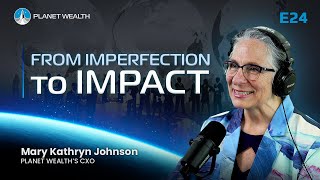
Mary Kathryn Johnson, CXO of Planet Wealth, shares how she built three companies by embracing imperfection and using a backward-planning map from your goal to today. Her courses hit an 80% success rate versus the industry's under 20%, powered by daily gratitude and celebrating small wins.
Chapters
Each detour teaches you a lesson and moves you closer to the impact you are looking to create in the world. Because when you have permission to be imperfect and to make mistakes, that's the only way we learn and grow is to make mistakes. If everything's perfect, there's no lesson to be learned. There's no growth possible. Hello everyone, and welcome back to another episode of Fortunes of the Brave. Mary Katherine Johnson here, CXO of Planet Wealth. All right, I'm gonna talk about journeys today. That's what I'm all about here at Planet Wealth. So we might as well dive into some of the things that we've learned through this process of how you can use your journey to really overcome overwhelm, right? Change overwhelm into momentum. Because that's, that's really what it does. So let me start off with a few things that I've had to do over the years. My first business was called Mommy Loves, and it was a novelty maternity store. Boy, that's going to bring me back to a lot of memories talking about that. But that novelty maternity store, I went on a journey and I trusted that journey. That whatever I needed to do, I was gonna do. There were many mistakes, many difficulties. 2008 hit, right? This store was started in 2003, grew and grew, doubled revenue every year until 2008. If you were around for 2008, you know what I mean. And I learned so many lessons from that journey and had quite a few difficulties, got myself in quite a bit of debt. I had no idea why as a retail business, I was actually not able to sell what I was selling before. Right? So those difficulties, those detours, those imperfections led to the next business. And I dabbled in a few different things, but the next real business was Messenger Funnels. It was an agency, an automation, in conversational design agency. And I was able to keep pushing forward, keep taking those lessons that I learned with Mommy Loves and, uh, manifesting them differently in this next, uh, phase. But then other mistakes, other difficulties came up through Messenger funnels and made mistakes there, over-delivered, did things for free, uh, you know, all kinds of things that I did in that business and learned many, many lessons about How to really serve customers. That was my journey. That was exactly what I was working toward is serving customers. And through that had incredible success for myself and for my clients, but most importantly in my role now, what that uncovered was ability, an ability to help people reach their goals so that I had courses and bootcamps that I did through Messenger Funnels. And then ultimately another business that I purchased called Bot Academy. And through those courses, the lessons I learned and the customer service and success I created in Mommy Loves, the lessons I learned in the customer success, lessons that I learned with Messenger Funnels, all transitioned into an 80% success rate for my customers and my students. Which typically results in only about 20% success rate when you have courses or training programs, 20% or less, especially if they are on-demand, pre-recorded courses. I did everything live so that I could help my students and my clients directly with their personal issues that they encountered through their success journey. So 80% of my students and customers created the successful outcome that they paid me for. And with that, the next journey led me to Planet Wealth and being able to apply the same success criteria, the same live event style processes so that I could help. I and the entire team, the marketing and the customer success team here at Planet Wealth, could help our customers do the same and take that journey. Because each detour that I took taught me a lesson that moved me closer to the impact that I love making in people's lives and helping people make in their own lives. And the same applies with my customers and students and anyone listening to my voice. Each detour teaches you a lesson and moves you closer to the impact you are looking to create in the world. Because when you have permission to be imperfect and to make mistakes, as Magic School Bus always was with my kids, make mistakes and get messy. That's the only way we learn and grow is to make mistakes. If everything's perfect, there's no lesson to be learned. There's no growth possible. So permission to be imperfect, builds not only success and character, but it also builds credibility with the people who ultimately get to know you. So now let's take that into a practical possibility. How do we, um, when we're overwhelmed with all of the things that we're doing, and especially if there are situations where we're making mistakes or doing things and it's not exactly ending up the way we want, we start getting potentially overwhelmed. How do we take that overwhelm and turn it into momentum? So I know the last many times that I am on this podcast, I talk about mindset shifts because I really do believe, and it's proven true with every entrepreneur I've talked to, every successful entrepreneur I've talked to, mindset is the first thing that needs to shift and change. Before the actions can follow that create the success. So that's the first thing I will ask you. If you're feeling overwhelmed, or if there are mistakes, or you're feeling you're imperfect, all of those things, we need a clear mental picture of what's coming. We need to look forward and figure out how we can shift that mindset from overwhelm to momentum. And one of the ways that we can do this is it's kind of a 3-stage map, okay? And I look at everything like this kind of backwards, okay? I don't just go linearly straightforward because right now, if you're overwhelmed, you're kind of in a fog, right? You can't really see the trail. If you're taking a hike, you're on an adventure, you're on a journey. If it's foggy, you don't quite know where you're going. But if you knew what your destination was before it got foggy, then you know what the trail ahead might look like because you know what the destination is, and you can work backwards and figure out what you need to do now to clear some of that fog in order to follow that trail and to continue to flow through in your journey. So that's what I would suggest you do. Look at not the fog in front of you, not the overwhelm in front of you, but the ultimate goal that you're looking for. And sometimes The trail has to change, right? When we make mistakes. When I was in Mommy Loves, the trail needed to change during 2008. I kept adding higher ticket products, right? I went out and got Swarovski crystals and put them on my maternity shirts and started, you know, doing things that cost me more money, got me higher in debt with the idea that I could charge more. Well, that was not the trail I needed to be on anymore with the shift that was happening during 2008. I needed to do something different. So even though the destination was still clear, I wanted to sell my maternity shirts and create success. The path had to shift because of the changing economic situation. So I was in a fog. I had to look at the path differently, even though the destination was the same. Same thing with Messenger funnels, doing the agency and looking at now potentially purchasing Bot Academy. How was I going to shift this? The goal, the, the actual success, the end goal, the end result was still the same, but it shifted from helping people in an agency and actually performing tasks to, to further someone else's business, specific business with clients, to how do I help students actually create an agency like I did? And create success beyond what I've experienced. So the, the, I think in that instance, the actual goal shifted, but the actual trail stayed the same. I still had to do the same things, but the goal shifted. So it was foggy and I had to look at which one of these 3 steps, the what's in front of me right now, where I am right now in the fog, the trail ahead to get to where I wanna go, and where am I going? Which one of those 3 things can I focus on and then shift the one that's not quite working? Momentum now replaces overwhelm. If I stop looking at the fog and I look at either the end result and the trail that I need to get there, or shift that trail or shift that end result, and that helps create a clear mental picture of what's coming and where you're headed. Now, sometimes we get focused on the difficulties rather than the tasks or rather than the mindset shifts, okay? And sometimes it's easy, easier to clear that fog by just brain dumping all the worries that you have, all the things that are causing that fog. Just write 'em all down. I don't know if you like sticky notes, Post-it notes, if you like just a legal pad of paper or college ruled, whatever you like, or on your computer, whichever it is, but just brain dump it all. And then circle the one thing that you can tackle now to be able to clear some of that fog. So here are some of the things that we can do to look at those three parts of the trail to success. Brain dump all the worries, circle the one you can actually tackle now, and flip that self-talk, that mindset, like we talked about in another podcast episode. Switch it from, "I can't do XYZ," to, "How can I do XYZ?" Because again, your brain responds when you ask it a question. It feels compelled to answer that question. So you create a self-fulfilling prophecy in that way. Okay? So that's number one. If you write down all your worries. So if I went back to Mommy Loves and I was like, oh my goodness, the, you know, I'm in this much in debt, nobody's buying my stuff. My sales have gone, dropped by 50% year over year. Then 2009, my sales dropped another 50% year over year. What are all my worries? Well, what about manufacturers? What about all these Swarovski crystals I've got? What about finding customers? Am I going to do ads? Am I going to be on social media? What am I going to do? Circle the one thing I can tackle. Well, I can tackle contacting all my previous customers or as many of them as I possibly can and asking them, how are you? How did you like your shirt? Because most of the people were, moms or grandmothers buying one of my shirts for their daughters or daughters-in-law or cousins or granddaughters or whoever they were. So I can call and ask, how was your shirt? How was it received? Is there anyone else in your life that might need another shirt? That's what I can do right now instead of, I can't sell any, I can't sell a— ah, let's see, how can I? How can I sell more shirts? Right? Single focus starting point. And then that will cascade into step 2, which is what's my trail? Where am I going to find that trail again through the fog? So borrowing from a success path, basically steps 1 and 2 of a success path, steps 1 and 2 are stating the destination, and then building a question about that, the people and the process of that destination. So if I can take and find the trail in this way, I'll, let me outline how, what that looks like. Again, I'm going to start at the end, with the end in mind, and work backwards. So you're going to state the destination. You're going to talk about where is it I'm headed? Where is it I have to go? So here's the trail again. Where am I going? Where am I headed? And then build a 5-question home base, if you will. What, who, why, how much, and next step. So if you think about what do I need, Who do I need? Why am I doing this? How much do I need? And what's the next step? Those are questions you can ask yourself to find that trail, if the trail is the one that's shifting, right? If that's the foggy place. So if you can draft a one-sentence outcome that leads to a tiny action step to clear the fog of the trail, that's what this will help you do. So state the destination. So with my shirts again, let's say I want to sell more shirts, more maternity shirts, and I can ask myself, I can build that question for my home base. What? Well, maternity shirts. And I can even get more specific. So the highest, the highest revenue I made all year was around Halloween. And that's because women would buy themselves a Halloween costume with one of my shirts that was designed to celebrate Halloween. And so if I'm coming up to Halloween, I could say, what? Well, I want to sell more Halloween shirts, or let's say holiday shirts. And that's— there were many times during the year that are holidays. I had 4th of July. I had, you know, Easter. I had New Year's. I had almost every holiday. I had a maternity shirt that was, you know, some kind of novelty saying on it. So wherever I am, I could say what, okay, what shirt am I going to sell? Let's just say Halloween shirts. Who, who am I going to target? Where am I going to try and find? Well, again, I could either call some of the people that are on my list, I could go to forums or Facebook groups or even craft fairs or fairs around Halloween. Okay. I could target that. Why? Well, they love Halloween shirts or whatever the holiday is. How much? I could do a discount for that particular fair or that particular person. And then what's the next step? Well, find the fair, decide on the discount, start selling my shirts. That's basically going through that home base can make the trail of your journey clearer. So that's your homework. If you're in that kind of a situation right now where the trail is the part that's foggy, draft that sentence, that home base of what, who, why, how much, and what's the next step. And then take an action toward that goal. Okay? Now let's look at entering the flow of this process. So when we talked about before looking at the map, we've got the fog. If there's a fog somewhere in your, in your path, in your journey, you need the trail and you need to get into a flow toward the goal. You need to go toward the goal. All right. So now let's look at the goal and the end, end part. So I have a a momentum engine that you can look at, that you can think about. And again, this is to, because of the things I learned in Mommy Loves with that very difficult time during 2008, I could easily get stuck in my own head and just keep trying to do the same things over and over again. So what I had to do was schedule a daily, like 15-minute moment, just a moment to remind myself of what I'd accomplished so far and where I was headed. Just 15 minutes, just to, because every day was pretty difficult. Just 15 minutes to remind myself of the good things that I was doing and all of the customer testimonials, the people calling me saying how much their daughter or their sister or they loved the design that I had made for them. Just schedule that 15-minute moment every day to remind yourself. And it's, you know what this is, this is a gratitude moment. This is a, what am I grateful for moment? That's what that is. And believe me, that helps create momentum. And then what you can do is celebrate every micro-win publicly if possible. I mean, you don't have to go and pronounce it to everyone, but definitely when I was both in Mommy Loves, Mommy Loves didn't have as much as we didn't really have social media in the beginning of that, but Messenger funnels, definitely. So celebrating micro wins, and it wasn't a talking about or bragging about what I'd done. It was usually in relation to a customer, a micro win for a customer. This particular customer had, you know, 30% more show-up rate, higher show-up rate to their webinar when they used one of these funnels, one of these automation communications, conversational funnels, things like that. This particular customer had, you know, 20% higher download rate of their, you know, their lead magnet or their introductory video or whatever that might be. Celebrate those. And I, and I shared them publicly and it, again, it wasn't bragging about me. It was celebrating a win either for my agency or my customers. Talking about that brought me more customers than anything else. And you can do this in a text thread, in a Facebook group. Most of the time I would go into Facebook groups or chats that I saw in different, different social platforms. And I would just answer questions. People would ask questions about automation. People would ask questions about how do I get more people to show up to my webinar, show up to my, my challenge or download my lead magnet or whatever that might be. And I would go in and provide advice, provide guidance, provide the things that had worked for me. And for my clients. And it was always true that the people who came to me later were not the people who asked the question. They were the people who listened in the background and read the question and read my answer, and it aligned with them. So lock in those micro wins. Lock in, even if it's a micro win, when I, hired a particular employee, or one of my employees learned ClickUp and got a badge in ClickUp for use of the software, massive use of the software. Sharing that, sharing that micro-win. It wasn't a micro-win for my employee. It was definitely major. But for the company as a whole, that might be considered a micro-win. Sharing that. And then people ask, how did you do that? How did that work? And these are, these are practical ways that you can keep that momentum going and remind yourself of the good things that are happening in your business. Believe me, they will keep you headed toward your goal if you practice them every day, every day, 15-minute moment and share your micro wins. So with that in mind, let's round this out and finish this up with You finishing a sentence because we're talking about the journey that you're on. And sometimes we don't trust that the journey that we're on is really where we should be or that we should completely change things. And sometimes that's the case. I would tell you, trust. You're here for a reason. You're on this journey for a reason. You know, if you're a surfer, ride that wave, ride it all the way home. As best you can. So finish this sentence: I trust my journey because— What's your answer? Write down that question and answer it. It's— this is just a mini reflection. It's to internalize this shift that we've been talking about this whole podcast. Finish this sentence: I trust my journey because— and see what you say. And if it's a negative thing, if it's, I trust my journey because so-and-so told me to do it, well, that might be an indication you need to flip that script a little because that's not trusting your journey, that's trusting someone else's journey. And if you're saying, I trust my journey because I'm too unintelligent to do something else. You know, those are not the things we're looking for. I know there's a reason, you know, there's a reason you're on this journey. And when you, when you dig into that and when you trust that you're on this journey for a reason, you got yourself here for a reason. How you were able to get where you are is going to transform you into who you need to become to create the success at the end of this journey. And the journey never ends. It just transforms into the next goal, the next destination. But at least we have to get to the first destination. It's like creating a freeway or a highway on the road. You don't usually start paving the highway or creating the path for the highway with the on-ramp. You create it by the destination, and then you move backwards, and you know which off-ramps you need to take from that highway. This is your highway. This is your journey. Trust it. I hope you have a fantastic day and see you next time.
Thanks for watching. If you enjoyed this episode of Planet Wealth: Fortunes of the Brave, check out our other videos for more insights and strategies to elevate your financial freedom. You can subscribe right here and hit that notification bell so you never miss an update. Join our community and take your financial future to the next level. I'll see you in the next video.