Protein vs. Moisture Dilemma: How much product to use for your curls and waves?
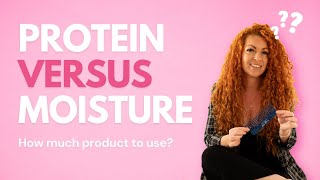
Heather Kennett shows how to tell if your curls need protein or moisture by looking at how they behave. Gummy, limp curls mean protein; crispy, snapping hair means moisture. Use the single-strand stretch test: if it snaps, add protein; if it stretches then snaps, add moisture.
Chapters
Let's cover the elephant in the room topic, which is protein versus moisture. I wouldn't recommend getting too wrapped up in this at the beginning part of your journey, but it is good to understand. So our hair has proteins within it and as you may be losing protein, you would need to do a protein treatment. So there's several reasons why you'd lose protein. If you had high porosity hair, it lets in as much as it lets out. Also, low porosity hair does need protein from time to time. So if you are in a habit of wet plopping as an example, that hair is being really hydrated continuously, it may make it mushy and over moisturized and that breaks down the protein in your hair. So, so that may be one reason chemical treatments are another reason. So if you've had your hair dyed, you may be lacking some protein in your hair. Heat styling. So at the beginning of your journey you're making some really good adaptions to your routine. But if you have been heat styling before or you go back to heat styling whilst being in part of the curly girl method, that is going to break down protein in your hair. Too much moisture will break down the protein in your hair, which is why I indicated that wet plopping, you know, isn't great long term for your hair or your scalp. So that just breaks down your protein. So do you need a protein treatment? What I would say is usually for me, if I just think what is going on with my hair, I've done my deep treatments, I've done everything and it just doesn't feel right. I'm losing my curl, it feels mushy, it goes stringy. That's when I know that I've lost my protein and I need to do a protein treatment. But what I would recommend is if you are not sure to do one or two treat it deep conditioning treatments. Because if you do a protein treatment and your hair doesn't need the protein, your hair with protein overload just isn't very nice. Takes a little while to break down. If it's soaked up all that protein, it can feel stiff and, you know, not great at all. And especially if you're doing a protein treatment when in fact you needed moisture, it's gonna, it won't be great. So if you need moisture on your hair, your hair is already crispy, it's dry, it's snapping. If you were then to add protein to that, you going to have even worse symptoms. So that's why I say steer away from it in the beginning, try some deep Treat it deep treatments on your hair just to make sure that it is protein that you need until you're a bit versed in how your hair reacts to things. So if you're looking for signs of whether or not you need a protein treatment, your curls can go limp between washes. So if your normal shrinkage, so my hair's air drying, my normal shrinkage would be from here to around here and maybe shorter. If my curls are strung out, they'd still be sort of this length when they dried. So that would be an indication, amongst other things, that I needed a protein treatment. But you really want to gather a few indicators before you rush off to do a protein treatment because of protein overload. So strung out curls, feeling gummy or sticky, feeling mushy. All of those words probably don't make sense until you've felt it and then they're the only words to describe it. So if you've got gummy, sticky, mushy hair, it's probably time for a protein treatment. Also, if you have limp curls, they're not holding their shape and they're just stringing out, then I'd recommend jumping in for a proteins treatment. So how do you know if your hair needs moisture? So if your hair is stiff, it's tough, it's crispy and it's snapping, it's moisture that you need. So regular co washing squish to condition. Check out the video, treat it, check out that video and do make sure that you're deep. Conditioning your hair as part of your hair routine doesn't need to take a lot of time. I put my treat it on, put my hair in a mum bun and actually it gives me a break from having big curly hair for a day. So definitely recommend that a test to determine whether or not you need protein or moisture. If those signs aren't telling you or if you just want to double check before jumping in would be to grab a strand of hair. My hair's not too coarse, so you actually can't see my hair there. Well, I have a strand of hair I'm going to wet using the refresh bottle and just water going to wet that strand of hair. Because I picked that strand of hair from the back of my hair. My hair is low porosy. You will be able to see. I wish you could see that the water is just sitting on that strand of hair. So if the water sits on your strand of hair, strand of hair, you need to work it in. So I'm just making sure that's really wet. It's just a singular strand of hair. If I stretch this and it goes back into shape, my hair, my protein and moisture levels are normal. Yay. If I stretch this and it snaps, I'll need a protein treatment. And if I go to stretch it and it simply snaps, then please moisturize your hair. Squish, sticking dish, deep treatments. I'm going to wet that again because I was talking. Right, here we go. So holding both ends and you tug. And mine's gone back to a curl. Mine didn't snap, so that's good. I don't need moisture or a protein treatment. I did gen. I did genuinely know that because I'm quite good at deep conditioning my hair and doing protein treatments when I need it for me, protein treatments probably two or three times a year. Desperate measures, I think. What is going on? Do a protein treatment. Voila. My curls bounce back up, but it's not often. So when you've got your hair and I know it's really tricky to see there, going to try and find a way for you to see it. You can see it if I. No, it's gone again. Okay. You're going to hold both ends. You just tug on it sharply. Mine just goes back to a curl because it's balanced. If you're tugging on it and it snaps, you need moisture. And if you're tugging on it and it stretches but then snaps, you need protein. If you tug on it and nothing really happens, it stretches and then you hold it up and it goes back into a curl, then you've got balanced hair. So really big topic there. Protein versus moisture. I'd recommend looking at this part of the process a bit later in your journey. You certainly don't want to be looking at this in the first week. Nail that wash and go look at see from different product techniques. And then if you are feeling desperate measures with your hair, do the protein and moisture strand test there.