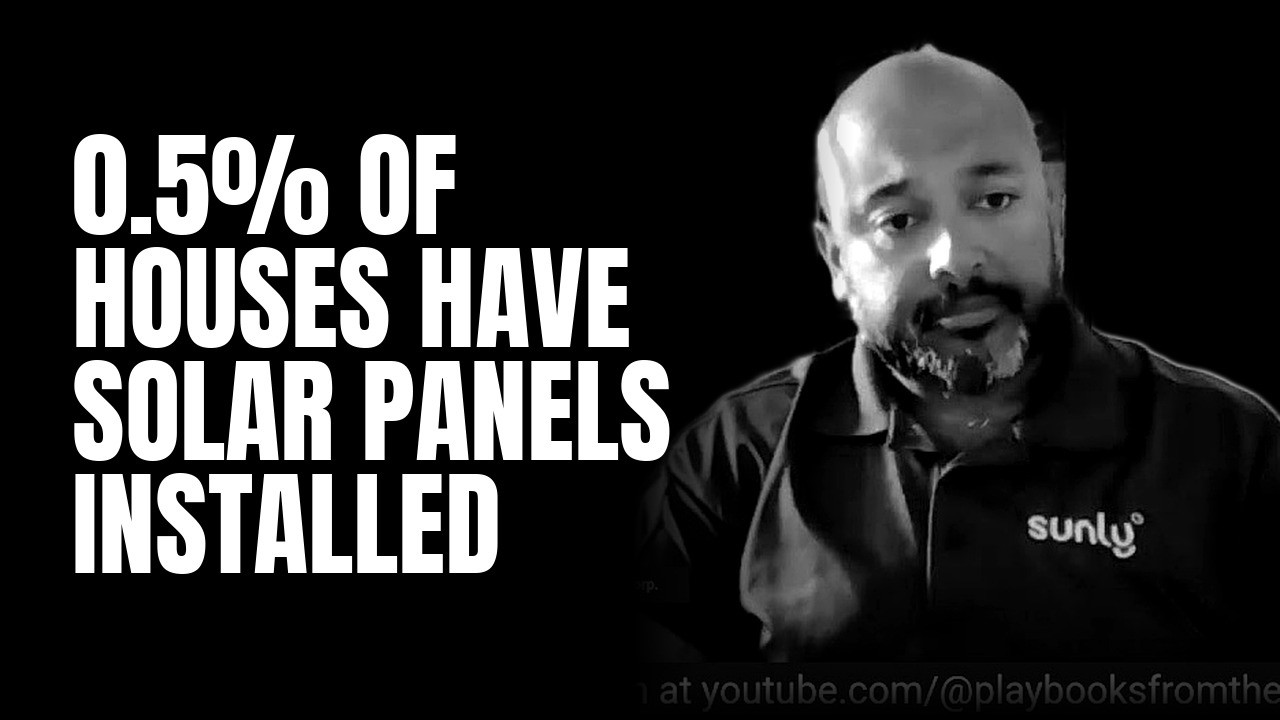
0.5% of houses have solar panels installed
In this Founder Wisdom episode, host Charles Cormier interviews Shamir Paul, co‑founder and engineer of Sunly Energy, a solar installation company based in Charlottetown, PEI. Shamir recounts how he entered the solar industry in 2009, teaching himself the technology, and grew Sunly to about 50 employees and 4,000 clients. Sunly differentiates itself by keeping all work in‑house—sales, project management, electricians, and installers—to maintain quality. The company uses a franchise model to expand across Canada, arguing that local territory owners can build relationships with regulators, utilities, and customers, which is essential given the fragmented regulatory landscape. Shamir explains how franchisees are selected through questionnaires, financial modeling, and on‑site visits, and outlines the typical licensing fee ($65‑70k) and expected earnings (roughly a few hundred thousand dollars profit per year with 20 sales/month). He discusses market penetration (under 1% of Canadian homes have solar, about 8‑10% in PEI) and the economics that have shifted as panel costs fell from $8‑10/W to $1.60‑1.70/W, while incentives have waned (loss of Greener Homes loan, provincial rebates). Growth plans involve recruiting new franchisees via dedicated sales staff, franchise shows, and a partnership with HGTV personality Brian Baumler. Shamir also covers territory sizing (≈40,000 households per franchise) and the limits on scaling multiple territories. The interview ends with a call to action to visit sunly.ca for more information.
Chapters
Welcome to another Founder Wisdom pod. We have Shamir Paul with us today. He's an engineer, he's a co-founder at Sunly Energy in Charlottetown, Prince Edward Islands, of all places. Shout out to our Canadians out there. Yeah, Shamir runs, uh, has been running this company since, what, 7 years? Uh, has been working at various companies before that, GP Jewel, uh, Grasshopper Solar and a bunch of other companies, uh, schooled at University of Waterloo. So trusty guy altogether. Shyamal, welcome to the pod. Tell us a bit more about yourself and what you've been up to.
Yeah, thank you, Charles. I really appreciate the time. Um, so got myself into solar, uh, sort of by accident. Uh, Ontario launched a program back in 2009, and at that point really had no experience with renewables and had to learn from a really grassroots level using just very few people who had been in the industry doing off-grid systems, reading up on the internet, getting books from the library, things like that, and then just teaching myself the technology and how to apply it. So, you know, as an engineer by education, you know, you don't necessarily know all the information, but you certainly know how to find the information, how to use it.
Tell me about the scale of the business. Like, how big is Sunly right now?
We have 50 people in the company. That includes administration. We also have project management in-house. We have in-house electricians, in-house installers. We don't subcontract the work. That's one of the key things that we do differently compared to other solar companies in the industry. We like to be able to control the quality of the work all the way through from sale to implementation.
And 4,000 clients, that's a lot. How did you scale to that many clients?
So initially it was a bit of an uphill battle. Prince Edward Island, beautiful place. You know, if you ever get a chance to visit, I would strongly recommend it. A lot of natural beauty, wonderful people. Delicious seafood if you're a foodie. And when we first got there, coming from Ontario originally, there was a little bit of resistance. We were, we were sort of seen as outsiders in what is a very tight-knit community. But we set our roots there, we set up an office, we employed over 50 people at one point, and we sort of ingratiated ourselves to the locals. So with that, we, we were sort of starting with leads and, you know, that very sort of basic organic pay-per-click and so on and so forth. But since then we have moved to a more referral-based business, right? So every client, as soon as their system is installed, our salesperson will go back, show them how the system works, and at that time say, hey, do you have friends, neighbors, so on that are interested in solar? And that's been a big part of our business is to sort of taking happy customers and making more happy customers with them.
Interesting. Um, you've probably studied SolarCity, right? Like, why did these guys fail and why did you guys win? Or, or did they fail? Like, who are the competitors in that space nowadays?
Yeah, uh, so as far as SolarCity, that's a really good example, uh, and one that we really took to heart when we decided to go with a franchise model to expand the business rather than what SolarCity did, which was basically expand the business across the states. When we were in Ontario, very large geographic space, you can drive almost 17 hours within one province and not leave the province. That's how big Ontario is geographically. With that, solar has a lot of stakeholders. There's municipalities, building inspectors, electrical inspectors, utilities, clients, engineering stamps, and so on and so forth. And to be spread over that geographic area with as many different combinations and permutations of regulatory requirements made it very difficult to be efficient and effective. Again, with a franchise model, you have a person that owns a territory. Ideally, they're going to become first name— they're going to become on a first name basis with the electrical inspector, with the you know, Sally at the building department, hey, this building permit's been sitting there for a couple weeks, do you mind looking into it? You know, these sort of basic relationships make the overall implementation much, much faster when you have that many hurdles to jump. So when we looked at SolarCity and we sort of looked at how they went everywhere, you have so many layers of management and that both brings in overhead as well as inefficiencies and, you know, even quality control. How do you maintain it all over the place when you've got regional managers, district managers, you know, blah, blah, blah, blah, all the way down to the installer?
And does solar make sense for most house owners?
Yes and no. So in Canada, we obviously have access to electricity primarily. So pretty much everybody is on the grid. Things like natural gas, propane, heating oil, these are things that are maybe not quite so readily available. Being connected to a central natural gas network means that your primary heating is typically natural gas. That brings down the cost-effectiveness of electrical heating for hot water and HVAC. Where you have propane and heating oil, the economics are slightly better for solar to sort of replace those fossil fuels with electricity, especially things like heat pumps. Canada being very cold, we know that heat pumps have a sort of a limitation on the cold side. Around -20, -25, they become quite inefficient to be your primary heat source. But we don't have too many days like that unless you're far north. The other limitation I would say for people is their— the physical characteristics of the property. Are they in a forest? Do they have trees south of them, east, west of them? Things of that nature are going to limit the efficacy of solar.
Tell me about the commercial aspect. Do you do commercial as well or just residential?
Our majority of our business is residential, but we are we are consistently busy on the commercial side as well. Yes, on the commercial side there aren't that many rebates. Actually, on the residential side there aren't that many rebates anymore either. But on the commercial side, what the incentives are more on the income tax credit side of things. In across Canada federally, there is a clean technology income tax credit that is as high as 30%.— of the capital cost of the system. And in Atlantic, in the Maritimes, the Atlantic provinces, there is an additional Atlantic ITC, which is an additional 10% on top of the 30%. So potentially 40% in ITCs for businesses. And now the Atlantic ITC is specifically for farming, industry, manufacturing, processing, not retail, not any sort of businesses eligible for that 10%, but a good number are.
Interesting. And the franchise aspect of it, do you feel that franchises are still relevant in 2026? Why is that a core part of your strategy?
I think it is still a big part of it because, like I mentioned before, we want people to build relationships locally. We want people to be seen as a local provider, local supporter of the, of the technology. When you have somebody with an issue on a system or questions or anything like that, you want to be within a short distance of servicing their needs, whether that's buying the system or fixing the system after the system has been installed.
And how do you pick your franchisees? What type of personalities are you looking for? What's your ICP? And yeah, like, what kind of interviews you have them go through?
Yeah, great question. So typically we start with a questionnaire, right? We want people to do a little bit of their own legwork, right? So those questions could be, what— who are the main competitors in your area? What's the— have you seen some systems that are going up in your area? Which utilities are you working with? Are there fees associated with those utilities? Especially in Ontario, there are over 50 different utilities at play, and each one has its own requirements, and that includes fees. Some of those fees are zero, which is fantastic. Other fees can be as high as $1,800 or more. And when you know those sort of things, it plays into how feasible that territory is for systems. After they've gone through that questionnaire, there's a financial tool that they go through, you know, confirming that they have access to some liquidity in order to establish the business. There's a modeling tool to sort of establish what their price point would be. So, you know, if you know your cost of goods are this, here's what kind of margin you're looking at, here's the volume of sales, this is what we're projecting your revenue could be. And they're responsible for building something like that, right? Because we can't define what the price they sell at is. After the— if they've gone through all of that, then we bring them to Prince Edward Island. We show them the business, we show them the team, We take them out to some installations in progress because we constantly have installs going on. So they get a chance to see some of the efficiencies that we will teach them once they become a franchise. If they are— it also gives us an opportunity to meet those people in person, gives them an opportunity to ask us the tough questions, and we really encourage them to try and stump us or, or go for those, those uncomfortable questions that they may have nagging at their, at their decision whether or not to go ahead with us. We also at that point determine if they're going to be a good fit for us.
Interesting. And what's the cost of opening a franchise, and why would I open this type of franchise and not another type of franchise?
So this, the licensing fee, we, we're looking at around $65,000 to $70,000, right? If you wanted to get it into one of our territories that we've already sort of started operating and selling in, that, that number could be higher because you're not starting from scratch. We already have brand recognition in the area. We already have potentially some installs in the area that the, the incoming franchise can leverage towards their, their ongoing business. The reason why they would want to go with a franchise rather than starting from scratch, uh, in our opinion, is because we have years of experience. That experience includes the best way to do things, uh, the way to do them, um, quickly, safely, and properly. We also have a lot of mistakes under our belt, right? So being in a situation where we learned and built this business from, from, um, from the ground up, we have our share of mistakes that we've made. And, and I'm the first to sort of say that I make mistakes all the time, right? Like, this is the challenge of being the leading tip of the spear. You're the one who's being put into new and novel situations. You're the one who's looking at all of the different situations and then having to come to a conclusion, right or wrong. But you're kind of saying, I need to be the one to make the decision. I need to be the one to hold accountability for the outcome of that decision. Fortunately, majority of them have been great, but not all, right? And so, when you make a mistake, you go back, you fix it, you learn from it, you try never to let it happen again. With almost 15 years, sorry, with over 15 years of solar experience, there are a lot of mistakes that we have learned from and we want to impart that knowledge on someone who's coming in carrying our brand, wearing our gear, selling under our license.
Got it. Interesting. And as a franchise owner, like how much can I make on a yearly is year 1, and how much can that grow in year 5 or year 10?
So when we started down this road, what we wanted to do compared to a previous company that we were at is demonstrate that solar does not need to be, you know, this hustle kind of an industry. You know, we wanted to create a model in which people operated in their, in their territory, sold a very reasonable number of systems, installed a very reasonable number of systems, and basically achieved a good life-work balance, right? This was not meant to be a 7-day-a-week, 12-hour-a-day kind of venture when you enter a franchise. So realistically, as long as you're making 20 sales a month and you're installing about the same, so, you know, looking at that, you could be, uh, you would be basically a couple hundred thousand a year, uh, clear profit, right? So after all costs, that includes having your own staff electrician, your own staff, uh, installers, not subcontracting. So, you know, assuming that you follow our process all the way from origination, lead generation, how we've, how we've successfully sold, you could live a very comfortable life as a franchise owner. Without needing to burn, burn yourself out, basically.
Interesting. What's the TAM on, uh, the potential market with the solar, solar panel, uh, market? Is it like 10% of houses have solar panel in Canada right now? Like, what is it?
Much, much less than that. Um, so PEI, where, where we've been since 2019, we are probably bumping our head up against like 8 to 10% of all of the buildings on the island. So across— and PEI per capita is the highest solar concentration. Alberta is probably a little bit after that. Ontario is way down there. So I would say less than 1% of houses right now, or less than 1% of buildings right now have renewables on them.
Them. Interesting. Wow, less than half a percent. That's crazy. Why do you think that is? Uh, do you, do you think that people see the ROI to install these?
Um, when in, in 2010, the cost of the unit cost of, of solar was $8 to $10 a watt, right? So if, if you had a, a thousand, if you had a 10,000 Watt system, 10-kilowatt system, you'd be, you know, $80,000 to $100,000 out of pocket. There were no programs. There was really no rebates other than a feed-in tariff program in Ontario. And so the economics made it very limited. The barrier to entry was access to that capital. Since then, like compared to today, today we're probably $1.60, $1.70 a watt, right? So you can see how much it's come down. In the last 15 years. Um, and so that— the, the biggest drop has been in the last 3, 4 years. Uh, so prior to that, I would say the, the main issue, the reason why, even though the industry and we've been at this for so long, um, is, is access to capital and access to substantial capital before. Now it's far more reasonable, far more competitive with, uh, utility rates. And that's the other part of it. 8 years ago, the cost of electricity in Canada in general was very affordable. We have good access to hydropower. We had the nuclear plants that were producing. Since then, the nuclear plants are going through refurbishments and our demand has grown. So what do we do? We're putting in new nuclear plants, but those won't be ready until 2030, 2035, if I had to guess. So it's really now where we can accelerate the, the growth of the industry. But prior to now, the cost of capital— oh, sorry, the cost of, uh, borrowing was the major barrier to entry.
Okay, interesting. What's your growth plan this year? Like, how do you plan on getting, I don't know, 10 new franchisees this year?
It's been a challenge. Um, so in the last last year, uh, we, we lost the green— the, um, the green— what's it called? Sorry, I'm blanking on the name of the program. Greener Homes Loan, right? So there was a federal $40,000, 10-year, 0% loan that homeowners could take advantage of towards systems, and that $40,000 more than covered the cost of a system. That's gone. Uh, we also lost rebates in PEI, Nova Scotia, and New Brunswick. Okay, um, so with, with some of those wrenches, uh, it has definitely cooled the interest in the industry. Uh, you know, most people hear about any of these shocks to the system and they are hesitant to, uh, jump in, right? So they kind of want to see how does the market correct, can we weather those changes, uh, and if so, they'll reconsider entering the market. For our existing franchises, it has been a challenge, right? So again, we try to them. We try to do things like for the first 10 projects that they do, there's no royalties. We'll support them. We'll even provide our crews at cost to go and help them do those installations so that they can get somewhat of a portfolio for future clients to be able to point and say, you know, we did this house, this house, and this house. They were really happy. Here are the reviews. Here are the testimonials. So that's how we try to help. But, but as far as growing this, It's kind of the same way we've always done it, right? We also partnered with Brian Baumler, who is an HGTV personality. I'm not sure if you've heard of him. So we're not just Baumler approved, we're actually part of the Baumler partnership. So he has a group of companies that he endorses, and we are one of them. And we're hoping that that will generate some, some credibility and interest in us as well.
Did you have to give him shares in the business? What was the, the actual deal?
No, it's, it's, uh, it's a paid thing, right? So typically, we— Bomber Approved, it's a much smaller fee than if you're a Bomber Partner. And, and what I will say about that program is he will not have more than one company from every industry. So if he has a solar company, he will not there cannot be another Baumler-partnered solar company in his portfolio.
Interesting. I love it. Yeah, and that seems promising. How do you separate your territories for the franchisees?
We basically looked at roughly a 40,000-unit kind of territory. So obviously if you're in the GTA, Greater Toronto Area, that territory could be part of Mississauga. But if you were in Grey-Bruce County, that could include everything from Tobermory to Owen Sound to, excuse me, to Sauble Beach and, you know, a much larger geographical territory to get that roughly 40,000 unit kind of a number.
Okay. Interesting. How do you reach your franchisees? Like, what's your number one way to get them to know more about your business?
You mean potential franchisees?
Your potential franchisees, yes.
We have a dedicated salesperson who, you know, we do all the usual lead generation activities. We attend the franchise shows, you know, all of those sort of things to try and garner interest.
And do you find that, like, I don't know if it's a guy that has an existing construction business, right, or roofers, do you find that these guys are perfect fits? Normally they can still run their business while running a SunLee franchise on the side.
Ideally it's, it's full-time. So in order to realize the, the potential that we're trying to demonstrate to them So sorry, first part of your question, electricians, roofers, construction people, these are ideal. These are the people that are hands-on. In order to be successful in a franchise, the owner needs to either be on the sales side of things driving that sales engine, or on the delivery side of things, right? So what we are not interested in are the franchise owners that are just looking to throw a bunch of money in and then, you know, sunbathe in the Bahamas while stuff's happening here. That's not the, the type of franchise that we're looking for. We're looking for people that want to roll up their sleeves and, and actually get out into the field to do the work. They should be sitting in front of clients trying to have those conversations, learning what are the, what are the common, um, pushbacks that the, that their salespeople will get, developing, understanding the local culture. So selling in Toronto versus selling in PEI, very different cultures, you know. Maybe in the GTA it's got to be a little bit more of that. I won't— I don't want to call it a hard sale, but a little bit more of a direct thing. Whereas in, in the Maritimes it's more relationship, it's more friendship. They're willing to make a deal on a handshake, right? So it's, it's sort of understanding that culture. So again, as a franchise owner, you want to be able to get in and understand that and then, and then come up with the best way to sell in your territory. Or if you're going to hire somebody to handle that then you're going to be on the end where you're buying the material, getting to site, putting it up on the roof, making sure it's done properly so that there are no leaks and, you know, there are no fires, there are no potential breakdowns in the system. So those, those are sort of the things that we look for when we, when we look at franchises.
But you said full-time. What if I'm a roofer and I sell roof roofs and then I can sell your solution right after? Isn't that like a smart funnel?
I don't disagree. And again, I think that's a conversation that we have when we meet the franchises. But we have definitely sort of flagged and parted ways with potential franchises because they were looking to keep going on their current business or even their current job, right? So these may be people that are looking to leave a job and start their own endeavor. And, you know, they want to, they they're passionate about renewable energy, they're passionate about affecting climate change and things like that. So yeah, it sort of depends. If it's that complementary, by all means, there's a way that we can sort of structure things. But if you've got another business where you're renting, you know, skid steers or something and you want to do this on the side, that's a little bit more of a concern for us.
And can they have many franchises and just dispatch their own team to manage the other franchises?
And like I said, I don't think that's what we want. We're really, really passionate about the brand that we've built. We're really passionate about the reputation that we have with our customers. And our concern is that a franchise owner that is just spread too thin is not going to give our franchise the attention it needs, which may mean slower growth. But again, Part of why the 4 partners founded this company, uh, the way we did is because we had— although we have very different skill sets, we have a very sim— a very common ethos in terms of how we wanted things to run. Um, we are all—
but how can they scale if like the time of a specific territory is limited? And if I want to build my own empire and if I'm limited to just owning like, uh, one Sunly, like, isn't that like limiting?
It shouldn't be, you know, if you get to a point where you want to buy additional territories, that's, that's fantastic, right? But you've got to prove that. We've had people come in with, with deeper pockets and wanting to get all of the GTA, right, or all of a province, and, and we have been hesitant to give up that, that.
Well, that's too much, you know, like, but owning many multiple micro territories would, would be logical to me. Not like full Ontario, right? Like, that sounds like someone that just wants to buy out something quick, uh, just to secure ownership, and that would limit your growth, right? But like, if they can own multiple small territories and not be capped, I think that would be like a win-win, pretty much.
Yeah. And if I would encourage them to get adjacent territories, right? Again, part of what we've learned the hard way is servicing a large geography, um, can eat so much of your time. If you need to replace one panel and you have to drive 2 hours to do it and 2 hours back, like that kills the economics of a service call. And what client's gonna spend $600 in a service call to replace one panel? That effectively maybe eats a month of their revenue, the benefit of a system. So as soon as something like that happens and they tell their friends, "Oh, don't get it because as soon as one panel goes down," guess what? You're losing a month or two of the benefit of your system. Your payback gets extended a month or two out every time that happens. So again, trying to manage all of that in terms of people's expectations to ensure that they're happy. So as a franchise, you want them to be happy and telling everyone, hey, I got into this, I'm making good money, I'm living a good life, I'm doing well for the planet. That's kind of what we're hoping to get out of a franchise.
Yeah, I love it. Where can people, uh, find out more about you, Shamir?
Uh, sunly.ca, our website is, is very comprehensive. From there you got everything from residential, business, and our franchise information. Um, and by all means, you're welcome to go there, contact us if you have any questions. Uh, we're happy to help and we'll be transparent and honest with you.
That was Shamir and
More from Charles


Founder Wisdom: the audiobook, version 2 (5 hours of stories from founders and CEOs)

8 CEO Questions I Love Asking: the audiobook (64 founders answer, in their own words)





