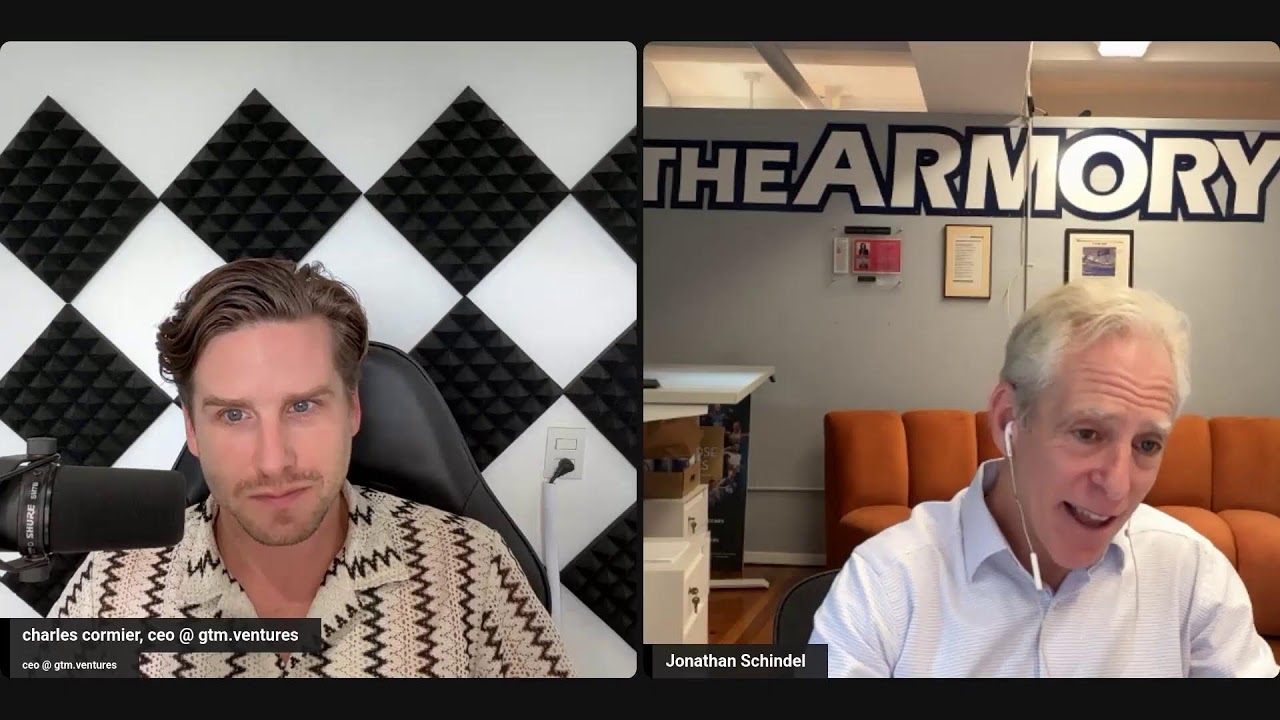
In this CEOism podcast episode, host Charles Cormier interviews Jonathan Schindel, co‑president and CFO of the Armory Foundation, the nonprofit that runs the historic Armory indoor track in Manhattan’s Washington Heights. Schindel explains that the Armory is the world’s busiest indoor track and field venue, welcoming roughly 350,000 visitors annually, ranging from children to nonagenarians. He highlights the venue’s strategic placement atop three subway stations, making it highly accessible. The conversation delves into the arena’s naming partnership with Nike, which began after a chance encounter at a Millrose Games press conference about four and a half years ago, replacing a long‑standing New Balance sponsorship. Schindel recounts the Armory’s rich history: its inception as a track site in 1914, prominence through the mid‑20th century, conversion to a homeless shelter during the 1970s‑80s crack crisis, and revival in the 1990s under Dr. Norbert Sander, a former marathon champion who “just did it” to bring back track and field. The Millrose Games, described as the oldest and most prestigious indoor meet, is highlighted for its global broadcast reach. Finally, Schindel clarifies that while the Armory operates as a nonprofit, it runs with for‑profit discipline, leveraging investment expertise to sustain its mission.
Chapters
Welcome to another CEOism podcast. We have Jonathan Schindel, uh, Schindel, sorry, with us today. He's the co-president and CFO at the Armory Foundation in the NYC area since a decade now. Previous to that, he was an investor, quite successful one. So John, welcome to the podcast. Tell us a bit more about yourself and what you've been up to.
Thank you, Charles. I don't know how many of Your audience know about the Armory in New York City, but we happen to be the busiest track and field facility on Earth. We have 350,000 visits each year. We're sort of the heart of indoor track and field. And it's a wonderful sport. And you're a big fan. It's— we have people on our track as young as 6 years old and as old as 96. And when I'm not injured, you'll find me on the track as often as possible.
That is crazy, right? 350,000 people a year. How, how crazy is that? Is it in the heart of New York? Like, where is it exactly?
So we're in Manhattan. And we're in the northern part of Manhattan in an area called Washington Heights, which is just north of Harlem. But one of the neat things about the Armory is that we basically sit on top of 3 subway stations. So for those of your audience who have been to New York City, the subway is the circulatory system of New York. It's how everybody gets around efficiently. So we're so fortunate to be on top of 3 subways. Most of the people who come here find their way here by subway, which is very convenient.
Man, that is, that is crazy. Is it called the Nike Track and Field Center? Like, how can I find it on Google Maps?
Yeah, so Nike is our arena sponsor. They've been our arena sponsor for 4 years now, and they're great partners. So on Google Maps, you'll probably see it referred to as the Nike Track and Field Center.
You've probably studied Phil Knight and Nike itself. How did that partnership come about, the Nike one?
That's a very interesting story. About, oh, several years ago, I was at the press conference for the Millrose Games. And the Millrose Games, if your audience is not familiar with it, it's the oldest and most prestigious indoor track meet in the world.
It's—
this year will be the 119th year of the Millrose Games.
Wow.
And it's live on NBC here in the United States for 2 hours. It's simulcast and rebroadcast in 255 countries and territories around the world. And it's the most— I guess the way I would describe it is if you took track and field from the Olympics and squeezed it all into a 2-hour time period. Uh, that's what I'd call the Millrose Games, and it's electric. We sell it out every year. We have 5,000+ screaming fans here, and typically we get 1 or 2 world records. Anyhow, at the press conference for the Millrose Games, I got a tap on the shoulder from a Nike executive. who said, hey, uh, when is your New Balance contract expiring? We'd be very interested. It was completely sort of out of the blue, and it was the beginning of a wonderful relationship.
And when was that?
Um, it was, I guess, uh, call it 4 and a half-ish years ago.
That's that's crazy. But you guys are the biggest. What took them so long, right? Because initially Nike for the audience, I mean, it started in track running, right? Phil Knight was a track runner, pretty obsessive one, right? He has this legendary coach. I think he started Nike with that coach as well. And yeah, like he he made the one of the best founders of all time. You know that I study founder a lot, John, and. Phil Knight is still like one of the best founders ever, right? And I still subscribe to his motto, which is just do it. Nike's motto, at least, right? Like, I think people nowadays, they ask themselves too many questions. They overanalyze stuff, especially in New York, right? It's like the land of ambitions. Like, no, stop thinking about it. Just do it. Just go take your shoes on and you just go for a run, right? And this will change your life eventually. Do it enough times and you'll do distance and you'll get these insights while you run, right? And it's like, just do it.
And I think that you'll appreciate this story because it's very much a just do it story. Track and field began at the Armory back in 1914. That was the first time someone ran indoor track and field here. So you're talking 112 years ago. And this was the center of indoor track and field in the 1930s and the '40s and the '50s. In the 1970s, there became a drug crisis in New York City called the crack crisis. In the 1980s, the Armory was converted from a track and field facility into a homeless shelter.
Really?
And for about 8 or so years, there was no track and field here at all. It was just an enormous homeless shelter. And New York passed new regulations and said you can't have homeless shelters with 2,000 people in them. They have to be no more than 200 people. So New York City said, what are we going to do with this huge homeless shelter? Well, our founder decided to just do it. And he convinced New York City to give him the keys to the Armory, which was full of 2,000 beds. His name was Dr. Norbert Sander, and not coincidentally, he won the 5th New York City Marathon. So he was a great runner in his day. He ran at the Armory when he was a kid, and he was a physician at that point, and he decided he wanted to just do it and bring it back to track and field. He began to bring all the shoe companies here and said, we want to be Switzerland. We want to have all the shoe companies here. And the answer he got was, no, we don't want to play in the same sandbox as these other folks. And this was back in the 1990s. But he twisted New Balance's arm and they became the title sponsor for the arena. And that went for decades until, as I mentioned a moment ago, Nike tapped me on the shoulder.
Yeah, and there were great wars going on between Nike and Adidas. I think it was Reebok as well, maybe Puma nowadays. I personally wear Hokas, by the way. Hokas are the greatest ever. I think they're the GOATs in terms of quality. Nike, is the greatest brand ever, but in terms of shoes, Hokas is superior. Like, and we can talk about that later on. I had various ex-Nikes on this show, right? And it's not a secret anymore. The Armory itself, is it for profits? You actually make money out of this? Is it, what's your relationship with like nonprofit stuff, right? Like, if I, I mean, if I would head that business, I would want to make money with this.
It's a great question. We are a nonprofit, and I spent most of my career obviously in the investment world, in the for-profit world. But just because we're a nonprofit company doesn't mean we can't operate like a for-profit company, and we do.
Mm-hmm.
The difference is that instead of having shareholders who get the profits. It's our stakeholders that get all the benefits. So the people who walk in our door, the kids, the pro athlete, the adult athletes, the masters athletes, the community programs that we have, instead of the profits going to the shareholders, as you would in a for-profit company, we reinvest all that money into programs for