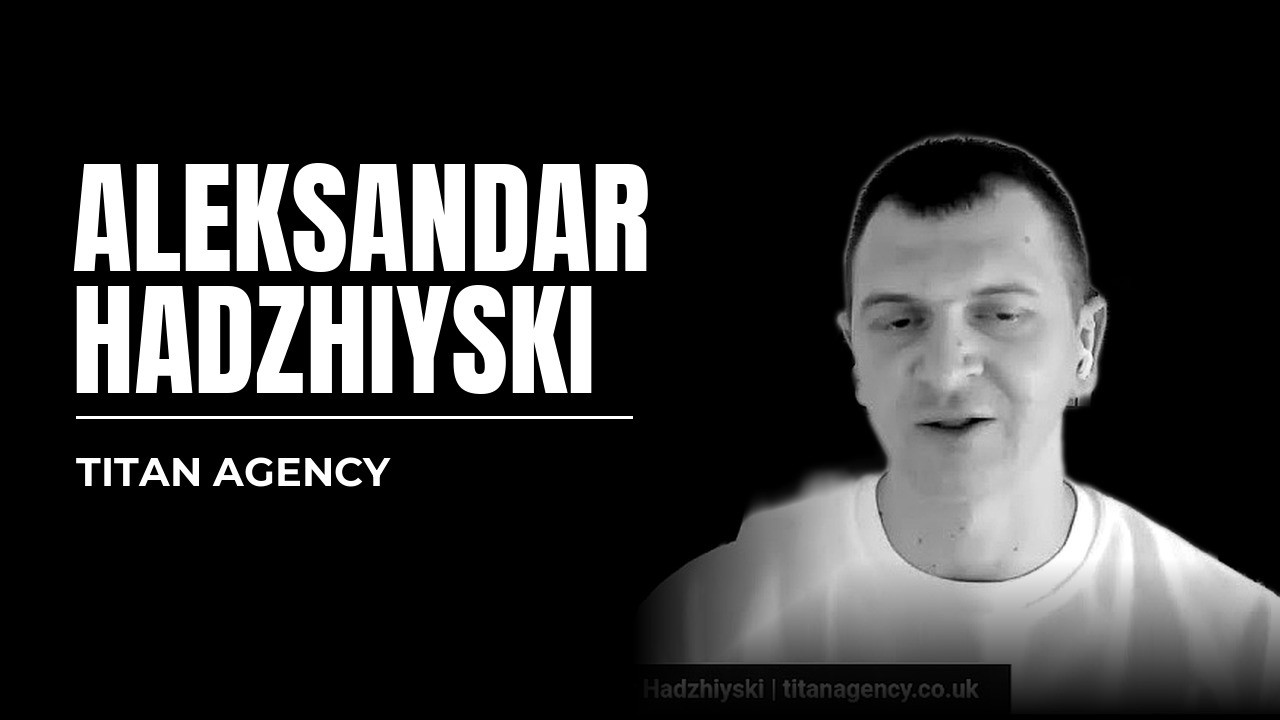
In this CEO Wisdom Pod episode, Charles Cormier interviews Aleksandar (Alex) Hadzhiyski, founder of Titan Agency, a DTC marketing agency that has grown to about 20 clients and roughly $100K‑$200K MRR. Alex explains how the agency was born during the COVID‑19 pandemic after previous affiliate ventures failed, and how a surge of local businesses moving online provided the first client base. Titan focuses on fashion brands in the US, offering Meta and Google ads, email/SMS, and creative strategy, with a strong emphasis on profitability over pure scaling. The agency distinguishes itself by acting as an extension of the client’s team, providing full‑stack advice on forecasting, contribution margin, inventory, CRO, and organic channels. Client acquisition is driven primarily by referrals (11 out of 12 new clients in 2025) and some cold‑email outreach, supported by partnerships with CRO agencies and software platforms like Klaviyo and Triple Whale. Alex shares common audit findings: outdated account structures, over‑reliance on ROAS without profit metrics, and insufficient creative volume. He highlights a flagship case study where a jewelry brand grew from $0.5M annual revenue in 2021 to a projected $10M in 2024. The team consists of 12 members covering paid media, email/SMS, creative strategy, design, and video. AI is used for automation of manual tasks but not for strategic decisions. Market trends discussed include rising CPMs (15‑20% YoY), AI‑driven search traffic, increased competition, and consumer price sensitivity. Alex’s growth plan aims to reach $200‑$300K MRR, target larger brands, and eventually invest in equity stakes of promising DTC brands. He promotes his personal brand on LinkedIn, YouTube, and Instagram for further outreach.
Chapters
Welcome to another CEO Wisdom Pod. We have Alexander Hadzinski with us today. Alex is a founder at Titan Agency, scaled to 20 clients nowadays, charges anywhere from $2,000 to $10,000 a month, mostly in the DTC space. Alex, welcome to the pod. Tell us a bit more about yourself and what you're up to.
Hey Charles, well, thank you for having me. Well, as I said, we are a marketing agency who operate in the DTC space. The majority of our clients are in the United States. We mainly operate in the fashion space. So clothing, jewelry, accessories, anything of that sort. Probably 60% of our clients are in fashion. We're currently trying to expand into other verticals. The services we provide are Meta Ads, Google Ads, email and SMS, and creative strategy. And currently what we're working on mostly is preparing for Black Friday and Cyber Monday because it's Just 2 months away and it's the most important time of the year for our clients.
There you go. How did you get there? So you told me like you went referral marketing and what happened during COVID that prompted you to launch that agency?
So when COVID hit and we got furloughed, previously I had tried to start 2 to 3 different businesses all in the affiliate marketing space. Unfortunately, none of them were successful. So when the pandemic hit, I was like, I need to take a step back and see what I'm good at. That and focus on it. I had a few friends that had marketing agencies. I reached out for advice and yeah, that's how I started. Something that really helped that I noticed during the pandemic is that a lot of local businesses realized they need to be online because when something like this happens and they have to shut their stores, they're basically not generating revenue. So This really helped me get the initial push in going from 0 to 1 in the agency because there was a huge influx of local businesses going online.
The last question I asked you before we got disconnected previously was, how do you distinguish yourself from all these other DTC agencies? I mean, there's tons out there, right? So why should they pick you?
There's, I would say there are 2 things. The first one is that we really focus on profits. We really don't, advise scaling and pushing if you're not profitable because if you're losing money, scaling is just gonna make the problem bigger and you're gonna lose money a lot faster. And the second thing is we really work as an extension of our clients' teams. We're not just an agency that you hear from once a month and just upload ads. We really get into the weeds with the clients. We analyze their entire businesses. We help them with forecasting, contribution margin, inventory as well. Even if we— even if they hire us to just manage their Facebook ads, for example, we're also gonna give advice on CRO, email, social media, organic. So we— our main goal is to scale the client profitably, and we do everything we can to do it. Even if we don't manage certain service, we will give advice.
Right. And you're specialized in beauty Why go after that specific niche? Is it just a client in a niche that you had a strong concentration in and just decided to go like all into this?
So we're concentrating actually in fashion, but the reason why we ended up in this situation with the majority of our clients being in fashion is because initially when I started Um, for some reason, mostly fashion brands were replying to, to my cold email outreach. We signed them as clients. So initially, we— I built a huge portfolio of case studies of just fashion brands. And when you have a case study to show another fashion brand that you've actually done it with one of their competitors, for example, or a similar brand, they are a lot more receptive and easier to close.
There you go. How do you get your clients? Do you run ads? Do you run cold outreach? How do you get in touch with them?
So currently we do cold email outreach and I'm building my personal brand, but the majority of our clients are coming from referrals. So for the past, let's say in 2025, we get a total of 12 new clients. 11 of them came from referrals and only 1 from cold email outreach. So we do get a lot of referrals. We also have partners We are partnering with the CRO agency that we refer clients to each other, and then clients refer friends, people that they know with businesses.
Interesting. And it's mostly European clients by now?
No, it's mostly clients in the United States. We don't work with European brands.
Okay. And how do you— why wouldn't they pick like an American agency rather than yours?
I would say the main thing is because we are a lot more affordable. I think an agency in the US will probably charge them twice as much as we do. And we deliver results. Yeah.
The first step is an account audit, right? Like most of the time, how do you win their trust so that they give you the keys to the account without really knowing you?
I think, I think in today's day and age, people are a lot more— they trust you a little bit more with this kind of stuff. I think maybe 3 to 4 years ago, it was very like taboo to give someone access to your accounts. But I think in today's day and age, especially with the bigger businesses that are doing $10 million plus, they, they know they have to give you access to analyze their data and to give them a proper audit and structure. Obviously, we sign NDAs every time we, we audit the clients, but I think It's a lot easier to get access to an ad account nowadays than before. Before it was just whatever you can say on the call and what you can see in their ad library from the outside. But yeah, I don't think it's an issue at the moment.
Roger that. And usually what's the main problem you see when you do these account diagnoses? What do you go with like recommendations most of the time?
A few things. The first one is that a lot of agencies and brands still operate like it's 2020. The accounts are very messy. They have tons of campaigns where Meta now really prioritizes account structure to be really consolidated. You don't need 10, 20, 30 campaigns like you used to before. Now you can go just 3 to 4 campaigns and really focus all of your budget there. The second thing I see a lot of brands is that they don't understand their numbers. They just have heard from a friend or they've seen online that you need to be achieving, let's say, 3 or 4 ROAS, and they just focus on the ROAS. They don't take into consideration, let's say, contribution margin. They don't look at profit, and they just scale based on ROAS, which it's a huge mistake because if you don't know your metrics, you don't know what's working and what's not. You don't know if you have to scale or you don't. The ROAS might look really good, but you might be losing money at the same time. And the third one is a lot of brands and agencies underestimate how many creatives you need. Meta now prioritizes accounts with huge creative diversity, and brands and agencies think that you can get away with just 10 to 20 different ads every single month, which is definitely not the case.
Right, right, right. What have been your best case studies so far? Can you give me an idea? Like, let's say I'm a beauty brand, I'm making $100,000 a month, but I've seen like my ads have been stalling in the last couple of weeks. My SEO is not doing as good with like AEO stuff, right? What do you do for me? Can you bring the revenue to 15% plus on a month-to-month basis? Like, what's your number one flagship case study there?
The number one flagship case study is that we have a jewelry brand. We're still working with them. We started working with them in 2021, and at the time they were doing half a million a year, and this year we're gonna do $10 million. So in 5 years, we managed to scale them from half a million a year to $10 million that we're gonna do this year. And this is like our, by far the best case study.
What's challenging about working with these clients most of the time? Like, where are their expectations versus what you deliver for them?
So clients, I'm gonna divide the clients into 2 groups. I'm going to say clients that are doing less than $3 to $4 million a year and clients that are doing more. With the clients that are doing less than $3 million a year, The biggest challenge there is convincing them that they need more creative. They're getting good numbers and they can scale because, for example, when you're working with a smaller brand, they don't have that much experience and they think you can optimize your ads all the way up to getting 20 ROAS, which is definitely not the case. And they underestimate how many creatives you need. For the smaller brands, if they don't say if they don't want to pay us to manage their creatives for them, 99% of the time they don't provide us with enough creatives, which I said earlier that brands underestimate how many you need. And these are the 2 main things. For the bigger brands that are, let's say, doing $5 million plus, the challenge there is that the funnel is a lot more complex. For example, with Meta now really favors also targeting different personas with your ads. Let's say for example you are selling supplements and let's say protein powder. You have to divide your personas into pain points. So for example, someone might be taking protein powder to gain muscle. Someone might be taking it to recover. The third person might be taking it to lose weight and just get fit. And you have to, you must have all of these different personas in their own campaigns different messaging, different creatives. So it's just a little bit more complex, but it's a lot easier to work with them because bigger brands have been in business longer. They understand their metrics, they understand what it takes to get there. So they're a lot more collaborative, I would say, and a little bit more understanding.
You are probably at what, $40 grand MRR, $50 grand MRR? You started the business 6 years ago. What would it take you to bring the company to $100 grand MRR?
We're currently close to $100K MRR, actually. And my next—
How to take it to $200K then?
Yeah. So my next goal is to start acquiring bigger brands, to start working with bigger brands. In our portfolio, we have, I'm gonna say, 5 brands that are doing more than $8 million a year. And my goal is to keep the same number of clients, so 20 to 21 clients, but start But start working with the bigger brands and maybe have 10, 15 of those.
Interesting. So do you have like partnerships as well, like partnering with brands that could actually bring you more clients, or have you started doing some of that?
Yeah, so we, we, with the way we work on referrals is that if a client refers us a business, We give them a percentage of how much we charge them every single month as long as they are our clients. Same thing with our other agency partners. If they refer a client to us, we give them percentage of what we charge the clients for as long as they are our clients.
And who are these partners? What are their profiles?
So the agency partner, they are CRO agency. They optimize websites for better conversions. And then our clients are just our regular clients in the fashion space.
Okay, so you serve them, you satisfy them, and then they know some other friends in the industry?
Yeah, yeah, a lot of DTC brands know other DTC brand owners just because of conferences they're going, friend circles.
So yeah, interesting. What about like programs like Klaviyo partners and stuff? Like, have you thought of partnering with some software brands that can refer you clients?
Yeah, we are partners with Klaviyo and we're partners with Triple Whale. We're partners with Polar, which is similar to Triple Whale. But those software companies, they have such a wide range of agency partners that 99% of the time they'll refer someone to their biggest agency that they've been working for like 10 years and they know they can handle $200 million spent a year. So it's very difficult to get a referral or a client from software companies like Klaviyo, like Troopo, because they're too big.
Right, right, right. Interesting. Tell me about the team, right? Is it only yourself right now and a couple of customer success managers? Do you have salespeople?
So salespeople we don't have. I'm the one closing the deals. We're a team of 12 people. We're 6 people managing accounts, 3 on the paid side, so Meta and Google, and we have 3 people managing email and SMS for our clients. We have 1 creative strategist that manages all of the creatives for the ads. We have 4 graphic designers and 1 video editor.
What have you outsourced to AI since that whole revolution started? How different is the agency now versus when you started it in 2020?
The main things that we have outsourced by AI are mostly the manual stuff that we're doing. When it comes to strategy, we still do it ourselves. I feel like AI is still not there yet because it just doesn't have enough context on the brand. But we utilize it a lot for automations and all of the manual work that we're doing. But for strategy, we're still doing it ourselves.
Interesting. And the agency, where do you see it in 5 years from now? Do you mostly see like an exit or do you want to scale into software? Like what's the next plan for you?
I will most likely keep the agency. It's a really good cash flow business with really good margins and with all of the partnerships with different clients, it helps you to meet like a lot of different people. My idea within the next 5 years is to get the agency maybe to $200,000 to $300,000 per month. And then instead of continuing to acquire new clients to work with, starting to invest in smaller brands. Let's say we find a jewelry brand that's doing half a million a year. We buy a piece of the company, we invest in them, we manage their ads, we help them grow. We get it to let's say five ten million. We sell it just as an example. So that's my idea and where I'm I'm heading.
Yeah, I love it. Yeah, it's it. I've talked to a lot of agency owners in the DTC space that are are doing a killing right now. Like, do you where do you see the the market shifting in terms of beauty? Have you seen like? Beauty products or fashion product buyers change their buying habits? Like, do they use AI nowadays? Like, how's the market shifting on the buyer side?
Yeah, so we're seeing for a lot of our clients that a lot of customers are coming through AI search like ChatGPT, Claude, Gemini, and all the other stuff. Also, people are now just hungry for discounts. Selling a product on a full price, it's getting harder and harder and people are just waiting for discounts. So the marketing is getting tougher. Also, with AI, it's so much easier now to launch a brand, to build your website, get your social media up and running. So competition is rising as well. And on the paid media stuff, ads are getting more expensive every single year. With the clients that we're working for 5 years now, we can see the CPMs are increasing every single year by 15 to 20% and there's like, there's nothing you can do about it. So this is something else that I advise a lot of our clients is that they need to have a really good social presence, really good organic presence because ads are getting more and more expensive and having social presence really helps. Also, you need to have good margins on your product because with rising costs, with algorithms being changed every 3 to 4 months now with AI, You need to have good margins so when there is a dip in the market, you can you can survive and you don't lose money.
Where can people find out more about you, Alex?
So I post regularly on my LinkedIn profile. They can they can find me there and on my YouTube channel. I also post shorts on Instagram. So basically all the social profiles.
Got it. So that was Alex and Charles for another Founder Wisdom.