Amanda Philpott - Founder / CEO @ eargym
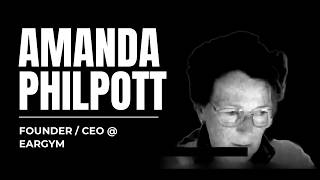
Amanda Philpott left a 28-year NHS career to start Ear Gym, an app that uses AI-powered auditory training to prevent hearing loss and dementia. Her game-based training improves hearing capacity by up to 25% in seven weeks. The app has hit 56,000 downloads and 2.3 million ear-age checks, with partnerships including Cleveland Clinic and AARP.
Chapters
Welcome to another CEO Wisdom podcast. We have Amanda Philpott with us today. She's the CEO and founder at Ear Gym. It's a very interesting company. Yeah, hearing loss is a thing, right? Like me and Amanda were talking about my stepdad's last time. She said that the new AirPods can even help him hear better. And her app helps people keep their hearing loss in check, have a score, and then the potentially improve on it afterwards. Ear Gym's a B Corp. She's into fundraising strategy, and yeah, they're building an AI-powered hearing health intelligence system. So Amanda, welcome to the podcast. Tell us a bit more about yourself and what you've been up to.
Hi, Charles. Thanks for having me on. Yep, I'm the founder and CEO of Ear Gym, and we incorporated in 2020, just a couple of days before COVID started. So we're a fully remote company, and we started because of the correlation between hearing loss and dementia. So hearing loss is the biggest amenable factor in dementia, and I'm an ex-NHS chief exec. I was in the NHS for nearly 30 years, and I was chief exec for quite a lot of that, and I found that we weren't spending enough money on prevention. And at the time that I left the NHS, my dad was still alive, and he was living with the impact of dementia. And a couple of decades of unaddressed hearing loss. So when I realized about prevalence and the correlation and the fact that, you know, there are barriers that are about our beliefs, so they're about the belief that hearing aids are the only solution, that it's an inevitable part of aging, that if we wear hearing aids we'll look old, etc., etc., I thought we could tackle that with the opportunity of you know, bringing forward hearing care and offering auditory training.
Very interesting. Like we spoke last time, tell me about your time at NHS. 17 years, right? And even more than that, I think—
28, actually. Yeah, 28 years. I started in 1991 and then I eventually left in 2015. That's crazy.
28 years. So how could you survive that long in a governmental organization and then launch your, your own company? Like, how does that happen?
Uh, well, the NHS is massive and complex, so it's many, many, many organizations within this overarching structure. And so you get the chance to try loads of, you know, you work in acute hospitals or teaching hospitals or ambulance services or mental health or in, you know, general practice. Um, I'm a manager by background, so I had the opportunity to manage loads of different services and information technology and health records and strategic systems and things. And then, and then I moved into board-level positions and started, started making strategic decisions for the organizations that I was in. And then, and then the inevitable next step really is to become a chief exec. So you end up running large and complex organizations, and they're deeply political because you you're making decisions that are really affecting your local communities. And you're, you know, one of the, one of the biggest and hardest decisions I made was with my board, was to recommend the closure of local maternity services because they were unsafe. Um, and those are hard conversations that you have. So at the point at which I left the NHS, I think I, I have loads of, um, knowledge and experience of how to run organizations and how to do good governance and how to have really difficult conversations. But what I didn't know was anything about building a startup. So I joined the Zinc Accelerator in London and had this whole new world presented to me. And I've been on that learning journey ever since.
It's fascinating. Yeah, the political games and so forth. And yeah, that hard decision, for example, how did it pan out? Right. And was like closure the only viable option there where were there other possible cards on the table?
Well, it was a choice of, um, it was a choice of which sites. It was a, what we call a hospital trust, but it was an organization with two acute hospitals, and they had about the same number of births on each site, but each site therefore was too small for— when you're in medical services, your clinical teams need to see enough births because most births are safe, of course, So they need to see enough births to be able to respond appropriately when the births are in that very small proportion that are going to be dangerous or unsafe for the mother or child. And so the choice really was not about— was not about could we keep it open because there were too few births happening, but which site would be most appropriate. And of course, then you've got the job— you know, we had a site that was serving a poorer but younger community and a site with a much more articulate wealthier, older community, and they were obviously frightened that it was signaling the end of their whole hospital. So we had to make sure that we were having very engaged, open conversations about what safety means. Safety is not always distance. Safety is all, you know, it's more complicated than that. It's not always time. It's about who you see as well and the skills of those people. So Were there other options? Not really. Not— I mean, the option, you know, you can kick it down the road, but I don't know if you're aware of this in the NHS. Obviously, there's quite a few maternity concerns about some poor practice in some facilities, and we didn't want to be that. We didn't want to take the risk.
How would you describe the public health system of Britain vs the US or Canada's, for example? Is it similar? What are the differences?
Yeah, that's a great one. I mean, there are pros and cons in every system across the world, but the real benefit, the real opportunity of the NHS is that it's free at the point of delivery. So we pay for it through national insurance. So it's sort of deducted from our pay, if you like. So we don't— when we are injured or when we have cancer or when we're worried about something, we can go to the NHS and get care without checking who's paying first. Because it's free at the point of delivery. That's the point of principle that it was set up with. But what that leads to is sometimes it's not always a consistent standard of care, and of course there's a huge amount of demand, so there's some waiting. Whereas other systems, you know, when I or my family have had care in the States, or when I talk to my friends who live there, we're talking about really making sure that your health insurance covers everything that you do. And actually, I see, I see a bit more preventative care in those systems because the downstream, you know, addressing risk earlier so that you delay downstream cost or defer downstream cost is something that's much more explicitly within the economic modeling in insurance systems. So I see I see pros and cons in both systems.
Do you feel that people are outsourcing their health to the governments and not caring enough? I mean, the role of the government also is sort of to take care of people, like a big brother, is like, hey, this may happen and I'm gonna take care of you, and you're probably not in a position to think for yourself about these things, like black swan events that might happen, like a cancer, for example. Um, that, that is one question. The second question I have, don't you feel that with AGI or super intelligence, right, there's Demis Hassabis and DeepMind that have been trying to solve this, don't you feel that the cost of healthcare will drastically lower, hence, uh, the current models of governments and insurance companies won't scale as much in the future?
Oh wow, that's, that's really interesting. I think that the opportunity of AI and those big models is really great because we are aging as a population, we are aging and we are growing in number. So the present way of delivering healthcare is entirely unaffordable in the long term and unrealistic in terms of being able to service all the needs of an ageing and growing population. So I think radically rethinking those solutions and enabling AI, AGI in there is great, and it will enable us to meet need better, but it won't replace one or the other, but we'll make better use of, if you like, the human, the necessary human-facing parts of health and care. The bit about responsibility is really interesting. This is just a reflection, but, you know, before email, when I used to be a manager at the age of 25, and I'm afraid I am that old, I didn't have a mobile phone and I didn't have email, and I would be the on-call manager for the hospital I worked in 7 days, you know, 24/7 for a week. And if I called the chief executive, the hospital had to be on fire. You know, you had to make decisions, and I think I know that decisions are escalated through our ability to communicate much more quickly and easily so that we are not so capable of, or maybe we, I don't know if capability is the right word, but we don't make decisions as powerfully as we used to before we had all of this technology. So, I think it's both, and I use that sort of minor analogy, but it's kind of real insofar as we both benefit and disbenefit from technology. And so I don't know. And the thing about looking after yourself, you know, there's loads of discussions about, you know, well, if people smoke, should they have access to lung cancer care? If people drink, should they have access to emergency A&E? If people eat too much, then should they be allowed to joint operate? You know, I've been— I've heard all of those conversations, but that that leads towards a conversation that a medical condition is just that specific thing and that there is cause and effect. And most lives are far more complicated than that. So I'm averse to having that.
And from a first principles perspective, someone that drinks heavily or smoke heavily, they're— most of them are coping with something, right? Which is a disease, which is most of the time caused by living in a society, either comparing yourself with others or not having the same opportunities as others, not having, uh, as good of a childhood and upbringing that you could have, right? So smoking and drinking, most people don't do it for fun. They do it to, to block up a major hole in themselves, right?
So I think it's much more complicated than just it's somebody's fault. Yeah.
Yeah, I think as, I mean, quote unquote successful people, it's something we need to care about as well. It's sort of a responsibility to give back and sort of pay that taxes, although I am mostly opposed to the concept of taxes the way it is nowadays. I think that should be reformed as well or greatly improved with all the technology we have, right? Let's talk about Ear Gym. I love the name, by the way, of the business. It's a great name. Um, tell me about that one, uh, your quote-unquote pivot from, uh, I mean, you were, yes, an executive in that governmental organization, but startups are night and day, right? So where did the ideas stem from? And yeah, where did you find like all that energy momentum to launch your own company?
Uh, well, I, um, I've even in the NHS, I was really driven by population health. I think it would be great to have a massive, massive global impact on good health. And actually, one of the things that motivated me was I realized that even with hearing care being the biggest amenable factor in dementia, I had never— not in my years of leading commissioning organizations— I'd never commissioned hearing care. And I hadn't— I didn't know about it, you know, despite really being in a position to know a huge amount of stuff. I didn't know about the prevalence of hearing care and its correlations, and I just thought, well, you know, there is a seriously underserved area. Why is that? And the more that I looked into it and the more that I understood the barriers to care, I thought I could do something about it. And we found— when I was looking into it, I learned about the science of auditory training. So if your hearing is built of two parts, effectively you've got the sensory neural hearing, which takes in the sound, so your ear and middle ear and into your cochlea. In your cochlea, you've got roughly 18,000 hair cells. They're not hairs, they're hair cells. They translate into electrical signals that go to your brain, and your brain applies meaning to sound. But if you— if you— the lab-based science says if you practice listening, the importance of auditory processing, of applying meaning to sound, is so significant in your overall hearing mechanism that you can improve your overall hearing capacity by up to 25% if you practice listening in as little as 7 weeks. And I thought, A, I didn't know that, but B, that gave us a huge opportunity to make hearing care more affordable. At the moment, most people believe that the only thing you can do for hearing is hearing aids, and they're an average of $3,000 a pair. So if you, if you think you've got do nothing or $3,000 spend, then then do nothing is quite a big option for most people. But if you've got the opportunity of checking your hearing via your phone, medical-grade hearing check, and then practicing listening with a few entertaining games for, you know, 3 or 5 times a week for 5 minutes, and that can improve your overall hearing capacity, maybe defer your hearing decline, maybe defer your cognitive decline, then that seemed to me like a really great opportunity for people to use it. And what we've seen is that that's true. You know, we've done 56,000 downloads, you know, when we've stuck things up on YouTube just to see if people care about their hearing. We've done 2.3 million ear age checks. So that accessibility and taking the fear out of affordability and cost and, sorry, and looking frail and all those things, those are the barriers that we've been addressing. It's been really good fun. It's quite different. To public service. Quite challenging, but good.
Yeah, for sure. Explain the correlation between not hearing and dementia. Is it just that the brain is less active in itself? Is it as simple as that?
Oh yeah, interestingly, one of the biggest problems in hearing care is the absence of data. So because we don't check our hearing, people— it's really hard for scientists to tell you the direction of cause. So the correlation is absolutely definite. The Lancet Commission on Dementia shows the correlation, has brought together all the science that shows it. So the correlation is hearing loss, social isolation, stress, depression, mild cognitive impairment as a marker for dementia. But whether or not dementia causes hearing loss or hearing loss causes dementia is because of the absence of data over time, you can't make that statement. So one of the things Ear Gym does is give you the chance to measure your hearing whenever you want to so that we see that hearing and cognition over time. But the two, they're not really competing theories, they're simply two theories that say either because you're struggling to hear the sound, your auditory cortex turns off So you get some brain decline or because you're struggling to hear, your auditory cortex is working so hard that it's drawing resources from your working memory. So that part of your brain is under challenge. But we need the data over time, the sort of data that is in Plex to be able to contribute to greater knowledge about how that correlation works.
And Alzheimer's. One of my first company was a nootropic 12 years ago, and we were in research and building studies to actually actually build a supplement to delay the onset of Alzheimer's. My grandmother died of Alzheimer's. It's a terrible disease because it's like a slow death, and the, the person that you love and that you used to know becomes weak, incapable, sometimes angry. Um, what's the difference between that one and dementia? Can't Alzheimer's also be explained in simple causes as someone slowing down their lives, they lost a spouse, they don't interact as much with people anymore, and as a result, their brain decays/oxidizes faster?
Well, I'm not— two-thirds of dementia are genetic, two-thirds of causes of— two-thirds of cases caused by genetic factors, and a third are more attributable to environmental factors. And as I said, hearing is probably the biggest of those at 8%, but there are other— even smoking or exercise, etc., etc., sleep and things all contribute to the symptoms. But there's a difference between the symptoms of dementia and the, um, and, and what causes it in, in terms of the brain atrophy, um, and the disease that it is. But I'm, I'm not a sufficient specialist to want to to feel confident about arguing your question, about answering your questions, right?
Ear Gym in itself, uh, you've launched an app, right? And I think you launched as part of Zinc, which is like a VC. Um, tell me about the early days, um, and the idea picking up traction, because you, you went like top app quickly, uh, enough, right? Like, has it been a resounding success? What have been the challenges so far?
Well, the successes are that we have a— we've had a couple of research grants that have enabled us to do user-led design, including people diagnosed with dementia helping us build an app that's accessible. And we've had good reach, as I've mentioned. We have good access, which means that we've started to build a really strong database for influencing or informing research studies. But as you will know, you know, we face the same the challenges as every startup, which is about proving that you're commercially viable. And so with hearing health being such a relatively new field of interest, and there's a lot of interest now because of new tech entrants coming in, you know, with, as you mentioned in the intro, AirPods being able to call themselves hearing aids and hearing glasses coming on the market and all these things, there's a renewed interest in hearing care. But it is, it is at that stage where, where people are trying to work out what, where they need to invest to look after their long-term health. So for us, what we're doing is focusing now, we have a strong product and we're focusing on commercialization and our early contracts are in health insurance. But we've also got a collaboration with Cleveland Clinic, so that's about assimilation to hearing tech. So when people get hearing tech and they re-hear sounds or hear sounds for the first time, that can be quite alarming. And so we give them the opportunity to practice safely with auditory training games. So we're finding these routes into market, but that's been our biggest challenge. Yeah.
And you came up with like innovative things like your YouTube challenge, for example, to pick up traction. But isn't marketing to 65-year-old plus like a big challenge? Like where do these people hang out? How do you convert them into clients? Isn't that a big challenge?
Yes and no. I mean, our target market really is below— is 45 to 65, and I'm 59, so I'm bang on. I can mark, you know, I know what my friends and family think. I mean, I know how they respond to marketing is what I mean by that. We've done— what we found with our— when we were direct-to-consumer, and we now were available predominantly— we're available in the app stores, but we predominantly route to market is our B2B licensing route. But when we were focusing on direct-to-consumer, we had a cost per acquisition of about 50 cents. Because actually, when people are aware that they can do something rather than nothing, they are really interested in their hearing. And what we know, what the World Health Organization says, is that younger people age 12 to 35, there's another billion, another billion people at risk because of noisy worlds and headphones and things. And we can see that decline in hearing coming earlier in the life stage. So marketing is something that we're looking at an age group who use smartphones, who use hearing tech, and who do care about healthy aging. So actually, we did find a really interesting gender difference. So when we were message testing, we found that women aged 45 to 65 really respond to, could you contribute to dementia research? And men in that same age group really respond to the idea of Ear Gym going train your hearing. And, you know, so we, we find some interesting differences, but predominantly, actually, given the opportunity, people really want to care for their hearing.
Interesting. What's next for you? What do you want to accomplish this year?
Well, we're a medical device Class 1 in the UK and EU and Class 2 in FDA. And that's for our speech-in-noise hearing check. And then we offer the auditory training games, and we want to demonstrate the therapeutic benefit of those. So we are going to kick off what we call a Class IIa randomized control trial to be able to achieve that medical device status. And we are also predominantly— our focus is on growing in America. And North America because we have that relationship, the collaboration with the Cleveland Clinic, and because we're working with the AARP's Age Tech Collaborative on ensuring that Agee meets the needs of older North American people. And so that's, that's our immediate focus over the next year or two.
Right. And last, last but not least, like the business in its current state, how How would you describe its growth between 2019 and now, and where would you see it like in 2030, in about 5 years from now?
Yeah, it's been slower growth than we originally anticipated. We, as I said, we started just before COVID and you will know that COVID significantly changed the investment world, and then sort of economic shocks in 2023 and beyond have very much changed all of the, um, what turned out to be nonsense that was told to us when I was on an accelerator in the early days, um, in terms of projections and valuations and all of that stuff. So it's been quite a painful journey, but we are 6 years old, uh, we are growing, and we've 10x'd our revenue. It's still lower than we would like it to be, but we 10x'd it from previous year, and now we are looking, um, to grow through commercialization quite significantly in '26 and '27 and '28. By By 2030, we should be widely available in, obviously, in the UK, Europe, US, and Japan and Asia. We have a partnership with a key player in Japan, and we are just setting in place the conditions to be able to extend that. So multi-language versions, including a medical device that works both for hearing screening and for therapeutic benefit. And honestly, the success would be that we are able to demonstrate through our data that people's cognitive well-being is being maintained for longer because they're looking after their hearing.
Amanda, thanks for showing up today. Where can people find out more about you?
I'm on LinkedIn, Amanda Philpott. Our company website is www.earjim.world. And I'd love to hear from anybody.
With Amanda and Charles Cormier for another founder
More from Charles


Founder Wisdom: the audiobook, version 2 (5 hours of stories from founders and CEOs)

8 CEO Questions I Love Asking: the audiobook (64 founders answer, in their own words)





