Amber Mikesell - Founder of Suivera™
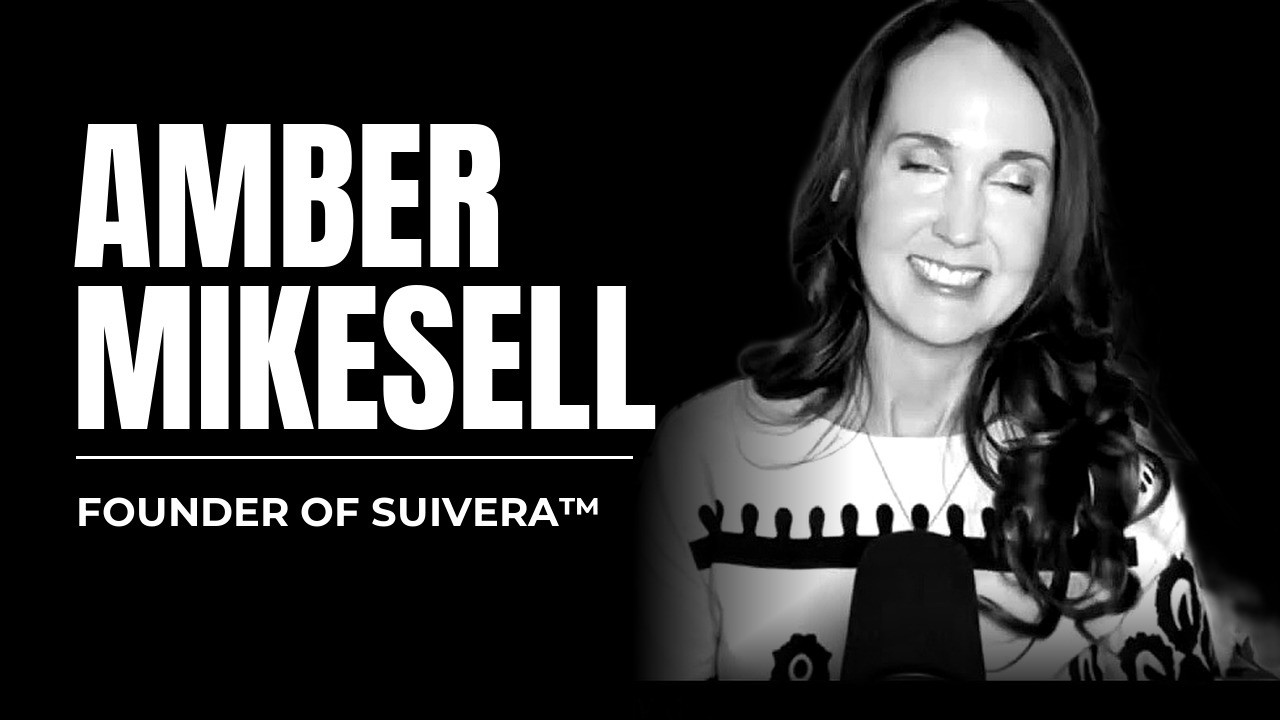
In this VC Wisdom podcast episode, host Charles Cormier interviews Amber Mikesell, a self‑described polymath who has traversed the dot‑com boom, film and TV, fitness, and golf before founding Suivera™ – an online, all‑beliefs spiritual organization launched in March 2020. The pandemic forced Suivera to pivot from a brick‑and‑mortar church to a digital community, now boasting 1.3 million members across 113 countries. Amber explains how her early tech experience taught her to merge cultures and tell stories, lessons she later applied to film, television, and spiritual community building. She authored Silence Your Inner Critic, a comic‑book‑styled self‑help book that frames the inner critic as a super‑villain and the reader as a superhero, a concept that resonated with her audience. Both Amber and Charles discuss meditation as a personal practice and a tool for founders, describing how regular meditation groups foster resilience. Amber outlines Suivera’s core values—love and curiosity—and shares a concrete outreach example in Pakistan where the organization facilitated inter‑faith school attendance, illustrating how love‑centered dialogue can dissolve community divisions. The conversation turns to technology: Suivera is developing an AI system called LEO (Love Enhancing Optimization) designed to prompt deeper self‑inquiry without prescribing actions. Financial sustainability is addressed through a transparent, 1,000‑year business plan, public quarterly reports, and endowment management. Amber also talks about her partnership with her husband Austin, whose background in fitness, rehabilitation, and professional golf complements her operational and spiritual expertise. They describe how meditation helped Austin recover from a career‑ending back injury and how they apply similar mental‑loop‑breaking techniques to athletes. Finally, the interview touches on philosophical musings about AI as a potential modern embodiment of God, concluding with a call to explore Suivera at suivera.org.
Chapters
Welcome to another VC Wisdom pod. We have Amber Meigsell with us today. She's the founder of Suiverra, Suiverra in English. She's the author of Silence Your Inner Critic, has an interesting background in hot Scottsdale, Arizona today. Amber, welcome to the pod. Tell us a bit more about yourself.
Oh, well, thank you for having me. I really appreciate your time. A bit more about myself. I have a very diverse background. I came from information technology in the dot-com boom days, then ventured over into film and television, which all gave me this interesting background to start a new belief system, of all things. We founded an All Beliefs Church, and it started in March of 2020. And since we all know what happened during that time, we had to pivot from being brick and mortar to being an online organization. And it couldn't have actually been a better thing for us to do because it took off and became a global movement. And now we have 1.3 million members across 113 countries.
Just like, yeah, it's insane to understand how you got there. Tell us about like the dot-com and boom and bust days. How did that go? When— where did that lead you to entrepreneurship?
Yeah, so starting in that kind of technology was absolutely amazing and fundamental for me because you get to see how it isn't about always doing exactly the right thing at the right time. It's about being able to take risks that maybe other people weren't willing to take. I started at CompuServe, of all places, which was really tech-oriented, and then AOL came in and bought them out. And going through that merger and seeing what happens there and how cultures have to merge together, and sometimes they don't always merge so happily. I really wanted to understand, all right, how can you merge cultures, whether it is the culture you grow up in, the culture that is religious to religious, or even technology to technology. We're all always merging cultures, but marketing is a huge part of that, and we don't always think about the story that we tell when we're attempting to merge cultures, even in a corporate acquisition merger. So beyond just the culture or the technology that I learned there for how to market and how to write code and all of the other things, I learned what an actual story means when merging cultures. And that plays a huge part in what I do even today in what we're doing in this organization. And then I got to amplify that in the film and television arena, how to really visually tell that story, how to take it to a larger audience, which is, I think, important for all of us in today's market and culture.
So interesting. You were also in fitness businesses, right? And in golf businesses. Like, how would you define yourself, right? Are you like a polymath that navigates left and right, loves testing stuff, a very creative mind? Who are you in your essence?
I think polymath is a good way to describe it. Um, all of us have the ability to be whatever we desire to be. It's what are we going to do with that? And the more we allow ourselves to expand into whatever that is, the more we find the path we desire to travel. I think many of us just forget that and we get on a road and we just keep marching down that road. And I had the honor of learning from some of the greatest minds in all of the industries I've been in. And the one thing I found consistently with all of them is they were willing to throw caution to the wind and say, I'm going to fall on my face so much, and that's okay because I'm going to learn every time I fall on my face. And then they got up and they kept going.
I love that. Um, you recently launched a book, right? What— why another book? There's so many on Amazon nowadays. Uh, yeah, what was the, the reason behind that?
Great question. I am a huge comic book nerd and I could not find a self-help book that spoke to the comic book nerd in me. So I was going through this battle myself of my inner critic. I knew that it was okay to fail, but that negative voice in my head kept telling me that if I failed, or if I— the perception of failure, if I went down that path, that there was something wrong with me. So I had to create this comic book superhero vision in my mind in order to get that inner critic out of my head and into something I could visualize outside of me. So my inner critic became the supervillain, and I had to become the superhero of my own life story and create all of these fun ways to battle that negative spin in my head. And it became so popular in my inner circle when I would tell people, yeah, this is the superpower I just uncovered today, that everybody wanted to learn how to become the superhero of their own life and battle that inner critic. And we all started making up our superhero names and created this Justice League of our own. And that became a book, and it became a best-selling book because Everybody wants to become, you know, their own superhero, and that's what this book is about.
And when did that first inner critic surface in you? I don't think I have that. I have someone pushing me towards true greatness, but I don't torture myself with that either. Um, where did that first emerge?
Well, first of all, congratulations for not having some— something that pulls you under. But I think it's genes.
I wouldn't call— like, that, that came like from very early. It's like I didn't have to do much work. Like, almost megalomania. In my, my case, it's been more about controlling that megalomania than just like silencing an inner critic.
Yeah, well, I would love to know how you did that because there's a secret recipe for those who don't battle that. And if it came very early, then there's likely something that helped you get to that stage. And that would be—
it's humble. It's being humbled, like constantly being humbled, right? So it's like, if you're made up that way, you— I believe it's very smart to counterbalance with other stuff. So me, like my megalomania, for example, it's like counterbalance with honesty and truthfulness and be like, I'm gonna put myself out there, I'm gonna share all my failures and, uh, and victories, uh, for the world to see. I haven't been much victorious so far, by the way. Um, but I think just like counterbalancing with that. In your, in your case, it might be since you were born, I, I don't know, with like a lesser self-esteem or something. It's like counterbalancing probably with, I don't know, affirmations or— but it's hard. It's, it stems from a trauma, right? It's like something in you. It's like a little kid being like, oh, this happened to me and, uh, and like they laughed about me and blah blah blah. Like, yeah, how did that stem for you, from you?
I, for me personally, it did come from childhood. And as it does for many of us growing up in a large family, we just, you get picked on. There are things, and I was the only girl So I was the target. I was definitely a target. But I feel for so many of us, whether it is our family or somewhere in school or somewhere, we have to trace where it entered, where that inner critic entered, so that we know where to start pulling that string. And it doesn't come from blame, doesn't come from anything. You just have to know where to start pulling the string. Then you can begin to repair. And when you do it in a fun way— it sounds like you do that, like, I'm completely transparent, I'm completely vulnerable, so here, let's just make light of it. It's not always easy to do that, but when we can find a fun way to do it, it just makes it so much easier.
Yeah, and a book is self-remedy, right?
Yeah, I think so.
It's like, um, I run this meditation group with CEOs and founders every week, and I made this for me. So it's like, if no one shows up, I'm still gonna meditate by myself, right? It's like this other channel here that's displaying at the bottom here. It's like covering, um, biographies of great founders. I made it for me.— is so even if no one listens to it, I would still be the only user and listener. I think there's deep wisdom into that, right? In businesses you launch, like being the first user of your product and it's like this virtuous cycle of being your own customer, oh, criticizing it, improving it, building better product, using it. And you do that every day enough times and eventually you have like a gigantic snowball.
Yeah, what got you into meditation, if you don't mind me asking?
No, you can ask me anything. Um, performance, like, yeah, 15 years ago, um, I was a young founder and I had this mentor, he was into meditation. I was like into Tim Ferriss books and all the, the self-help stuff, right? And just started sitting in my room with an RGB light of anything, right? Like flashes, blue, green, yellow, whatever. And I could get pretty deep in these meditations, but I've sort of lost that ability to get very deep fast. Are you into meditation as well?
Very.
How did you get into it?
I've always been. It's one of those things since I was young. I don't know how or why, it's just something I've always done and then later learned what it was. So it's a way to calm and silence.
It's like altering your mind, I think, is another good answer on my end of why I got into it, right? Because me, there was various, uh, phases to my lives, like the kid that was very good at video games but a bit more asocial. Then it was like the partying kids getting into drugs and woman and all of that. And after that, it was like, oh, I still want to alter my brain with something. Uh, then it's gonna be caffeine and meditation, I guess, right? So it's like a logical next step. It's just like opening your eyes and be like, whoa, that was deep. I didn't know that the mind could do that. So the logic follow-up questions, like, why aren't we teaching our kids that?
Yes, very much so.
It's like, I wish I had an answer. It's like the education system is crazy when you look at it. But coming down on that parallel, right, you'd launch like, um, a church with all religions are welcome. So I guess the commonality is what's like spirituality. Is there— is that the commonality to all religions? Like spirit meditation, I guess, and prayer. Is that like a common denominator to all the folks that step into your, your church?
It's actually love.
Oh, I love that. Yes, love is the common denominator of everything. When you strip down like all layers, pretty much everything, love remains. Yeah, in my opinion.
And we agree. So anyone who joins our organization, they join with a desire to be love in action and utilize curiosity as the form of connection. And yeah, it has created this bond. It's amazing to watch.
Yeah, what if the world and humans would look through curiosity lens instead of hatred, right? Um, is a philosophical question. The more precise one is, how do you switch that default, um, hatred lens, which seems to be predominant nowadays because of social media, jealousy, inequalities, and all of that? How do you strip these layers and replace your lens with curiosity lens? That looks like a hard thing to do.
Yeah, and what we found is when we do bring individuals together with that common knowing that we're starting from love— love is where we are. If you come with hate speech, you come with anything that does not fit within our boundaries, you are not joined. You're out of the organization. But when you come in and you understand that we're beginning our discussion here. Now, if you have curiosity, then ask the question, and then the responder responds from that space of love as well. And I can give you an example. In Pakistan, we support an organization that is providing education to children who have been not able to go to school, either because they are Christian and they were not allowed to go to Muslim schools, or because they were female and they just were not allowed to go to school past a certain age. And when they started going to school, the rest of the community that was Muslim, even though before they were not talking to the Christians, they started to gather around and say, "We don't care whether you're Christian or you're not. We would like our children to be able to go to school. Let's do this for the children." And then because we were willing to not discriminate and say, "We don't care," what belief you have. We care about the community and we care about being love in action. These kids all started to be this focal point and curiosity spread from there. And when the Christians and the Muslims started talking, they realized they weren't different. And now the whole community is coming together and the separation that once existed no longer exists. Everybody is talking. Nobody's changing their belief system. But they're no longer divided in that community. It's been heart-opening and mind-blowing.
Yeah, I love that. Hmm. So I guess it's like leading, for example, and yeah, community first, right? Like humans are very social creatures and they adapt their behaviors through what they constantly see in repetition and social patterns, right? I guess is the term. How are they attracted to Suivera and Doesn't that mean that they get like, um, exiled from their existing community if they join you?
Such a great question, and it can depend. I would love to say no, they don't get exiled, but there are some belief systems that really, if you join a different belief system, you are out. And we understand that, and if we're not a fit, then we completely support that too. It would be we would be hypocrites if we said you have to join us. We don't have a dogma. We don't tell people what to believe or how to believe. We just love you. And so if we can support you and love you, then we're here. And if it's not a fit, then that's okay too. And the way that they found us and the way that they really connect with us is through that very social media or online platform. That we talked about. We created a lot of videos, a lot of information, a lot of support systems that anyone can access anywhere from swivara.org.
So where did you have the profound insight, or I don't know, spiritual awakening, that you needed to launch that? Like, not everyone that has like an insight be like, yeah, I need to launch my own church. I also felt what happened obviously in 2020, the isolation I still feel it today, this day. It's crazy, the backend of that, right? Like the mental health issues we're seeing nowadays, especially in my founder and CEO and investor community, in the high-performing community, it's crazy how many people implode every day. So how did you get that insight and how did you knew that you had to act on it and it wasn't like another action item on your roadmap?
Crazy enough, meditation. It was—
I knew it. I was like, I knew that was the answer.
Yeah, it was one of those things that about 6 months before, it just came through that we needed to move into this direction. We had high net worth individuals that wanted to support us starting a for-profit, and it just didn't make sense. Um, and so we just continued to meditate and meditate and really, we wanted to feel what would be best for humanity and not what would be best for us, because that's not what we're about. And that's what came forward. And so it was really ironic when we set forth, and then the moment we got ready to start, COVID happened, you know.
Yeah, it's like, uh, being at the right place at the right time, right? It's like, uh, I don't know, folks that were dependent on OpenAI, like companies, Skeld.ai, that were selling metaphorical picks to miners, right? And then the OpenAI moment happens, and overnight they get a billion, multi-billion dollar valuation. Talking about AI, how's that affecting people? You're using AI, but you're also seeing effects of AI, right? Like what has changed in you, your business, or people in your community since, uh, all that craziness happened?
Yeah, so for us, AI is a phenomenal tool, and just like any tool, it can be weaponized or it can be used for positive upliftment. We are choosing to use it for positive upliftment. We think it could really help We're building an AI that we call the Leo, which is the Love Enhancing Optimization. So we're using it to create a closed system where individuals can go in and it will not tell you what to do. It will continue to prompt you to go deeper within your own insight. And provide you with enough information to ask yourself deeper questions. I think it can really help humanity. It just depends on how we choose to use it.
Follow-up question on that, um, which is not related to what you just said, but need to ask. Austin, your partner, how did you guys meet and It's pretty rare that I see like successful husband and wife like, uh, partners. How do you guys manage that aspect? Did you separate it from the personal relationship as well? So tell me a bit more about that.
It is not separated at all. I am the luckiest woman alive. Uh, we met in 2014. I At the time, I was running a fitness center where we were seeking to integrate the whole being into it, where I was offering meditation, nutrition, everything along that way. And he had broken his back and was seeking rehabilitation. And the moment we met, we knew there was something. We didn't know what, but we knew there was something. And I was his mentor, and then we became best friends as I was helping him heal, and then we got to fall in love through that process. Then we kind of moved into this capacity, and we spend every day, all day together, and we love every second of it.
Yeah, that's crazy. How did the business aspect came true? Did that came organically? And how did that scale? Like, you must have seen him evolve, he must have seen you evolve. How did you guys adapt to one another?
Yeah, fortunately we have very different skill sets and gifts. He is very adept in the financial aspects, and I am very adept in running the business aspect of things. And so we were able to merge what we both do incredibly well. But we're both deeply spiritual and understand culture and religion and have studied that throughout. So it was really a natural fit right out of the gate.
Now, how does meditation and golf intertwine? Like, golf is a deeply mental game, isn't it?
It is. And Austin was going to become a professional golfer before he broke his back.
And how does one break his back?
I know, um, by swinging too hard, crazy enough. He'll tell the story far better than I will, but the, uh, torsion— like, he was moving way too fast, and as he spun, it broke it in the center and in his neck. And oh my God, he just collapsed and snapped. He snapped. He snapped himself because he was moving way too fast and way too hard.
Oh my God. And was that— was the mental aspect of that, of like pushing your boundaries way too much as an athlete?
Athletes often define themselves by what they do and the number of times that they are successful in what they do. So it becomes a mental competition between themselves and the sport, even more so than between themselves and their competition. So what we would do is help them get out of that constant loop One of the things I— my strength, I would say, is I'm always looking for looping patterns and understanding, is that looping pattern actually serving you, or is it sucking all of your energy away from you? And oftentimes with athletes, especially professional golfers, that mental game creates a really negative loop that just pulls your energy on the course, and that's what we would do. Austin had this deep knowledge what it was like to be a golfer, and I had the deep knowledge of what it's like to be in this looping pattern and how to get out of the loop.
Yeah, some of us have watched like, uh, Full Swing on Netflix, and you can see some less mature versions of the player that are like swinging their golf club in the grass right after they made a bad shot, or talking negatively to themselves. Um, such a mental game. Tennis is such a mental game. Well, pretty much all sports are, right? Like, even the UFC athletes I study a lot. Um, follow-up question on that, um, you saw Austin at his weakest, right? Like, uh, how did, uh, that influence, like, the, the relationship in itself? And how did he recover from such a devastating injury when this is tied to his identity?
Yeah, so to answer the first, it really built our relationship in such a strong way because he knew that I would not judge him even in his weakest moments. And to, to us, unconditional love is such a key component of everything we build upon. And that includes never ever evaluating somebody based on their worst moment, their weakest moment. And that's all any of us ever desire because those moments are only moments and they'll pass. And we should all have the opportunity to have another moment after that. And in order to really kind of move through it, and not let it be his identity. He had to realize that they are moments and they're not who he is. A golfer did not define who he was as a person. It was just something he did until he didn't do it anymore. That was the biggest thing that helped him heal. And when he got to that point and he was like, okay, I can do something else and still be productive. It was amazing how much that mental shift healed his physical form.
Yeah, it's crazy. Um, to talk again a bit more about Suívera, right? We see sometimes these megachurches, we see these cults, right? Um, how do you engineer the financial model behind Suívera to make sure that it sustains, right? And I mean, I'm an ultra-capitalist, right? Um, I'm always honest about money and how I make it. And I don't hide. I think that's where it becomes toxic, right? And we see that in cults a lot and so forth. But how do you engineer that on your side to make sure that it's aligned with your values?
We are completely transparent. We have a 1,000-year business plan so that it is very, very clear. 1,000 years. Because if you are setting up a church that you desire to withstand long term, you have to think generationally how the finances are going to pass generation to generation. How do you invest long term so that it will sustain for that long? What is the technology going to be throughout that? And so from a financial standpoint, we look at the endowments that we have coming in. How do we invest those and be fiscally responsible with those, transparent to anyone who would like to see what we're doing. We have donations that come in to support our global outreach, which we're currently in the midst of, and all of that we do quarterly reports that are made publicly available for anyone who would like to see. So yeah, transparency is key.
Last wild question for you, but you, you brought it to yourself, a thousand years Um, with AI nowadays, um, and with AGI and super intelligence, I feel we already have a god, uh, an overlord, which is this alien thing that we produce. But it's also our kids. Ironically, we birthed that crazy thing that is AI. And a bunch of people will say, oh, it doesn't have taste and blah blah blah, but I feel we manufactured a god, right? And Not saying that I'm worshiping it, but I'm sure like in awe every time that I chat with the large language model and I'm impressed. And of course I preach it like, hey, wow, amazing, humanity changed since AI. Are we— did we create a god here? And especially in 1,000 years, is that the manifestation of what we called gods?
Maybe.
I think it's the closest thing to God, like, uh, arguably, like, scientifically, I think that's it, you know, like, it's the embodiment of what we call God, in my opinion.
Yeah, it is not for us to say whether it is or it isn't. It is only for us to provide a space for others to have that discussion so that we can all begin to say, what does— if it is a physical manifestation of what God would be, how does that help us become more loving, more connected, more open to being there for one another? And that's really the discussion. If God is love, or love is the common connector Then what does AI do to help us enhance that?
I love that. What's, uh, what's— where can people can, uh, find out more about you, Amber?
Uh, going to suivera, S-U-I-V as in Victor, E-R-A, dot org. And suivera means self-truth in Latin, so that's how we came up with it. I know it means something different in French, so I wanted to Clarify.
That means follow, follow in French. Suivre. Uh, thank you. That was Amber and Charles
More from Charles


Founder Wisdom: the audiobook, version 2 (5 hours of stories from founders and CEOs)

8 CEO Questions I Love Asking: the audiobook (64 founders answer, in their own words)





