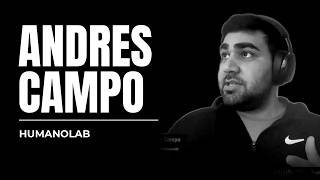
Andrés Campo built Humano Lab, a preventive healthcare platform for Latin America, after eight years supporting founders and personal health struggles. The platform offers over 100 biomarker tests and integrates data from wearables like Oura and Apple Health. In LATAM, four out of five Latinos die from chronic diseases that are 80% preventable.
Chapters
Welcome to another Founder Wisdom pod. We have Andrés Campo with us today. Andrés is building Humano Lab. It's, uh, preventive and proactive healthcare for Latinos, which is pretty intriguing as a company. He's a member of the residency, which is why I reached out to you. It's not your first company, Andrés. You've, uh, ran Pygma, uh, in 2022, I believe, 4 years, and you've done a couple more before that. I believe your journey started in Netherlands, which is pretty interesting. So welcome So, bud, tell us a bit more about yourself and what you've been up to.
Awesome, Charles, thank you for having me. Uh, yeah, Andrés Campo, originally from Colombia, currently here out of San Francisco, uh, one of the houses from The Residency. Happy to share what The Residency is and how it works later. Um, yeah, so I've been an entrepreneur for the past 8 years. Most of my career has been around supporting, uh, founders, early-stage founders. So I started out with BuildUp Camp uh, essentially an e-learning platform for founders, uh, early stage. And then that turned into Pigma, which was a project that I also enjoyed putting together as well, that became a massive accelerator incubation program for startups out of LATAM. And in the past 2 years, uh, I've been focused on wellness, and more specifically in the past 6 to 7 months, building Umaro Lab. We saw the opportunity to build a new preventive healthcare system for LATAM, and that's what we're going for. So that's, uh, too long, didn't read.
Uh, tell me about your first one. First, how did you land— landed in Amsterdam in 2018?
Yeah, so I came to school here in the US. I went to the University of Nebraska, uh, spent some good time here, then I moved to LA, uh, for my first job out of college. And at some point I was looking at different masters and I really wanted to check out Europe. The Netherlands seemed like it aligned a lot with what I was looking for. It's an innovative country where there is a lot of initiatives around sustainability, innovation. So it just caught my eye, and I decided to go, uh, to the Rotterdam Business School to do a master's there. And that's how I ended up there, and I lived for the past almost 9 years in the Netherlands.
Interesting. And where, uh, did BuildUp Camp ended up? It was acquired. Was it a Victorious, uh, multi- $1 billion acquisition?
Not quite. Buildupcamp was the seed to Pigma. So essentially what we did is that we turned that and another incubator into what Pigma is today. What I had built was a lot of the educational infrastructure around the programs, how to run it, how to run them online, how to support early-stage founders, what's the right methodology. I taught at the Rotterdam Business School for 6 years and a half, so I have a background in education.. And I think that's what I brought into the table with Buildcamp. And that's why it was essentially acquired for by Pigma.
And how did you balance that educator job and mindset with being a founder? Because I love teaching, right, too, but I love teaching by doing. And I find that a lot of teachers should never teach entrepreneurship. Probably not your case, right? Because yeah, I love what you're up to, but most teachers are like, yeah, they're teaching entrepreneurship. They never build shit. They get paid $50K a year, right? So how did you balance that?
Yeah, for me it was a great opportunity because at the end of the day, my product was education with BuildUp Camp and then PickMa. So, you know, I always use my work that I wrote at business school as a testing ground, and we validated a lot of the hypotheses we had. We learned a lot from new methodologies. So I quite, you know, I try to balance that really well. It went on for 6 years and a half. To be honest, I wouldn't recommend it to anyone to have like this, like, two-sided role where you're doing something else. I think commit to entrepreneurship the earliest that you can. In my case, I had a couple of personal things that kept me from doing it earlier, uh, but yeah, I think it's the way it is, but it, it worked out pretty well.
What prompted you to move from the Netherlands to SF, and how was it?
Yeah, so essentially, uh, what I realized, uh, quickly was that the future, it was being built in SF. Um, you know, I spent 8 years and a half in Europe, and I think Europe has great ecosystems, uh, Amsterdam, Berlin, Paris, London, Madrid. I visited all of them, and I realized that things were moving much quicker here, so I started to come to SF as much as I could. In the past 6 months between Colombia and SF. And then when I got the chance to move in into the residency, uh, yeah, we took it with the entire team. It's been roughly 3 weeks since we moved here. Um, yeah, and it was basically, basically a decision based on opportunity. We just think that here's where the opportunity is unparalleled at the moment.
What lessons from, uh, Pygma, uh, did you bring into Humanolab? And what was the reason for you to start Humanolab personally?
So lessons, uh, tons. At PYGMA, I interacted with hundreds of early-stage startups and hundreds of early-stage founders. You learn so much from them and their struggles, um, around fundraising, putting products into the market, growing, uh, going to other countries. So I think I just— the amount of lessons are, you know, it's a huge number that I, you know, reflect on every time I make a decision at Umano. Um, Umano came about because, uh, there's a personal story. There is also a story regarding my wife. My personal story is I've always struggled with sleep. Uh, I, you know, could never really get my sleep together. Um, so I've been using an Oura Ring since 2020, and when I realized in 2025 that you could measure your blood, I was so obsessed with the idea of measuring myself that to me that's felt like the, you know, uh, natural next step. And I realized no one was doing it in LATAM, so we just, uh, you know, set out this mission to build that for LATAM so people could understand their biology. Uh, the other reason was, uh, my, my wife's parents, uh, they went on a couple of years without getting properly diagnosed by the current healthcare system, which also showed us that around diagnosis and early, uh, disease diagnosis There's just so much to do in Latin America, and that's exactly why we decided to go on this endeavor.
And the market is underserved, right?
It is hugely underserved. 4 out of 5 Latinos currently die from chronic diseases. 80% of these diseases can be prevented. Um, so that just goes to show, if you can prevent 80% of these diseases, why are we not doing it? And the reason is because there is just not enough, um, supply of preventive healthcare for the demand that there is.
And what's the stat in North America that 4 out of 5 is deeply disturbing? What's the stat in North America?
It looks very similar. I wouldn't be able to tell you right now exactly what's the stat, but it looks very, very similar. Actually, yesterday we were reading that the US particularly is the sickest country in the world by number. When you look at the number of disease among the population, So it shows you that is a problem that is global. People are getting sick and it's a product of the system that we live in. And the healthcare system is just designed to treat, it's not designed to prevent. And that's exactly what we want to change.
But isn't that the same system worldwide? In my native Canada as well, in LATAM, I think pretty much all systems are also similar to that. So my brain is like, Is the US the sickest because of capitalism? You know, because of the ambulance that we hear in the background of your noise, the stress, you know, um, of like inequality. Because US is beautiful, right? It's like optimism and American dream, and that's where you go if you're ambitious and if you want something better for yourself. But there's also the backlash of like constantly trying to make it and stress, right? Cortisol in your blood. Do you feel that's one reason too?
I think so. I think it has to do with that, but you could argue there is a stress in other regions where there is also a lot of poverty, poverty as well. I think it also has to do with access, you know. There is a lot of access to things that are not, you know, necessarily good for your body. Um, so if you look at the modern life that we live, uh, there are addictive products all around us. If you walk outside of the streets, there is fast food, Uh, there's gambling, there is a number of things that you can consume that make you sicker, and we've normalized that. And I think that's also part of the problem.
Um, but LATAM I think is even worse. If you step in a Chedraui, uh, in a— or just in, uh, worse, right, like Bodega Azulera or whatever that's called, you know, it's like the poor, uh, grocery store here. I forgot what they call that phenomenon, right? But it's just They sell like sugar cereals and just like not, not good food, right? Because they can't afford to bring products with either low margins or non-corporations because the deal is like less good. And that's a product people constantly buy and feed to their children. So yes, there's products that are cheaper to access in America with like just shitty content that are more addictive, right? Like, I think it's like ground zero for that, but I think, uh, LATAM also has that, and it's, it's pretty dire. I'm in Oaxaca here, and it took me forever to find like a fit plan, right? Like a healthy fit company that would deliver food to my door like every day. Took me like 3 years to get that. So what do you have to say about that?
No, I think it is, it's, it's a problem that you see everywhere, you know. I've been in pretty much every continent in the world, and I see it in Asia, I see it in Europe, I see it in US, uh, also in LATAM. I think their problem here is that people have access to more cash, disposable cash, so they can invest— uh, well, I wouldn't call it invest, but they can spend money on things that are, you know, are harmful, uh, you know, at a different rate, you know, like it's more accessible, they can spend more money in it. Um, and yeah, I think it's still in LATAM, um there you can go by, like, you can find some quality food still that's being grown. And you'll be surprised, actually, that's the food that is the most available to people that are in poverty, uh, right? Because, uh, you know, this is food that's being grown by farmers, and then mostly that's why they get access to. Whereas here it's more— it's the opposite. It's more difficult to find that type of food accessible and at a cheap price. So I think it has to do with those two things.
And if I, if we speak about Humanolab today, right? Like on the, I'm on the Mexican website. It's very hard to get like a personalized health test here in Mexico and just like see what shape you're in. Uh, what's available for me right now if I want to use Humanolab?
Yeah. So every single country in the, in the Latin region has different challenges. We've come to learn. Um, in Mexico, for example, with Humanolab, what you can do right now is get tested for over 100 biomarkers. What that allows you to do is to take a very 360 look at your, your biology and understand where there might be disease that's developing, uh, that you wouldn't normally see. So the problem that we see with the current healthcare system is that if you go for a general checkup, you describe your symptoms, and if you don't have any symptom around any particular disease, they're not going to want to do a blood work or any checkup particularly on that. And that's exactly the moment where this disease starts to grow. So in Mexico right now, what we offer are pretty much programs, you know, that are tailored towards different objectives like losing weight, testosterone treatments, and also just getting a general checkup. That's what we have in most, most of the region.
And how does it work? I see I have to book like a calendar appointment with a doctor. Okay, what happens after that? What do I have to pay? What do I get as a client?
Yeah, so depending on the country that you're contacting, uh, from, uh, the, the rates vary because we work with partners, uh, with labs that collaborate with us and we get the data from them. Um, we always try to have a doctor in between so we can assess what's the best way to support you. Whether or not you have like advanced symptoms around something. Uh, since we're very focused on preventive healthcare, if you come to us very sick already, let's say, let's talk about cancer, which happens to us all the time, uh, people that are terminal or people that are developing an aggressive cancer, uh, the system already, uh, decided that they don't want to support them. Uh, so they come to us, but we can't also support them because so, so far we're only focused on preventive healthcare. So what will happen is that you will take a call, we will look at your data and, you know, what you're sharing. We will do a little assessment of your health and then we will point you towards the right direction. Oh, you need a general checkup, or maybe it's a good idea to start one of the programs that we have. But we also do it with a doctor. We always do it with a doctor.
Interesting. But is it deployed as of today? How do you deploy it that fast in all of these countries, right? So what's the state of things? Is it deployed or is it like very early and beta?
No, so for the past 6, uh, 7 months, we've supported people in, you know, pretty much entire region. We do this by, you know, through partnerships. So we partner with doctors and with labs that allow us to provide healthcare, uh, in those specific regions. Uh, it's a partnership model. It's tough to build, but that also makes the business defensible or defendable. Um, but yeah, it's a lot of work into building relationships with labs and with local networks of, uh, clinicians and doctors.
And if I'm in Oaxaca, is it fully online or do I need to go to Ciudad de México?
Everything is fully online. Uh, the only offline experience is where if you have to go to a lab, um, we will have to look at, you know, uh, you know, where are you exactly located and if there's any labs around you. In certain regions, uh, in certain cities in Mexico, we can even send someone to your home. Um, so yeah, it depends.
And I can connect my Oura, Whoop, uh, Apple Health Band, potentially Eight Sleep too soon. So, uh, what's the state of this?
Yeah, so we do the most popular wearables at the moment, which are, uh, Oura Ring, Whoop, Apple Health, Samsung, Google Health, Garmin. Unfortunately, they closed their developer program, so it's not our fault, is that they just don't want to provide data anymore.
Why?
Uh, I, I think what I read online is that they're switching to towards monetizing. Um, so they want to even monetize that data somehow.
Uh, that's smart, but that's also creepy.
Yeah, yeah, I think they want to do it from a place where the user also gets, uh, uh, you know, compensated. Uh, but I have no clue. Uh, you know, everyone is in the dark in this one. Uh, yeah, so we can connect with wearables, and the whole thesis behind that is one thing is to grab a snapshot of your body and your biology through blood, uh, or through genetics and microbiome, which we are, are going to start offering some of these advanced diagnostic tests very soon. And another thing is to have a constant monitoring, uh, that we are able to do through wearables like a Whoop. Uh, so that's why we make sure that we put a product in the market where we have a constant monitoring of your body.
How's been your health since you started taking all of this seriously?
Uh, it's changed a lot. So I went through burnout last year, and I gained a lot of weight during this process. And when I first landed in Colombia and I did my first Humanolab test, my vitamin deficiency was so low— like, was— sorry, the deficiency was so high that doctors would— like, they were wondering, how, how do you go through it day. And that's why at 3 PM I will have this massive crash. If I didn't take a nap, I just wouldn't be able to continue. And I was highly inflamed, and that was because I was overweight, or more overweight at that time. Um, a lot of those biomarkers have improved. I'm actually supposed to get my second reading in like, I think, 7 days that I'm gonna get the results. No, not at all, because I mean, I looked at— I mean, it was bad. But everything was worse.
You've hit rock bottom already. So with like 0.1 milligram of vitamin D in your blood—
it's just for people to know, it was, it was at 14. That's really low. Um, so I am excited to see how much I was able to change, uh, my habits. And I think that's what's important, that you take a test with Humanolab or with anyone that allows you to do this. I'm 32. I— everything that I was able to find is reversible. And if you have that power, then, you know, you can do so much for your health, as opposed to what happened with my grandfather, that because he didn't have like this type of access to these checkups, he developed diabetes 2 really early on in his life. And that had a massive impact in the way that he eventually passed and the amount of diseases he developed in his last 10 years. So that's why it's important that we have Umano Lab, uh, for the region.
I'm also 32, uh, but I've always prioritized like happiness. I impose a lot on myself, but I have like recovery mechanisms, right? Is that what was lacking in you, like a pre-burnout?
Um, I think burnout comes from a lot of different reasons. In my case was I wasn't happy with where I was in my life, uh, and that was, uh, this is gonna sound bad, but it was the, the Netherlands. You know, I, you know, let's face it, I'm the Netherlands.
Oh dude, so it doesn't sound bad. That's why I left Canada a long time ago. A lack of vitamin D and, uh, so fucking boring.
It's like, so it's a great country, it gave me a lot, but my biology is different. I need exposure to vitamin D. I need, you know, a cultural setup that I'm familiar with. So when you are extracted from this culture for so long, um, it's gonna eventually go wrong. So that's what I learned. Like, sometimes you can't push it.
Yeah, dude, like me, I did the other way, right? Like, you went north, I went south. Um, my wife is Mexican. The Mexican culture is very family oriented and just like chilling, right? Like, especially guys like you and I are probably very competitive and spend so much time behind a screen. Like, we need to chill and not think about anything for quite a while and let, like, the insights consolidate in the back end, which is what the brain is good at, uh, at doing. And, uh, yeah, Peter, uh, Peter Levels would agree with you, uh, builder from Netherlands. He would totally fucking agree with you. Um, okay, so yeah, the burnout, uh, but dude, you've thrown yourself in San Francisco now. Is that better?
It is, uh, San Francisco is amazing because although it's super competitive, there's so many parks around. I, I don't know, I like— I love the lifestyle here. Everyone is sober, everyone is like working out, so I, I, I just, I don't know, I feel like everyone is trying to improve their life. And by the way, you know, this is like Bryan Johnson, don't die, I'm like optimizing everything, and this is like rock bottom. We do Manolab, or this is, and it's like be in the middle, like, you know, be aware of what you got to do to improve your, your body, your lifestyle, but don't go all the way here because I think that's just as bad to like try to optimize every single thing about your, your life.
So yeah, Brian— but Brian is so inspiring, right? And when you look at his biometrics, I'm not sure if he publicly posts his cortisol, but he seems pretty happy doing this. Uh, obviously the community aspect was lacking, right? And I think, I think he's trying to fix that, but he's like at the top of his cult, right? Which is also— and you know, the LA-ish culture, which is like also like big red flag. Um, not for Brian, not saying Brian— I love this guy, this guy's so inspiring, he's probably my top 10 favorite human, right? But it's just like, as for him as a human being and living on top of that, and I think he's done a huge service for the world, right? Like, uh, just spreading the, the message and for longevity, and he's fighting a lot of unhappy people as well that don't want to live, which is sadly the world we live in. A bunch of people don't want to live longer. Their life fucking sucks. So why would they want to extend it, right? I think that's a huge problem to be tackled. Just before we go, I was reminded of the GLP-1 ludicrousness that's happening right now. What's your take on MedVie, right? The GLP-1 business. Like, have you studied them? Like the one-man billion-dollar company that's going to shit right now.
I'd like to address that as two separate topics. So first, I'll talk about this company. Um, I mean, it's great that someone can scale a company really fast as long as you do it with morals and, you know, ethics. I, I think when I see that particular case and using fake ads, fake, fake images, fake testimonials, fake doctors, um, that's not cool because it takes away a lot of the credibility from the space that I'm working in, and then it makes that there is less trust. And we come from a system where, you know, people don't trust the current healthcare system, so the new healthcare system should not be just as untrustworthy. Um, so, uh, yeah, it sucks that that happened, but I guess everyone can learn from that experience. Two things: number one, entrepreneurship is wildly changing, so if you want to build something big fast, you can. Uh, number two, you gotta, you know, keep your ethics and morals in check. GOP won. I'm extremely excited about GLP-1 peptides and everything that's coming into market. I think we got to be very careful. Everything has to be done with the support of a doctor. Actually, at Umanolab, we're rolling out weight loss programs that use GLP-1, but we first measure your blood, then we pair you up with a doctor. We support you, and we see what happens after you take the peptide. I think that's the safe way to do it. And I'm really excited about the safe use, responsible use of GLP-1s and peptides. People don't realize this, but GLP-1s are life-saving, you know, medication. At the end of the day, if you're developing diabetes 2 or if you have insulin resistance, this is the best medication that can help you to fix that. So Uh, yeah, I think there's a lot of misconception of what— about what it is, um, but I'm personally really excited about it.
Hey, last but not least, I think I can see the Residency rules behind you. How's that been so far? Because that is community right there, dude. Like, that's, that's fun, you know? So how's that felt for you so far?
I think having been at the other side, building spaces for founders to learn and to build community Uh, I'm like, I'm, I'm in love with what the residency is doing. I think they're doing an amazing job as far as building a community, putting yourself in a good space where you can perform. Um, so my experience has been great, and if you want to apply, I really encourage you to apply. Reach out to me if you need help with your application. I would love to, love to help. It's been 3 weeks. This is— they put you in an environment where you can succeed and they help you. I'm going to give you a very Small example, today I was at a speech training because they know that if you are from abroad, you have an accent. And you know, if your accent is really thick, like, I'm pretty sure there must be a study about this, you're less likely to raise. I'm pretty sure these two things are correlated. I'm pretty sure. So I love that they No, I, I am certain because I've spoken with VCs and with angels that if, if your communication is not assertive, then absolutely they're less likely to invest in you. And if you come with a very thick accent and if you don't work on it, and it doesn't have to be perfect, then I'm— I, I'll put at least my thoughts on it or my opinion, you're less likely to raise. So I love that they take care of these little things and they just find where they can support you. So my experience has been amazing.
I don't know about that, dude. Um, would Thiel, um, look at that? You know, I think the best investors actually don't give much fucks about that. They, they will invest in you because other investors will not. I mean, you're probably right from a majority perspective, but I think contrarian investors and the best of them, the leading investors— because as we know, the VC world is plagued with followers, right, that are real VCs. They just like take others as crutch to make their decisions, which is pretty sad. But, uh, I think the immigrant founders are the best, right? And if they just arrived, they might come with like a killer mindset that we might not see. But indeed, if you're like an Indian American immigrant that had parents that immigrated and now you speak perfect English, uh, yes, you would have some kind of edge. But no, it's interesting, dude. Thanks for being on the podcast. Where can, uh, people— yeah, go ahead, Charles.
Can you give me the chance to elaborate on that point?
Yeah, go ahead.
What I truly mean is there are people that, because their accent is so thick, you— it just doesn't come across. Like, what you're saying is not understandable. And I love that they are thinking about, hey, how can we help this founder communicate better? So that's also what plays into it.
Yeah, yeah, no, for sure, there's a, there's a point to that. They need to understand your words. Where can people find out more about you, Andres?
Um, just on LinkedIn. Uh, follow me on LinkedIn, reach out, and then I, I love interacting with founders. So, uh, yeah, let's talk.
So that was Andres and Charles for another, uh,
More from Charles


Founder Wisdom: the audiobook, version 2 (5 hours of stories from founders and CEOs)

8 CEO Questions I Love Asking: the audiobook (64 founders answer, in their own words)





