Andrew Schmertz - CEO, Hopscotch Air
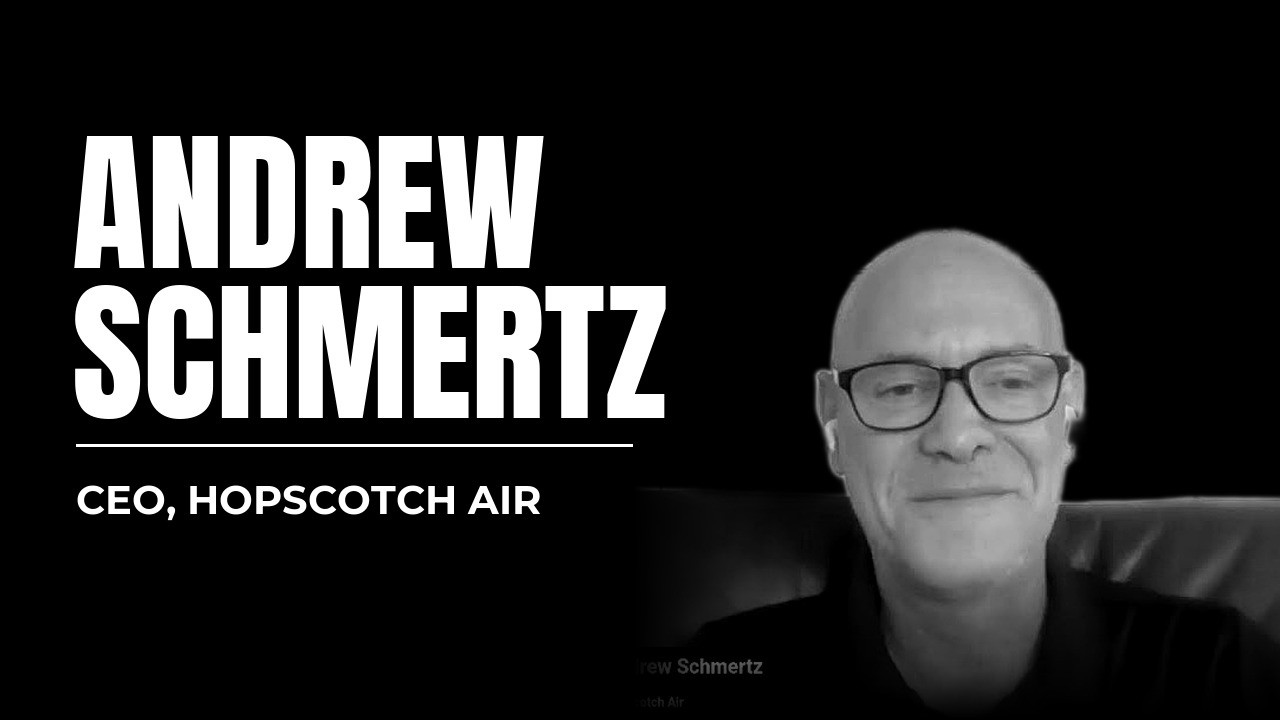
In this episode of the CEO Wisdom podcast, host Charles Cormier interviews Andrew Schmertz, CEO of Hopscotch Air, about the company’s unique air‑taxi service. Schmertz explains how his background as a media anchor led him to turn a personal piloting hobby into a business in 2010, navigating a 15‑month FAA and Canadian certification process. Hopscotch Air operates a membership‑based model where members pay a flat fee for access to 4‑seat, single‑engine piston aircraft (Cirrus) that serve regional routes of roughly 150 miles, offering a utilitarian alternative to traditional jet charters. The service emphasizes speed, airport accessibility (including small public‑use fields), and pure transportation without catering or other luxury frills. Schmertz details the company’s cost structure—fuel, insurance, labor, and variable airport fees—and highlights safety technologies such as whole‑airplane parachutes and Autoland. He outlines the current fleet (six aircraft, expanding to ten), pilot staffing (13 part‑time/full‑time, seasonal fluctuations), and operational logistics (parking at three bases, minimal negotiation with airports). The discussion covers target customers (wealthy sole‑proprietors, lawyers, doctors, and leisure couples), marketing tactics (earned media, radio, social platforms, partnerships with the New York Islanders and Swiss International Airlines), and growth plans, including a capital raise to expand into southern and western markets to smooth seasonality. Schmertz also touches on challenges like rising avgas prices, insurance costs, pilot shortages, and the future of electric aircraft, noting that battery weight limits current electrification prospects. The conversation ends with contact information and a call for listeners to learn more via hopscotchair.com.
Chapters
Welcome to another CEO Wisdom podcast. We have Andrew Schmertz with us today. He's CEO of Hopscotch Air. He's a media advisor, former television business anchor of ABC One and other companies, also former reporter for New York One News 12 in Long Island. He's in New York. And yeah, I'm just eager to talk about Hopscotch because I covered a couple of airlines on my channel called The Greats and It's hell of a stories. It's like there's a lot of movements in these companies, very competitive, right? So welcome to the podcast, Andrew. Tell us a bit more about yourself and Hopscotch. Yeah, yeah.
Thank you, Charles, for having me on. You know, Hopscotch Air, you know, many people ask how I left the media business and went into the airline business. And I used to joke that I left the stable media business for the stable airline industry. Because it's extremely challenging. So we started the company and we think it's a really unique private aviation company. We call it an air taxi service. We started around 2010 because I was a private pilot. That was my hobby. I then made the mistake of turning a hobby into a business, got some investors, put together a team, certified the airline from the ground up, FAA certified and Canadian certified. And we launched what we think is a unique service. We focused on regional travel. That's travel of about 150 miles. So if you're in New York, that's like White Plains to Nantucket. And focused on small aircraft, purely a utilitarian service. So we're using technologically advanced small aircraft. They're 4-seater piston airplanes to fly people on these routes about an hour, an hour and a half. That is the core of the way Americans travel. So the traditional jet charter market is highly inefficient. There's average 2 people on board a Global Express or a BBJ, a Boeing Business Jet, traveling large amounts of miles. Very inefficient, very expensive. And as a result, only the 1% of the 1%, and those are about the numbers, ever fly privately. We've expanded the private aviation market substantially by prices that are about a third less expensive than traditional service, and by appealing to a wider customer base. We're heavily branded, we're heavily marketed. These are all kind of new ideas, or new ideas in the private airspace. So we modeled ourselves from that perspective on the airlines. We did not model ourselves from the airlines in the perspective of customer service or on timeliness or those type of things. So it was a combination of that. But it was a different approach.
I flew Cape Air to Joe De Sena's ranch in Vermont. I can't remember exactly where that is. Riverside Farm? So what was the nearest location? Was it Burlington? I saw you have a Burlington flight, but I'm guessing the company, your company is somewhat similar to Cape Air, correct?
It's a little different than Cape Air. Cape Air is more of a regional airline, more scheduled service, you know, price points that are typical with the airlines. We're, we're modeled more on a private aviation solution. So you're the only ones on the plane if you book the plane. So that there's a differentiator there between us and Cape Air.
Right.
But, you know, Cape Air is a friend. They're all friends of ours.
Yeah, yeah. Why did you decide to launch that company, right? Because back then in media, would you like fly over places? Guys use helicopters sometimes. What was like your first, uh, touch in, in that specific business?
Uh, no, no. Um, my first experience in, in aviation, flying myself basically. I got a pilot's license. I left New York One, figured that was a good time to spend $10,000 on the credit card when you're out of a job. But you have the time. And back then it was $10,000. Now it's probably $25,000 to learn to fly. And that was kind of my first experience. And then I said, you know, if I could turn this into a business, into a way that more people could enjoy it, let's take a shot and do that.
And that was incredibly naive looking back at it, right?
Yeah, very naive because, you know, you don't know what you don't know. That's the thing about this business. And you don't know a lot. When people come to me and say, should we go into this business? I'd be like, stop. Let me explain to you everything that we've learned. And probably there's a lot more that we don't know since then through the years. It's a heavily regulated industry. It should be. There's a tremendous amount of homework, I like to call it, that the FAA gives you and then the Department of Transportation. And that process, we got through it in about 15 months only because of the time that we applied, but that process can last as long as 5 years. And, you know, 5 years you're sitting on expensive equipment, aircraft that are not flying. You are— you've had to hire certain people to do certain things, so you're not generating revenue for that length of time. So it's very challenging.
Right. So what keeps you in the business is just like offering the best experience and seeing smiles on faces and creating top VIP experiences?
You know, that's part of it. You know, certainly it's rewarding, especially when you provide flights for emergency purposes. So someone's got to to a funeral, for example, or someone has to visit a sick relative in a hospital and has no other way to get there but driving. You know, in the United States, 90% of commercial travel goes through 30 airports, but there are 5,000 public use airports, almost all of which we can access. So I think that's the rewarding part of the business. Of course, you know, taking people to their vacation homes is fun. and rewarding in its own right, but certainly helping when helping to provide a service that they would not otherwise, otherwise get. You know, and, you know, we stay in the business, you know, for business reasons where we're making money and hope to make a lot more money.
Right. So I paid $30,000 for the membership, right? And I get 15 flying hours. Is that the dealio?
No. So at $30,000, you pay $30,000 for the Club Scotch membership and all of that money goes to flights. And it's not based on— we don't charge by the hour. We negotiate for the members, we'll negotiate pricing on a flight. And those prices are locked in for about 12 months. Obviously, we face fuel costs and there's a fuel escalator in there. But if you become a member, you get that service. Most people become members, I think, not because of the discount, but so they don't have to break out their credit card every time they fly.
Got it. And okay, so I fly alone with the pilots, right? Like me and my family. What's the experience? Like, is it nice? I mean, it's not like a Cessna level, right? For sure. But like, is it great inside? Do I get like drinks or like—
No, no, no. The experience— so we, we do not provide any services other than transportation. And we have to tell our customers about that, new customers about that. It's the service that you're getting really is you get to show up to the airport. You don't have to spend an hour waiting in a waiting room. You don't have to go through complicated security lines. We do have our own security, but you don't have to wait on security lines, and you get out of the aircraft— airport much quicker. So we have a, we have a phrase: you show up to the airport, you get on the plane, and you get to where you're going. That's the service we're selling. We're not renting you a car, we're not providing you catering, we're not providing you drinks. It's purely a transportation service. And here's the thing, I don't think most people really want all the other bells and whistles that come with private aviation. I think there's an expectation that's not aligned with customers because we have customers, quite honestly, who are NetJets clients, and they use us to supplement their lift that they're only flying to the Cape or to Martha's Vineyard. So they'll use us. They never complain about what we're not providing them.
Right now I get the value. Personally, I hate traveling, right? Like I did it full time for 5 years as a digital nomad. So every month on a plane, The experience is so crappy in airports. It's crazy how bad it is, how it's a broken system, right? Like, that's what it is. Let's call it out.
It's a broken system. And, you know, we can take people to destinations that are much closer to where they have to go because we could access all of these other airports. So, you know, no airline is ever going to fly you into Fisher's Island. Fisher's Island is 2 miles off the coast of Connecticut. It's a 1,900-foot runway. No airline is ever going to fly you to Montauk, Long Island, 2,500-foot runway. So all of these places we can get to that other airlines cannot.
I love it. Yeah, I would probably use it. Who's your ICP? Is it corporate? Is it people with families that want to go ski? Give me like a couple of profiles.
Yeah, so, so the average customer We don't have any corporate clients, and that's because of a workers' compensation with the aircraft. But we have a number of people who fly for business. So the typical business traveler is, you know, owns their own firm, either a public relations firm, maybe an insurance company. We have lawyers, we have doctors. So they're sole proprietors, wealthy individuals who need to travel for work sometimes or from their vacation spot to work. Maybe they spend the weekends in Newport, Rhode Island, and have to be in the city in New York City during the week. So that's one component. And as far as the pure vacation kind of leisure travel, it tends to be a couple, 2 people. So either a married couple or they're dating. We don't take— or they have one kid. It's a small aircraft with seat 3 people. So 2 people and a child.
Right. What are the planes? I think that model costs— because I would like to have one of these pretty soon. I think it's like $500 grand, right, for one of these They've gone up in value.
The new ones are now $1.2 million. So, they've gone up in value. They're the most expensive single-engine piston aircraft, I believe, available out there. Though they have amazing safety features. These are the planes that have a whole airplane parachute system in a catastrophic emergency. You pull the lever, a parachute deploys from the top of the airplane. They have a new feature called Autoland.
Wow.
You push a button, plane will land itself again in an emergency. So those features are really comforting to our passengers because it's a single pilot operation. So they need to know what kind of redundancy you have.
Man, how crazy is that? How many times I ask myself the question, like, why? If like a Boeing gets down, right? Like, why don't they have a gigantic parachute? It's probably not a technical reason. It's probably economic reasons, right?
Like, I imagine, I imagine it's economic. I imagine for a Boeing you need a gigantic parachute. It's also a weight issue. Any time you add weight costs you more to fly. And, you know, tragically, most airline accidents— and thank God there's fewer of them than ever right now, we have the safest aviation system in the world— is on landing or takeoff where it would not be in the commercial space, where it would not be useful.
Wow, that's, that's crazy. Okay, so I buy the membership that grants me hours. So you own the planes, right? Like, how do you negotiate with the airports? Like, tell me about like the full structure of the business, like what you do on a day-to-day basis.
Yeah, so, yeah, so it's everything from wash the planes in the morning to making high-level, in our world, high-level decisions about the vision. Of what you want to do, where you're going to go forward, you know those things. Plus there's the general management issues that come up during the day. We have a robust customer service director; she's terrific. She handles all of that. We have great director of operations and chief pilot; they handle the operation. So I stay out of those lanes for the most part, focusing on the vision of the company. And like I said, the occasional you know break out a sponge and wash the airplane. As far as negotiating with airports in the general aviation space, which is what we occupy in the United States, there really is no negotiation. With the airports. You can just show up and land. You know, it's courtesy to tell them you're coming. It's a courtesy to let them know if you need fuel, if you're dropping off passengers. We do all of that. But for the most part, you have access to the big airports and the small airports. We had 2 flights today out of JFK. That's not an airport we'd love to go to. It's a gigantic commercial airport. But those customers, I think one customer today was going to Fisher's Island again. That's a tiny, tiny little airport. And we're able to take And we're able to service both airports very efficiently and quickly.
And so it's like if there's many planes, they'll just circle around and then they'll be like coordinated one after the other. Some airports are way busier than others. Some have longer wait times as well, right? Somewhat different rules and cultures.
Yeah, yeah. No, there's certainly local rules regarding airports. You know, air traffic control has an incredibly challenging job. There are more planes flying today than in the history of the United States. It is a very congested business, but it's not congested airspace. There's a theory when you're flying and as a pilot called the Big Sky Theory. Sky is really, really big. You could fly along and never see another airplane. So it's not really congested in the airspace, but as you get closer to the airports, and like I said, most traffic goes through couple dozen airports, it becomes more congested and more challenging. Air traffic control has to manage all that and manage the arrivals and the takeoffs.
Got it. How many planes you have? How many pilots? The pilots are scheduled on a random basis, sort of, right? Like, tell me a bit more.
Yeah, so, so there's 6 aircraft in the fleet right now. We're adding 2 more this, this fall, and we're hoping to grow the company to a minimum of 10. By the spring. That's going to be challenging, not just from a capital standpoint, but you need to source the aircraft. They're hard to find. The Cirrus, which is the aircraft we use, has backlogs. And so we're going to be in the used marketplace probably. We have 13 part-time and full-time pilots during the summer. One of the challenges of the business is it's highly seasonal. In the winter, we have less pilots because we have less flights.
So the guy that was driving me, uh, back then to, I believe, close to Pittsfield, um, Vermont, like, he was paid what, like $75 an hour? Is that like standard price for pilot salary?
You know, I, I don't want to get into what we pay. It's a competitive, uh, reason. We believe we're competitive in the marketplace, uh, and we are hiring pilots who are new to commercial aviation. This is often their first commercial aviation job. We've sent a number of pilots from Hopscotch Air to the mainline carriers— Delta, American Airlines. We, you know, we've been in business a number of years, so we have a number of pilots who have moved on, which we want. We want the pilots to gain the experience and then advance in their career and say good things about the company because that helps attract, attract pilots on the back end.
And if I'm a pilot, I can accept contracts from you, I can accept contracts from Cape Air, and at the end of the day it makes sense and I decide of my schedule. Is that the advantage of Being a freelancer pilot?
Um, I, you know, it depends on the company because that's company specific. Cape Air, I don't know what Cape Air's policy is. Uh, we do let some of our pilots fly for other non-competing operators, uh, but we, we try to hire full-time pilots. And so there's, there's no contract and there's no kind of, um, competitive competition for that role.
And a cool thing of the job, like flying your type of plane is more fun, right? It's smaller, it's more nimble, it's more agile. Plus you don't have to step into crowded airports. That's like advantages of working for UVS, a bigger commercial company?
Yes, certainly. You know, those are the advantages. You do not have to, you know, slog through a commercial airport on the way to work. You, you know, you show up to the airport, you walk through the fixed base operator, the FBO, those are private terminals at airports, and you just do your thing. So there's huge advantages. But what we found is we also have a huge training component, a very important training component, because the business involves a lot of paperwork and a lot of record keeping. And we require the pilots to really have that down. Most of the pilots we're hiring are, you know, former flight instructors. You know, they're 22, 23 years old and they haven't been exposed to that. So we're exposing them to that, which is good for when they get the next job. Certainly, because they won't have to go through all that again.
Got it. That's super interesting. So, but I can't wrap my mind around like the zero cost, um, of airports, right? Like, do you rent a hangar to wash the airplanes? You have a permit? Also, do you just fly the planes back sometime, or you just have them there until they get another client? Tell me a bit more.
Yeah, that's a good question. Um, when I talk about zero cost, I don't mean parking. So we have parking spots at 3 airports right now, Republic Farmingdale on Long Island, Westchester County in Westchester, New York, and Lawrence, Massachusetts in Lawrence, because we service those 3 markets. We've looked at other markets to put planes in. So yeah, you have to rent, you know, it's like parking a car. You have to rent either tie-down spots. We do have a hangar in West Hampton Beach. So there are some costs there and there's landing fees. So, you know, but the landing fees vary. The landing fee at Republic is $2.50. At East Hampton, it's $65. At JFK, it's $500. So the landing fees vary. And so those are costs, and those are probably barriers to entry to everyone just landing at Boston Logan or at JFK. But there's no other— there's no air traffic control costs. The United States is unique in that versus like the Canadian system where they privatized air traffic control. You have to pay for those services. We don't have to pay directly for those services.
And what about the flight back thing? Do you need to fly the plane back so that it can be used, or can it just chill at one destination for quite some time?
You know, it never resides too long at a destination. We put the planes though where the pilots live, which is a nice feature. So on Long Island, we'll put the planes at Republic. We had a pilot down in Philadelphia, South Jersey, I think he lived. This is a couple of years ago. We put a plane down in Trenton, New Jersey. The planes generally returned to base after a day, which is another selling point for the pilots, by the way. They're home almost every day. They don't have to do overnights. In the traditional jet charter business or in the airline business, you're on the road or in the air for, you know, 10 days or 2 weeks. You're not home at a time. So that kind of wears on pilots after a while.
That's intriguing. What kind of insurance do you need for that type of company?
So I could tell you the FAA insurance requirements and I could tell you what the real insurance requirements are. The aircraft are all, you know, there's liability insurance, obviously there's business insurance. You know, the insurance costs on each aircraft is expensive and rising. Insurance rates across all industries have been going up, but they've been going up faster I would say in the airline industry, our insurance rates are up literally 100% over the past 5 years.
Why is that?
Well, I can tell you what the industry says. The insurance industry blames it on Ukraine. They've lost about $30 billion, I think, on the Ukrainian war. Their risk profiles have changed. They did not have much spending power or pricing power for a number of years, so they had to— they claimed they had to catch up. You know, we have our own theories as to why insurance rates are higher now. We do have a very good working relationship with our insurance company, so I'm pleased with that. But we would love to see prices soften on the insurance market because it obviously controls one of the major factors of the cost of business.
Interesting. What about the cost of fuel? What have you seen on that level?
Yeah, fuel is up nearly 100% since March. So avgas, which is the type of fuel our aircraft use, was, you know, this is an average ballpark price, priced at about $5.50 a gallon in March. And it is in some places over $10 a gallon. Now, we negotiate fuel prices because we go into airports a tremendous amount. So we get some breaks. But fuel prices are significantly higher than they were in March. The good thing is this aircraft only burns 17 gallons of fuel an hour. So if the price goes up by $5, you're only spending, you know, $50 or more an hour, which is significant and you have to kind of COVID it. But it's not as significant as flying other aircraft that burn much more fuel.
So what's, what's the end bill per year for a company of your size? It's like millions. And what about for For a company like a commercial company, isn't that like their most of their costs? Isn't that like the highest cost after fuel?
Fuel and labor are the highest costs across the airline industry. That is correct. And labor costs are going up too. There's a pilot shortage. So there's more competition for pilots. So pilots are earning much more, much more money than they were a few years ago. And we think that's good. But it is a cost that we have to factor in. And those— and we don't really have much certainty on those costs. They continuously grow with really kind of no end in sight. So there's going to be a pilot shortage for probably another 10 years, according to studies, as well as the fuel prices. I've never seen avgas prices go down. That's, you know, they say, well, give it some time, prices will drop. I've never seen them drop. So we're probably living in a new normal with high prices and high labor costs.
And aren't planes ready to be electrified like cars? Like, isn't that a thing?
Not yet. We do have deals with electric aircraft manufacturers. I think you're going to see electric aircraft probably not for another 5 years or so. The real problem with that is batteries, right? Batteries are heavy. So, you could put 1,000 pounds of batteries in a Tesla, doesn't have to take off. But you can't do that in an airplane. And so right now, the electrification of these aircraft, they could only fly for half an hour, the ones that they built. And those are little 2-seater trainers. As they grow and get bigger planes, they're going to need longer-range batteries. And batteries' power only grows at a certain frequency every year. So there's challenges for that industry. But I think they'll get there. But You know, the verdict is still, still out.
How do you get your clients nowadays? You run ads? Also, do you run like partnerships with other companies that could get you clients down the pipe? Yeah, we do.
We do all of that. So word of mouth is probably the biggest driver of the business. We're very big in the earned media space, which is free public relations. If you Google us, you'll see us come up on a number of articles, both in the aviation media and the consumer media. So we're really big on earned media and we do some paid advertising. We are— our most cost-effective advertising is the oldest of old-school advertising, radio. We find that extremely effective. But we also do, you know, we advertise on social media platforms across the board. And as far as partners, yeah, we've had successful partnerships before. We've had partnerships with the New York Islanders Hockey Club. Those drive some businesses. Some business. We've had partnerships with Swiss International Airlines that drove some business. So we're, we are, I think, unique in this concept. We are open to all ideas of marketing, and we will try just about anything. And if it works, it works. You never know, you never know what works in marketing until you try it.
Um, do you do that while working as a journalist?
You know, I've, I pretty much left that business behind a number of years ago. Yeah.
Okay. Okay. Interesting. Your LinkedIn still says you're there, but how does that feel like running an airline company versus like being a journalist, right? Like being in the media space. Was it night and day transition? Did you take some of your skills there and translate them to the new company?
I don't know what skills I had to translate it to, but it is night and day.
PR, media, communication, right?
Yeah, the media industry is entirely unregulated, right? So you could do anything you want. Aviation, on the other hand, is you can't do anything you want initially. You have a partner with you the whole time, which is the United States government. And that's good because, you know, the industry obviously, you know, bad things can happen. So those skills really didn't transfer over. What did transfer over is the marketing that we do, the communications that we do, the conversation we're having right now. Those are skills I certainly learned in the television news business that has translated well.
What's next for you as a CEO? What are your top goals for this year?
So our top goals with Hopscotch Air is we're doing a capital raise right now, and we're looking at a number of offers out there. We want to do a capital raise to expand. So we want to just— we want to smooth out the seasonality of the industry, of the business. And to smooth out the seasonality of the business, we need to expand into southern markets. So we're looking at a couple of cities in the South, one in the West Coast. The aircraft won't be a problem. We have the airplanes. It's the pilots and the marketing, the components that go into it. So that is our near-term initial goal. Love it.
Where can people find out more about you and the company, Andrew?
Yeah, visit our website, flyhopscotch.com. You can go to my LinkedIn profile and shoot me a note if you want more information. You know, we're very transparent. We love— I love to talk to anybody who wants to talk about aviation. So please, you know, feel free to reach out.
This is Andrew and Charles for another CEO with a Story.
More from Charles


Founder Wisdom: the audiobook, version 2 (5 hours of stories from founders and CEOs)

8 CEO Questions I Love Asking: the audiobook (64 founders answer, in their own words)





