Baruch HaLevi - Men's Peer Groups
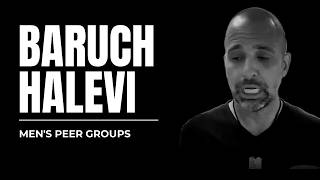
Baruch HaLevi, a former rabbi and logotherapist, founded Men's Peer Groups after his grandmother's suicide and his father's depression. A man dies by suicide every 13 minutes in the U.S., 80% of them male. HaLevi's solution: small groups where men practice vulnerability and accountability together.
Chapters
Welcome to another Founder Wisdom pod. We have Baruch Halivi, aka B. Uh, he helps, uh, men stop drifting and start living their why, which is a very important topic nowadays. So founder at Men's Peer Groups. Um, we're gonna talk about the 13-Minute Mission, Men's Peers Group, obviously. Uh, Logotherapy and Real Men Coaching. So Baruch, B, welcome to the pod. Tell us a bit more about yourself and what you're up to.
Hey, Charles, man, it's an honor to be on the Founder Wisdom Podcast. Thanks for having me. Yeah, man, I just help, uh, men discover, live their, their why, their purpose, meaning, call it whatever you want. It's a concept that doesn't need that much explanation, but I'm a logotherapist That's a meaning-centered therapist or a why therapist created by a man named Viktor Frankl. Viktor Frankl is well known for Man's Search for Meaning, but he's the father of this school of psychotherapy. And both his insights and his example have defined me for the past 25, 30 years as a rabbi, as a logotherapist, as a men's coach, as a man. And it's just my life's mission is to live it and to share it.
You don't look like a rabbi. Uh, are you the modern picture of a rabbi? How did you first get into this?
Yeah, I retired from being a rabbi. I'm covered in Viktor Frankl tattoos. That's his prison number. This is his message. You know, these things don't necessarily go well in organized religion. I've always been a disruptor. Um, even when I was a rabbi, a congregational rabbi, I was an entrepreneur, which is why I feel so much kinship with you and your program. I started lots of different entrepreneurial efforts and realized, you know what, I'm coloring inside the lines. I'd rather be outside the lines and color on my own terms. And so, you know, about 15 years ago, left being a rabbi, think of myself now as a spiritual entrepreneur and men's guide.
Man, I love this. Um, tell me about Viktor Frankl and how he changed your life. Yeah.
Um, when I was 15 years old, my grandmother killed herself pretty violently. My father found her and began his descent into hell. And over the next 20 years, I watched my hero fall apart. Um, and during that time, I started to turn to other insights, uh, mentors, teachers, most of whom I never met, most of whom were dead by the time I went looking for them, and other spiritual traditions. And he was one of them, although he was alive, I think, at the time. He died in '96, but The bottom line was I found my way to Man's Search for Meaning, and it gave me sort of a roadmap of how I wanted to live my life. I've had different iterations and permutations of that, but it's always been around Frankl's philosophy and example. And I even just wrote a book about it and about him. And so he's been a massive influence. I, I say, always say I have two fathers, my birth father and my spiritual father. And Viktor Frankl is very much my spiritual father and continues to be.
How did you manage to live with your father's descent to hell? I never had that. My father had challenges like all fathers, but he was an incredibly great dad and protected me, protected my childhood, the base layer. How did you survive that hardship?
Um, maybe partially luck, partially great insights and teachers along the way. Found my way to spirituality. First, I was born and raised a Jew, but it wasn't interesting to me. I was born in Nebraska and raised in Nebraska, so not a hotbed of Judaism, uh, always on the outside looking in. My friends were and still are Evangelical, so I'm very comfortable in between worlds, but none of it spoke to me. I went off to the world and found Buddhism, um, and that spoke to me for the first time and opened up to me a spirituality, a connection to Source that I never Knew that transformed into Hinduism, to yoga, and then finally my way back to my birth religion, Judaism, in Israel, where I started studying Kabbalah and found, um, you know, a roadmap for me in that. And in the end of the day, I call myself a spiritual mutt. Like, I just want best practice. If it's good, does it work? And so I've been cobbling together my own spiritual pathway for the past 25 years. And, um, yeah, that's kind of what I've been doing and what I am.
And Viktor Frankl, I've read or listened to a book like more than 5, 10 times. It's not one of my favorite books. It is most entrepreneurs' favorite book, especially if you're— you come from a Judaism background, I would guess. If we can recap on the story, right? So Viktor was in a concentration camp. I can't remember which one, maybe Auschwitz, right? Auschwitz.
He was in 4 concentration camps. Auschwitz was one of them.
Okay, okay. And yeah, he details the horrendous story basically of like surviving in the camp with, um, I don't know, like 40, um, other Jews like cramped in this little barrack, um, and, uh, suffering horrendous treatment, all obviously malnourished, right? Sleeping at night was horrible, that there was all kinds of bad orders, people would die, there was disease, and during the day was even more horrendous. It was like torture and forced labor, right? And he survived through that because he had a North Star, right? Like, what was this North Star again? Help me refresh my memory.
Yeah, they murdered his wife, his unborn child, his parents, his family, his friends. They stripped him of everything. They reduced him to a number. 119104. I wear it right here along with other dead family members who were reduced to numbers. And what Viktor Frankl said is he was never a number because within him was the defiant power of the human spirit. And that spirit is his north star, was his north star. And that spirit is uniquely his. Yours is uniquely yours, Charles. And in that spirit is bound up your meaning, your purpose for being here. It's either meaningless or it's meaningful. It's either arbitrary or it's by design. And so what Viktor Frankl said was his meaning was to help other people discover their why. And this was the context that proved out his philosophy. He had come into the Holocaust with it. But, you know, theories are great. And as an entrepreneur, we both know theories are worth, you know, nothing. It's how you execute on those theories. And although there are some great theories out there in psychology and systems, I trust a man who's been through it, who's lived it, and who's come out the other side. And I think that's why so many entrepreneurs are drawn to Frankl.
I think other keys of how or why he survived— was he like a motivator to his group, like a leader? Was he talking to his people sometime in the barracks and have them survive? I've heard about, uh, songs that were sung, uh, in these terrible situations. Singing and just can just put everyone behind it. Not too loud because obviously the guards would probably fuck him up for like singing as well, but What were other tips other than just like your North Star? Because not everyone has a North Star. I'm— and where I'm going with this is like, if not if you or I, but if a common human would be placed in these situations, um, yeah, what could they do, uh, to— in order to survive? Is it, uh, group therapy type of things and, and leadership? What, what else can save your ass in these terrible situations.
Yeah, everybody has a North Star. They just may not know it or have lost their way to it. And the work of our lifetime is to find our way back to it. I don't believe we create it. I believe, you know, Viktor Frankl would say meaning is never created. It's found. It's not something, you know, that we create out of thin air. And so his meaning was to help others. He was a psychiatrist and a neurologist prior to the war. So that was his North Star of helping other people discover and live their why, helping them find their meaning and their purpose. And I think that's That's a big one for entrepreneurs. You know, Frankl called it self-transcendence. It's real easy to be caught up in yourself, serving ourselves. And the big work, I think, of being a man, of being an entrepreneur, is how can I serve others? How does my work, how does my product, what is my life in service of them about and for? And so that to me is a key takeaway from Frankl, is he saw himself in service of his fellow men who were suffering.
But if you came to that camp with no meaning, you were cooked basically, because meaning needs to come before you're put in a very unfortunate situation, right?
Well, meaning is discovered in the darkness. So I've done 500 funerals as a rabbi, and there's meaning in each one of those dark nights of the soul for the survivors. You have to face it. You have to go into it. What I think you're referring to is certainly what I would agree with is you need a why, you need a purpose before you go in and discover meaning. And that is something you better have locked and loaded, because, you know, Charles, everybody's going to have their ass handed to them. Everybody you love is going to die, hopefully after you, not before you. And you better, you better know a purpose bigger than yourself.
Because take 20-year-old me that was alcoholic and life was mostly party and women and drugs, um, send me to the camp, I don't think I would make it, send me to this camp nowadays, um, even before my wife and my daughter, I think I have a strong why, but these are like visceral physical, uh, pieces of meanings, like I need to survive to come back to my wife and daughter and ultimately maybe build a community and help the world, right? Um, but send the 20-year-old me, I didn't have a meaning really well, or maybe I did, but I would have like a lot less probability of surviving that. You know what I'm saying here? And I think in Viktor Frankl, there was a bunch of young people passing away like flies because they didn't have a meaning, right?
Well, I would challenge that. I, I think it's Marcus Aurelius who said, circumstances don't make a man, they reveal him. And I think your 20-year-old self was probably— had too much freedom, had too much boredom, had too much meaninglessness. You know, suicide rates go up, um, in those scenarios where you have too much freedom. They go down when you have too much pressure. There was a lower suicide rate in the Holocaust than there was afterwards because, um, you— again, circumstances will reveal who the real Charles is. And I would challenge that you maybe would have been revealed as this version of you that you are now at a younger age if you would have seen more adversity.
Right. I think I was always stubborn, but I was lost and the drugs and the distractions were blurring the meaning, I think, because funnily enough, even today, right before my wife and my daughter, my meaning is, oh, the education system mistreated me. I was smart, but always outside the class because teachers didn't want the little class clown messing up their schedules or whatever. And even to this day, it's like, it's not really prove them wrong, but it's just like, remember who you were. And I was stuck in that system for what, like 10 years? And that was pretty horrendous. That was my prison. And no, in no shape and form am I comparing that to Viktor Frankl's physical prison experience. But even to this day, I think that's like the iceberg underneath me. What is yours?
Viktor Frankl would say we all have a personal concentration camp, and he didn't use that term lightly. And if, you know, you don't think that's true, then why does a man kill himself? Because he's in hell, and that's a concentration camp, and he's his own inner Nazi, and he sentenced himself to death like my father. You know, in this book, The Guy in the Glass, my father hung himself in front of a mirror, in front of the glass, and I can't think of a more horrific ending and cruel fate than to do that to yourself. So You know, it's very important for your listeners to know that every man, every human being has a personal concentration camp. What is yours? That's for you to decide. But you know, you better figure that out. You better stand guard against it and you better find a purpose bigger than yourself, bigger than that. Um, and you named it, you know, self-transcendence, my wife, my children, right? I'm in service of them. My grandmother killed herself. My father killed himself. My bare baseline is I will not do that to my children. I will not be number 3. That's my starting point. I got a mission vision on top of that, but that's the baseline that I always come back to. And when you're going through the dark night of the soul, you better have a baseline, a starting point.
Man, that, that's heavy. Um, how do you deal with such a meteorite in your life, like an asteroid striking you like full force, full power? Is it surviving at first and eventually coming up with systems to, to deal with the pain?
Yeah, always, you know, those 500 families that when I took through grief, I always say to them, survive. That's the starting point. Just breathe. I mean, people lose their breath when you tell them the loved one died. I did it multiple times. You, they just lose their breath, breathe, survive. But you do get to a point, Charles, when surviving is not enough. And when I'm counseling a guy who's still in grief, hard grief, lost in grief a year or two years later, and he's just surviving. That's not how you serve the dead, right? You gotta live more fully, love more fiercely. This is Viktor Frankl's message. Transform tragedy into triumph. I can't get my dad back, but I can take his suicide and save lives. You know, that's my podcast, 13 Minutes. Why every man needs a why? Because every 13 minutes in America, a man kills himself. 80% of suicides are men. My life mission is to push that back 1 minute. Based on my father's experience, it gives me street cred. I can share them with a man. I've been there.
80% are men. Um, and what age, uh, and what demographics or psychographics? Can you educate me on that?
Um, so 80% of all suicides are men. It does. So it's obviously, you do the math, it's 4 times more likely than the female population, but that's the bare minimum. Um, so 70 and up, it's over 16 times more frequent than women killing themselves. I think the big stats are below 25 and above 60, but even in the median, the middle there, 4 times more likely than women. Men are struggling. They're suffering. They're in isolation. They're entrepreneur syndrome, right? Bootstrapping it. What a lie we tell ourselves. I go it alone. I bootstrap it. You can't do anything alone. You certainly can't build a life alone. And so, so many men are in isolation. And so one of the things I do, and Viktor Frankl did, is bring men together in a group, a peer group, right? That's what we call men's peer groups. And so men in groups together start to learn how to be vulnerable and authentic and loving and open up. And that's how you defy this statistic. Has this statistic gone up since COVID It's been pretty much on the incline since the late '90s. So I do know it was some bumps up and down in through the COVID period, but it's on a pretty much steady trajectory up. But it's, you know, held tight at that number. Unfortunately, one man every 13 minutes for the past few years at least, which is crazy to think about.
And I'm gonna come back to this, but technology, right? Is, is that the main source of isolation? So less interaction with humans, more interaction with machines, more comparisons with this very toxic invention called social media. Is that a good 60%+ justifier of the high suicide rate amongst men?
You know, anybody who gives you an easy answer to a very important question is just making shit up. I would say it's certainly a factor. I'm not a statistician, but I can tell you this, meaninglessness is the ultimate source of suicide. If you have a meaning to live for, if you have a purpose to live for, if you believe in something bigger than yourself, you can call it God, you can call it source, you can call it love, you can call it Bob. It doesn't matter what you call it. If you have something bigger than yourself, you are infinitely less likely to kill yourself period. Somebody can ask me for the data, I don't have it, but I know it.
Me, I view the world through, uh, biochemistry lens. So meaning means attention. Uh, where does your attention go? Does it go on your one meaning, your one thing, or does it go towards comparing yourself with Bob or, uh, watching, uh, Janet strip herself on OnlyFans, you know? So is that Is that a good equation for meaning? Where do you focus your attention? Well, answer that and also answer how do you find your meaning, because I'm pretty sure you have assistance for that.
Yeah, I would say those are distractions. I call it avoidance, a void dance, a dance around the void. And watching OnlyFans is a void. I'm not putting a moral judgment on it, I'm just telling you that people fall into that void and lose themselves. And so that's just an outer manifestation of a man or a person who is lacking understanding their meaning, their purpose. So the bottom line is everybody's purpose is uniquely their own. It's not a one and done. It's an evolving thing. But, you know, when I work with a man in particular and I chart his life at 15, at 25, at 35, at 55, outward expression changes. But the man himself has always been in there. The core values were there. Maybe they got lost in the shuffle, or maybe he betrayed himself and gave those away. But finding your way back to your core values. What do you stand for? What do you want on your tombstone? I got 4 kids. I want them to remember me for a handful of things. I know what those things are. I've articulated them, I've communicated them, and I've left no doubt by the way I live or the way I talk of the legacy I will have imparted upon them. So that's the work. Most men don't know who they are. They've never— you know, I ask them all the time, what What's your company's vision, mission, purpose? Boom, boom, boom. What's your personal one? Uh, I've never thought about it.
My case, pretty much the same as my business and personal, is pretty similar.
What is it?
So money and power, and to impact the world. That's, that's my thing. I think that there's many places in the world in which the, the world is not turning around, and to impact it, it's money and power. Um, I told you about my Core, my core is wife, uh, daughter, community. Who's my community? Founders. I believe founders are saving the world, so invest that, uh, money and power into founders to impact like the world at broad. That's my personal one, and I feel it ticks all of my boxes, right? It's like ikigai, uh, very much, um, in my personal case. But let me ask you this, um, let's say that I have a— I had a very rough childhood because In my opinion, meaning is a story, right? It's a story you tell yourself. And these values of mine, and I could list my values like honesty, transparency, helping others, competing, cooperating, for sure. These, yeah, come from probably my dad that was very generous, and my mom as well has been a stable force in my life. But let's say I had a fucked up childhood and I can't tell a story of that. First, I don't know what my values are, and second, I don't have a stable story. Where do I cherry-pick that story? Is it like a recent story? And what if my life has been a whole mess my full time? How do you work with such a client?
Yeah, somebody came in to me and I was a physical trainer and they said, my life is a mess. I'd say, okay, well, let's get started and let's get back to the basics. Right. And so you got to spend time you have to, first of all, find a trainer. You have to commit and want it. You have to do the work right in between the trainer. And most men in particular— women are more inclined to seek out therapy, statistically, more inclined to seek out good friends and share and explore their inner life. Men are resistant. We can talk about it, 1,000 reasons why, but they are. And so the work for— again, my focus on men is to spend time, right? All these guys I coach and counsel and guide, they spend 60 hours a week at the office. How much time are you spending with a journal knowing thyself, figuring out who you are and what you stand for? Very little. So, start with somebody you trust, somebody you guide, and start to dig into one question. Who am I? Right beyond the flesh suit? Because if you are leaning on the externals, trust me, I used to have more of this. It changes. But there's something in Baruch Halevi that is the same at 5 and 15 and 25 and now 54 and will be to the day I die. What is that? Dig in, do the work. I use the Enneagram. It's a personality typing system. I use journaling. We use prayer, meditation, spirituality, 1,000 different ways. Those are hows, right? The why is digging in to know who I am and what I stand for.
By the way, I think I listed the how, not the why, um, because money and power is not like who I am. Like, fundamentally, I am, and I think most humans are, love, right? Like, they're fully love, which is like pure energy on the back end. Um, just that I feel nowadays, yeah, with the AGI revolution coming, in my opinion, that's like a tsunami coming. I want to prepare myself, my family, and my community for that. So money and power is good for that, and obviously creating software pieces, but Good, good. I think, yeah, just, yeah, one, one, uh, one more point before I ask the question here. After AGI and post-capitalism, I think I'm gonna fully go back to love, 100% love. Um, well, I'm not, not like as quick from 0 to 100%, but ultimately, and if I live forever, which I think I will with like, uh, this revolution coming I think even like the strongest capitalist out there would be mostly love because the monetary aspect of things and the power aspect would be sort of taken care of. What do you think of that?
Well, first of all, again, yeah, good catch. You described your how. I'm not— but I would say why. Why do you want those things? You know, money's called a means, not an end, for a reason. What are you doing it for? You know how many guys I buried who had maybe not a billion, but certainly a lot of money. And so what? It's meaningless unless you understand it's a means to do what. And so that's what I would protect. To what?
To survive and protect.
Um, yes, but you get to a certain point where more is just more. How much do you need? I mean, I, I buried guys with plenty of decimals in the bank, and that's disease, right?
I think I would catch the disease before that. It's not more just for more, like Warren Buffett's. Although I do love Warren Buffett, I think he's just wanting to win the game, to win the game. But he gave it back, which is good. But I think it's pathological when it's just like to accumulate more and more. I've— I'm already at a phase in my life which I have like all the material things that I need. And if I buy this thing, the happiness step up is going to be like 0.1%.
So and so standing guard against that while you're in it is very hard. Every man says, I won't get caught up in it. Every man gets caught up in it. I call it the decimal chase.
And so power corrupts.
It does, um, unless you stand guard. Power also liberates. It depends.
How do you stand guard? How do you keep that consciousness so that you don't fall in that trap?
Go to the mirror, the guy in the glass, every day and check in. Have a mirror here and look yourself in the eye. Look yourself in the eyes and be honest. And surround yourself with people who will hold you accountable. And be in a men's group where you can't bullshit and they can call bullshit because so much of what a man does is start surrounding himself with yes-men and echo chambers.
Yeah.
And the slippery slope to hell.
Yes. Yes. Like accountability mirror for sure. And not cutting corners, right? Like sometimes when you're asking yourself a question, like, I don't know, should I accept this line? Should I do this thing? If you're asking the question means that you've reached like an ethical or value inflection point. And most of the time you, probably need to stop and not make that decision, right? Like, when something feels wrong as well, from a gut level, is the best way I can describe it. Um, your men's group, tell me a bit more about them. Uh, bullish on those, right? Like, are they physical? Are they online? How do you maximize the impact of your men's group?
Yeah, both. I counsel a lot of men who are YPO. Obviously you're familiar with YPO. Entrepreneurs Organization, Young Presidents Organization. And, you know, I'm midlife, um, or north of mid— I guess depends how long I live, but I'm 54. And the guys that I really guide are in the 40s. Did I make it this long? I don't know, man.
No, that you look— you look like, I don't know, 35 or 39 or—
yeah. Married 27 years, 4 kids. My oldest 23. So yeah, I'm proud of it, and it's the best time of my life. Do you want to talk about true power? This is the time of power because it's authentic. It's coming from the inside. And so I meet these YPOers who say enough, right? Enough of the business. But I want the, what they call forum, we call peer group. I want that connection. I want that camaraderie. So I partnered with a couple of guys who are ex-YPOers. We took their formula called forum. We brought together Viktor Frankl's content and philosophy, and we call it Men's Peer Groups to answer your question in person. Currently in Denver, we have 6 groups, but we are scaling. Anywhere there's 8 to 10 men, we will build a men's peer group, but we're doing it virtually now, online, a little bit less of a heavy lift, a good way to get started and going into it, and then can find your way into an in-person peer group eventually.
How have you evolved in your various phases of life, and has it always been somewhat linear, or did you have like big, big falls? On the way there.
Yeah, man, I came to the brink a couple times. I call it the dark night of the soul. Um, you know, 15 years ago when I left being a rabbi, I was, I was top of my game. I had golden handcuffs, everybody revered me, and I felt like a fraud. I'm, you know, I'm a showman, I'm, I'm selling something I don't believe in. So I walked away and I went from on top to on bottom. We moved to Israel, uh, barely spoke the language, didn't know the culture, and came close to becoming my family's number 3 in suicide. I thought, you know, I'd be worth more dead than alive, a typical male story. And basically came to that point and to my knees. And that was one of the greatest moments of my life. I don't want to wish it upon anybody, but if it comes to you and you're in the darkness, there's meaning in the darkness and you can strip away the bullshit and you can get real clear, real quick, and you can start rebuilding. And so for the past 15 years, I've been rebuilding my life. On purpose, by my design, by my rules. And I'm just really grateful to have been given this chance.
And being worth more dead than alive, isn't that like an ego story? And isn't that also laziness of pushing the boulder up there? Because to me it's like, oh, there's so much negativity that accumulated itself that the hill is too big to climb. That's like my realistic assessment. Um, was, was it the case, and did the ego play games with you, just convincing you that you're not worth anything, you're a piece of shit, and you're a failure?
Yeah, um, for sure, the ego is always doing that, right? As Wayne Dyer says, ego is an acronym: edging God out. I'm, I'm God. Um, fear, I would call it brokenness. I would call it shame. And when a man is in there, right, that's a personal concentration camp, and you better stand guard because the Nazis are fucking coming for you. And when I meet men in that dark place, we start rebuilding, um, fast. We put guardrails on there, and the first thing we do is, you are more than you're doing. You are a human being, not a human doing, and you are worth an infinite amount, and we're not going to put a number on it. And it's easy to say, but when your bills are mounting and you don't have a means to pay for them, and you're responsible for 5 other human beings, right? And you're scrapping and everything you do, you're failing. This is an entrepreneur's reality. Sometimes you need ways to keep going. And again, we've touched on a lot of those ways. I didn't have them. I didn't have God. I didn't have community. I didn't have the guy in the glass and his respect. And I came very close. And now I, my life is to help men never get that close.
And that's the thing with men. I feel that they have a gigantic burden as well, and sometimes that burden, it turns down on you, right? And that's when it gets dangerous. Me personally, I'm a systems guy, right? It's sports, it's physical activity, it's sauna community for sure. Entrepreneurship is my main thing. I have an addict's personality, right? Like, if I'm not tweaking on something, then I may like fall down to the traditional society easy path, which is a dark hole, a black hole that will suck you whole. Um, last question for you, uh, since the war in Israel, what has changed in you and your practice?
Um, wow, that's a, that's a big one.
That's a heavy ender.
Yeah, it became real clear real quickly that there is such a thing as good and evil in this world, and you're either— Viktor Frankl said, I don't care He didn't say this, I say this. I don't care if you're Jewish, Christian, Muslim, Arab, Israeli, American, Canadian. There are only two races. There's the decent and there's the indecent. And we better get real clear, real quick about that, that there are decent people, whoever they are, wherever they're from, and we should connect ourselves to them and celebrate them. And there are indecent people and we must stand guard against that and we must have protect ourselves against that. And, you know, October 7th was a defining moment for me as a Jew and as an Israeli, that never again isn't just a slogan. And, you know, the reason why we say never again is because we came close to the brink of annihilation, and that won't happen ever again. And that will only happen if the Jewish people have a homeland where they can protect themselves and have their own autonomy. And yes, living side by side with our Arab brothers and sisters And we can have a whole conversation about that, but that was the takeaway for me. There are decent and there are indecent, and I will be a part of the decent.
Baruch, B, uh, where can people find out more about you and what you're building?
Thanks, Charles. Uh, bhalevi.com or menspeergroups.com, the best two ways to get ahold of me, to get in touch with anything we're talking about.
And, uh, yeah, I was B and Charles.
More from Charles


Founder Wisdom: the audiobook, version 2 (5 hours of stories from founders and CEOs)

8 CEO Questions I Love Asking: the audiobook (64 founders answer, in their own words)





