Being dropped as a new CEO in a multi-million dollar SaaS Business
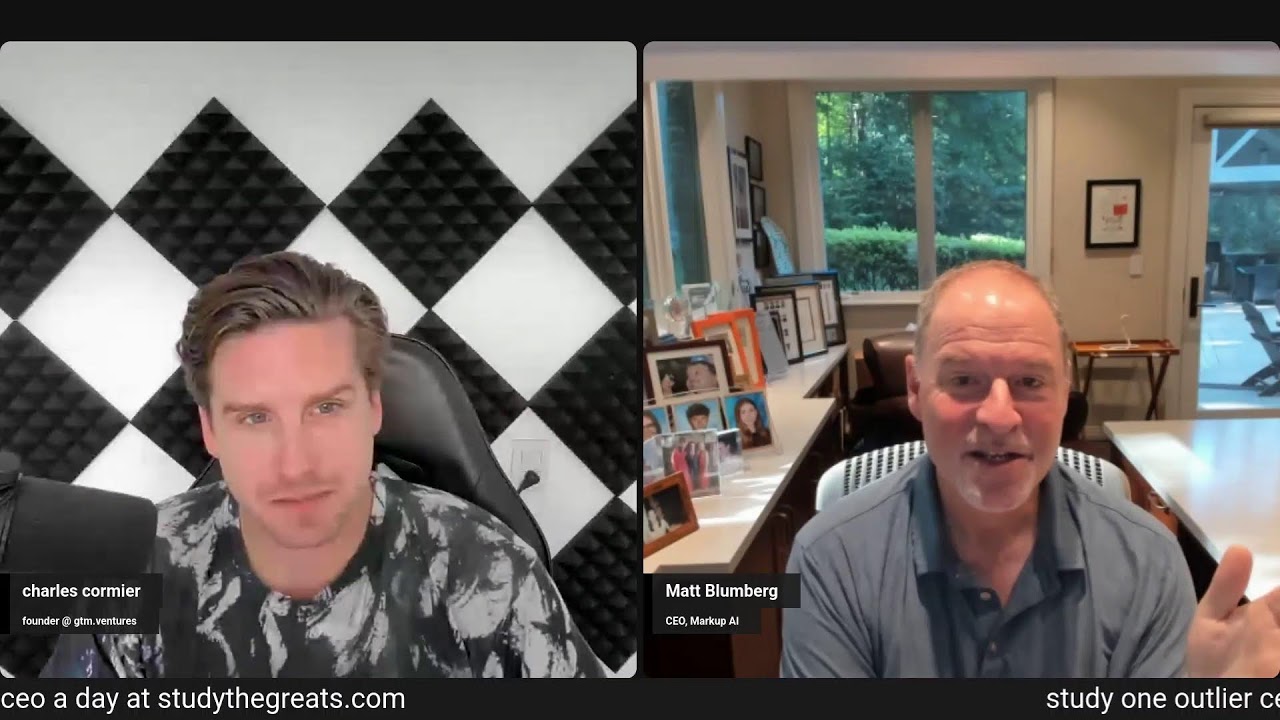
In this episode of the CEO Wisdom podcast, host Charles Cormier sits down with Matt Blumberg, the newly appointed CEO of Markup AI, a 25‑year‑old enterprise NLP company that is being transformed into an AI‑native platform. Matt explains how he was recruited to "drop" into a legacy business with an aging, proprietary stack and a market disrupted by large language models. He outlines the three‑month onboarding/strategy‑consulting phase, the rapid development of a new platform, and the launch of a suite of AI‑driven enterprise content‑governance agents that enforce brand, compliance, discoverability, and fact‑checking standards. He discusses the challenges of aligning with a private‑equity‑style board, building a blended management team of long‑time insiders and trusted lieutenants, and fostering a collaborative, non‑adversarial relationship with owners. Matt describes the go‑to‑market strategy, targeting large enterprises as well as smaller startups through a self‑service, usage‑based model, and outlines the ideal customer profile across marketing, product, and regulated industries. He positions Markup AI against competitors like Grammarly, emphasizing its deep enterprise focus and lack of a freemium consumer model. The conversation shifts to Matt’s personal “vibe coding” projects, notably a Relationship Intelligence Manager that aggregates personal and professional data, and his commitment to mastering AI coding tools to stay technically fluent as a non‑technical CEO. He reflects on the founder‑to‑CEO transition, drawing on past roles as a general manager and management consultant, and shares his view that while not every CEO will become a vibe coder, proficiency with AI tools will become a competitive necessity. Finally, Matt outlines his top priorities for the year: achieving product‑market fit and escape velocity for the new platform, personal mastery of AI development tools, and continued board alignment. Contact information and links to Markup AI and Matt’s blog are provided.
Chapters
Welcome to another CEO Wisdom pod for a round 2 with Matt Blumberg. I had to have Matt on again because last time I feel we talked about your background and everything you've accomplished, but I really want to double-click on Markup AI, which is your current company that you've been dropped into, right? Navy SEAL style. So Matt, welcome to the pod again. Tell us a bit more about what you're doing nowadays.
Yeah, thanks, Charles. Happy to chat with you more. Yeah, Markup AI is really interesting. This is the first company that I haven't, you know, sort of started or business I haven't started exactly from the ground up. But, but I was recruited into an existing company to basically restart it as a native AI agentic business. So in some respects, I'm running a startup and in some respects I'm, I'm doing a bit of business transformation/turnaround work. So Uh, Markup AI is a really interesting business. It was founded almost 25 years ago, and, um, for those people out there who think AI is like 3 years old, this business was originally a carve-out from the Berlin Artificial Intelligence Institute in 2002. So artificial intelligence has been around for a very long time. It just didn't do what large language models do today. So the company, which used to have a different name, had a really powerful natural language processing stack that it sold to large enterprises, some of the world's largest companies, sort of Fortune 500, Global 2000 level, to do a bunch of things that you couldn't do without the power of large language models at the time. So it was a really, really unique software application. But large language models came along and started to really disrupt the business.. And as I always said, or as I've said since I got here, um, LLMs made the business a lot harder in some ways, but it also made it a lot more necessary and important in some other ways. So I mean, that's the headline, um, is, uh, I'm about a year and a half in. Um, I've brought in, um, a new management team, although we have a lot of really talented people that have been at the company for many, many years. We launched our new platform 5 weeks ago, 6 weeks ago, so it's, it is fresh in market. We have lots of new users and customers, and we're also now working to migrate some of our legacy, very large enterprise customers onto the new stack as well. Oh, and I guess I didn't tell you what we do, which is probably the most important thing, and then I'll breathe and let you ask some questions. So we do enterprise content governance. And what that means is we have an agentic solution to help companies make sure that their content follows the rules and standards that they define, and our agents help them define them. So for example, we make sure their content follows their brand guidelines, uh, and their tone and voice and terminology and writing clarity, sort of style guidelines. We make sure that their content follows, uh, regulatory and compliance laws and, and, and guidelines. We make sure their content is discoverable by AI search engines, what's what people are kind of calling AEO and GEO. And then finally, we're just about to launch our first accuracy and fact-checking agents. So basically all of that is an engine that helps keep content on standards. If you're a large enterprise and you've got a lot of people writing content and using different large language models to crank content out like crazy. This is the guardrail to make sure that what you put out in the world is safe, high quality, ready to go, represents your company well.
Interesting. And in what kind of chaos were you dropped when you arrived in the company?
It was a challenging environment in a couple of respects. One is it was a really old stack. So the stack was literally created in 2002. It had been added on to a lot over the years, but it had never been overhauled. And it was— a lot of it was written in like a proprietary language that the founder of the company created, and the founder had already been gone for many, many years. So it was an aging stack, and it was a business that had been in the process of being disrupted by LLMs for 2 or 3 years and hadn't really reacted to that. And, you know, it was also a business that had been doing really well. So it was a, you know, sort of a comfortable place that was like slow, steady growth, profitable. And it was a business that was anchored in Europe. So there were lots of things about it that sort of didn't match what the future— you don't have to necessarily need every single thing to benefit from working with us. The legacy business only worked with huge companies because it was a very expensive solution, so it was really only appropriate for the, some of the largest companies on the planet. The new stack actually works downmarket all the way to startup. So I would say our ICP from a selling perspective is probably a little higher than that, um, you know, not raw startup, but, um, you can come onto our website, sign up for an account, self-provision, and get going in less than 5 minutes without any help from us. At the moment, everything we're doing is free trial. And even when we switch to a free-paid hybrid model, it's going to be based on usage and consumption. So a one-person startup would be able to benefit from us quite a bit.
Since you arrive, or let's say the first couple of days, weeks, uh, what was the plan, right? You're dropped into chaos, you analyze a lot of data. When did you first come up with a plan, and when did you start putting that plan in implementation?
Yeah, actually, I think a lot of people would probably say I was dropped into a steady environment and I created a bunch of chaos, but that's maybe a different story about for another day. Um, but you know, so interviewing for a CEO job is interesting. I've never done that before. I'd always been the founder. Um, it wasn't like I just did an interview and then took the job and started. I actually spent about 3 months, um, in the process of really getting to know, um, the, the company, the industry, the board some of the members of the senior management team. And that was really productive, both for me and for the organization. It let sort of both of us figure out that it was a good fit. But I always sort of joke that what I did for those 3 months was basically a free strategy consulting project. And the, you know, the net of it was when I was hired, we had already designed the contours of a strategy between me and the board and a couple of the members of the senior management team. So I didn't have to start on day 1 trying to figure out what the strategy should be. We had already agreed on that and I had accepted the job with the understanding that that was what I was going to go execute against. And so that meant we could, you know, sort of hit the ground running quickly. One of the things I was doing was bringing in new leadership team members. A couple of the old people were leaving. I brought in some new people that I'd worked with before. All of us kind of started at the same time. So what I would say is the first week was a really intensive— or week 2, 3, 4 weeks was really intensive period of learning the business in a way you can't learn it from the outside. And making sure that the strategy where we had the contours, that we started coloring in the contours and stress testing that back and forth with the board. So I would say that was probably 8, 7, 6 to 8 weeks from my first day to the first board meeting where We came forward and we said, here's the plan. I know we agreed to most of it, but here are the finer points. And since then, we have been just executing like crazy on lots of different priorities, but I'm really proud of what the team has done. And we built a phenomenal platform from scratch. As I said, it just launched. We've had to restructure the company, which has been very difficult work. Um, and we really in some ways had to kind of look deeply at ourselves and what we were doing and what the company was good at and said they were good at relative to what the market needed today as opposed to what it needed before LLMs. Um, so there's some real heavy lifting involved with that. And, you know, look, it's, it's hard work. Turnarounds are, are not for the faint of heart, for sure.
And who are your allies when you were dropped, right? Because I guess, uh, you needed lieutenants and the company to sort of, uh, be the bridge between like the people that worked, right? Like how big is your, how many lieutenants you have and how quick was the change? Did most people get behind you or were there resistance?
Well, I would say the first thing is, let me talk about my board and my shareholders and then I'll talk about the team. You know, there are a lot of businesses, particularly private equity businesses where, you know, the business is wholly owned or owned by a couple of firms, but really kind of controlled by one firm. There are a lot of those businesses that I've observed over the years that run in a way where management and ownership are on different sides of the table. And, you know, the private equity team feels like, oh, their job is to poke holes and, you know, hold management accountable. And maybe they have a value creation team that they drop in to, you know, to do some work. And I said to our owners before I took the job, that's not how I'm gonna run this business, and that's not how I think this business needs to be run. I want to be on the same side of the table as you, and I want to be looking at the business together. And everything I learn, I want you to learn. And everything I'm thinking about doing, I want you to onboard and challenge me. Do the job of an owner, but let's not be adversarial about it. Let's be collaborative about it. And I'm really proud of the relationship that I and the rest of the management team have built with the board. Which really has the board as our principal ally. And that extends to— we've added a couple of great independent directors as well, but it really at its core is the two firms that own the business, and one of them in particular owns a majority of the business. So that allyship with owners has been absolutely critical. By the way, that's no different than how I've been running venture-backed companies for the rest of my career. You've got to be aligned with your VCs, but it's a little bit different when you have a control owner. So I would say that was step one. In terms of the key people on the team, I think we've done a nice job of blending a few leaders with sort of deep experience, many, many years of experience at the company, understanding the customers, the legacy technology, the problems we solved, and all the quirks and sort of, as they say, where the bodies are buried with a 25-year-old business, blended with a few trusted lieutenants who I brought in who who I have worked with for many, many years. I don't even like to think of them as lieutenants. They're business partners that I've built multiple businesses with now. And the first thing we had to do with that group is sort of consolidating a legacy management team and a new management team was almost the same style of work that we did with the board, which is I said, hey, we are not here to be the old guard and the new guard, and we're not here for the new guard to tell the old guard everything that's messed up about the business. We are here as one management team. We gotta look at the business together critically. We have to rely on you guys who've been here for a long time to tell us the things we don't know, but you guys have to rely on us as fresh set of eyes, and we're gonna work on this thing together. And I think that's been really productive. I think in some ways, you know, when you're dealing with a business that's being disrupted, and this company is not the only example of that, every company that's ever been disrupted, It's much easier to look at it from the outside than it is from the inside, right? It's like the parable of the boiled frog. And, you know, I think some of the observations that I had during the interview process even, and certainly in the first week or two on the job, as I started expressing those to the management team, the people who'd been there for a long time, a lot of them were kind of relieved. And they said, you know, it's good to call it what it is. And let's figure out— yeah, let's figure out how to, how to tackle it and how to, how to turn this into a winning business again.
Do you feel the board's looking over your shoulder sometime? How do you manage with that dichotomy?
Um, I don't. I mean, I, you know, look, it, um, it was run more like a private equity style investment for many, many years. I think they had like weekly board meetings and 25-page reports every week, and We're not doing things exactly like that, but I'd also say we're not doing things exactly like I would run a raw startup venture-backed business, and we can't because we have a legacy business as well. So we've reached kind of a good operating cadence with the board and the management team. We don't just have a one-and-done quarterly meeting. We do check in between them, but it's not every day or every week, and it's not a sort of burdensome reporting of like, here are 500 metrics, and the analysts at the firm are criticizing everything. What about that? Why is that 1.2 and not 1.3? Um, everyone really is focused on the most important things, and the most important things here are getting the new platform out the door— check. Now selling it to new customers— great. Now migrating legacy customers over— really important. Driving to product market fit. So, you know, we try to keep the, um, you know, the tone and tenor, um, uh, with the board of Hey, we'll tell you everything that's going on in the business, right? My board books are really thorough and detailed, but I really want to use our time together to talk about the most important things and the things where we need your help.
So as a pureblood founder, you're not losing your mind.
I'm not, but I really have— I have our board to thank for that. The partnership and the allyship with them has been great. And look, you know, I think if you ask them, they would also say that You know, that the partnership has been really important and the way that it works is what makes it work.
Right. Not all great founders are good CEOs. I had an advisor on my pod today that assists in the transition from founder to CEO. Why could you make that transition from— because founders normally is 0 to 1, right? CEOs, it's 1 to 100. How could you make that transition so seamless on your side?
Well, I don't know that it was seamless, but it's already happened a couple of times. A couple of times, so I know how to do it now. But I've always said that I feel like there are two kinds of founders. I don't think it's that founders go zero to one and CEOs go one beyond. I think there are two kinds of founders. I think there are founders that start businesses and founders that start and scale businesses. And that is no judgment. It doesn't mean that one that founds and scales is a better CEO. There are times— and I'm more of that one, right? But there are times where I'm kind of envious, like, God, I'd love to be able to start company and company and company and company. But I'm not wired that way. I'm wired to nurture ideas over a long time and really focus on scalings and systems and everything else. So I would say, look, the best training I had for that was the job I had before I became a CEO, where I was general manager of the internet business inside of another company. And I took that from just me or me and one other person up to 30 or 40 people. So I kind of learned a bunch of elements of it without having to run a whole company, which has a lot of other complexity to it. And I had been a management consultant, which I think kind of helps train you in systems thinking and data and quantitative analysis. But when I started Return Path, you know, 0 to 1 was a really different journey than 1 to 100. But quite frankly, it was like 0 to 1 was one thing and 1 to 10 was something. 10 to 50 was something and 50 to 100 was something else. So, you know, I think the journey of scaling a company isn't binary. I think, you know, there are people who don't like it anymore when it gets too big. And for some people, too big means 10 people. And for some people, it means 100 people. And for some people, you never get there. But you do have to redefine what the job is and what it means to be successful regularly.
But your breed is pretty rare, right? Like, as a headhunters, like, ex-founder, you were— you dabbled in the venture world as well, right? Um, is that the next part of your career, just being like a CEO for tech companies? There's not too many of you, right, with a track record.
Yeah, I don't know what the next, uh, the next leg of the journey is. I'm really focused on this one right now and, and making this business successful. And, and also you know, kind of developing the worldview of what AI is going to do to business and what the next, you know, 5, 10 years of business are going to be like. And what I do with it, uh, you know, whenever this chapter ends is, uh, anybody's guess. Uh, the world is moving so fast right now that, uh, uh, it's, it's hard to figure it out.
And the competitors of Markup— I don't know why my brain is saying Grammarly, it's probably not exactly it, right? Like, but Grammarly has done some pretty spectacular stuff as of late. I think they've acquired a bunch of brands, would that be like part of your strategy as well?
Yeah, I would say we have companies that are sort of partial competitors and then we have companies that I would more call comparables than competitors. And Grammarly is a really interesting one that you just landed on. The original Grammarly business actually does have a lot of things in common with us. There are a lot of our clients that look at us and say, oh, you guys are like Grammarly, but you're Grammarly on steroids or Grammarly for for real industrial-strength enterprise use. And to some extent, that's true, but it's really only true if you talk about the original Grammarly business. So Grammarly, I think the way it's structured now is 3 companies put together. It's now called Superhuman, and it's a mix of Coda, Superhuman, and Grammarly. And I don't know anyone there, so I don't have any inside knowledge on them, but I think if you look at those things put together and you think about the companies, new brand and everything that they're working on, it looks to me like what they're trying to build is the third office suite after Microsoft and Google. And that's obviously a really different business than the original Grammarly or even the Grammarly Enterprise business. So I do think we have a lot to learn from them and the way they operated and how they were successful. But, you know, they started as a free B2C freemium business and then kind of layered some enterprise stuff on top of it. Our roots are deep in enterprise and really understanding how enterprise's content works and content flows and orchestration and systems work. And we're delighted with our new product that we can sell to much smaller businesses, but I don't see us being a freemium consumer plugin either.
And you talked about the GTM, right? So in your GTM, in your ICP, I would say like enterprise software manufacturing, industrials, and then title, I would say, yeah, CMO probably, right? Chief Communications Officer, Chief AI Officer. How do you get in touch with these folks? What is your number one preferred top of funnel initiative to get in touch with these guys?
Right here, Charles, it's you. It's talking to you. No, I mean, look, we—
I don't think that's going to yield much.
You know, we are— yeah, I mean, look, yes, we typically sell into the marketing department. Frequently though will sell into the AI council or a technology team. We also frequently will sell into like a technical documentation or a product or a knowledge base kind of team. We, we scale and fix content. And if you think about where enterprises have content, it's really kind of marketing and product and technology and kind of depends on the business. So you identified some of our verticals. We also work in some regulated industries like banking and financial services and pharmaceutical and medical devices. A lot of those companies have huge amounts of content, which is why they're sort of our legacy bread and butter. But yeah, we typically will reach out to the marketing department. In a very large company, it will not be the CMO. In the very large company, it'll be someone in charge of content marketing or product marketing. In a smaller company, it'll be the head of marketing. And, you know, we do brand building and demand generation, just like all of our clients do. Some techniques work better than others. We're still pretty early and trying to figure it all out right now. One of the challenges, and I know this isn't just us because I talk to other CEOs all the time, one of the challenges that we have is that there is so much noise right now in the system and so many people that are pitching, you know, to marketing departments and everybody else. Use my AI widget, use my AI widget. So, you know, we really love doing in-person events. Those work very well. We do a lot of content marketing and obviously we use our own product to make sure that the content marketing is spotless before it goes out the door. And my head of marketing and I both do a lot of podcast appearances and speaking and I'm not sure we know exactly the right formula yet, but in some respects we're not a lot different than any other B2B AI or software vendor.
I love it. So what's on your plate for this year? What are the top 3 items you want to check off your list?
Well, I would say the, you know, the most important thing for our business is to really achieve product-market fit and kind of escape velocity with our new platform. So there's a lot that goes into that and a lot that our team is really working hard on in terms of, you know, feature and functionality and usability. And, you know, with AI, it's really all about creating magic. And, you know, you've had that. Anyone watching this has had that, that moment where you're using one of the models for something and you're like, oh my God, I cannot believe it just did that. And we're starting to see some of those in our business, but we gotta, we gotta get more. Um, so, you know, number one is, is really successful launch, product-market fit of our new platform, and everything else on the business side follows that. Um, for me personally, my number one objective for the year outside of business is to get really, really good at using AI tools myself. So I am a non-technical CEO, but I've been running technology businesses for 30-plus years. But I don't write code, except now I can. I just don't actually see the code and I couldn't read it if you put it in front of me. So I'm spending a lot of time in, you know, with Claude Code and, you know, building my own applications and really getting deeper in the technology myself. I think it makes me a better leader of the technology organization. It keeps me super current with what the toolsets are and capabilities are and language and everything else. So I have a personal objective that dovetails really nicely with work.
What are you vibe coding precisely nowadays? Is it client-facing stuff? Is it team-facing stuff? Give me a bit more details.
No one should have me do anything that's client-facing. That would be a terrible mistake. As my business partner Sean, who's our CTO, says, the coding assistants are great at writing lines of code. They're not really great at building beautiful software products. And, and may never be, or maybe someday. So, um, yeah, I mean, look, the, the kinds of things I'm via coding have a really wide range. Um, there is, uh, one thing I'm doing that I would describe as professional but not for the company. So it's sort of the benefit will be to the company, but it's for me. Um, that's, uh, an application that I'm building called Relationship Intelligence Manager. So Relationship Intelligence Manager is the thing that everybody wants LinkedIn to be, but it's not. Um, LinkedIn is totally great and good at some things, and it— they just stopped. Um, and I would pay those guys $10,000 a year to do what I'm building, which is not just a repository of people with whom I've connected on LinkedIn, but a deep understanding of my relationship that covers all sources of relationship has all of it in one place, um, understands not just who I know but how I know them and how well I know them, um, pulls in all sorts of third-party data about them as well and lets me really leverage my network systematically for the business in ways that I could do in my brain before, but really only in my brain. And that application's taken some real time. That's the thing that I was vibecoding when you and I started talking today, that I'm doing like a whole rebuild of a bunch of things today. But look, the first thing I threw at it was 25 years of my email, my calendar, my contacts. Yes. Then I did the LinkedIn export because you can't connect to LinkedIn with an API. Then I did third-party data enrichment. Now I'm doing a huge data cleanup. I'm throwing all these other things into it that have signal like, hey, here's the roster of employees from all of my companies. Here's my last cap table. Here's this, here's that. And it's, you know, it's putting it all in one place with a high degree of intelligence, with a UI that I can query. One of the things I'm doing today is I'm making it mobile-friendly so I can query it mobile. I'm also putting some access privileges in it so my EA can jump into it and look at it. You know, I'm doing all the things you have to do when you build software that when you're not a coder, you don't really think about until you realize it doesn't exist. Then you have to go back to Cloud Code and ask it why it didn't put that in in the first place, and it says, oh, you didn't tell me to. So, um, so that's, that's one example of something I'm building that's, uh, uh, that's really, really powerful application.
I love it. I built something similar. My co-founder built something similar, right? So great minds think alike. Also, what you're describing, sort of a SaaS-pocalypse or agency-pocalypse, in which you can code your own stuff, you know, you just got tired of trying all these tools that aren't fitting your needs or trying these agencies and just did it yourself, right? Which is smart. Yeah, it's very smart. I like it.
But by the way, there's a difference between doing something for me that has some runoff benefit for the business and pretending like I know how to build enterprise software. Those two things have some things in common, but they are different things.
Yeah, yeah. No, I mean, you got this across and I know it for sure, right? Like your product needs to be picture perfect, as few steps as possible. UX is pretty much everything. AI still don't understand super well UX, right? Uh, as much as humans do. Yeah, the complexity, technical complexity of it, and speed and cost and all of it, right? And scale. So hey, do you feel most CEOs will become vibe coders like, uh, you do eventually? Is that the future CEO codes an army of agents and build his own, uh, stack while not having too many employees?
It's a good question. I don't think it's going to be everybody, but I don't think CEOs are different than anyone else that, that is a professional employee today, which is if you do not know how to use it, someone else is going to take your job who does. Now, if you're the CEO of a big enough company, uh, you know, can you have someone use it for you? Absolutely. Um, you know, I— years and years ago Yahoo, back when Yahoo was a thing, hired a CEO from Hollywood, this guy named Terry Semel, because they wanted to be more of an entertainment company. And he was a pre-internet guy for sure. I think when he took over Yahoo, he was in his 60s. And I remember we did a lot of business with Yahoo, my previous company. It used to be said of him that between Terry and every email is a printer and a secretary. And like, literally, someone used to print his emails out, he would handwrite a reply, and someone would type that in, and that's what email was. So, you know, was he a successful executive during the internet age without using the tools? Yep. But he was an outlier.
Um, and, um, Warren Buffett's another one, but even Warren's been— Warren's full business would have— was about deep thinking and not interacting with humans, so Yeah, different type of business. If you're CEO of Yahoo, that's like, no, man, that's losing.
I, I'm with you.
I don't even have to look at the Yahoo stock to know that things didn't go well during that time.
Yeah, long time ago.
Yahoo did all kinds of mistakes, right? That's not their first bad hire. Um, yeah, won't name names, but we all know the, the bad CEOs that went through Yahoo. Um, not saying that it was an easy company to manage, but they had something very, very solid and they lost their footing in exceptional moti situations. Of course Google came, but yeah, we're gonna reserve this dissection for another time. But yeah, I hate it too, man. Like, uh, some CEOs that I— yeah, one that I spoke to not so long ago, and he's a great guy and he's super techie, he has 2 assistants to book a call. What is this? Like, dude, can't you use like an agent? Like, it will be 10x faster. Yeah, you will not piss off the people you book meetings with, right? It's like, I deserve better. All the ballers you talk to deserve better than just being relayed to two assistants, right? It's like, things should be simpler.
I don't— I've never understood two assistants. I will say I have an EA who's fantastic. I get a ton of leverage and value out of her, but there are things I don't use her for now that I used to. And, you know, she has a lot more capacity than she used to have, and she helps, you know, 10 different people at the company and as a project manager on things. You know, people's careers, careers and job descriptions change as technology lets them change and as people adopt.
And you know, the part I dislike the most about it is that ultimately it's laziness. You know, you could spend time coding a solution to your problem, right? And building a system for a problem. But no, you decide to outsource it to a human. And even the human is suffering in that equation. The EA is suffering. She's like, 'Can't you use Calendly, bro?' Um, but she's— and she's doing it anyway. So don't be lazy. It's like code solutions to your own problems. Just go vibe code, especially nowadays, right? Matt, thanks for your presence on this podcast, um, again, right, for round 2. Where can people find out more about you?
Um, I'm a pretty easy person to locate online. Um, my email is matt@markup.ai, um, and anyone who's interested in Markup can email me or go to markup.ai. Markup.ai/matt to sign up, and that's sort of my, my secret door in. And my blog is startupceo.com.
Love it. That was
More from Charles


Founder Wisdom: the audiobook, version 2 (5 hours of stories from founders and CEOs)

8 CEO Questions I Love Asking: the audiobook (64 founders answer, in their own words)





