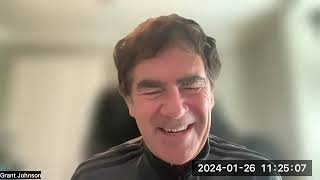
Grant Johnson, CMO of BuildTrust, an accounts-receivable automation company, discusses precision marketing, data-driven testing, and how AI accelerates credit and collections. He shares his career path from Symantec to scaling established SaaS businesses, and explains sales-marketing alignment through a connected motion framework.
Chapters
Welcome to another CMO Wisdom podcast with Grant Johnson. Grant is a cmo, a mentor. Right now he occupies the CMO position at Build Trust, formerly at Embers and a bunch of cool companies. We're going to talk about that today. We're going to talk about CMO stuff, mentoring stuff, SaaS and FinTech best practices in scaling a business. It's going to be really fun. This pod is brought to you by podporry.com if you want to stay start and scale Your own podcast that is can go to Bodbuyer.com we help you monetize the unconventional way. Grant welcome to the bot. Tell me a bit more about yourself and about BuildTrust.
Yes, I'm a career marketer. I've always had a passion for marketing. With Generation AI, I, I continue to say what I've always said. This is the best time ever to be in marketing. You can learn and grow and scale your career, your company, your industry and, you know, have a lot of fun. That's why we pick marketing in the future. First place built trust is a leader in B2B AR, which means accounts receivable. Basically we help people get paid faster and what business doesn't want that?
Man, everyone wants to get there faster. Your CMO career, what have you been Some of the greatest campaigns that you led marketing wise that led to the greatest outcome?
Yeah, I tell you, early in my career, I'll give you a couple quick highlights. And then most recently I had started in tech and I was the company that was up to 2 billion. We doubled in size from 1 billion and we launched the first people PC in China. The company was called AST Albert, Sophie and Tom AST Computer. And that was in the, in the 90s, late 90s. And then I was at Symantec and I got to run marketing worldwide for Norton. And back in the day when people would buy software at stores, you remember that you might or you might not. I helped design the yellow box that flew off shelves for Norton Utilities. And of course when the Internet took hold from the last couple decades, I've been a SaaS guy, Internet guy, and I've had a lot of success scaling companies through what I call precision marketing, targeting your audience, understanding your audience, their motivations, developing integrated stepwise campaigns, testing, iterating, adapting, proving and succeeding. And there's not one campaign that stands out because it really takes a series of campaigns and just being creative. That's really the science and art of marketing. I love the fact that we can track everything, but I also love the Fact that you can still stand out with really good creative, really good messaging, really strong branding. And that's been a key to my success over the years.
Right. And as CMO at the end of your career might must be quite lucrative roles, why haven't you decided to start some companies of your own?
That's a great question, Charles. You know, I once had somebody say to me that and they were observing my career. One of my mentors said, grant, you're a, you're a hired gun. And I didn't take that as a pejorative term. It's like I can make it happen. I'm an executional wizard. I love growing businesses. And you know, the part that I've done on my own I started a few years back is I've mentored 15 other CMOs. I have a site called cmomentor.com I'm currently mentoring generally one to two because I still work full time and I get a lot of satisfaction out of that. There was a time in my career when I was a general manager and it seemed like he had to work seven days a week. I love playing competitive tennis on the weekends. I still compete at the national level. I've got three kids and I just wanted work, life, balance. And I suppose some CEOs strike it, many don't. You've talked to some of those folks. It's at 7 by 24 and same with starting a business. You know, you might put your house up for mortgage. I admire people that do that. But I'm really good at scaling businesses from 100 million to a billion and beyond. I'm not a pure startup guy, although I've done that. I was employee 14 at Frontbridge and the company got bought by Microsoft. That was pretty cool back in 2005. But generally I'm at companies as you had noted, like, you know, File Net or Pegasus or Kofax Imburse and now build trust that I'm one of the executives brought in to get them to the next stage and beyond.
Quite fascinating that a bunch of your companies, probably 50% or more of them, got acquired, sometimes by IBM, sometimes by open Tax. These humongous companies. Did you had shares in these companies when they were acquired?
Yeah, I've done pretty well. I'm still working. If I'd done better, I'd probably be sitting on an island right now. But yeah, when you're the CEO, yeah, you make insane money, but if you're the head of one of the functions, you do fine. I have to say I'm Quite happy that I've got three kids in college, third one starts next year and I, and I can fund their colleges. I mean that's like I, that's my legacy, right? Help my kids succeed, help others succeed. So I've done fine. But no, I don't have crazy money like a lot of people.
Yeah, education nowadays costs a lot. You've acquired lots of wisdom as a cmo. How are you applying everything that you've learned at build Trust nowadays?
Another great question. One of the things I used to play chess as a youngster and I still compete quite effectively in tennis. And one of the reasons that I can start fast and continue to grow and succeed is pattern recognition. In a lot of ways, business, chess, tennis, those analogies all work fine because you know the situation, you know what to expect, you can anticipate it, you know where if you're going to try a strategy, you're going to hit a wall. Right. You know where the blind alley is. And I think that's partly. I know the CEO hired me at Bell Trust. He said, grant, we could have hired somebody who was a first time cmo. We decided to hire a five time cmo. I know I don't have to worry about marketing. It's in good hands. I got plenty of things I want to worry about, but I don't have to worry about marketing. It's not to say that we don't have an ongoing regular dialogue about things that we can do or do better. It's just that the odds of succeeding. I've taken one of these predictive index and the Recruiter said, You're 100% guaranteed to succeed. I said, well I don't know about 100% but I do feel confident.
Right. And BuildTrust is this fascinating company. They reduce friction in accounts receivable with AI. Tell us a bit more about that company and specifically the use of AI to move faster in credit applications, cash applications, invoicing and collections, for example.
Yeah. And it's, and it's, and we've had a number of years where, you know, build trust. We've been a pioneer in machine learning, artificial intelligence and now with gen AI and you know, we have like in, in the cash app or in the collections we have a predictive index like hey, based on our analytics and our AI, this customer is going to be late to pay. You know this person, you're going to have to put in collections. This company pays early pay on time. You can actually sell them more. So there's a lot of practical applications. The Great thing about what's happening with Gen AI Charles, is that very soon this year we'll be shipping a finance copilot, right? And what that'll do is you can query your own data and say, hey, you know, who is trending late, who is paying fast? You know, where do I have the most potential? Based on analysis of our own data set, we use large data models as others do, and we actually process hundreds of billions of dollars of payments. And so we can look in an anonymized way at our database and tell people like what we have is days to pay index and say, look, you're in manufacturing, you're in health care, you're in heavy equipment, some of our key verticals and you're getting paid faster or slower. We can help you get paid faster.
So what are your priorities in marketing? Beautiful website, cool ads, remarketing, most likely. What are you focusing on this year?
Yeah, this year it's about accelerating our transformation journey. We were a company that was publicly held. We were taken private December of 2022. I joined January a little over a year ago of 23. And so we, we're about scaling our business so adding additional customers, growing existing customers, expanding geographies like Europe and trying out new techniques. I'll give you an example. My marketing is about 40 folks. And last year we did a Geni experiment. Not like the tech, Everybody did, did 442 experiments because there's so many tools, there's almost new one every day. And some work, some don't. Some work better at this, some work better at that. And so I try to foster an environment of continuous learning and growth and my team has embraced that. And that's partly why I think we're a good contributor to the company's success and we aspire to contribute and be more impactful over time. But yeah, I think digital is a big thing. Had a lot of success with content syndication quite frankly. You write good content, you get it in front of the right people, they read it, they go to your website, they interact with you and hopefully become an opportunity.
If I hire a cmo, should I expect him to or her to pay for their salary on year one?
Probably not. Oh, I mean, see, you mean to earn their salary. Oh absolutely. Actually, I look at ROI of everything, meaning that you know, you're right, whatever you invest, they should more than pay for it. Like a multiple factor. For example, let's say your budget is a million dollars. Just use it. Could be a hundred thousand or one hundred million. Let's Say it's a million dollars for demand generation. You should at least create 5 to 1 ROI. I can't tell you what ours is. It's a, it's a. It's a secret, but it's much higher than that. So if you go to the board and say, look, you want to grow faster, if you invest in marketing, we can get you more revenue at a very exciting return. Just like if you're, you know, capital, you know, venture capitalist. So the same thing when you're talking to your CEO or your board. And that's exactly right. You know, if you say, give me a year to prove myself, you probably have the wrong cmo.
Right. Because, for example, build trust the stats I have here. So you guys are publicly listed, right?
We were public. We're now private. We're held by eqt. They're based in Sweden. European company and the third largest PE in the world. And we're going to stay private as long as we need to.
Yeah, there you go. And I see here 170 million a year. Maybe that was when you were publicly listed, but big company. And I'm guessing the marketing budget in these companies, probably around 20 million a year, Something like that.
Yeah, I can't disclose, but you're probably in a, you know, in a range of things. Let's say we're 171, double that and then double that. And, and you know, you certainly market as a percentage of revenue. So I think, you know, your math, not too far off.
Right. So that budget is probably around 5, 10 million, then 2 or 3 or 4 million in payroll or 5 even. So, yeah, I would guess that in that case your marketing would need to yield around 40, 50, if not 60 million a year back into the companies. How do you calculate all of that?
Well, first I'll say that I was asked by another podcaster to disclose information. I couldn't. I had to take a shot of hot sauce. So thanks for not asking that. But we, you know, we calculate it based on a simple, you know, funnel metrics so that, you know, you start with, you know, you. What does it cost? You create a lead and you go all the way through the funnel. That lead has to be qualified by. We use a BDR organization. And then it has to be, you know, close and you have a close 1 percentage and you have an average contract value. You just do the math and, you know, the math is proven that, you know, we've got good ROI and that's why we can scale effectively.
What platforms are you bullish on this year I'm quite bullish on YouTube shorts, on podcasting, tick tock. Where can you get the greatest return out of your ad dollars?
Yeah, you know, honestly for us, we've done, we've done all those. But you know, we're, we're exclusively B2B. In fact, we sell companies that we consider corporate or mid market up. We don't do SMB. If I do more, I've done consumer market SMB. Yeah, I would probably try more on those. But for us, you know, Certainly Google being LinkedIn, some YouTube will certainly experiment more with some of the upcoming platforms that are growing in popularity. But retargeting has worked pretty well for us and we'll just continue to experiment on all the digital vehicles that we can to see what gives us the best return and also the most predictable return. Sometimes something works and it doesn't work. That's what I'm very hard on. Our events, you got to do events, but if the event doesn't have a positive return, it's kind of no reason to show up. Right. For a physical event. Webinars are different. Of course. Right.
And then how do you work with sales for them to have more and better pipeline?
Yeah. We have what we call a connected motion line formation. Whatever analogy you want to use, we're one team. That's how the head of sales myself look at it. We have weekly calls up and down the chain. So the CRO, the cmo, my head of revenue marketing, the heads of sales and we have dialogues all the time, you know, just, just cause we're not, you know, we're virtual first company. Like why is this work? What is it not? Why is it not working? Where do, where do we get traction? Where we not get traction? And it does vary by segment. Some things work better for enterprise, some work better for corporate or SMB. And so it's a partnership and it's a, it's a mutual feedback. We try to, you know, inspire each other to greatness. And you know, we just came back for our annual sales kickoff. We actually did it in person in Atlanta last week. And you know, it's great when you can form those relationships, you can take them to the next level. And I think it's working quite well.
What are inner games of tennis analogies could you make between tenant tennis and being a cmo?
Well, I think it's a great, great one to think about. It all starts with having a plan. Right. There's this book called Fuzzy Yell Balls that other tennis players would, would recognize it's got 50 plays. You know, how do you hit against a serving violer? What's the strategy against a counter puncher, which I am. How do you go against a strong baseliner? So you got to make a good strategy. You have to be nimble and adaptable. Some things don't work. Like I've got a guy played for 25 years. I crushed him yesterday because I tried a new strategy he'd never seen right. But, you know, if I tried the old strategy, it wouldn't work. He's crushed me before when he had a new strategy. So I think that's what's great about, you know, marketing and the inner game of tennis is you have to have the mindset, the willpower, the termination and the endurance. Let's face it, I play three, four hour matches. Business is the long game. And so you just look, take your lumps and, you know, figure out what you miss. I watched Sinner last night win. I know when this will be broadcast, it'll be old news. But he beat Djokovic. He'd won Australia Open 10 times. He had the belief that he could do it. He had the strategy and first couple sets. Look, Djokovic looked out. So if he got a set center one and four. Sorry if I'm spoiling it for anybody. Hasn't seen this, but he adapted. He'd lost before. He's figured it out.
Do you think it is boring to be a Djokovic, always at the top, you know, and feeling the wear and tear on your body? Or like, does this guy keep on working on his game and becoming 1% better on a daily basis?
I think so. People say you can go to 40s, 36. I don't really know. It's a tough sport. You're pounding, you're grinding. It's really hard,
right? What are you doing on your side? Do you take care of your brain and your body?
Yeah, I, you know, it's funny, I've got a 22 year old son who's on the tennis team. No surprise at junior college. And you know, for me, you know, I, I continue to work on, you know, on fitness, agility, flexibility. So I do, you know, stretching and I, I work out CrossFit. I don't know if this is a global thing, but, you know, orange theory is called here. But you know, cardio core and then just, you know, technique. The, the great thing, as you said about YouTube, is everything is on and you can, hey, can I apply this video to what I'm trying to do or Take a step by step. So I'm always working on something, you know, could my, my serve, my return to serve, you know, my quickness to the ball and I think just, you know that's the analogy of business. You got to, you know, make everything better.
Are you bullish on podcast being in B2B? You've been on many would build trust, start his own potentially, you know it's
possible you know we, we've, it's, it's in the range of possibilities. One of the things I, I've done some at other companies, I've had some success. I wouldn't say overwhelming success. So you know, as we think about what we might endeavor in 2024, it's on the list
trends of this year. What are you foreseeing in your field?
Well, there's certainly the acceleration of utilizing, you know, gen AI tools. I think you know, speed to market. Is it a trend? I think, I think it's just a way of doing business. You've got to get to market quickly with something. You got to see if it works, if it works scale. If it doesn't work, stop doing it. So I think those are a couple of key things and then just I think understand the customer journey, the buyer journey and meeting them where they want to be met with relevant information to help them make the take the next step. They may not be ready to buy but as long as you keep them engaged when they are ready to buy, you want to be top of mind so that you know you're on the short list and you have a chance to for nat bat to win.
Seems you're also bullish on physical events post Covid what did tell us about that part of your strategy?
Yeah, we, you know it's part of the marketing mix. It fits in. I will say that the, the return to in person events has been welcomed. Last year for example we did four we call inside on the road and we were in four major cities and this year we've got our annual conference in April in Phoenix. It's moving finance forward. That's the brand positioning my team came up with where Bill Truss is moving finance forward to help your business and you were expecting hundreds of folks and we found like from last year and previous times that there's a certain level of connection and advancing the mutual understanding and partnership that can only happen or certainly can be also accelerated in person. So I'm a big fan.
Last but not least, it seems that at your stage it's really much about gathering customer testimonial and have them brave about your product. Jeet is always a strategy there and being on the quadrant and so forth. So how do you make sure to gather all these great customer testimonial testimonial and be on top of that?
Yeah, that's a really good question. I, I will say that it takes a dedicated, systematic, sometimes exhausted effort. I, I have a couple terms that I use for documenting customer success. Right. And you have to have a, you know, a platform for doing and a process for doing it. And it has to be cross functional. Like if sales sells it and then they don't and the implementation team doesn't get it right, the customer will be unhappy there. Maybe we don't meet their expectations. And so I put it's a very conscious effort. I have a dedicated person that works on all those areas that you mentioned. You know, the crowdsource. We want 11 straight G2 leader in AR then accounts receivable. And so that I think it just takes a lot of effort. Then you have to tell the story in a compelling way. What was the situation? How do they approach it? What business value did they realize through adopting Build Trust technology and you know, becoming a partner in the success of that company's business?
Well Grant, thank you for all the value added today. Where can people find out more about you online?
Yeah, the best place to find me is on CMO Mentor. The letters CMO and mentor.com it's got my Gmail contact that on LinkedIn. I'm Granny Johnson1 and I really appreciate finding me how you do it and having a conversation about marketing and how cool it is and what the future holds, which is a lot of promise. And thanks again.
More from Charles


Founder Wisdom: the audiobook, version 2 (5 hours of stories from founders and CEOs)

8 CEO Questions I Love Asking: the audiobook (64 founders answer, in their own words)





