brandon karpeles, ceo at sovreign.io
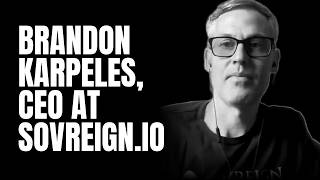
In this episode of the CEO Wisdom podcast, host Charles Cormier interviews Brandon Karpeles, the CEO of Sovereign (formerly Sovryn). Karpeles recounts his two‑decade career in commercial banking, handling distressed borrowers, before transitioning to the Bitcoin space after a personal encounter with the Full Tilt poker bankruptcy. He bought his first Bitcoin in 2018 and went all‑in during the 2020 pandemic. Karpeles explains Sovereign’s business model, which combines Bitcoin education, a "Geek Squad"‑style technical support service for exchanges and institutions, multi‑signature custody solutions, and advisory services for high‑net‑worth clients and family offices. He positions the company as a support arm rather than an exchange, aiming to simplify Bitcoin’s reputation and complexity for newcomers. The conversation shifts to the intersection of Bitcoin and AI, with Karpeles arguing that Bitcoin’s immutable, instant settlement via the Lightning Network makes it the ideal payment rail for AI agents, and that even a future AGI‑created currency would struggle to displace Bitcoin due to its massive proof‑of‑work network and entrenched network effects. Karpeles identifies two main challenges for Sovereign: limited market reach beyond personal networks and customer hesitancy to adopt Bitcoin. He outlines future goals of scaling outreach, expanding services, and solidifying Sovereign’s role in the broader Bitcoin ecosystem. Contact information for Sovereign (sovereign.io, X @SovereignBTC, LinkedIn) is provided at the end.
Chapters
Welcome to another CEO Wisdom podcast. We have Brandon Karpeles with us today. He's the CEO at Sovryn, has a podcast, and it's all about Bitcoin. Rocks these Dave Asprey glasses, so love the guy already. Brandon, uh, what's your background? Tell us a bit more about yourself.
Well, well, uh, thank you for having me on, one, and, uh, two, I can definitely tell you're European because you pronounce my last name correctly. You guys are the only ones who know how to say it correctly. So, it gets butchered here in the States. But I came from a career in trad fi working for a commercial bank for almost 2 decades. And most of that time was spent handling distressed borrowers, defaulted credits, and workout as it was colloquially referred to. To do in the commercial banking space. And so spent a lot of time getting my hands dirty and getting into the guts of businesses and left that position in March of last year to come be the CEO and run this company Sovereign.
What was your first, uh, acknowledgment of Bitcoin.
So I actually have a bunch of friends who are professional poker players, and I actually used to play semi-professionally as well. It was kind of a second job. I would come home from my day job and then I would play a professional— well, I play poker. I don't know how much you could call it professional, but I would play for some extra money, so 4 to 5 hours a night. Pretty much every night during the weekday and sometimes on weekends. And I actually got caught up in the Full Tilt bankruptcy, if anyone remembers that. If not, you can go look it up. But basically my funds were trapped on the site. They got entered into the bankruptcy estate and ended up actually getting my money back 3 years later from the bankruptcy payout and had no way of cashing the funds out. And was trying to figure out with my other poker friends how I could possibly get this money into my bank account. And they offered to give me Bitcoin if I would transfer the funds to them on the actual platform and they would just use it. And I said, what is Bitcoin? I have no idea what that is. And I kind of laughed at them and took the dollars instead. Obviously a horrendous decision. That was my first touchpoint. And then bought my first— 4 years later, I didn't buy my first Bitcoin until 2018 and bought a little bit. It was part of sort of my diversified portfolio, if you will. And then 2020, once COVID happened and all the money printing and everything, really went down the rabbit hole and really went all in on Bitcoin at that point.
Do you know Rafe, the poker player?
Yeah, I, I don't know him personally, but I know who he is.
Yes, Rafe is a friend and client of ours, actually. Uh, Full Tilt was his company, right? Was it Full Tilt? Yeah. Yes, it was.
Well, there was a conglomerate of players that were all sort of the equity holders in it, and Annie Duke and Phil Ivey and some others, and it was A lot of finger-pointing, who knew what, who was playing with the actual funds. And to this day, I don't think anyone's ever gotten a clear answer on what happened, other than the fact that they— that insiders were using other customers' accounts and funds to play their own games and lost money. It's— it was the it was the decade earlier precursor to FTX.
Yeah, that's what I was about to say. That's like, I see some parallels here. Did you ever read like Raif's long-ass post on Medium about like his mental breakdown and, and all of that?
I never did, but now go have, go have a read at that.
It's pretty intriguing and fascinating. Yeah. Long story short, that brought him in an asylum. Wow, it was pretty fucking rough. Um, but yeah, Rafe is an amazing human being though. It was his CEO that like mingled. And yeah, what Rafe said, right, is that, uh, the— he didn't have like an oversight on that. So that is bad because I also had like CEOs that I managed personally back then that were doing some stuff. And there's like something to be said about that equilibrium, to, to give someone to too much leeway, right? So you're the CEO of that company, right? Like, um, I guess you have, you have shares in it. I saw the founder as well. Uh, why did he bring you on as CEO?
So I was brought on— yes, I do have shares of the company, and that is a very big balancing act, exactly what you're talking about. Bitcoin actually makes it pretty easy for the Bitcoin side of things because we have a few of us at the company, we all hold a key separately. So no one person can kind of bring the thing down. You need multiple parties to collaborate. So that is a nice thing about the multi-signature properties of Bitcoin. But I was brought in because our founder, he had more of an SEO marketing type background. And there were a couple things. One, To this, to this day, shortly after I came on as CEO, he got really, really sick, completely sick. He's been unable to work and help the company out since then. And he was beginning to have those health effects and needed to get a lot of stuff off of his plate and someone else to come in. But he also needed someone who had my background, who was also a hardcore Bitcoiner, who understood what we were trying to do at the company. To come in and run the day-to-day business. He just didn't have sort of the financial, the operations. He had the marketing part down, he had the SEO part down and that sort of thing, but he just didn't have sort of the business background to actually run a business. So he— there was someone else that was CEO before me that was doing that, but he was kind of doing it on the side, and it really just required someone who was willing to commit full-time and a lot happened at my current— at my job at the time and in my personal life that kind of brought me to the point where I felt comfortable stepping out and taking on the role full-time.
I love the branding of Sovryn, and it's like a Bitcoin education business. That's— that was like my first definition of it. Of course it's deeper. Of course, uh, these are the roots and we can see the tree later on. Um, Could you picture you guys becoming a Coinbase eventually? You know, like, Sunny, my partner, started the, the Coinbase of India. Is it, uh, that a wedge? You start with a consulting business, it pays the bills, it's a cash cow, and then you can invest in building an actual platform?
So I don't know if we would necessarily become an exchange per se or a platform, but I could certainly see us being the support arm of all those platforms and the, you know, we've kind of pitched ourselves as the geek squad for the Bitcoin industry. So whether that's for existing exchanges, something like a Coinbase, or, um, you know, we currently are partners with Bitcoin Well, we handle their technical support, and doing that 20, 30, 40, 50 times. We also do, as you said, we have the education arm as well. So there's an opportunity to do courses. We have someone on our team who was an actual teacher at a community college in Southern California. So he has a whole curriculum that's scalable from K-12. So that's an option for us as well. And then, um, that kind of Geek Squad technical support, bus— and add business advisory to that for high net worth individuals, family offices. A lot of these places, they— okay, Um, we know we want to do something with Bitcoin, we're going to make an allocation to it, but we kind of want to understand what we're buying. Along with, we don't necessarily know the best technical setup, which wallet to buy, do we want to run our own node, do we want to buy the ETF, do we want to hold the asset ourselves, and a lot of these questions. And I would envision us being more of that kind of support and then have have a, a massive client base where we're servicing, um, you know, people all across the globe at thousands of times over, as opposed to building an exchange or even something where someone could come transact. We really want to be the support arm for the places that, that have already established themselves.
Got it. Um, I think it— why I like the business also is I think the number one plague in Bitcoin and crypto is just the reputation of it and the space, and you guys make it look good on the front end. And that's one. And then I think you're hitting the second pain point when people are thinking of crypto or Bitcoin, for example, it's complexity, right? It's all fucking Chinese to them. And you make it super simple. And I think that that's a product of genius, right? Geniuses, they're good at taking a bunch of ideas, a bunch of concepts, and simplify it in very simple terms, layman terms, depending on what kind of audience they have, right? You need to simplify the message in different ways using different words, and that's what you're doing, correct?
Yeah, that's absolutely right. We're— we are— I always joke that I'm here to take what took me 1,000 hours and give it to you in 10, and that's the value add. To your point, there have been so many scammers, and it's a massive headwind too, uh, the number of people we have to differentiate between crypto and Bitcoin, or digital asset treasury companies and Bitcoin. It's, you know, Bitcoin the bearer asset, and then there's everything else, which is some derivative scam or variation, but it's not actual Bitcoin. And helping people who are looking at Bitcoin, these are, you know, this is something I, I left my career of 20 years. I could have easily stayed there. I could have just kept getting a paycheck and something like— this is serious to me. This is— this matters to me. This is not a joke. And I want to treat our customers and people that come to us with the same respect because it's not a joke to them. This is a portion of their kids' inheritance or their grandkids, or this is part of their family estate. This is— this is their legacy. This is what they're leaving behind. And to steer those people in a wrong direction or put them into a bad setup, that I, I— that's just completely unacceptable to me. And watching a lot of these people get scammed or lose their money or do the wrong thing or not have the right setup, not have redundant backups, not protecting their seed phrases appropriately, all these things that we take so seriously at Sovereign and It is not— it's truly not a joke. Like, this isn't funny to us. This isn't some sort of game that we're trying to play to see what we can do. This is to help people with their legacy, to pass wealth down to their kids, to store their wealth currently, and to be able to understand how to use Bitcoin as it becomes more and more prevalent as a medium of exchange, as more and more people are accepting Bitcoin for goods and services. That you're equipped to step into. And, and, and, you know, what, what you and your partner are doing a ton on the AI front. Well, all the AI agents are going to want to use Bitcoin as money because of all the properties of Bitcoin. It settles instantly over the Lightning Network. Um, there's no chargeback risk. You don't have to KYC. All this different stuff that makes Bitcoin the perfect money for the AI economy. That's going to be hitting these people square in the face before— they're already being confronted with the AI issue, and they're— the next part is going to be, okay, now the money issue over the internet, how do I handle that? And it's all gonna be a huge part of their businesses, their companies, and their organizations. And so we're really here to make sure that these people know how to do it and know how to do it correctly.
I love it. As a libertarian, I've always been bullish on Bitcoin. I missed out on the Bitcoin wave, uh, 10, 12 years ago. I didn't have any money to invest in it back then. I was like an exchange student in Hong Kong, and I had a friend that was like, yeah dude, Bitcoin, Bitcoin, Bitcoin. And I totally missed, uh, that wave. Uh, what I didn't miss though, uh, is the AI wave, right? I'm from Montreal, and Joshua Bengio is from Montreal. AI, I think, is going to pretty much revolutionize everything in a— well, let's start with that one before I drop the bombastic long-term question. Short-term agents, can they use Bitcoin? Is Bitcoin like the payment rails for agents?
So first of all, I want to apologize for calling you a European. You're a Canadian. My apologies.
I live in Mexico. I'm a weird— you can call me an alien. I'm a citizen of the internet.
Uh, before anything else, you're like the sovereign individual. You're—
oh yeah, for sure, 100%.
You're putting your, your citizenship in the digital space.
Yes.
So yes, absolutely, AI agents. There— I, there's, um, I'm in a group chat with a lot of Bitcoiners who are having their— they get their agent spun up, they give it access to a Bitcoin wallet, and it makes payments for them. It makes token payments. There's a website out there called, uh, ppq.ai, which is pay-per-query. So you can choose any of the different models you want, and you can load up a Lightning wallet, and instead of paying with your credit card or a monthly subscription, you pay per query, per question you ask the, the AI platform, the LLM, and it just takes it right out of your Lightning wallet, pays it, done. And That's the quote unquote token is you're, you're paying with Bitcoin. So you're buying your tokens with Bitcoin. And in my opinion, that's going to be every single setup going forward. I'm sure there will be an interim period where there's stablecoins and credit cards and all these other things accepted. But the second you are running an enterprise at scale and all of a sudden your LLMs are getting money clawed back, imagine if like the Iranian government, right? What if they were using ChatGPT and they paid it a million dollars of stablecoins, and then the US government comes in and says, hey, Tether, you have to undo that million dollars of stablecoin transactions. Now all of a sudden you have, uh, an AI company, ChatGPT in that case, who's out a million bucks because the US government pulled their money back. So you're just as these AI companies move forward and progress, they're going to have to take money that has final settlement. You're not going to be able to have something that's not immutable. And that— the only money that qualifies as that today is Bitcoin.
Interesting. Yeah. Um, and the bomb is, if we get superintelligence and AGI, why wouldn't it create something better than Bitcoin? As a currency overnight.
Well, so even if it created something technically better, you still don't— you still don't have the network, right? So you— the Bitcoin has 17+ years of proof of work, so it has a head start on the proof of work. So you have a trillion-dollar network that's not just going to give up its economic viability. And then if you have something else like Bitcoin that's quote unquote better, it's going to require real-world energy use to secure the network. That is the value proposition of Bitcoin. So even if you had agentic AI— or, um, they're not agentic AI, excuse me, um, uh, AGI, uh, artificial, you know, general intelligence and that sort of thing, you're still 17 years behind Bitcoin. You're never going to be able to make up the amount of energy that's been expended to secure the Bitcoin network already. And then you have the network effect where now you have to go convince people that this is actually better than Bitcoin, that you need this, that you should move your move your capital from the Bitcoin network to this new network. And I, I just don't see that. Like, to me, Bitcoin had the immaculate conception, the whatever you want to call it, the, the, the genesis block. When that happened, that was a discovery, an invention that can't be replicated. Like what's happened since then has so much, so many network effects behind it that you, that even a quote-unquote better— so like, if, if in my opinion, if AGI came up with a quote better Bitcoin, those changes would just be implemented into the current Bitcoin network.
And, um, so, um, you know, of course, like, isn't the real answer like it's a trust nodes still. And if AGI— let's say that the rails would be technically better, which I think it would with superintelligence— superintelligence would still have to convince humans that it's better. And this seems like a harder task. I mean, humans are easily manipulatable, right? But they also— I think they have like intellectual auto-defense, right? So these—
oh, look at Bitcoin—
still have to convince them that it's better.
Well, look at Bitcoin, for example. It's 8,000 times better than the current fiat monetary system, yet less than a few percentage of people globally have truly adopted it as their actual day-to-day money. And so you, you have this massive inertia from this massive system, and I— and that's kind of an education, um, but to your point, it's hard to get humans to change. I do think the energy aspect of it that we spent— okay, here, think about like, uh, like the gold supply that exists today, right? Like, you're like, I'm gonna come up with a better precious metal, a better precious metal monetary— better, sorry, a better monetary precious metal than gold. I'm gonna have to start pulling it out of the ground. I'm gonna have to start expending the energy to go get it. How long until I would have enough of that commodity above ground to even compete with the existing amount of gold and the entrenched monetary aspects of gold, et cetera, et cetera. And I just see the same problem with competing with Bitcoin, just in a digital, um, just in a digital space as opposed to a physical space.
Right. What's next for you and the business? Like, what have been the challenges of running that business and what, uh, what are the potential mirages of, uh, running this? Where could it bring you in 5, 10 years from now?
So I would say the hardest part is getting, getting in front of people, that getting in front of enough people. There's such a small percentage of the population that wants Bitcoin, wants— even wants to learn about Bitcoin. And we've been, we've been kind of individually trying to tap into our own networks, get in front of people, get— talk to, we think, what we think are potentially interested customers. But just having reach outside of our sort of personal networks and accessing that is, has been a hangup. And then the, just the, the hesitancy of people to want to try something new, even if they— even others— the amount of people I've talked to that say, I know Bitcoin's the future, I know I need to do something about it, but I'm just not ready to commit to it, is— it's pretty astounding, actually. So there's the difficulty of even getting people over the hump of their own sort of lack of initiative, which has been really difficult as well. So I would say those two things have been the, the toughest part about getting out there and running this company.
I love it, dude. Well, thanks for being on the show. I eager to do round 2 soon. I believe we're gonna work together as well, so honored to stick around you and talk about these things. Where can people find out more about you, Brandon?
Yeah, so please, just the best place is the website, as spelled on my shirt, S-O-V-R-E-I-G-N, so Sovereign without the first E. Sovereign.io, and you can reach out there. That's the best place to get us. We also have, um, an X account, Sovereign, @SovereignBTC. And I'm on LinkedIn, just my name, Brandon Karpeles, K-A-R-P-E-L-E-S, if you want to look me up on there.
I was— Brandon and
More from Charles


Founder Wisdom: the audiobook, version 2 (5 hours of stories from founders and CEOs)

8 CEO Questions I Love Asking: the audiobook (64 founders answer, in their own words)





