Broc TenHouten - CEO of Intrinsic Power
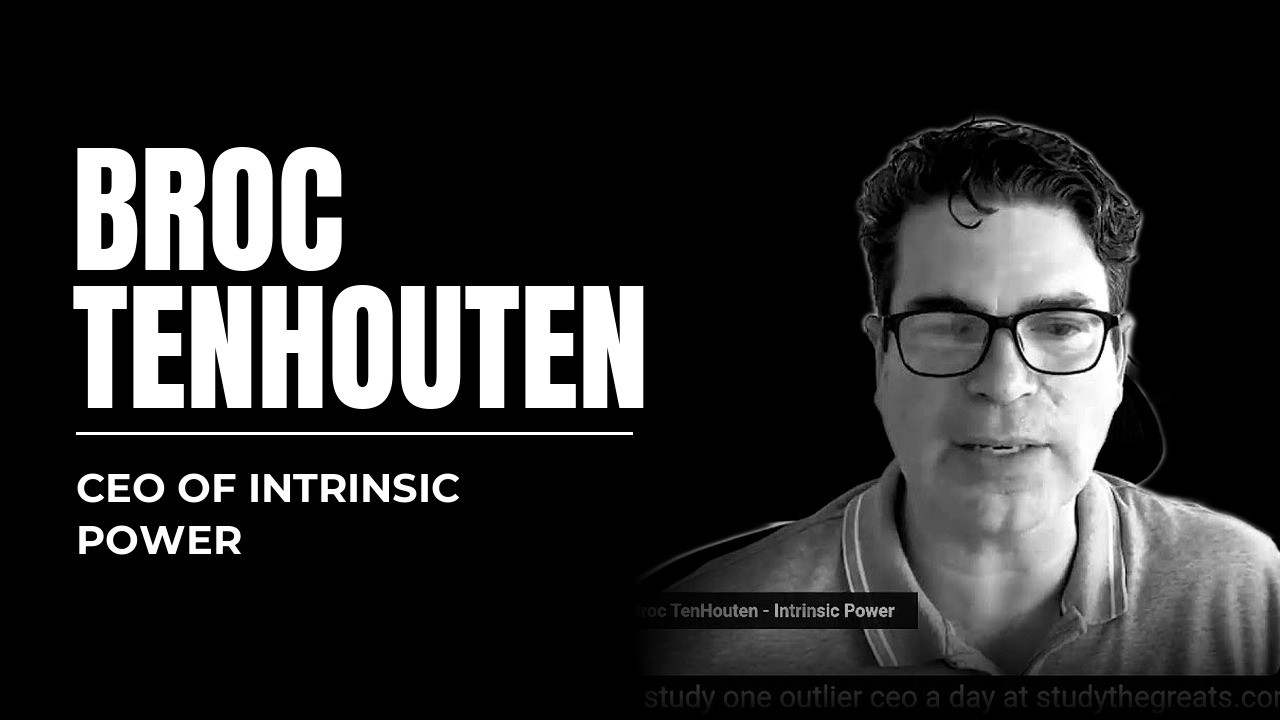
In this CEOism podcast episode, host Charles Cormier interviews Broc TenHouten, co‑founder and CEO of Intrinsic Power. TenHouten walks through his engineering background, early career at General Motors, and a series of successful exits—including a space‑medical battery company acquired by EnerSys and an electric‑car‑to‑energy‑storage venture. He then describes his role as COO and chief engineer at Divergent 3D, where the team created a 3‑D‑printed multi‑material hypercar and developed AI‑driven production processes applicable to many markets. The conversation shifts to Intrinsic Power, a company founded to solve the timing mismatch between grid‑available power and demand in commercial buildings and data centers. TenHouten explains the technology: a combined hardware‑software platform that uses AI‑enabled controls to unlock up to 40 % additional capacity by limiting power spikes, allowing sites to operate near 90 % of their service‑rated capacity without costly service upgrades. Early deployments in commercial buildings have proven the concept; the company is now expanding into data centers with first deployments slated for 2028. Go‑to‑market relies on cold outreach, referrals, and strategic partners such as Drive Catalyst and Kyocera, which sell into data‑center portfolios. Funding includes a seed round with Boost, RPV, Drive Catalyst, and Kyocera, with a second close planned later in the year. The team is about ten people, including TenHouten’s brother Dave (COO). Business model details include pilot payments, software/operation fees tied to unlocked capacity, and modest discussion of defense contracts. TenHouten differentiates from Tesla’s Powerpacks by focusing on an integrated hardware‑software solution rather than a pure hardware offering. He outlines three 2024 goals: complete deployments, file and secure patents for data‑center technology, and validate hardware at data‑center scale. The main bottleneck is deciding how much to scale the commercial‑building side versus the higher‑impact data‑center market. The episode ends with contact information (intrinsicpower.com, LinkedIn).
Chapters
Welcome to another CEOism pod. We have Brockton Houghton with us today. He's a co-founder and CEO at Intrinsic Power, interesting company. I'm seeing a bunch of cool motorcycle and hypercar background, your background profile, so I love that. Uh, yeah, I think it's your first company in some time, right? Because you were Chief Strategy Officer, Chief Engineer at many companies before. Brock, uh, welcome to the pod. Tell us a bit more about yourself and, uh, Intrinsic Power.
Yeah, sure. Thanks for having me on. Really appreciate being here. And, and, uh, yeah, you know, my background is that I'm an engineer, um, originally from Berkeley, and, uh, you know, uh, UC Berkeley, that is. And, and, uh, I started my career at General Motors, and then, uh, 18 years ago I went into EV energy storage and AI startups, and I've been doing that ever since. And, you know, I'm, uh, had a few successful companies, have sold two, and have one that's still running as a private unicorn. And it's gone really well. But, you know, the whole time I've been working on these things, I've wanted to build this company, Intrinsic Power. And what's really special about Intrinsic Power is it solves a problem in timing between the available power of the grid and the demand of our economy. And so that's a huge problem right now. It's, it's, uh, you know, obvious with data centers and commercial buildings all trying to get power And that's the problem we're squarely taking on.
Tell me about, tell me about your exits before we get to Intrinsic Power. So obviously worked at a bunch of cool companies, GM I see here, and a bunch of other car manufacturing companies right before that. So which ones did you have significant exits from?
You know, there's two that sold, uh, a battery company, uh, in space and medical battery got acquired by EnerSys, and I stayed on for a couple years with them. We did an electric car company that wound up being an energy storage company, and it was also acquired by a larger company, uh, and, and so those were two things in the space. And then, uh, more recently I had done— I was the COO and chief engineer of a company called Divergent 3D and Divergent Technologies. And we had made a 3D-printed hypercar that's in production now, and, and it's a pretty exciting vehicle. But more impressive than that, we had used AI to create a production system for 3D-printed multi-material structures. And so, you know, that was, uh, what I worked on there. And, you know, I've done other things as well, and, and in both the EV and energy storage space, but Really, on all of these things, it's been about using software and AI and, and core principles to impact the physical world. That's been the common thread between all of these things, right?
Tell me a bit more about Divergent itself, right, and the hypercar, I guess, that we see on your LinkedIn profile. Why did you accept that? I mean, hypercars are cool, but Most of the time they're money pits, right? So tell us a bit more.
I wouldn't have done— I wouldn't have worked on that car. A friend of mine had the idea to make 3D-printed cars and, you know, it invited me to come do that with him. And I did. And, you know, developed the technology that created that. And, you know, it's an interesting car. It's, you know, more than $2 million. So it's, you know, it's a production car, but it's obviously low volume. And, you know, the more impressive thing that happened there was creating the technology to make them multi-material structures. And that's applicable in lots of markets. But, you know, it's— you can see it's public that there's deals with multiple global automotive OEMs. And also there's obvious defense applications for it.
Right. And tell me, how does one print a car? Like what material? I'm guessing it's not plastic or resin, right? Because that would just break. Is it carbon fiber? Like, give me a bit more details there.
Yeah, back when I was there, uh, before, uh, uh, Intrinsiq, we were— we made, uh, more print, uh, more malleable printed materials that could be incorporated. We also used a mix of, uh, printed and non-printed parts in order to make these lightweight optimized structures. And, you know, there's plenty of material on that, and, and, uh, it's, um, It was a challenge and it was the fun thing to do. And, and, you know, throughout my career what I've really enjoyed doing is taking problems or, you know, uh, looking at things and coming up with these ideas that other people thought were impossible and then proving that they worked and then making real products out of them. And so I've done it there and I've done it at all the other places I've been, and, and that's the same thing, uh, we're doing here at Intrinsic Power.
And, and what about Damon? Uh, how does Damon rank up?
It was really important to get moving on Intrinsic, and it was, you know, in 2023 we saw that there were a bunch of metrics that made it just obvious that we had to do this now. And I've been talking about wanting to build Intrinsic Power, uh, you know, or a company to solve this problem of available power capacity, uh, since 2008, and you know, it was way too early to do it. But in 2023, we saw that there was a spike in power prices, and there was, uh, you know, change in the net metering regulations, uh, and, and also, you know, more than a million EVs on the road in the U.S. and a multiple abroad in that same time frame. And so, you know, we saw that that was the moment, and that's when I stepped in to do Introducing Power full-time. And so I've been doing that since, and only that. And, uh, you know, it's been an exciting thing. And, and, uh, initially we used this technology to give commercial buildings more power capacity to add charging stations, and it was success— successful with that. We were deployed at multiple, uh, commercial and multi-family buildings, uh, and it showed the technology worked. But while we were working on that, we realized that there was this bigger problem. And, you know, data centers and industry was having this larger problem that there's not enough power to go around. The, uh, you know, it's not compute that's holding us back, it's power. And we realized that our technology, the same way we could unlock additional capacity for these commercial buildings, we can do the same thing for these data centers. And that's when we, uh, decided we were going to expand into that market.
One of my ex-client is Posh Energy. Maybe you know them, you're on the same side of the, the coast. Uh, it's challenging to reach out to these data centers and have them buy energy even though like all the factors seem to be pointing towards the fact that it's an obvious solution for you to serve these guys. What's your go-to-market channel to reach out these guys and have them buy?
You know, I, I don't know that other company and what they're doing, uh, or what their problem is, um, so I can't really comment on that. But I can say for us that, uh, we've been well received. Uh, our technology worked for these commercial buildings, uh, made a big impact on how much capacity they had. And we're doing the same thing for the data centers. Uh, we already raised a, uh, did a first close on our seed round uh, you know, uh, Boost and RPV, uh, and then also we had two strategics come in, uh, Drive Catalyst and Kyocera. Uh, you know, Kyocera sells into data centers, uh, Drive operates, uh, uh, you know, a portfolio of, of, uh, buildings and sites including data centers. And so we're up and running and expanding in that direction right now.
Your GTM, Brock, what's your main GTM channel to answer your question, right? How do you get in touch with these guys, your ICP? Yeah, the centers and so forth.
What's your preferred channel? Yeah, it's not directly. Our existing sales into the commercial and buildings was really easy. We reached out to a few, told them what we did. They had a real problem and realized it. And knew that they had this problem. And so when we reached out and said we could solve the problem, they said, "Okay, great." You know, and then it was just cold outreach the first few, and it's been all referrals since then. We have more business than we can deal with on that front, and we have no salespeople. So we're just, we can't even keep up with the deployments, and we're trying to ramp up to conquer all that business, but we've had to turn some business away. On that front already just because we're too busy. And on the data center side, we're solving a real problem. And I, I think that there are other people that are approaching pieces of the problem, and they've got pieces of solutions. They'll provide a battery, they'll try to make a solid-state transformer. There's companies out there that are just making the software by itself. Those things don't work. You're not going to unlock the value unless you combine the controls, energy, and analysis— your, your AI-enabled software— all in one package. That's what it takes in order to act fast enough and smart enough to unlock additional capacity for these data centers. No one else is doing that.
So what percent of your time is spent on hardware vs. software?
Oh gosh, um, my time personally, it's You know, of the time I spend developing, I'm probably spending 60% on hardware and 40% on software. But as a company, it might be a similar split, might even be 50/50. It's hard to say, and it moves back and forth depending on the stage.
Okay, so hardware is hard, right? So you produce everything in the US, right? You're not depending on China to build what you're building right now. Have you faced problems on the production side of things? Because hardware is pretty hard.
Yeah, people say hardware is hard. I've been doing hardware for 25 years. I mean, hardware is hard if you're a software person. If all you do is figure out how to make software smarter in enabling hardware, that's what you do. There just aren't that many people that do it, and so they make it look extra hard. And, you know, if someone has a software degree or is just out of college and they have an idea for a startup and they pitch that hardware idea, idea, they can burn a lot of money of investors. Uh, but you know, if you have a team of people that have been successful and have been building startups from the ground up for, you know, the past 18 years— and the team with me, lots of the people have been working with us at multiple companies now— uh, it ends in a different result. And so yeah, hardware takes more time than software. Uh, but I, I don't think that there's something magic about it, right?
And your main ICP right now, it's mostly data center. That's like 60% plus of your, uh, client/pipeline, right?
That's what we're expanding into. A lot of our businesses is in this initial rollout of these commercial buildings. Yeah. And the expansion is in the data centers. Okay.
And do you— how's that going, right? Like, come back to my questions because I did reach out to these, uh, guys and it seems the sales cycle takes forever. Um, have you deployed something yet, or it's still like in the midst of, of the making for them?
Our first deployments are going to be in 2028.
Okay, okay, got it. Yeah.
Um, we have partners on the, on the data center side, and, uh, you know, uh, commercial venture partners. These things are helpful.
Yeah, yeah. Uh, who's on the team? Uh, do you have a co-founder? I would guess, like, give me a quick overview of the team.
Yeah, you know, there's, there's about 10 of us, uh, and, you know, among them is, is my brother Dave, who, uh, you know, has helped me at multiple companies now. Uh, I've gotten him to leave several companies to help out and do this thing, but we've been on the same mission together— energy and EV startups— for the past 18 years, and we've been successful both together and apart. And then the team is just people, some of the most talented, the brightest engineers and technologists that we've met along the way.
Interesting. Um, how do you and your brother complete yourself? Uh, are you more on the sales side, he's more technical, or what's the combo?
We're both technical. Uh, he tends to be, uh, very organized and process-oriented, and that's why it's a natural fit for him to be COO. And, and, uh, you know, I've, I've been doing some of the outward-facing stuff, uh, for better or for worse. And, uh, you know, that's been a piece of my focus. But we'll both spend a lot of time on development. Uh, we haven't had to spend that much time on sales. Uh, what we found is if you look at the problem that the customer has, talk to them about it clearly, figure out what they need, and make a better solution based on, you know, core physical principles, you're going to wind up winning by making a better product for everyone. And that's worked at all these other companies.
And do they pay for that pilot? Because they need skin in the game, right? Else you're just building, uh, on thin air. So it's like you unlock pilots with them of, uh, what, 5, 6 figures? And there's a clause that at this time of the deal, once we accomplish X milestone, then you pay us this amount. Is that the structure?
You know, the structure varies from customer to customer, but what I can say is that we've, you know, we're getting paid for all of our deployments.
Okay. And I mean, will you take a percentage of what you have them save? Is there like a nice little financial model in the energy you save them and the outage that you prevented? Have you thought about something like that? Around that?
Yeah, there's some, there's some calculation on that, but it shows up more in the form of a software and operation fee, I think. But yeah, the calculation of it is based on the additional capacity we're unlocking. But this is, this is something that, you know, we're not trying to worry too much about that specifically. We've got a model for it. So far when we've tested with customers, they think it's reasonable. And, you know, the goal is to get this deployed and really change how power is managed at data centers and power-constrained commercial buildings. And that's what we're doing.
The defense sector, I would guess, like, this is a very long-term play as well. Long sales cycle, hard to get in, but once you're in, you're in, and it's a major cash cow. What's your thesis on that sector? The—
I'm sorry, which sector? I, I couldn't understand.
Defense.
Oh, on defense. Yeah, uh, you know, there's a lot of important, uh, power problems that the military needs solved as well. And, you know, we're happy to have won a couple contracts with them and, and to be, uh, helping out how we can. And, and we'd like to continue supporting them as we have been.
Okay, so do you— I mean It's phenomenal that you won contracts that fast, right? Like, the business is not even like, uh, 2 years old. So I guess it's like pre-existing connection, right?
Not hardware delivery, just development.
Okay, development. Um, interesting. And that field, like, how would it compare in terms of, uh, sales cycle and, um, yeah, numbers compared to data centers? Because data center is like the future, right? And once it hits, it hits, because AI and superintelligence cannot wait for outages, right? And just one outage might cost them what, like millions per hour, right? So defense, I mean, yes, an outage can be dramatic as well, but seems there's less funding in that niche. So what's— how would this ICP complete the other targets that you have?
Yeah, the defense work is not about maximizing profits. It's about doing something that's right. Um, I, I would say that the obvious big market is not defense, it's not the commercial, it's the data centers. That's where the biggest problem is. And I would say that the, the biggest part of the problem is not the outages. That's all— that's a common misconception. And a lot of people that are just trying to sell energy, they think that the problem is the outages. The problem is that there's unlocked capacity available within companies' existing service connections. So they have a power that's coming in from the grid to a data center, and they wind up running at approximately half that available power because they need to package protect for power spikes. Yeah. And power spikes happen quickly. They can be long, and they need to, need to worry about that. And so they run at about half power most of the time. So that they don't go over their available power and cause all the problems that come with that. The way to address that, that Intrinsic Power is doing, is we have a hardware-software solution for controlling those power spikes and limiting them to 10%. And by doing that, you can then run— instead of running at about half, you're running at close to 90%, and you're unlocking up to 40% additional, uh, available capacity. At that site before a service upgrade. And the service upgrades are impossible to get in some places, and in others the wait is 4 to 10 years. So this is something that's causing more data centers to be built than need to be built. It's something that is a real problem everywhere because at these data centers they, they put in the racks, uh, in the rows, and, and, uh, you know, but then over time they replace those GPUs with, with higher power hungry chips and all of the circuitry that goes with that, and they can't do that unless they get more power to the site. We help them unlock that additional power at the site, and then side benefits are it's more reliable. We can help them with a long— longer outage from the grid. We have better forecasting, so we can give them advance notice that a grid outage is coming, uh, you know, and it's not a long outage, but it's, uh, it matters in the time it takes to write things down, uh, you know, to record the last state.
And wasn't Tesla trying to solve this with Powerpacks and a bunch of other players? How do you differentiate yourself?
Yeah, Tesla's, uh, has a hardware solution for the energy, and they've been partnering with someone on the software side. And, and, uh, you know, I think that they're supplying their own facilities with that. And, uh, you know, I, I don't suspect we would wind up being— having them as a customer. Or their data centers as a customer for our solution. But what I can say is that we're fully focused on that, and that's one of many businesses for them.
What are your top 3 goals for this year? What do you want to achieve?
You know, uh, we have a bunch of deployments to finish this year, and then, uh, you know, more to line up for next year on the existing product and finishing those with excellence and, and building that business and then allowing it to just continue running. Is one, uh, and two is, is, uh, you know, filing all of our patents that are in process on the new systems. We've already got a couple filed and one in process, or one granted, one filed, one in process, and we've got a bunch more around the data center technology that are, are going in. But it's really getting into the hardware and lab testing and really starting to validate that these things that we've shown work at the commercial building scale will work at that next scale of data centers. And so we see that as the next big step for us.
I love it. What's been challenging about that company so far? How did you surpass these challenges?
Gosh, you know, I, I'd say, uh, it's, it's been going pretty well. I mean, we're working in a space that we know on a problem that we know And we have supportive investors that have been helping us through as we go. And, you know, the one thing that we've done is we went to the commercial buildings first and put quite a bit of effort into that. And if we'd gone directly to data centers, we'd be in market with this technology on data centers already, likely. But maybe not. Maybe one reason why it's easier to have the conversation with the data centers is that we already have commercial buildings using this technology. So it might be that, that the, uh, I'm discounting having taken that Securedus route.
Are you gonna raise another round this year or the next?
Yeah, we're going to do a second close on the current round. Um, it's, it's not urgent or something we have to do right away, but it's something we're going to start conversations on later this year. Uh, we haven't set up a specific close date.
And what's your bottleneck now? You said you can't take more, right? Uh, as an investor, I don't like hearing that. Like, let's hyperscale, baby, no limits. What's the bottleneck to take more clients?
Oh, on the commercial side, I think it's a decision we need to make, is how much we want to grow that commercial side of the business versus pouring all of our effort into data centers. And that's a, you know, discussion we were having internally and with our current investors. About approach. And, uh, you know, I think that, uh, we could obviously continue to scale up our commercial business, and that would be a very easy thing to do, but it wouldn't have the same impact. You know, it's not just about the size of the market for data centers, but the, the possibility of impact is huge there. The solutions they're going to now are, are, you know, localized, inefficient, generation, uh, building new data centers close to where— to communities where they probably aren't wanted so much. Uh, you know, these are not ideal scenarios, and so we see ourselves being able to help that industry and make a difference.
Brock, thanks for being on. Where can people find out more about you?
intrinsicpower.com. Reach out directly from there, and also, uh, just find me on LinkedIn. Happy to talk.
This is Brock and
More from Charles


Founder Wisdom: the audiobook, version 2 (5 hours of stories from founders and CEOs)

8 CEO Questions I Love Asking: the audiobook (64 founders answer, in their own words)





