Chris Daigle - ChiefAIOfficer.com
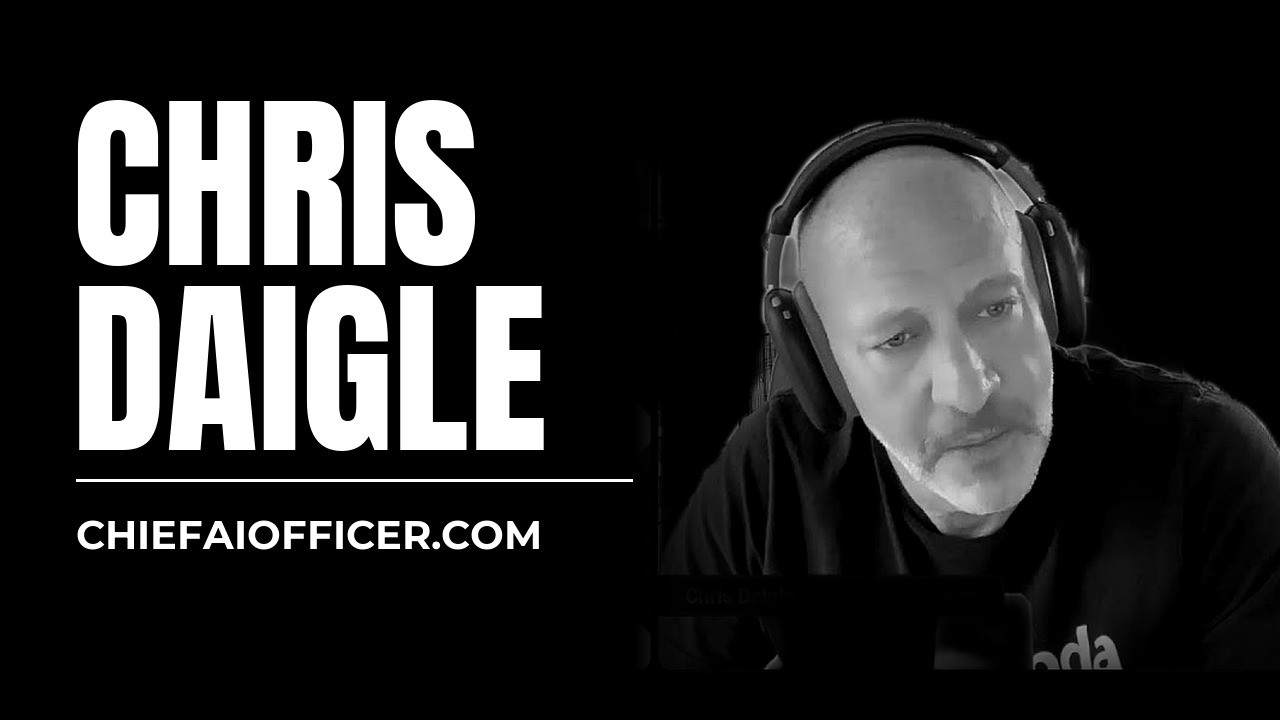
Chris Daigle built ChiefAIOfficer.com to help lower-middle-market companies, especially construction firms, adopt AI. He uses "growth architecture" to find internal inefficiencies, offers fractional CAIO services, and takes equity stakes instead of upfront fees. His path from cigar arbitrage to AI consulting shows how late-blooming entrepreneurs can build credibility through domain names, podcasts, and strategic partnerships.
Chapters
Welcome to another CEO Wisdom podcast. We have Chris Degle with us today. Chris is the founder of an organization I found pretty cool. It's called chiefaiofficer.com. He's also the host of a podcast called Using AI at Work. He's a speaker. He's done a bunch of things. He's been owner at Degle Strategic for 15 years. Chris, I'm glad to have you on the pod. Tell us a bit more about yourself.
Yeah, thank you so much. Entrepreneur, I guess, born that way. I, you know, people go and try to get degrees in entrepreneurship, and I'm always like, how do you teach the fortitude required for entrepreneurship? So—
Yeah, it's like your teacher should be building something, not speaking to you.
Yeah, and I guess, you know, as an entrepreneur, sometimes I regret not getting an MBA and things like that, because later in my career, I certainly would have appreciated maybe a better understanding of finance and those sorts of things. But yeah, so I have done a lot in my career. Most recently, obviously, is in the AI space. We launched ChiefIOfficer.com in March of 2023, which is now 3 and a half years ago as of this recording. And I thought we were late when I launched it, but I think anybody listening to this probably understands that it's just now like companies are really starting to get serious about it. Prior to that, Immediately prior to that, I was doing something through my Daygoal Strategic brand, which was— I called it growth architecture. And I've been an operator of businesses for a long time. I've never really been the zero-to-one guy. I've always been the person that came in after an organization was already up and running and was maybe feeling some friction or constraints on growth. So they would bring me in as kind of that outside person who had seen the inside of a lot of organizations, and I would help them kind of identify that maybe their own internal bias didn't allow them to see. Why are you doing it this way? Hey, this looks inefficient. Maybe we should explore that. So I did that primarily in the financial publishing space. So if you're familiar with brands like Motley Fool or Agora, that's where I did a lot of that work. Prior to that, I ran business development for one of the largest private equity funds in Beverly Hills. It was a lot of fun, flew all over the world supporting the founders of that, doing some really cool stuff. Prior to that, I actually ran business development at Agora Publishing for off and on for about a decade. I've got 20 years, 20-plus years, I guess, in direct response digital marketing. I launched my first SaaS in 2002 supporting foreclosure investors with a piece of software that I had been using as a foreclosure investor, turned that into a membership site. And that was kind of like my first experience in like, oh wow, you can make money online. Prior to that, I was an SAP consultant working with Accenture. Ran one of the best restaurants in the Caribbean when I was in my 20s in St. Thomas called Romano's. If anybody had ever been there, it was fantastic, amazing experience. So I've just always been— and while I was there, there was a big demand for cigars. This kind of cigars came up on the scene in the late, I guess mid-'90s, and there was no inventory in the US. So I flew over to the Dominican Republic, secured a bunch of inventory, and was arbitraging cigars in my mid-20s to outlets in New York, San Francisco, really all over the US. So I've always been— and to me, an entrepreneur is somebody, whether it's a blessing or a curse, it's somebody who can see opportunities everywhere. And, you know, for me, that was always the case. And I guess what I've kind of realized is that for the most part Entrepreneurship is a game of arbitrage. Can I buy or produce something at X price and sell it at X plus? So I'm always looking for those opportunities for arbitrage or leverage in the actions that I do. I guess that would give you a good summary. Father, I got 5 kids, happily married, living in New Mexico now. And, you know, outside of that, I think I've certainly mentored or advised thousands, literally thousands of entrepreneurs over my career, even if that could be some small advice at a cocktail party all the way up to more formal mentorship. And I've had one of the greatest privileges, and that's people coming back, seeing me somewhere else years later and saying, hey, that bit of advice you gave me led to this path, and now I'm, you know, successful, I've created this, blah blah blah. So knowing that I've been able to have that kind of impact on entrepreneurs in general has been, uh, an unexpected, unanticipated enhancement of being who I am, I guess.
Let's start with that last part then. Uh, do you have a scientific formula to maximize the impact of your advice, uh, when you mentor people?
You know, even if I had that scientific formula, if you don't have, as I mentioned early on, like the, the spirit of the entrepreneur, the innate drive of the entrepreneur. All the advice and formulas might help, but they're not going to sustain you when there's the inevitable challenges or roadblocks that, that might seem like the end of the endeavor, when in reality it's just a huge opportunity for you to grow as an entrepreneur. So for me, it's been more anecdotal advice. There was a few sayings that I've heard throughout my career that really stuck with me and have kind of driven me. And the first one that I remember learning probably in my early 20s, somebody told me this one. They said, if it is to be, it's up to me. And that, like, ownership of self-reliance for the outcome has been something that I've shared with many, but it certainly— I've shared it with my children. It's a saying that I think about almost daily. So as an entrepreneur, I would encourage you to pocket that one. It's going to be something that will help you when it's— when it might seem like, oh, this is outside of my control, or it's not my fault, or you want to blame somebody. Remember, if it is to be, it's up to me.
So, right, right. I guess my formula on that level is like target the right person first, right? Online. So that's why I don't give advice on cocktail parties, because even, even if I give advice and I don't really know them and I've not ran a deep analysis on their past, their victories, who they are, I know I'm just wasting words, right? It's wishful thinking. Oh, do that.
Yeah.
But I don't even know them and their profile, right? So that's one. Two, I guess a person needs to ask for feedback, right? Because if not, most will feel like offended by it. And frankly, some people don't need advice. They're just on the right path and they're just not having the high roll right now. It ebbs and flows, right? So it's like they need to ask it. And yeah, like I don't give much advice nowadays except with my partners or maybe my clients, right?
Sure.
Because people just don't have skin in the game, right? It's like, and I don't have skin in the game in them. I don't give a fuck if they succeed or not. If I have equity in them, if I invested in them, for sure, we're both going to want to win, right?
What do you think about these Yeah, I think that, um, you know, for me, if it's something like at the cocktail party or a casual conversation as I'm sitting next to somebody on a plane, um, I kind of see it maybe a deposit in the karma bank. Let's say maybe that, that conversation will result in somebody else at the next Delta Sky Lounge saying, hey, here's some advice from me that might have been unsolicited, but when I hear it, it lands at just the right time or just the right way. So certainly would encourage people listening to this not to invest at the expense of your own success in others who haven't shown the commitment or the capabilities. But for me, I kind of see it as, I don't know, giving back a little bit, I guess. But I certainly would encourage those to consider your perspectives as well.
Right, right. I have a podcast guest that did like a card that you can scan in QR and do like little acts of kindness like this in airports. And you can watch the reverberation of your— the butterfly effect, sort of. Yeah, he's Steven Spielberg's co-founder. So pretty prominent guy as well. And sure. Yeah, I dig that for sure. The second part I wanted to explore with you, right? You have 5 kids, man. Like, yeah, that is a lot of kids. Was it planned? Is it like, yeah, it was How's it going on the ground? You know, like the chaos, how do you control that chaos?
Yeah.
And how do you educate these little minds?
None of them were planned. They were all happy accidents, I guess you'd say, which it's worked out. They've all been blessed with high intellect and healthy, which is again a blessing. You know, you, you, you do what you can when they're younger, but as they get older and they start to— because a lot of your advice when they're younger, it's just they'd rather do something else. But as they get older and they start to encounter situations in life that maybe you've been through or you've counseled others through, that you notice that they— at least in my case, I've got 17-year-old twin daughters, they're about to graduate as, you know, seniors and go into college. I notice now that when I give them advice, They like, they stop, they turn to me, they pay really close attention to what I'm saying, and I can tell that it's landing with them. How do I handle it? You know, sometimes better than others for sure, but for the most part, I don't know. For those of you that might be listening to this, you can't see I'm wearing some Apple AirPods Max. I won those at a raffle. I was at an event with, I guess, GoHighLevel, a big CRM in the direct response space, was giving these out. So Um, it was an event that Dan Fleischman had put on. I was invited. Anyway, they— and the other day I was doing a podcast, um, and our housekeeper was running the vacuum behind me, and I was like, hold on a second, can you hear that? And like, nope. So get some technology that will support that. Um, but in general, you know, like, if I've got these on, I use brain.fm as, uh, kind of like the, the— not the white noise, but the, uh, neurologically calibrated music to help you go into focus zones in general. Um, might mean that you're doing a lot of early mornings before everybody gets up or doing a lot of late nights while everybody's going down. Um, but you know, it's, uh, I wouldn't trade it for sure. Um, because I have friends, uh, who don't have kids, been very successful. Um, but I know that there are experiences and joys in this life that they have missed out on because of those moments when the young one comes up and says, Daddy, I love you, and those sorts of things. So as an entrepreneur, look, if you're in your 20s, man, no rush. I mean, I just— I had a— I'm 53. I had a 3— I have a 3-year-old, right? So you don't have to feel like you're missing out. As a matter of fact, in my 20s, I wish I would have— I enjoyed bouncing around the world and that sort of thing. But looking back, I do— there's a part of me that wishes that I would have dug in a little bit more and really taken my 20s a lot more seriously. But I heard it said at one point, another one of those sayings, you learn in your 20s, you earn in your 30s. And I skipped a lot of that learning in my 20s because I was on the beach or in Dominican Republic or Amsterdam or wherever. I found myself. But yeah, I would say, you know, I certainly don't look at it as like an impediment. We all have our, our journeys that we're on, and, you know, if yours includes having children, then it's a blessing. And, you know, don't, um, don't miss that time regretting that, that you've made those choices. Uh, understand that, um, you know, it will certainly shape the character and make you much more resilient having You know, all of the cleanup required with young kids and those sorts of things. So I would say no regrets. Je ne regrette pas. What is that saying? Je ne regrette pas.
No regrets. I don't regret anything. Yes. I had a similar background. I mean, I partied from 15 to, I guess, 20. So at 20, I started my first businesses. And even that, yeah, was like getting late in the game. I think what you mean, well, me, my regret is like not having known entrepreneurship sooner. I don't mind having fun because I've known my wife, what, in 2015? And while I was building some business, we were traveling the world, right? So we had fun, it was healthy. I would scale my businesses at the same time and my traveling arguably helped my business, right? I could just have new ideas, be more creative, be more inspired, be more energized. I don't certainly regret that part because a lot of people in their 50s and 60s, that's what they do full-time, right? And I mean, I did it full-time. It was fun, but it was not my ideal life. My ideal life was, yeah, still traveling, having kids, having dogs.
Yeah.
Running every day, but also doing business at the same time. I don't ever want to fully retire or just spend too much time traveling. I did the fun part of my life and because of that, Now I can focus on the work and I wouldn't call it like an equilibrium-based life, but, and also I think there's such a thing as late bloomers, right? Like—
True.
Kids that have been like hustling and working since they're 15s and been obsessed with business, I think they're sort of missing out on something, the social part of it and understanding life in itself, right? So—
Oh yeah.
I don't fully regret that, but yeah, the toxic part of overdrinking, right? And gossiping and wasting time in club and chasing women like that. Certainly, I think I fucked up on that level.
Yeah.
I'm asking this because I'm starting my AI school for kids, right? And oh great! I just wish that younger folks would learn entrepreneurship sooner, meditation. They would do physical activity daily, and they would learn like folks like you and I, right? Like 15 founders and/or CEOs or investors a day. They could talk to them, run their own podcast, and just learn from them. What do you think about that idea?
I think it's a great idea. And I guess I would be one of those late bloomers because, and it's interesting, you know, one of the first, I guess, entrepreneurial or self-development books that I read was Napoleon Hill's Think and Grow Rich. Everybody's heard of this book, but most haven't read it, right? And there's a chapter And there where— and if you don't know much about the book, Napoleon Hill was hired to— by Andrew Carnegie to, uh, interview the, uh, scions of business at the time with letters of introduction directly from Carnegie saying, hey, go find out, extract what is the secret, what, what are the commonalities from these people, and start to look for those patterns. And one of the patterns that he identified was that most of them didn't have big success in life until after you know, 50 years old. And he, upon further, uh, reflection on this, he called it, uh, sexual transmutation. He said that earlier in their life, a lot of their energy was in pursuit of, you know, wine, women, and song. And that energy that, uh, could have gone into business was, you know, looking for, uh, pleasures. But as they got older, as they had the families, as they matured, as their testosterone levels naturally dropped, that pursuit of wine, women, and song may have waned a little bit. And as a result, they now had all of this life experience and the time and less distraction to be able to focus on a business pursuit. And that's when things took off. So, um, I think I might be experiencing that in my life right now, actually.
Wine, women, and songs is so good. Oh, that's the fun—
You know what I'm talking about.
Yeah. Napoleon Hill also changed my life, specifically my mom, right? I never give my mom enough credit, but once she taught me reading, right? And I think reading is learning, right? When you unlock reading, you unlock learning, the same hemisphere, I would guess. And then she gifted me at what, like 19 when I was a young drunk, you know, like Napoleon Hill's book. And I would read it and I would just like, holy shit, this is my life right now and not going anywhere. And that like turned me around. And then I started dropshipping and making money. What was your first profitable business? When did you know that, like, you can make money with entrepreneurship?
Man, I learned it really early on, actually. Again, that arbitrage play, and it was in the 5th grade. I was a bit of a nerd. I carried a briefcase to school. I thought I was, you know, a big deal. But we would buy candy and erasers and stuff like that Uh, off-school campus, and then we'd bring them onto, uh, campus and sell it out of my locker. And I remember like, holy smokes, like, I mean, I didn't make a, a killing, but I, I learned that if I could identify a gap and I could be the person that filled that gap, that there was opportunity there. But I would say the first successful entrepreneur— entrepreneurial endeavor that I, I had that was a real business was probably that cigar arbitrage. I was in my early 20s I was, you know, working in again one of the top restaurants in the Caribbean, and I would listen to the people that could, you know, because people would come there sometimes they'd spend $15,000 in a night on wine and that sort of thing. And I paid attention to what they talked about at the tables. I listened to how they communicated to each other and to their children and those sorts of things. And I understood that Hey, like there's an opportunity here. I had never been to the Dominican Republic before. I got on a plane. I went there. Yo hablo un poco español. I don't speak much Spanish, but I was able to go and source from the same places that some of the top brands were. Negotiated a deal because I was face to face, which I would encourage. Like that's a big lesson there for any entrepreneur. Yeah, we can do a Zoom, but man, any I travel a lot as a chief AI officer. I go on site with companies anytime I'm in a city. In advance of that, I'll put a shout out and say, hey, I'm going to be in Charlotte, I'm going to be in Chicago, I'm going to be wherever, and I will host a meetup. It doesn't have to cost a lot of money, but the opportunity to meet people face to face— there is a rapport when you break bread with somebody. There's a rapport that gets built that goes beyond the Zoom introduction. And I can tell you that there's people that I haven't seen in 10 years, but because of that face-to-face interaction If I called them up now, they'd be like, like, goddamn, it's great to hear from you, Chris. Like, like, what are you up to? What, what can we do together kind of thing? So that was probably the first success. And again, it was like, I didn't have good financial foundations when it came to like learning from my parents and things like that. So saying that, I found pretty relevant this easy come, easy go. So The money that came in, I don't even know what I spent it on, but at the time I felt pretty, pretty rich doing something that was pretty easy. It was essentially dropshipping, really. Yeah.
And was that one for the cigars? What were the commodities exactly?
It was, it was cigars. And the demand in the US, something in the mid-'90s, it just became insatiable. And they were— there was a high premium being paid for any type of inventory. And I happened to be where they were rolling the cigars, so it made it very easy for me to source. Whereas the guy with the cigar club in New York City, like, he wasn't flying to the Dominican Republic sourcing it. He was buying from local vendors or distributors, and if they didn't have inventory, he was stuck. So, um, I, I became that, uh, many, many cigars were enjoyed, uh, because of my efforts, for sure.
Interesting. And that was in Puerto Rico, was it?
La República Dominicana.
República Dominicana. Interesting, huh? And you would ship these, uh, how much cigars per box? You know, like, give me an idea of the scale of that operation.
Yeah, man, it's been so long I don't remember, but a box of cigars usually has 20 or 30 depending on the size. If it's a Panatela, which is a thin long cigar, if it's a Robusto, which is, you know, bigger than your thumb, um, that had a lot to do with it. But, um, the— I was able to again be that arbitrage player in a dropshipping environment to where I would get the order, uh, I'd keep the difference, and I would pay the, uh, the producer in the Dominican Republic. Uh, I think the town was Santiago de los Caballeros. If anybody knows that part of, uh, northwestern Dominican Republic, it's known for its, uh, fantastic climate for growing Uh, rich tobaccos.
And you would ship in boat? Would you ship in pallets as well? Um, tell me a bit more.
Uh, they were being shipped, uh, via air. Um, the clients paid for expedited shipping. Um, we sold in bulk. Uh, I would imagine at times there were probably pallets that were being shipped out. Um, But again, man, it's been, uh, what, '95? Shit, that's 30 years ago.
Yeah, 30 years. But that wasn't— you said dropshipping, right? Dropshipping implies like some kind of website. I don't think you had websites back then, or did you? No, no, it was the phone, right?
Took orders on the phone or via fax.
Oh my God, yeah, interesting. So, and you had a couple of these orders come in per day or what?
It was usually bulk orders that would come in. Like, when somebody ordered, they wouldn't order 1 or 2 boxes. It was usually a supplier or, uh, like a vendor who had a lot of clientele, so they would order, you know, thousands of cigars at a time.
Interesting. So you would get orders of like $5,000, right? Like, I mean, cha-ching. And then your cost on that would be what, like $500?
Yeah, yeah, it was really The, the geo— the, the, um, currency arbitrage was also in my favor as well.
Okay, interesting. Oh yeah, that's pretty cool. That's a pretty wild start. Um, then what was your, your best home run so far? You, you'd say like in the last, uh, I don't know, 10, 15 years, what was your big home run?
You know, starting that, um That software business in 2002, I had been a consultant traveling around the world. I had everything I want that I thought I wanted. I was getting highly compensated, respected by the clients, working with big names, staying in nice hotels. But I was never home. I didn't have a wife or kids at that time, but I lived in New Orleans, and the saying in New Orleans is "Laissez les bons temps rouler," like like it's a fun place to be, right? And I missed that a lot. And I remember being in a hotel room. Uh, and an infomercial came on from a guy named Carlton Sheets. And any of your older listeners may recognize Carlton Sheets, but it was an infomercial about how you could, um, buy houses no money down and that sort of thing. And I didn't know about like internet hustles. I didn't know about like info products or anything like that. I ordered it, picked up the phone, uh, because it was still, you know, handheld phones then. I ordered the book and I devoured it. I think within the first year of learning this, this, these methodologies. I bought and sold about 50 homes in New Orleans. I helped, uh, significantly with the, uh, good word, bad word, I don't know, but the gentrification of a part of town called the Irish Channel. If you're familiar with New Orleans, it used to be really rough. Uh, now it's, um, a beautiful neighborhood. And in the process of that, we were doing a lot of short sales. Now what that means, that means that the bank has lent out a loan on a house at a certain value But now, because of the market, the value of the home is significantly less than the value of the mortgage. And what banks would do, rather than keep them on the books at a loss, they would sell at a smaller loss rather than, you know, have that, that capital tied up in inventory that was going to be non-performing assets. So if the house had a mortgage of, say, and this is, you know, early 2000s, so $300,000 or $400,000, you might be able to offer $150,000 for the house, and the bank might say, Fine, we'll take it. We'll get that non-performing asset off of our books. We'll take the cash and we'll put it back out into circulation. So that process of negotiating the discounts with the banks wasn't a phone call. It was a long process that involved paperwork and comparable sales information and a document in particular called a HUD-1 or an estimated net sheet. That's something that every home closing in the US, at least, there's a essentially a receipt of the transaction. And the receipt was a long PDF and it had all these fields in it. Normally you'd have to get your attorney to go in there and create this estimated— this is what we're guessing you as the bank will net out from this transaction. Now I said, man, I'm paying $75 every time I do these. I'm putting out, you know, 10 offers a week, sometimes more, on these short sales. And I reached out to— at the time it was called the eLance which most of you might be familiar with Upwork. Well, Upwork was originally called Elance. And I found a team in India. I had never done any outsourcing before. I'd never worked with software before. And I had them build essentially a wizard where it was just fields that somebody could fill out and the output would be an estimated net sheet on the actual document looking just like an attorney had done it. And I was using that a lot. Somebody said, hey, can I use that? And can I use that? Can I use that? That sort of thing. And I launched a website called easyhud.com. And thought, man, like I hope somebody you know. I think the subscription was twenty bucks a month, and it was during Mardi Gras in New Orleans. And I remember I launched the site. I went out to some parades. I came back, had my first sale. I was like, oh my god, this works! Next day, more parades. Mardi Gras last couple weeks in New Orleans. There were two or three sales, and then it just started to happen like that. So being I guess at that point, I was probably in my early to mid twenties. Um, no, I guess I might have been late, late 20s, uh, and having residual income, passive income from a— an asset that had very little fulfillment, uh, you know, cost of goods sold, let's say, was a real eye-opener for me. And I said, man, I got something here. Let me go learn more about this, this model. And so I got introduced to— at the time it was called internet marketing, and now I think it's just more commonly known as digital marketing, um, or even, uh, you know, go-to-market, uh, GTM. Um, and so I really immersed in the digital marketing, uh, space. It was very nascent there. There wasn't a lot out there. And I remember I would go to these events, there might be 100 people there, and I would learn how they were doing stuff, and I'd get to know those people, and I'd stay in touch with them. Well, turn out— turns out that those people back then, like, they ended up sticking with it ended up becoming very successful in the space. And if any of you have studied, you know, digital marketing strategy, um, some of the greats were at those original events, became friends of mine, and I ended up building this amazing network of high achievers that were just friends, right? And they— I'd talk to them and they'd say, oh, blah blah blah. And I'd say, oh, you don't know so-and-so? Well, I know of them, but I don't— I've never talked to them or anything. Hey, well, let me introduce you. So I started doing a lot of like just introductions really, and didn't realize that that was a valuable service to these individuals till a few years later. Got the nickname— my last name is Daigle— I got the nickname Dr. Daigle because like people would say, oh, you got a problem, call the doctor kind of things. That was my email address now is doc@chiefaiofficer.com. People still know me as that. But that got me introduced into, I don't know, this concept of business development, I guess, like identifying same gaps, but maybe not necessarily with a product, but with distribution or with knowledge or with expertise. So I started brokering those relationships, uh, and in exchange for, you know, some piece of the commercial activity that would occur. And, um, so that became kind of a side thing that ended up resulting in a lot of passive income. But to go back to your question, the probably cheap— or easyhud.com was my, my biggest up until now. And I would say Chief AI Officer. We have very high ambitions for valuation and exit at some point in the next couple of years. Um, and that— when that happens, that'll end up being my biggest success and probably, uh, the last time that you guys will hear about me if it hits the numbers that I'm looking for. I'm just gonna, uh, spend time sitting on a rock and meditating for a long time as my children run around my feet.
And Daigle, you told me about a couple of your clients, right? like some, some pretty big one there. So what happened there? This one's like mostly advisory, right? And this is still ongoing up to this day. Did you have any home runs on that one too?
Yeah, you know, I don't know if any of you guys know Tim Sykes. He's a big name and certainly was a big name on YouTube. Well, Tim had a fantastic product line. He had a lot of distribution and Um, but not nearly as much as the organization that I worked with at the time called Agora. Um, I was able to— and I built friend— uh, built a friendship with, uh, Tim's, uh, silent partner, the one who's, I guess, more operational, everything. Zach, if you're listening, shout out. Um, and, uh, I said, Zach, you know, like, at Agora, we could do some big stuff with Tim. He said, tell me more. We had that conversation. Them up to Baltimore, which is where the headquarters were, uh, had a fantastic dinner. They ended up, uh, doing a deal. And I think to this— at this point, you know, IRS, if you're listening, this is unsubstantiated. I don't know for sure, but I would assume— I mean, that was in 2018 when I did that deal. They've probably done a couple hundred million dollars in commerce at this point because of that, that one introduction. So there were a number of those that occurred. Um, did the same thing in the private equity space when I was working with, um, organization, a private equity firm in Beverly Hills. Uh, it was just— and you don't need a lot of those in your life, especially if you've got a piece of the action, um, for you to get lazy, actually. And that's kind of what happened. I, I got lazy and, um, uh, you know, was living on the fruits of my labor from those. And then, uh, COVID hit. Um, all the stuff dried up, kind of. I wasn't able to travel nearly as much and Um, but it opened up the opportunity for me to, uh, be, be ready when generative AI hit the scene with ChatGPT 3.5 in November of 2022. And I took all the skills that I had learned as an entrepreneur, but again, I had never been the zero-to-one guy, and that had always been kind of like an open loop, an unchecked box in this lifetime for me. And I said, this is going to be it. And, um, I'll just— I'll be honest, Charles, I thought I was going to get in and out get rich quick, right? Hey, there's going to be a lot of— it's a gold rush, there's gonna be a lot of money made if I start with Chief AI Officer. I've got a great domain. Um, and, uh, it didn't happen in 2023. We were just painfully early. But I can tell you now that being painfully early and sticking with it, uh, which was a new lesson for me— there's a lot of ventures that I had started and kind of half-assed and just didn't finish, but this is one that I guess a level of maturity had been introduced into my operating style and stuck with it. And now we find ourselves in a position to where 3 and a half years on, it doesn't sound like a long time, but in the internet space or the AI space, especially generative AI, that's pretty much since the beginning of its commercialization through GPT, ChatGPT. And now, you know, I launched the podcast in January of 2024, and now it's top 2.5% in the world, and it's got you know, amazing listenership, and it's opened up distribution opportunities and credibility and book opportunities and stuff like that. So, um, yeah, I guess I'm just rambling at this point, but that's kind of like what the experience was like.
Right. And you've seen so many companies at this point, why not become an investor, invest in the best of them? Because you've seen a lot of products, you've seen a lot of ICP, right? And that's what I do. Like, my agencies are laboratories, but I started my fund recently because I'm like, yeah, I'm not the best operator. I'm very good, but there's always going to be people outperforming me. So I can just raise capital, provide some advising to, to some of these investees of mine, and let it scale from there. Why not create such a model?
You know, I explored it, um, during COVID actually. I worked with a guy named Roland Frazier who launched a model called EPIC, which stood for Ethical Profits in Crisis, and it was kind of the poor man's M&A, I guess you'd say. It was how to essentially do what I did in real estate, which is negotiate an opportunity that didn't necessarily require capital. But in Roland's model, it was doing the same thing, but for businesses that weren't prepared for what was happening with COVID Or maybe the listeners have heard of the silver tsunami with all of these US-based businesses that the owners who have built this and run the company for 30, 40 years they're aging out of the business and they may not have a continuity plan or an exit plan. And as a result, like for them, it's, let me just shut it down. Whoa, whoa, whoa, before you shut it down, maybe we can work out some sort of a deal where I don't necessarily need to put money into it. So I had a small portfolio during COVID The AI business really has been an all-encompassing endeavor. But what I've recently started to do, and listeners, if this is interesting to you, please reach out, One of the things that we would do in that model was an earn-in, right? I brought a skill set to the table of growth architecture and the understanding of marketing and those sorts of things. And I could bring them into companies and say, in exchange for me contributing these valuable services to your organization, when I hit certain milestones, equity will be released to me so I could earn into the ownership of the business. Now with AI, now that we've kind of stabilized our business and have our model and product market fit and all that, I've got some bandwidth and I'm looking for opportunities where we can bring the just incredible acceleration that's possible with somebody who knows operations and knows generative AI to come into organizations and earn in, in exchange for introducing that and bringing, you know, a qualified talent to the table who can run those things. In exchange for some piece of the equity in the organization. So I'm going to start doing that again. I've had some initial conversations with some of the people I met through Roland's EPIC program, but I'm not quite there yet. I think by the end of Q4, Chief AI Officer will be like cooking, and I'll have a lot more time to explore that. But I think that that might be a fun— because In your case, Charles, like, you get to do the part you like. You're not an operator, you don't want to be the operator, great. For me, I enjoy the operations side. I don't like being the CEO. I don't like being the, the pressure of being the visionary or whatever, right? So for me, it would, uh, fit into things that I like doing and that I'm good at. So that's probably where we're going to go from there. So not necessarily raise funds, but, but earn in, right?
I like about the business, I told you last time, like, all your partnerships, right? Like, um, Yeah, you partnered up with like 2 organizations, International Association of Chief AI Officers, and there's another one. Why add this to the website? How did that happen? Is it just like proof of authority? Do you split revenue? What's the dealio here?
Yeah, so being chiefaiiofficer.com, it was an obvious move to be on the board of the International Association of Chief AI Officers. So it was a commercial interest for sure. And as far as the other organization, it's scaling up. If anybody's familiar with EOS or any those type of business operating systems, scaling up is like for more mature businesses. For them, it was distribution. They had a large audience and respect and credibility with our ideal customer profile, our ICP. And, you know, I learned— I had a friend who had been successful in Silicon Valley. And he told me, first-time founders focus on product, second-time founders focus on distribution. And when he told me that, I like— it was a, a light bulb moment for me. So that was a distribution partnership, but also the opportunity to, to be, uh, aligned with and mentored by some very brilliant business people who, um, had already kind of like had their their exits and those sorts of things. So it was a combination of— but on the commercial side, exclusively for the distribution.
These are quite high-ticket deals, right? So tell me a bit more about your ICP and your favorite go-to-market method to get to them.
Sure. Um, so our ICP is what we call lower middle market. So it's companies doing between maybe $20 million and $200 million per year, between 50 and hundreds of employees. We focus on universal activities within those businesses, so the sales, the operations, the finance, the HR, the marketing, the things that don't necessarily require like a background in the industry itself because it's more focused on the operations. We started speaking to groups and, you know, accidentally and unintentionally, we ended up being kind of the one of the go-to resources for commercial construction, which is a, you know, a $14 trillion a year global industry. And through that, it's been good because in the commercial construction environment at that lower middle market, the owners are the people that I talk to. It's not, you know, a committee or a board. And it's been, it's been very fulfilling because, you know, despite the skyscraper that they might be building, the margins on construction aren't very high. And anything that we do across the activities that we focus on, that information, like those savings drop straight to bottom line or EBITDA for the companies. So we're able to go into these construction companies and really have an impact on what the owners get to keep or distribute out to the rest of the investors. We spoke at the YPO Construction Industry Network event in February at the Four Seasons in Las Vegas, had the chance to work with And a workshop with hundreds of very successful commercial construction companies all over the world. And that like further pushed us into that space. Now, if you're a professional services firm, if you're wealth management, if you're whatever, yeah, we can help you. But we tend to do a lot in commercial construction and light industry, I guess I'd say.
Yeah, I guess it depends per product, right? Like there's a Kickstart Day. So $15 grand, there's embedded fractional CAIO, there's strategic oversight as well. So some of them just may want an intro, some of them might want a fractional person, they don't want to recruit that person, they don't even know where to start, they fully want to offload.
Exactly.
And some other might just want some advice. They currently have a chief AI officer, but they They're not sure if he's performing, what they should evaluate them on, and so forth. So yep, I love that. What's the challenge of marketing to larger companies with that type of budget?
Yeah, you know, I had never done a lot of B2B and always been B2C for most of my career. Longer sales cycle, for sure. Not the urgency that comes with like, if you're selling to B2C, like the They want the result immediately. They want the result overnight. B2B at the lower middle market, they, um, they're measuring things in a longer time cycle, which tends to be a bit more forgiving on results and that sort of stuff. If they don't get it tomorrow, that's okay. If they get it this quarter, that's a good target. Um, the marketing side, like, we've worked with some of the top names in cold email outreach and things like that, um, and it was okay. But for me, these individuals, they're not getting sold by a headline on a website or a lead magnet. These individuals are looking for— and they've got a lot at risk if they bring in, you know, a cowboy into their organization who can't fulfill. So they're looking for credibility and trust elements. The podcast itself certainly has helped, especially, you know, now that we're 2 and a half years in. The domain name, chiefaiioffer.com, Like, that certainly lent some credibility, the association with, um, the International Association of Chief AI Officers. But the best thing for me has been the public speaking, and I, uh, resisted it for a long time. We actually had a chief AI officer who was fantastic on stage, and I put him, uh, in front of all the audiences initially. And a dear friend who is a huge help, he's a brilliant marketer, And I wish I wouldn't have done that because I know he's very busy now in his individual practice because I put him in front of those stages. But now I'm quite comfortable. I'm keynoting, I'm doing small group, I'm doing large group, I'm doing, you know, big webinars, networks, workshops across industries and that sort of thing. So I would say that that would be the difference. It's not going to be necessarily the email you send. The email's great, might get you on a phone call, but especially in AI, they need to trust that you're— that you understand their business. They're not introducing risk because you're, you know, a brand new AI consultant or something. So if that is how you find yourself as a listener in this space, I would say, sure, get the email, but build— start building today those trust elements. Because the saying is, you know, the best time to plant the tree was 20 years ago. The next best time is today because the time is going to pass. And if I wouldn't have started the podcast in 2024, if I would have waited, or if I would have said I'm not going to buy a premium domain, I'm just going to get whatever, all of those things would have certainly mitigated the impact of, I don't know, our thought leadership that it has now on decision-making and trust with those B2B business owners.
There you go. Chris, thanks for being on the pod.
Of course.
Where can people find out more about you?
You can go to chiefaiofficer.com. If you follow me on LinkedIn, my LinkedIn handle is Dr. Daigle. We do, we regularly do what we call AI Lunch and Launch. It's LinkedIn Lives that are 30 minutes, but they're geared for executives or business owners that are running a business to learn, you know, a bite-sized application of AI, or you can go to chrisdaigle.com where you can find out more about all the things that I'm doing as a smarty pants in the AI space.
That was Chris and Charles for another CEO Wisdom
More from Charles


Founder Wisdom: the audiobook, version 2 (5 hours of stories from founders and CEOs)

8 CEO Questions I Love Asking: the audiobook (64 founders answer, in their own words)





