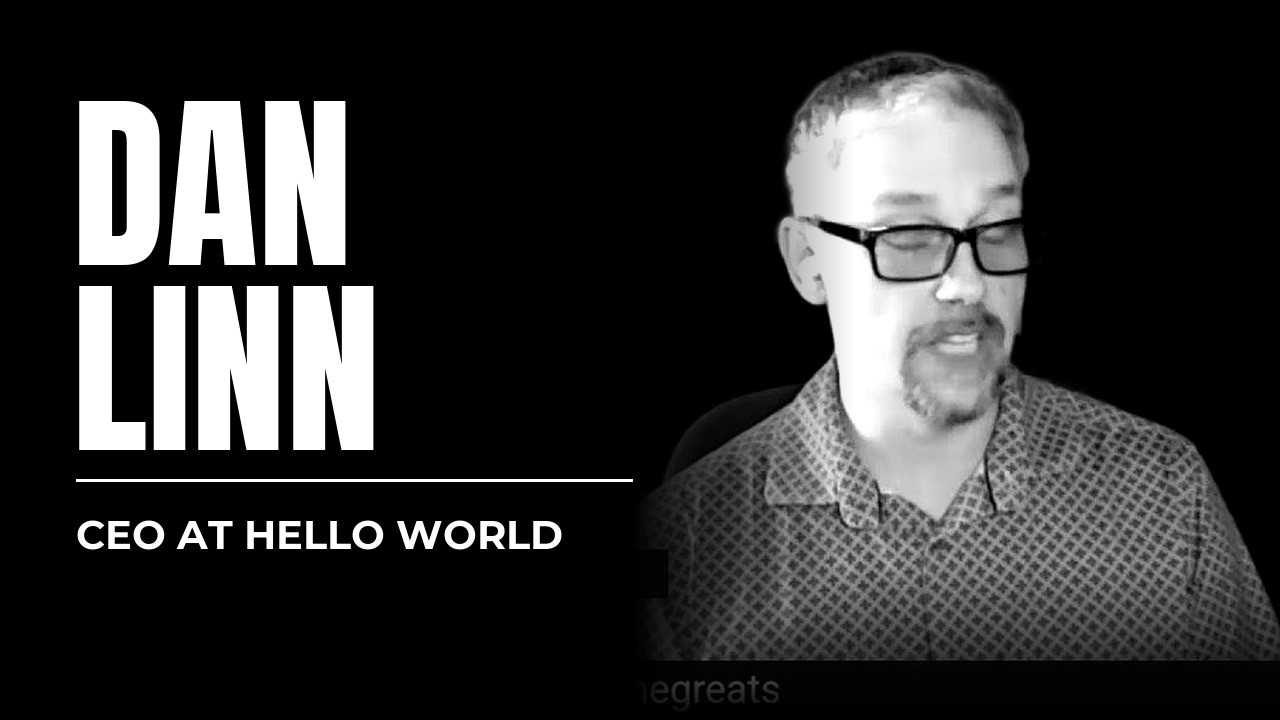
In this CEO Wisdom podcast, host Charles Cormier interviews Dan Lin, founder and CEO of Hello World, a consultancy that helps companies modernize through AI‑driven automations, integrations, and data‑warehousing. Dan recounts his early web‑era background (Backflip Digital, CTO roles) and frames himself as a problem‑solver who thrives on clarifying complex client challenges. He explains why agencies remain essential despite the rise of "vibe‑coding," citing security, authentication, and architectural rigor. Dan draws parallels between the current AI hype and the dot‑com bubble, warning of a future shake‑out driven by token‑cost pricing and standards enforcement rather than a total industry collapse. He describes Hello World’s flexible engagement models—flat‑fee projects, time‑and‑materials sprints, and fractional CTO/strategy work—along with a client‑persona approach based on shared values rather than strict market segmentation. Service focus includes backend automations, integrations, and custom data‑warehousing solutions. Dan acknowledges that Hello World is presently a lifestyle business but is exploring growth via grants and certifications. He discusses AI’s impact on jobs, emphasizing token‑cost awareness, societal safety nets, and the evolving skill set of a "1000x AI engineer" (architecture, testing, model expertise). Finally, his top priorities for the year are pursuing grants, obtaining relevant certifications, and expanding strategic services.
Chapters
Welcome to another CEO Wisdom podcast. We have Dan Lin with us. He's the founder and CEO at Hello World, has been 10 years at that company. Previously founder of other companies including Backflip Digital, was a CTO, a couple of companies, uh, but yeah, interesting guy altogether. Dan, welcome to the pod. Tell us a bit more about yourself.
Excellent, thanks for having me. My name is Dan Lin. I've been a developer for multiple decades. I currently run a company called Hello World where we help companies modernize their businesses in the face of AI. I'm excited to talk about AI today.
Tell us a bit more about your background though. You've done your own companies, you've been taking roles at other companies, you have developer at a bunch of companies. Tell us a bit more about your background starting with, I guess backflip in 2002.
Yeah, you got it. So I am a problem solver. I love puzzles. So I was very lucky to grow up in the era of the web where it was first being implemented. And I was able to do a lot of self-teaching on the web to get into that industry very early. So that experience has seen more than a few valleys and peaks, if you will, right? I've seen more than a couple busts. And we're looking at a potential bust here too. So I'm curious how, uh, AI will stack up to the, uh, dot-com bubble burst when that happens. Uh, my, my biggest thrill is listening to a client that has a sticky problem where they don't quite understand all the options or variables involved, working through that and getting a crystallized plan in place on how to solve it. We may not have all the answers right away, but that's what I really get off on.
And can't they just vibe code the solution to their problems nowadays? Do they still need an agency like yours?
They could try. They absolutely could, right? I've vibe coded my own apps and it's definitely possible. However, it's my experience with development that makes those successful. We actually have had multiple clients who have come to us and said, hey, We built this app, can you make it real? And then we get behind the scenes and we see, wow, this doesn't have any users, no authentication, one of them didn't even have a database attached to it, right? So you can vibe code an interface to an application fairly well. Vibe coding the logic behind an application, you kind of need to know what's going on there, right? It's not automatically going to add security to your application. It's not automatically going to add things like users. So understanding how development happens and the intricacies of it is still very important.
Right. And you mentioned the dot-com boom and bust, right? Big fortunes have been made. Lots of fortunes have been made during that. I think most people lost a lot of money. How dare you compare AI to this? Do you think the same stuff will happen? I can see something different, although I haven't been part of it. I've studied dot-com boom and bust extensively with lots of CEOs and founders as well. What are the similarities that you see between both and what are the differences?
Definitely the similarities I see, the reason I brought it up is that there's a lot of hype, right? Just like the dot-com bubble, there's a lot of hype around a lot of stuff. And there's a lot of people doing things in not the best way, right? And eventually, there's going to be a shakeout like there was with Web 2.0 that says, OK, now the standards are here. And there's going to be a number of folks who were not meeting those standards who either have to come up to those new standards, whatever those might be, or they're going to be left behind, right? So that's the bubble burst that I see, not necessarily talking about the fortunes that will be made. But how I see people working with AI in the industry.
But to come back to the question, right, you said that you're intrigued to see what will happen. Do you think that there will be a bust? Because the bust could look like OpenAI and Oracle, all these companies spending circularly into one another. That is the definition of a bubble to me, right? A lot of big players failing at the same time and sort of bringing the full ecosystem down with them., or OpenAI not being the, the most profitable companies, they're losing a lot of money, right? That could be the, the argument. What, what is the argument against the bubble?
Um, when I talk about a bubble burst, I'm not talking about the entire industry failing, right? When we have the web bubble burst, there were still lots of stuff to do on the web, there was still a lot of the web still coming, right? But it was a bit of a shakeout on both the personal and the application side, right? If your application didn't absolutely serve a need, right, it was just a flash in the pan, it probably didn't survive that bubble burst. By the same token, if you were using the web in ways that weren't necessarily the best and the new standards came along, you got left behind that way too. So there were still plenty of folks who made lots of money and survived the web the web bubble burst. I don't see the whole AI industry failing. One way I see the bubble bursting, and I think we're starting to see this now, is we'll start to see AI companies having to actually charge what those AI tokens are costing them. It's currently a loss-leader proposition. When they start actually charging for what that stuff costs, I think there's going to be some major sticker shock with folks. And I think that's going to cause some, some retraction from AI, right? Hopefully in a good way, right? There's a lot of people using AI in fairly silly ways right now.
Right. And how would that affect your company and/or your clients?
How would that affect my company and all my clients? Well, so far, most of my clients are being fairly reserved with AI. I am a big believer that we should be absolutely using AI to build better tools for ourselves, but we shouldn't necessarily be putting AI inside of everything, right? And that's where I think a lot of folks will get hurt. So I'm doing a lot with my clients to protect them from heavy token use within their workflows, right? It's one thing to have token use as you're developing something, but having a way to, to know exactly what your token usage is gonna be before that bait and switch happens is gonna be important. And I'm trying to set up my clients for that.
And who are your clients? Do you work with a specific ideal customer persona?
Oh, my ideal customer persona is the connection that I have at that company. So if we have a connection at that company that generally shares our values and has the same, interest and level of respect for their technology that we do, that's an ideal customer for us. Sometimes that ideal customer is a 3 or 4 person consultancy. Sometimes that's a Fortune 500, you know, major corporation. As long as those contacts we have within those same organizations are similar to us in values, working style, and and respect for the technology, then we'll generally be successful there. So no niche for us, we just like to solve problems.
Okay, no B2C, no B2B. What's different about your agency for them then?
That's a great question. So most of our stuff tends to be B2B, right? We don't do a lot of direct-to-consumer stuff, but when we do, do direct-to-consumer stuff, I like to treat them the same way that we treat those larger clients, right? It doesn't matter if they're a one-person shop, uh, who just started a company and hasn't even incorporated. If they're willing to work with us on what we think they need to do to improve their technology, then we can work with them.
Okay, and what you do specifically for them sounds pretty broad, right? Like, seems like jack of all trades, like any problem you can come at me, but you must be solving one specific problem that you're very good at for, for a bunch of people, right?
Yes, uh, automations and integrations with their backend office, uh, software. That's something we do a lot of, and we can help a lot right now, especially because of the AI tools available to us. Uh, another thing we do a lot of is data warehousing, right? There's, uh, very large data warehouse solutions out there. But data warehousing solutions can be built in a customized way fairly cheaply these days compared to the major players. So those are some big platforms.
Right. Okay. So how do you reach out to these folks? How do you get them in your pipeline?
That's a great question. I like to do a lot of networking. I'm involved in a lot of networking groups and professional organizations. And I try to meet as many people as I can so that I'm top of mind when they have a sticky technological problem. And also coming on podcasts like this.
Right. Um, your pricing, it's either $230 an hour, or do you have like MVP builds, right? Tell us a bit more about these packages.
Definitely. Uh, for the most part, we like to do flat fee projects. We like to designate what we're gonna be paid and what we're gonna do right up front. So that's very clear. But we do offer time materials pricing if that's more desirable. Sometimes we don't exactly know what we're getting into, right? So we'll do sprints. We'll say, you pay for this 2 weeks of sprint work, we'll come back and show you what we've done, what we think will need to happen in the next sprint, and then they can make a decision if they'd like to continue with more sprints or not. Kind of an agile methodology for that.
Got it. Your business, is it more of a lifestyle business or can you scale it to millions?
That's a great question. I'd say right now, it's probably more of a lifestyle business based on the state of development in the face of AI, right? Do I know exactly how I would grow that to a $10 million business in the face of AI? I have my ideas, and I don't want to share all of them, but I'd say they're not concrete. So right now, more of a lifestyle business.
Okay, you say your number one skill is clarity. What's your process to get clarity and get to the bottom of a problem with clients? Is it like the 5 Whys? What are your framework there?
Um, the way I like to start is I really like to start by listening, and that can be challenging for me being a problem solver. I want to ask questions and try to get into problem solving right away. But I found that listening first, really letting them get everything out that they're talking about first and then asking my questions, then I like to ask really challenging questions. And I'm not afraid to shake the trees when it comes to people or process either, right? Is this the right person to be doing this process? And is this process the right thing? So really getting raw and real with them quickly after making sure I've ingested what they're talking about.
With the AI revolution underway, you're afraid that AIs will slash most jobs?
Um, no, no, I'm not currently afraid that AI will slash most jobs. I think there's, there's some things preventing that. Um, one, AI can't replace a human yet. Uh, maybe for a very distinct function, but it can't necessarily do any of the soft skills around that to the degree that it would replace a full human. There are positions that I'm sure, you know, may be completely replaced. Transcriptionists may have a tough time. But for the most part, I think that AI will enable people to do more within their job rather than replace people, right? So you can get more productivity out of the same amount of people with AI.
But if I'm a founder and a CEO and I can see that the AI outperforms the human by 10,000x, because the— you just have to look at the AI's growth rate in terms of brains, right? Human brains aren't growing that much anymore, and most of them at least, like the 1% is different. But if you look at AI's growth and AI's capability and the agentic revolution underway, um, if I have the choice to hire an AI that's 10 times cheaper, faster, and plugs in instantly to my organization knowledge, why would I pick a human?
Sure, I, I don't think you're wrong there. I think the second thing that's gonna prevent adoption of this right away or fully is that we will have a societal problem of an amazing amount of people unemployed, right? And unless we have some sort of universal basic income Um, that's going to create a, a dystopian society, if you will. Yeah, yeah. So I think there's a lot of caution around that.
Yeah, I absolutely think it's, uh, mandatory that laws, uh, come around that, um, if society doesn't want to go to shit. Um, yeah. Have you studied this concept? Do you think about these concepts a lot of time and how it will potentially affect you?
I do, I do. Yes, I dream about this stuff. Yeah, I absolutely think about how it will affect me. You know, there's been times I wonder, there's been times I've wondered, do I need to pick up a manual skill, right, to be useful in the future? Do I need to become an electrician? So I've certainly, certainly thought about that and how it will affect me. I think early on in AI, I was a little bit naive and I told myself there would be lots of other industries wiped out before me as a programmer would be in trouble. I think that's, that's pro— that's probably not accurate. I think programmers are, are definitely in trouble. Um, so yeah, I think about what it is about my skill set that's valuable outside of just typing code into a computer, right? And that's really my problem-solving in not only technologies but people and processes.
Yeah, but because there's a concept of like a 1000x engineer, right? Like, what are the skills of this 1000x engineer? And I, I don't, I don't think these guys will disappear anytime soon. I think they'll become oligarchs, actually. So what skills do you think, uh, 1000x AI engineer would actually have?
That's great. First of all, I think they'd be very familiar with modern usage patterns, right? You can't assume that AI is going to come up with the best architecture for you, right? So knowing architecture, knowing the best tools and libraries that you want your AI to use, setting up that framework right off the bat, I think is incredibly important. One thing I tell my AI, if I'm doing a vibe coding project, is I expect 90% code coverage on testing, and I expect all those tests to pass before anything deploys, right? Just that little tidbit right there gets me a lot farther than somebody just, just vibe coding. So knowing those patterns, knowing the intricacies of, of how different models work, understanding, um, Even MVC is still important, right? Keeping concerns separated, knowing those things about the high-level concepts about programming are gonna become much, much more important than who can memorize all the syntax in JavaScript.
So how are you preparing your business for that shock?
Oh, that's a great question. We're doing a lot of work to do more fractional CTO work and fractional strategy work. The idea behind that being a lot of folks faced with AI are kind of in analysis paralysis. They don't necessarily know what they could be doing with it, right? So trying to be more of a partner with those companies to help them navigate the, the world of AI rather than just being a, a commoditized vendor that provides code to them. I think that's a big shift we're trying to make here.
Interesting. What are your top priorities as a CEO for this year?
Top priorities for this year. One of my top priorities is I want to get more involved in grants and start applying for some grants. I think there's some really good initiatives out there that we typically haven't gone after. That we want to go after this year. So getting some registrations, some certifications in place so that we can go after some of those more educational grants.
Where can people find out more about you and your company then?
Absolutely, you can find out more about me at hello-world-devs.com and we can be found on LinkedIn at Hello World Devs and I can be found on LinkedIn at /danlin.
More from Charles


Founder Wisdom: the audiobook, version 2 (5 hours of stories from founders and CEOs)

8 CEO Questions I Love Asking: the audiobook (64 founders answer, in their own words)





