Federico Cismondi - Founder @ BRNDTS
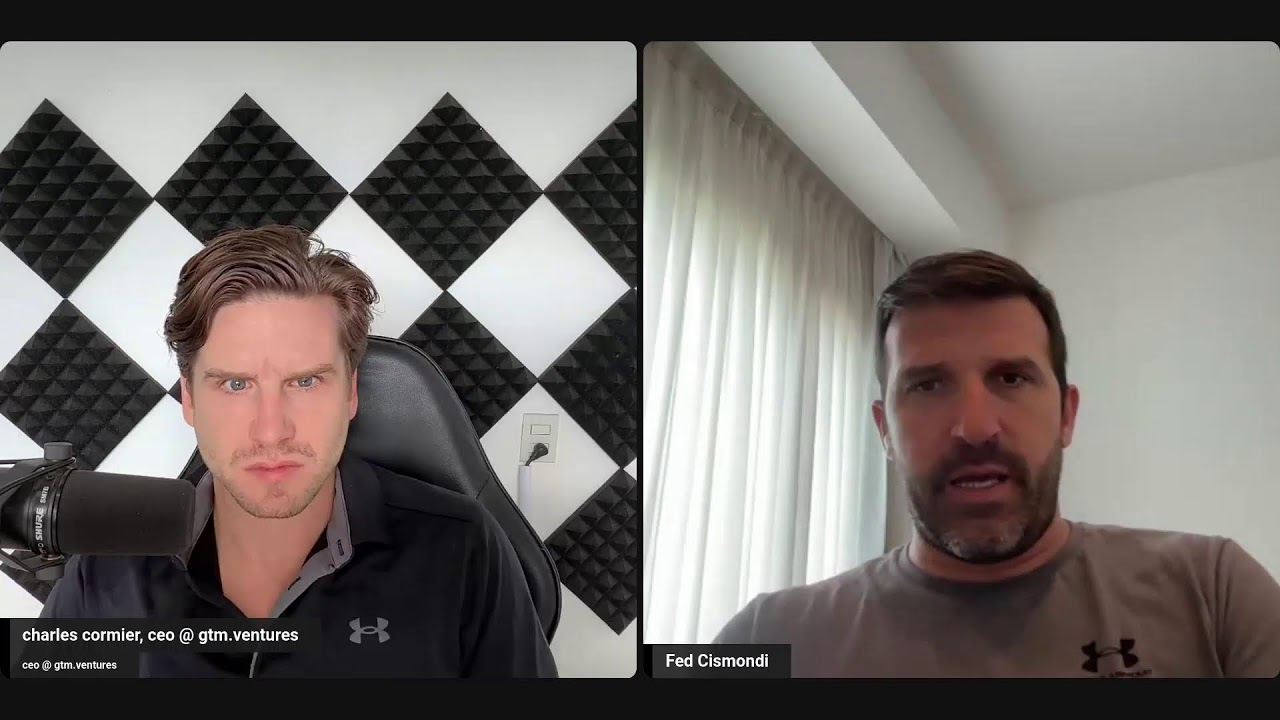
In this Founder Wisdom episode, host Charles Cormier interviews Federico Cismondi, CEO and co‑founder of BRNDTS, a Miami‑based startup that enables small businesses to run video ads without producing video content. Federico recounts his upbringing on a family farm in Argentina, his education in biomedical engineering and nuclear physics, and his early tech venture managing medical imaging data. He describes his first major venture‑backed success, Doodoc, which went through Techstars Boston and was later acquired, teaching him about fundraising and due diligence. The conversation then shifts to the genesis of BRNDTS: inspired by his father’s failed cable‑TV advertising business during Argentina’s 2001 crisis, Federico saw an opportunity to embed programmatic display banners within video streams, delivering location‑relevant ads without costly video production. He explains BRNDTS’s go‑to‑market model—partnering with video publishers and integrating with major ad exchanges (PubMatic, Magnite, OpenX)—and outlines current traction (aiming for $1.5 M ARR by year‑end). The team consists of four co‑founders (CEO, COO, CTO, Head of AI) and a 15‑person staff, with recent hires planned. Funding includes a pre‑seed and a seed round; the company is currently bootstrapped but may raise again next year. A substantial portion of the discussion focuses on how AI agents are embedded throughout the organization: they assist in feature ideation, product planning, code generation, testing across devices, and sales/marketing automation such as personalized outreach, lead scoring, and pipeline management. Federico ends by sharing his passion for solving technology‑driven problems and points listeners to LinkedIn and YouTube for more about BRNDTS.
Chapters
Welcome to another Founder Wisdom podcast. We have Federico Sismondi with us today. Fed is CEO and founder at a company called Brandits in Miami, Florida. Has been that way for three years. Been managing partner for 25 plus years at Encisa prior to that, and a couple of other companies we may talk about like DoDoc and so forth. I also see like a role at MIT here. So Fed, welcome to the podcast. Tell us a bit more about yourself and what you've been up.
Absolutely. Thanks for having me here. Um, I don't know if you want me to start from the very beginning or where, at what point in the, in the story.
Well, if the early beginnings, uh, shaped who you are as a founder, uh, today, so be it. So yeah, how was, uh, how was the early days for you?
Absolutely. So early days were in Argentina. Uh, I was born and raised there. Um, I'm a biomedical engineer by training. And I did a master's in nuclear physics. My, my first company was focused actually on, uh, managing images coming from scintillation cameras, CT scanners, and all that. And in the early days when other companies were figuring out how to manage standard formats for images coming out of these devices, I created a company and started selling in Argentina and Brazil. So those were the first steps uh, in, uh, entrepreneurship. And, uh, a little, a little far from, uh, from the very early beginnings. I was born in a farm, and that was the family business. So going for biomedical engineering was a big detour in the, in the family plan. Uh, and after that, I did a PhD in, um, biomedical engineering, but especially AI applied to figuring out what a what would happen to patients in the intensive care unit. And then other businesses came, came after that. So that, that is more or less the, the big, uh, um, connection between the, the very beginnings and where I'm now. I think you're muted, Charles.
In Sisa itself, that's the family business, is it? So that's the one you started in? 25 years ago, correct?
That's correct. Actually, I didn't start it, I, I joined it because it was already an existing family business. Um, it's a— it comes from that farming background. Uh, we, we do farming in different areas in Argentina, um, part is corn, soy, and all that, but also, uh, we have grapes and vineyards that produce different varieties of grapes. So So that is what we produce and we ended up developing the exporting part to other countries. So yeah, a little unrelated from technology.
Yeah, but how did that shape your brain, right? 'Cause you started quite early, I guess, in life and yeah, you're still there today. That was a good start. I guess it taught you some things that you implemented in technology later on, right?
Definitely. I think first the hands-on approach that always, I mean, regardless what position you have in a company, uh, being able to first to, to have the, the position that allows you to, to make decisions in terms of having the knowledge to make decisions and being put in the position to be allowed to make the decisions. My dad has been huge with that always since, I don't know, I remember since being 6 or 7 years old being able to make decisions about what things were going to happen in the farm. And sometimes his employees being surprised at being kids being so young making those decisions. And, and for him, it was always a big thing. And it's funny because it's a thing that I brought in, in all the companies that I, that I had over the years, uh, bringing that to even junior employees, not only giving them tasks to execute but also making sure that they have a part of the business that they can decide about so they can also own it and own the success and also own the problems and the challenges that can come with that. So So that probably for me is the biggest lesson that came from, from that family business.
And what led to technology ultimately? Because in that business, it's, uh, I mean, it's export and of premium dried goods, right? Uh, what led you to go into tech? Did you get tired of that? Why are you still also in that business nowadays?
Well, I, I guess it was at the time when I decided to go to college, uh, There was the possibility of staying within something that had to do with farming, like agronomic engineering or something like that. But I don't know, my passion was with medical devices, and I decided to pursue that. And then I started being successful, first working for hospitals and managing the devices, and then actually designing software for these devices. So it was, as I said, a major detour from that, but it was a little bit of follow And then I realized that the passion was beyond medical devices and medical technology, and it was more with technology. And that probably was the second part of my life, realizing what I— at least, I'm not sure if I was the best at that, probably really not, but that I was good at, that I was good at understanding and speaking the technical language so I could speak internally with my teams and being able to develop solutions for certain problems that I would, also be able to speak in a commercial language to clients. So being able to be in the, in that, uh, interface in which you can speak both languages and take advantage of that and create something new because of that ability. So I, I discovered that I had that, that, uh, quality, and, and I decided to, to pursue something that would allow me to exploit it.
And which one was your first successful one in tech? I see Cinder here. I see one to Techstars, I see Doodoc. Which one was your first home run in tech?
So the first home run definitely was, uh, Doodoc because of how it worked. The other, the other companies before had exits and they were all successful exits, but the home run was Doodoc because it was the first one that was venture-backed. And, um, with Doodoc, we went through Techstars Boston in 2015 and we learned a lot of things about it. Venture-backed companies that we didn't know. Uh, first, a part of how to develop relationships with investors and also how to organize information for that type of relationship. And then in the end of that company, when we were acquired, the exit also forced us to navigate something that we hadn't done before through very strict due diligences, uh, with groups of, I mean, top lawyer firms from Chicago and Boston And, uh, navigating that was such a learning experience and a great learning experience. And, uh, um, so that, that to me is the, the so far the, the, the big home run.
There you go. And what finally led to what you're building right now, Brandon? Where did the idea come from? Some of these guys had this type of ideas I've interviewed, what, like 6 years ago, right? Like, it's not a new thing. It makes all kinds of sense though, right? Like, when you think about it, I don't think no one ever scaled it, right? So why did you start it?
That first, it gets me back to, to the very beginning of, of my story, my personal story. Um, I mentioned that my family business was farming, but my dad was very successful with that, and at some point he decided to start diversifying the portfolio. And one of the projects that he pursued was building a cable company. With some small TV channels. And this was back in the '90s in Argentina, and, uh, it started going really well. And it was a business that was developing really fast in small cities in the, in the center of the country. And, um, the business model was, uh, advertising was supporting these TV channels and ultimately my dad's company. But the problem came with the big crisis of 2001. In 2001, Argentina went to hell with the economy. And advertising has always been seen as a thing that you do when you have money. When you don't have money, you just have to survive with a small store, with a business. So all the businesses that were advertising in these channels stopped investing that money. So ultimately my dad's company disappeared and it folded. And it was to me a very interesting thing seeing how a thing that actually advertising helps businesses sell, So if they were actually in a bad situation, the investment should have been on advertising, not on killing advertising. But in any case, it stayed with me over the years. And, uh, when we sold Duroc— and I say we because my, my co-founder in Duroc is also a co-founder now in Branded— we started thinking of this idea of what can we do for advertising with the current technologies, taking advantage of AI and all that. And I brought back this situation, and one of the problems was that in order for small stores, small businesses to advertise and, and, and get more market, they need to create good advertising. But to create good advertising, they need to invest a lot of money. They need to do productions for videos and all that. If you think of, for example, now you go to YouTube, you watch a video, what happens at the beginning? You get a skippable ad. That skippable ad is a video. Producing a video like that is expensive, so small businesses cannot do that. So very— it's very common for those small businesses to not be able to advertise on video. What is the problem? Most people now consume just video. Even when you go to read the local newspaper, you don't read the news, you watch the news in short videos. So we said, how can we link that? How can we link video with these small businesses being able to advertise without producing video? So this is the part that is slightly different from what you said about 6 years ago. We said, how can we mix the ads that these small businesses already generate within video. So we started coming up with the idea of using programmatic banners within videos. That is what nobody had done before. You have companies like Sponix or Myriad that are able to do product placement or replace the LED board around the soccer field— sorry, around the soccer field— but nobody had been able to use programmatic ads. Within the scene. So we started using programmatic ads, which means a small store can advertise on a video without producing a video because they use just display banners. And, um, not only that, but every person watching the video ends up seeing an ad that is relevant to them. So if I happen to be traveling somewhere in Argentina, the ads that are going to appear are relevant to me but relevant also to my location. So it creates a lot of win-win-wins in the sense of the person watching receives relevant ads, the advertisers get to advertise relevant things locally, and videos don't get interrupted with these ads because the ads blend with the video. So that is the whole long story for why this came to be.
How successful is it so far? How do you go to market to these potential advertisers and convince them to be on a billboard rather than a classic billboard or rather than a classic solution, right? Like, tell me a bit more about that.
So most businesses already advertise through Google AdSense. They create their banners and they become available. So Google AdSense, let's say, has 2 fronts. One is finding the inventory where they are going to show the ads, and the other one is finding the stores or the businesses that want to advertise. So they already do the effort of getting the ads, and they get ads for everything from Coca-Cola to the mom-and-pop's, uh, bakery at the corner. And, um, the problem was the placement. They— Google doesn't, beyond the normal placements in a website, they didn't— they don't deal really the way we do with video. So that is, they do the work for us with the advertisers. So the way where we are now is we're working with 2 types of clients. What we see as clients are the publishers, the ones that produce the video and publish the video. So we have what we call broadcasters or streamers that broadcast content that is usually long form, like for example, sports videos where you go and see the whole game or you have the whole content there, usually between 1 to 3 hours. And then short content. Short content is usually newspapers, magazines, where you don't see the whole game or you don't see the whole content, you see just the highlights. In the end, our, our products are the same for both, but those are the 2 buckets of clients that we have. So that is our go-to-market. We go to publishers, we offer them a technology that is going to create more inventory within the video, and then we plug that inventory directly to, um, advertising platforms that are, uh, that do the, um, live real-time auctioning and bidding for the, for that, um, that inventory. And, uh, there you— we connect with PubMatic, with Magnite, with OpenX. So all those big advertising platforms that provide us with the ads to show.
And how successful is it so far? I believe you scaled to what, like $50 grand a month or something like that? What are your Your goals for the rest of this year and the next?
So, uh, we want to finish the year closing with 1.5 ARR. And, um, um, the, the main idea that the big objective that we have is the business model for going after, uh, individual, uh, publishers is good because it allowed us to create a portfolio where we can show value, but it's not scalable in the long term. We need to find ways to get to more publishers at once. So we, we are starting to develop this avenue of becoming a technology partner for video players, for OTT providers, and also, uh, for advertising platforms that already provide the infrastructure for advertising in a website. It's just that we are, uh, specific to video, but those are the avenues that are— that we are exploring now. We believe that that way we are going to be able to scale up faster.
Interesting. And who's in the team? Uh, your CEO, like, uh, who helps you run this company?
So, uh, at this point we have a sales team with 3 people. Besides that, uh, we are 4 co-founders. Uh, it's myself as a CEO, Carlos Boto is the Chief Operations Officer, and then Thiago is our Chief Technology Officer, and finally Felipe is our Head of AI. And development. And then we have a structure for our product team, marketing team, and as I mentioned, our sales team. We are, um, 15 people strong at this point, and we are hiring people actually. So we're expecting to expand the team before the end of the year.
And mostly bootstrap? Are you raising?
Uh, we are not raising at the moment. We have raised, uh, 2 rounds, uh, one at the very beginning, a pre-seed, and then we did a seed round. So at the moment we are not raising, but we expect at some point next year to Okay, that's pretty exciting.
The company, how do you use AI agents? What kind of agents do you deploy right now to automate tasks and even not have to hire humans?
So it's amazing. We are producing more code and with better quality than when we exited Doodoc, our previous company. And at that point, we were 35 people strong. So, uh, it's amazing how it's multiplying our capacity and the quality of the, the, the software that we produce. Um, in the previous company, we were selling to pharmaceutical companies, so we needed to have certifications in terms of quality, in terms of information security, and all that. We decided to take the same approach now, even though we are not selling to those types of clients. Because when we did that, we learned that the quality of product that you produce ends up creating less headaches. It's easier to integrate. People understand what you're doing through the documentation and all that. Now, the agents are helping us with everything from the, the very genesis of every feature in terms of bouncing balls, in terms of how the features should be conceived, uh, what, uh, what, uh, details in the feature bring more value to every detail that we have collected from the, from clients. So ultimately, we are developing the features for the clients. So the first part is collecting that feedback from the clients, for processing the feedback, for understanding how the features should be conceived. Then the part of planning the feature, so planning the development, then going specifically to the structure of the software and the parts of the code that need to be done. Then the coding itself, then the quality control, unit tests, and all that. And then Even for testing, since we have to work with multiple platforms, so different devices, mobile devices, desktop devices, different screen sizes, different video players, we have a myriad of things that we need to test in order to make sure that one thing we develop doesn't break everything. That testing is impossible to be done manually nowadays. Even for that type of testing, we have a lot of agents that help with that. And that is just product. Then we have all the part of marketing and sales where we have a lot of support from agents too. So yeah, that is really multiplying our hands.
And tell me about some of these agents on the HDM level. On—
sorry, what level?
Go-to-market level. Uh, do you have cold outreach agents? Do you have lead scoring agents? You have pipeline agents? Agents building a dashboard so you know how much leads you have in the pipe and so forth?
Everything for all of that. But first, we start, uh, first with the, um, crafting of the messages for automated messages. So for that, we have agents. But, uh, once we have defined a certain subset of targets, we also have agents exploring their back— their background and personalizing the messages so we can really make it personal for every target that we are contacting. And then for the contacting itself, for the reaching out and the campaigns, the drip campaigns. And, um, and after that, even— I mean, we realized that it was easier for us to ask for specific things. So when we get those things, we have agents that take care of that information, collect it, and use it for, for filling out, um, our, our database in terms of, uh, clients and how they are moving in the pipeline, creating the pipeline. All that, all that is definitely, um, I mean, I remember doing it in the previous companies manually, and there were a lot of things that we said we are just not going to collect this information because we don't know for what we are going to use it, and we are just using up space and time. Now we use every single piece of information we can collect because it can indicate something, right?
Um, what's next for you? I mean, you travel the world, you've exited some companies, right? Like, uh, how do you still get lit up by, uh, stuff nowadays? Is that, um, mostly in brandeds? And, uh, yeah, what's next for brandeds if so?
Uh, yes, it's definitely brandeds what keeps me awake at night and, and also excited about things. And I think for me, I, I've discovered over time that the challenges I'd like to tackle, uh, have to have a technology component. Uh, definitely that, that is what I mean. Thinking about how you can put together either things that exist or have to, to craft something from scratch that didn't exist before to solve a problem is, is part of my passion. But then also the part of communicating that to the, to the potential clients or, or to the, to the clients that we have already in line, that to me is super exciting. I mean, being able to see that reaction in people when you're solving a problem that they've had for a while and that they couldn't figure out. Or even, we've had cases that we talk with companies, they have massive internal teams dedicated to building solutions for them, and they have not been able to solve something. And we come and we bring you the solution. That in seeing that reaction and, and the value that you bring is, is super exciting. So that, that is what it definitely keeps me going and excited about the business.
I love it, Fed. Where can people find out more about you?
Well, definitely LinkedIn is our platform for communicating everything we do for the, uh, with the company, for the clients, everything we discover in the market. We publish it there, uh, interviews like these and, and also any content that, that we find interesting that we believe our community should know. And then, uh, YouTube. In YouTube you see a lot of examples of what we do with our partners.
Fed and Charles for another CEO
More from Charles


Founder Wisdom: the audiobook, version 2 (5 hours of stories from founders and CEOs)

8 CEO Questions I Love Asking: the audiobook (64 founders answer, in their own words)





