From Anxiety to 9 Figure Exit - Derek Wilder, at CEO at Hallmark Homes
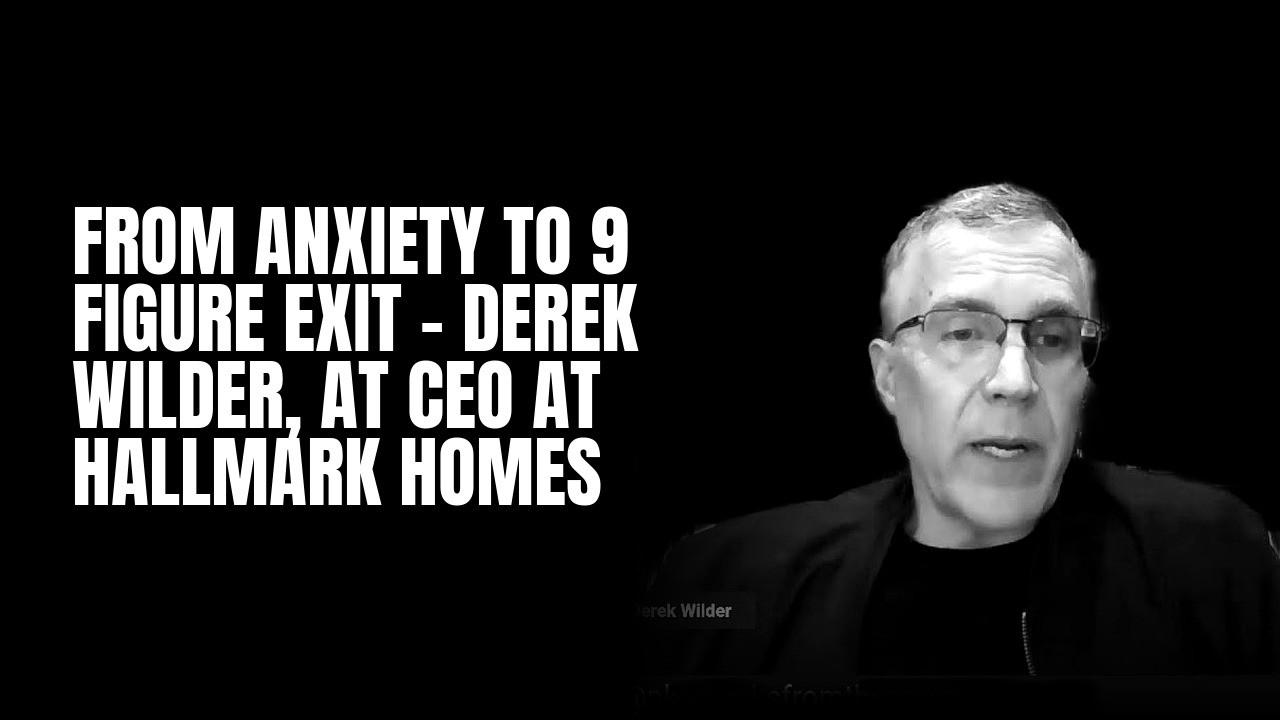
Derek Wilder built Hallmark Homes into Indiana's largest custom home builder with $60 million in annual revenue, then sold it in 2022. He talks about scaling through the 2008 crash and COVID boom, battling anxiety-driven workaholism, and why cultural alignment mattered more than the deal itself.
Chapters
Welcome to another CEO Wisdom podcast. We have Derek Wilder with us. Derek is a CEO at the company called Hallmark Homes since 35 years. That's a very long time. Started at Deloitte, and he's also the president of Butterfly Boardroom. He's a CPA, he's a PhD, so interesting guy altogether in Indiana. So Derek, welcome to the podcast. Tell us a bit more about yourself and what you're up to.
Yeah, thank you very much, Charles. Yeah, yeah, I was having a, um, I ended up selling the business about 5 years or 4 years ago, but I'm on with the company for, uh, I've been on with the company for 4 years after selling it, so I have another year left as the CEO. And during that time, I have been thinking deeply about how to maintain the culture, develop leaders to be able to carry on what we've done for now over 30 years. And out of that came this book, The Butterfly in the Boardroom. I was reading about chaos theory, and although I've read tons of business books, many of them didn't really land well with me over the years because a lot of them attempt to give easy answers to complex problems. And for the most part, my experience has been that it's much more complex than easy. Okay, and so in, in light of that, um, this really, the kind of the philosophy of chaos theory kind of represented the way I think about business, and I just wanted to put it in words. I wanted to get the message out. And just allow leaders to really, instead of trying to find certainty within a business environment, be comfortable embracing the uncertainty, because that's really the reality that we live in, in our businesses.
You speak about the early days at Hallmark. What prompted you to start it and what scale did you achieve with that company? I guess that's a good start.
Yeah, so I was working at Deloitte at the time. A friend of mine and I were, uh, just talking about business on a golf course, and he had been in real estate, and he mentioned to me that he was selling homes for a builder, but the builder wouldn't let those buyers change anything. They were doing a high volume, but, uh, the key was, is they had to, they had to to build the houses that they had in their plan book. They weren't allowed to customize anything. And I had just finished up reading a book, you know, an old book now, by John Nesbitt called Megatrends. And his philosophy was that with the technology revolution that was happening, we were going to be able to, instead of manufacturing— you know, the Industrial Revolution talks about this mass production His belief was eventually we would have the technology to do mass customization. And so our goal, my goal, was to be able to create custom homes because of the technology we were using and be able to move them out at more of a production price, um, of kind of this mass customization approach. Buyers were very much interested in it, so by the time we were I don't know, by the time I was 30, I think we were the largest custom home builder in Indiana.
And what does that mean in terms of number? How many homes build? How many employees? Uh, what's the average revenue?
Yeah, we've built thousands and thousands of homes. Uh, 50 to 60 employees, of course tons of subcontractors and suppliers. As far as revenue, this year we'll probably do $60 million. Or so, and probably move a little, you know, we'll continue to move that up here in the next couple years with some of the pipeline we have.
And it's a very, um, people's first business, right? Because if a contractor doesn't show up and the clients have specific requests, there's a lot of stress on the line, lots of money. What have you observed in terms of the challenges of running that business, and what has been rewarding in the last decades doing that?
Yeah, I mean, I think you hit on a really very important point, and that is in the contracting business historically, um, the barriers to entry are almost nothing, especially in certain states like Indiana. There's not really even a licensing, um, which is sort of scary in a way. Um, however, it's historically been an industry where it's all about just getting stuff done rather than being able to build the relationships and the connections. And, and, you know, culture has really been the thing that's kind of— our culture has been what's really kept us, I think, not only just alive but thriving. You know, our turn— from everything from our lack of turnover to, you know, we still have, you know, we still have plumbers and roofers, I mean, that have worked for us for decades. And I think this is something that is, you know, absolutely crucial, is being able to figure out how to create the kind of culture that people want to be at, with proper feedback loops and yet proper accountability. Really, no, you— people want to be heard through feedback loops, but at the same time, to the extent that you hold nobody accountable, the good people don't want to be around that environment either. If people are getting away with things that are inappropriate and you're just letting them— so they— people want both, and they want to be part of a team that they know is winning. They want to be part of a team that they know is growing. And so setting and creating that culture is absolutely critical for any leader. And this is what was so hard for me to kind of get this message out for so many years. We were doing it, but like, how do you explain explain it. And that was a challenge that I'd had, and that's what I've recently been spending my time on.
And that business span is 35 years. You've been through various, uh, economic cycles, booms and busts. Like, uh, have there been years in which it's been challenging, especially, I don't know, 2008?
Well, 2008 was one of the most difficult years for any builder. Um, you know, to give you a point of reference, the, the county of Indianapolis is Marion County, and the contiguous counties, 5 or 6 counties that connect to Marion County, built in 2005 approximately 15,000 homes. In 2008 to 2009, during that year period, they built about 3,500 homes. I don't know if you can imagine You're— whatever business you're in, it went from whatever it was to the market being 10% of what it was within a few years. You can imagine it was just devastating to builders, and, and frankly, the vast majority of them either went out of business or had to reorganize or restructure or went into bankruptcy or something.
It's—
it was a very, very challenging time period. You know, ironically, another time period which was almost as difficult was COVID. Because we thought everything was going to shut down, and then all of a sudden the building industry completely boomed after things started opening up to the point where you couldn't get product and you had this massive pipeline of sales. I'm not sure what was more stressful, not having any sales or having so many sales and not having any product to be able to build it with. They both seem pretty stressful to me.
Is that what you pulled out a couple of years ago? Was that like, um, the sign that you needed to sell the business? COVID?
No, we had been— that was 2019. We ended up selling the business in 2022. My partner, who's older than I am, wanted to retire, and I had a few years left in me. It seemed like a good time to transition. By the time we sold the business, we were back to being quite stabilized at that point. Um, but yeah, those two examples are, you know, a great example of how, uh, you can have all the 5-year plans you want, Charles, and at the end of the day, you can pretty much throw them out the window depending on what the market winds and the shifts do. And that's part of the chaos that we live in as business people.
And you said you had a couple years more in you. Does that imply that the business is, uh, stressful? What does that imply exactly?
Well, um, I just felt like, you know, at the time I was in my early 50s and I felt like I was, you know, I still had a lot to offer. And so I was comfortable with where I was, my age, and with my experience to be able to stay on for another 5 years. And like I said, that, that's going to be over here in another year from now. But I've certainly enjoyed being able to, to help coach and develop the team. That we currently have. And I really think we've got a great team going forward.
The exit, was it stressful? Was it a massive win? Because that in itself implies lots of energy, right? And also, yeah, the emotional part, right, of letting go of an identity you've built for 35 years. Tell me a bit more about that.
Yeah, so a couple things. One, these can be very, very challenging, and we had our own challenges, but one of the things we didn't have to have a challenge with was the people. The people we joined with were— have been great to work with. I've thoroughly enjoyed working with them, and that doesn't always happen in situations like this. Um, so we're— so we— I guess we would say we were lucky in that regard, but I would suggest that anybody looking at selling, it's absolutely critical that you— the cultures have to work together in, in a synergistic way. Otherwise, it could get really challenging very fast. You know, one of the big challenges we had is the, the founder of the business that bought us, uh, 3 months after we signed the deal and finished everything, finished the sale, he passed away. And this was something that we weren't expecting to happen.. And in light of that, clearly stressed kind of the, the relational aspects of things, you know, who's doing what, and, you know, you lose kind of a patriarch of the company. And it, you know, different people had to step up at different times. So there were definitely challenges in the transition. But fortunately for us, it wasn't a cultural challenge.
And that is crazy. What was your mentality when you heard that this would happen? Was it like, oh man, is this gonna just crash and burn? Was like, seems like bad luck. What was your emotional and mental reaction when you heard that he passed away? Is it panic?
Well, you know, I've led, you know, organizations, this one and a few others for many, many years. And so it wasn't panic in the sense that I wasn't uncomfortable. I had to take more of a leadership position, Charles, is basically what it came down to, because what— who I thought was going to be kind of coming alongside me, taking a lot of that leadership, uh, effort even off me, uh, just shifted back. So it wasn't really panic as much as it was, you know, I just knew I, I needed to be more, you know, more involved, uh, in working with the team and developing the team to move forward and And that's what I did. It was very sad. I, you know, obviously I was very good friends with Steve, and so it was horrifically sad, you know, but he had really good people on his team. I feel like we had really good people on our team, and we came together, and it's been okay, but it could have been a whole lot worse, that's for sure.
You have so many books behind you, so many potential mentor, how would you define your, your leadership mindset? Is it mostly Stoicism?
Yeah, that's interesting. Um, uh, certainly overtones of Stoicism, there's no question about that. You know, one of the things you'd mentioned earlier is about letting go and the identity and that sort of thing. You know, um, honestly, that was kind of taken care of back a long time ago in my late 20s. This business was growing very fast. Uh, I was a workaholic, uh, without question. My identity was wrapped up in my business. I was experiencing a lot of— I was experiencing a lot of anxiety, uh, primarily from tying my identity to my performance. And so how well I did seemed to directly connect with how well I thought about myself. And so my identity was tied to how well I was doing. And due to my own kind of, uh, we'll call it emotional train wreck. Now, my train wreck, I, you know, I didn't have any illicit affairs. I didn't go out and drink anything. I mean, there's nothing you could see on the outside that looked like a train wreck. I just knew inside I was in turmoil in my late 20s. And I had, you know, I had to deal, I had to come to terms with the fact that this business is not who I am. Uh, with or without this business, I am still me. And so as it relates to selling the business, uh, although that can be kind of an identity crisis for many people, I didn't have one because I already had one back in my late 20s. And so it was just a matter of moving through the next steps with this sale. But yeah, that was a big— that was a kind of a really defining moment for me in my late 20s, early 30s, when I had to kind of face those demons and realize what I was doing and how it was hurting me.
Did you always knew you would be that successful, right? Because if the business makes $60 mil a year, just for the audience, that's, uh, probably what, like 9-figure exit at least, right? Did you always had your sights on that? Did you always knew you were gonna make it big?
No. And I think this is something that, um, let me just put it this way. I really don't think that the input and the output have as much relationship to each other as what we think. So for instance, and, and chaos theory talks a lot about this, sometimes we put a massive amount of effort into something and the result is not very much. Sometimes we put a little bit of effort into something and it explodes, and we had no idea. Okay, so although there are some obvious basic tenets right, of business and life in general. Um, basic things like telling the truth and being honest and just being a good person, you know, ultimately those ought to pay off. But you know, sometimes bad people are successful, sometimes good people end up with bad luck. And so we live in a chaotic world. And so in light of that, um, I, I think, uh, from, from my perspective, when you feel like you're gonna make it, when you feel like it's gonna all happen, you often don't plan for the things that could happen. And then it literally, in paradoxically paradoxically increases your risk of not making it. So in other words, one of— I think the— one of the best, um, traits of a great leader is constantly questioning himself and not buying his own sales pitch too hard.
Yeah, the good, uh, good point here. Your niche, construction, right? It's traditional, it's lower scaling. You've probably checked some of your peers, uh, I don't know, from your Deloitte days that founded tech companies. And did you often compare yourself to them and was like, oh shit, this guy just had the $50, $100 million exit while I'm building this slower, uh, scaling business?
Well, Unfortunately, I have to say that yes, I did think about those things at times. In fact, Steve, who ended up purchasing my company, I started at Deloitte, he started at Ernst Young. So, I mean, it's the same thing. And he did start a tech company. He did cash out for probably $50 or $60 million in 2000 and ended up buying land and creating a development company that purchased me. So yeah, some of my friends are exactly like what you're saying. And yes, I question myself on whether I should have taken a different track. You know, this is something about life that's quite interesting. And it is, we can't know the counterfactuals. We don't get to play life out in different ways. And I reference this in the manuscript, um, one of Matt Haig's books, which is a fictional account of a character named Grace Winters who has the opportunity to go and play out different ways of her life living out. Okay, now in real life, of course, we don't get to do this. Only in a fictional novel do we get to do that. Do we get to do that? But it does, uh, you know, it's an interesting thought experiment, and it's something that I think you know, crosses my mind once in a while and probably crosses others too, right?
Um, you've played the capitalistic game and you talked about retirement. Um, nowadays you write books. Are you like fully going towards the direction of passion and doing something fun that you genuinely like? And you think that, um, career trajectories applicable to younger folks? Is like retirement the thing, or do you advise, I don't know, to go ikigai from the get-go, do something you love and make money with it?
Um, at this point, my plan is to definitely do something that I love. I'm very passionate about leadership development. That's something that I love. I have a couple other hobbies and things that I'm very interested in as well. Um, and that will be my main focus. I doubt that the focus will be on making more money. I don't need any more money, and quite frankly, um, there's freedom in not really even thinking about that, you know, where I can, um, publish content, create environments that hopefully I can pay it forward. And, you know, you don't need to always make money when you do something. And, uh, so that's not high on my priority list moving forward, but what is, is being able to stay engaged in things I'm passionate about. I'm certainly not the kind of guy that's going to sit in front of TV for very long, right?
Um, in the age of AI, do you think that's possible though, like to fathom retirement or fully do something that you like, the ikigai model? Granted that there's going to be agents that are probably going to be better at doing something than you are. What is your stance on this?
You know, AI is fascinating. I, I'm, I'm one of those people that thinks that it's taken way too long for technology to catch up with what I need to run a business. And I don't think AI is even going fast enough at this point. I mean, there's some basic things that we still can't do. Like, I can't get any sort of technology right now to draw a foundation plan like we want it automatically. I mean, just the most basic things that we can't make happen, okay, to speed up the process for our customers. So I think we got a long ways to go before technology stays up with what the human imagination can imagine and can deploy. And so AI is not something that I'm afraid of at all. We're definitely deploying it in very— in a lot of different areas. We're deploying it even in leadership development apps where people can go in based on the culture of Hallmark, based on this manuscript, based on the way we think, and go in and ask decision-making questions and allow it to be programmed to understand how we look at things and how our culture works. So I think there's a, a long way to go with AI. And, uh, at this point anyways, I don't really have any reason to believe that, um, it's going to take over the universe or anything like that. I mean, it's going to revolutionize the world just like the internet did, but it's going to revolutionize the world just like mass production did. So it's gonna be a revolutionary thing. But you know, it's just hard to believe when you look back over history that humans won't find ingenious ways to utilize this in a way that's probably very, very cool.
Yeah, yeah, I think the main barrier to entry to AI and AGI would be social laws. 'Cause I think AI and AGI can definitely outthink and outdo us in multiple ways. The robotics would take longer because it's way harder to teach robots how to do physical things for now. Talking about that, don't you feel that this is actually going to happen in the construction space, having robots building houses? And if so, what would that mean for humanity if you can buy a house for $30K instead of $300K or $3 million nowadays? I don't know about that market, but yeah, any thoughts on this?
Yeah, I think, you know, the construction industry is one that's going to be hit. It's going to— well, I'm very long ways away from it happening in market, in, you know, in industries like this, in my opinion. I'd love to be able to see, you know, technology to even just affordably lay out plumbing in a virtual reality way so my plumbers can go in and know exactly what to do and can speed up their process. You know, we, you know, there's some gimmicky kind of things out there that can do that sort of thing, but it's nowhere near where it needs to be to be able to make a massive impact. So it's hard to imagine what the future is going to bring in that regard. But I can say this, you know, one of the things that I've spent my business career thinking about, and that is how long-term planning is mostly nonsensical. And for example, if you would have looked at me 5 years ago before I sold the company and said, well, here's my 5-year plan. My 5-year plan is that in a year from now, I'm going to sell the company to a guy that 3 or 4 or 5 months later is going to pass away. And then after that, we're going to get into a space of multi-family building called build-to-rent that nobody's ever heard of yet. And then we're going to build 200 or 300 more homes per year just in that space. While we build out houses in subdivisions from a developer who just bought us. Like, seriously? Like, that would have been complete nonsense for me to predict that. Okay, so instead, uh, I think of things like very short time horizons, and that's how I think about AI. You know, we're going to take what AI gives us in the next month, in the next 3 months, in the next 6 months, and then we're going to adjust to it and hopefully going to make good decisions. We're not going to make big bets on what's going to happen 5 years or 10 years from now.
Your great obsession nowadays is culture. I think you're writing a book about it, Butterfly. Um, why? And also, there's so many people writing about culture. There's been Reed Hastings, for example, and all these greats. Why you? Why, why this book?
Well, why me is, is I'm not, uh is I'm actually a businessman doing it. And one of the biggest frustrations for me reading some of these books written by consultants— and I was one, by the way— is that, um, when I'm reading them, I'm like, yeah, but what are you doing on Tuesday morning? Like, what are you literally doing on Tuesday morning at 9 AM when this problem happens? Uh, it's really the— that's the thing I want to know about. That's the thing I want my team to understand. And that's what I'm passionate about, is being able to pay this understanding of how to build a culture, a healthy culture in a business, and how to explain it to people that are going to be replacing me. That's kind of where my passion is, not in a philosophical way, but in a Tuesday morning way.
Yeah, I love it. Derek, where can people find more about you and that book?
Yeah, they can go to, uh, it's easy, butterflyboardroom.com. The book is called The Butterfly in the Boardroom. It all is based on the fact that sometimes little tiny inputs can have massive, massive impacts down the road that we can't even see. Um, but yeah, butterflyboardroom.com.
Was Derek and Charles
More from Charles


Founder Wisdom: the audiobook, version 2 (5 hours of stories from founders and CEOs)

8 CEO Questions I Love Asking: the audiobook (64 founders answer, in their own words)





