Jackie Shoback - Co-Founder 1414 Ventures
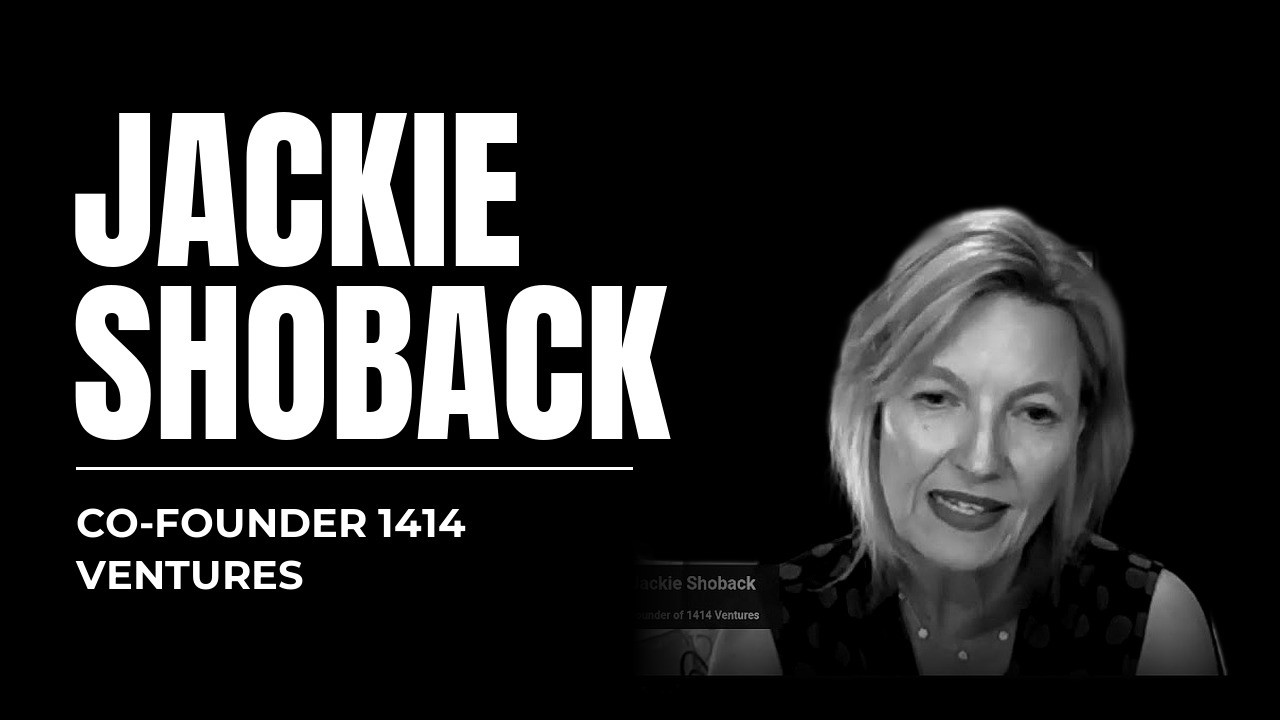
Jackie Shoback spent 25 years at Staples, Fidelity, and Boston Private before co-founding 1414 Ventures in 2020. She backed a low-code authentication platform that sold to Ping Identity in 90-100 days, and now invests in digital trust and AI-enabled identity infrastructure using a people-product-market framework to evaluate founders.
Chapters
Welcome to another VC Wisdom podcast. We have Jackie Shoback with us today. She's co-founder at 1414 Ventures. She's into private and public boards. She's a C-suite executive, proven expert in driving transformational change in high-growth businesses. Harvard Business School, spent some time at some pretty big corporations, right? Including Fidelity, including Staples, Citicorp that I see here. So Jackie, welcome to the podcast. Tell us a bit more about yourself and what you've been up to.
Thanks so much, Charles. It's great to be here. Well, you already hit the punchlines. I'm, I'm a former CEO, CMO, COO, 25 years experience scaling businesses from startup to over a billion in revenue. I'm an operator at heart and have deep experience running Large P&Ls. I've scaled and run a number of businesses, everything from launching the digital business at Staples to a digital bank at TIAA to the high net worth business at Fidelity. And what I'd say is I, you know, now run a venture capital firm. What I love is I really love investing in the next generation of platforms that are going to revolutionize fraud, fraud prevention, and hopefully enable digital trust and the needs that we have going forward to ensure privacy, safety, and security for all.
I love it. Let's start with your time at Staples. What was your specific role back then? That was like pre-dot-com boom and bust. Yeah, you were VP Operations, Direct Catalog Division, so mostly in ops, right? What changes did you have in that big organization in the 1990s?
Gosh, I, you know, I got to do so many. I was so lucky to be part of that. When I joined, we were about $300 million in revenue, and over the 10 years, we grew to $15 billion. About $1 billion.
That's more like it.
Yeah, $1 billion of the $15, I'd say, wasn't organic. And I'd say I probably had 8 different jobs in that timeframe. What was really great about it was I kind of moved all around the company. Even though I am an operator at heart, I spent time in a bunch of different places— marketing, strategic planning. I worked internationally. I ran the international division at one point. I ran a group of stores, about a $1.5 billion P&L back then. But the point of what I'm saying is it's all about connecting the dots and having experiences where each experience enables you to learn and bring insights on what worked well and what didn't work well. So that when you get to do it again, you kind of take it all to the next level. So I feel like what I really got out of Staples, aside from really learning how to be a tremendous operator, wonderful leadership skills, how to lead in really high-growth environments, how to lead where there is no blueprint for what you're doing. A lot of the growth that we experienced, there wasn't anybody who necessarily came before us who had scaled a business from zero to $1 billion in revenue in 3 years. So how do you put the controls in place? How do you ensure that the platforms, the people, the processes, that you're doing it in a way that enables it to be sustainable and to endure? So learned a lot there. And then I'd say the other experiences I've had since then really built upon all of that. And That was also where I got my entrepreneurial bug because even though we grew to be big, we still acted like we were a startup, which was amazing.
I remember Staples from my childhood, right? Like my dad was an entrepreneur and was often in Staples to buy paper, pens, binding books, right? Like computers. My dad's always been like tech forward as well. Yeah, the smell of Staples when you entered these doors, right? And as a kid, I would always like go in the, The aisle of I don't know color pens, right?
Like oh yeah, the pens.
Yeah, yeah for schooling, right? They also had that section with chairs. These still exist in Mexico, right? I'm in Oaxaca, Mexico, and they still exist. It's it's pretty weird. In Quebec, they were called bureaux en gros.
That's right.
Yeah, you remember that, right? Because you spent time in Quebec. So how far was the expansion? I read Belgium in your profile. That's crazy.
Yeah, actually, that's the great thing, right? Ten years I was. there. So I got to do a lot of different things. We actually set up our international division in Belgium, which made a lot of sense, in Brussels. And ultimately Staples really became a global player. I know the revenue probably in its heyday probably got as much as $25 billion way back. It really became global. It was multichannel and it was super innovative at the time, kind of set the pace for others who followed.
It was well capitalized, right? So what private equity group was behind it or were you—
I was very lucky. Yeah, yeah. The very first job I had there, I worked for the founder working on our strategic plan and We had just gone public maybe a year earlier, and Bain Capital, it was actually their first venture investment, and Mitt Romney was on our board, which was really quite something. It was an amazing time to be part of that team, and it was an amazing time to be thinking strategically about growth because Little did we know we were on the precipice of this huge explosion in computing, in home technology, in software, just like all categories around business. And also, I'd say personal and home offices. It was about to explode.
Yeah, that's pretty crazy. Mitt Romney is still alive to this day, almost 80 years old. What kind of mentors did you have early in your Well, I'm very lucky.
I clearly had Tom Stemberg as a mentor and Ron Sargent and, oh gosh, Shira Goodman was another person who was a mentor. And I would also say other places that I worked, I was very lucky at Fidelity. I had some wonderful mentors there too. Even, even my Even my investment banking days at Citigroup, I had some really wonderful mentors there and actually really good friends that I'm still close to. Um, you know, and why did you leave Staples?
Like, oh, it was a pretty good job, but Fidelity was like even better pay grade, I would guess.
No, no, I would say, um, the reason I, I left Staples, it wasn't so much I left Staples, it was more I got recruited to Fidelity. And what was was the opportunity to combine what I had learned at Staples across multichannel retail with financial services. As I mentioned, I was an investment banker before. And so the idea of being able to combine my previous financial services experience with my retail experience to go into retail financial services. And also, I would say, for me personally, I'm very curious. I'm always driven by a challenge. I love learning new things and kind of connecting the dots and putting pieces together. So to me, Fidelity, being able to combine those 2 things and having to go up a learning curve and learning a whole new— industry and environment was just really exciting to me. And that probably is why I also made other moves consistently in my career. It's more about building on the capabilities and skills I have to kind of learn new things and master the new things so that I can, you know, I can add impact and value in different ways.
And your role was fetching very high net worth individuals back then at Fidelity. What kind of windows did that open for you?
Yeah, actually my first role was coming into distribution. So yeah, setting up a national sales and service function and then later overseeing the high net worth business segment within retail. And I had other roles as well. But I'd say the biggest thing was Fidelity took such an amazing perspective on the customer and really understanding the customer, or as we call them, the client's needs. And that was what was pretty exciting, was really understanding their motivations, their decision-making processes, and really anticipating their needs and helping to evolve not only the product offering or the solutions offering we had, but the way in which we delivered it and meeting the clients where they were. That was really interesting because sometimes, you know, you can have a lot of assets, you can have a lot of income, you can have a lot of assets and income, but still at the end of the day, it can be very overwhelming when you think about making some of these decisions, especially when the stakes feel really high. Oh, sorry.
There's so much options, right? Like, uh, it's not because you're very rich that the, the data diminishes, right? Like, there's so many opportunities out there, and these guys need to focus on their craft, where they're— what they're good at. Usually that's their, uh, other cash-flowing initiatives, right? Then you do the full analyst work for them, and you present them with, uh, something that fits their, their needs, right? It's, uh, It's a cool job. Um, what happened after that? I think, uh, TIAA, Boston Private— you were the CEO of Boston Private. Maybe let's skip to that one. What's the BP about?
Yeah, so, um, so Boston Private was really fun for me because it combined private banking, wealth management, and trust. It's a publicly, or was a publicly traded company. And I got to do a lot of exciting things there because they, you know, they were really looking to invest in the future of the business. And I would also say that they were a very customer-centric organization as well. In other words, Fidelity, TIAA, Boston Private, one common thread through all of those organizations. They were very different in size and scope. Fidelity and TIAA are huge, right? Trillions and trillions of dollars. But Boston Private, what it had in common was a really high laser focus on the clients and kind of putting them first, that was very much in common with those other organizations. So, uh, what was fun at Boston Private was being able to help bring them to the next level with their technology, their operations, their client engagement, how we were marketing and outreaching to our clients, the products we were offering. And keeping the high touch while still being scalable and innovative and, um, you know, focused on the long term.
Right. Uh, and you guys got acquired by SVB at some point?
Yes. Well, I left in 2020 to start 1414, uh, something I had always wanted to do. So I guess my timing was kind of perfect because I left in 2020 to start a venture capital firm. And I think about 2 years later, I'll admit, you know, I was a shareholder. I voted in favor of the acquisition and was— and actually my fund, I am an SVB customer. Like I use— they have a great offering. I use their offering for my fund. But as you know, the main SVB ran into other issues. And ultimately got acquired.
Yeah, just today I was, uh, studying, um, Signature Bank as well during lunch. Um, that, that one got right under, right after it, and is directly relevant to what you do because it was high net worth clients as well, right? So what happened there?
You know, um, I, I have to say I was out of the company, so I, I can't Say exactly what happened, but my impression is, um, you know, there was a little bit of a, uh, a liquidity issue and, and a bit of a run on the bank. And, and I, I think, um, you know, ultimately they weren't able to move fast enough to keep it from, you know, going into receivership, which is what ultimately happened. So.
Yeah, having such a high net worth audience or tech audience, like double-edged sword, right? They're very good clients for many ways, but when the panic sets in, these guys are on X, these guys are in private chat, and they just freak out. Everyone withdraws their money at the same time, right? And the bank is left unmanageable. Yeah, you're right. It was so fascinating. And I mean, it's still somewhat unraveling, right? Like the report The action report on that one, or the, the post, um, the post part, the, the post, uh, failure report is still on. Yeah. So, um, why did you launch a VC at that specific time, right? So COVID had just hit.
Yeah.
Um, why, why did you become, um, interested in startups, right, and in betting on these?
So, so a couple of things. So first, the Staples experience, which is what we started with, Even though we were public and we grew to be big, the company still very much operated like a startup. And I was always in the most, you know, earliest stage startup area of the company when I was there. And I would say that as a result of that experience, even though I worked in big companies, I continued very— I was very active in the startup community making angel investments, mentoring startups. I was a judge in many pitch competitions, things like that. So I had been thinking about wanting to start something. And I had, at the time, a really good friend. We had been angel investing together. my co-founder, and he said, why don't we just start our own fund? It's— I'm sure it's not that hard, and we know as much as anybody else. And so we kind of took the better part of a year and thought about it and pressure tested it and then decided to take the plunge. We did not expect a pandemic in 2020, so that definitely threw a little wrench into things. But I'll say that we sort of took the lemon and made lemonade out of it, figured out how to fundraise over Zoom, figured out how to do fund formation over Zoom, and then got our first fund launched in 2021, made our first 2 investments in June of 2021, and had our first exit in September of 2021. So we had a busy— we had like a busy 18 months.
How did that exit happen so fast? And was it like a break-even type of exit?
No, It was up, it was 3x in 90, 100 days.
Nice.
What I will say is I believe it happened because of what we believe is unique about our focus and our model. So the first thing I'd say is, you know, the company, company with singular key, a low-code, no-code orchestration platform in the authentication space. We, so we source that, but then also we very much are— second thing unique about us, well, is our operating model. We have very much an operator-investor lens. We lean in and help. And so in one of our discussions, we determined that it made a lot of good sense to connect them to Ping Identity. We thought there'd be a good partnership there. We knew folks there. We made the intro. And Ping decided to buy them because they saw the value in the platform they had built. And so what we thought would be a partnership became an acquisition. And, and, oh, and then the 2 founders became investors in the fund. So that's why it's full circle.
I love that. So they did their exit proceedings and invested in the— in Fund 2, Fund 3 by now? Like what?
Fund 1. At the time, Fund 1, we still had room in Fund 1. And, and also, um, you know, they're, they're great. I— they actually, they send deals our way, and, uh, it's really great.
And right now, today, it's Fund what? Fund number 1?
So right now we, we, um, so we still have a little bit of, uh, gunpowder there in Fund 1, but the focus is more on, on Fund 2 and, and, and raising that.
Got it. And the boring is really profitable, right? Like compliance is boring. No one wants to do it. You have to do it, right? And that's—
We love compliance. We love risk management. We love fraud prevention. We love all those things that are regulated and require immutable audit trails so that technology can assist in that. We also love what I call safety, privacy, security. We love those infrastructure, data infrastructure, and digital trust capabilities that really enable trust and authenticity. You know, the world we're in now, especially as More and more players are not human. We have a lot of non-human identities online. Agents are really— everybody knows agentic AI agents are really taking off. So there's a real need to have digital trust establishment. And what's also been really interesting the last few years is I'd say when We first started, this whole concept of digital trust was so back office. And I feel like now because of, you know, we're at this point of inflection where everything has moved to this front office, really the center of digital trust is all about enabling the digital economy the data economy and the AI economy. So it's become mission-critical infrastructure. Without digital trust, you know, it's— you're not going to be able to scale profitably and in a way where you know who you're doing business with.
I love it. Yeah, right now, are you raising for Fund 2 as well? What are your main objectives for this year?
Yeah, well, you know, it's interesting. Yes, we are focused on Fund 2, but we're also focused on— we have an SPV the works as well for a very particular investment we're looking to make. So we have a few different things going on. And then we're also quite busy with our existing 10 existing companies. We have some that are, you know, scaling and doing really well and others where I think there's some exit opportunities that are, that are also likely. So we're spending a lot of time with them, helping them, coaching them.
And your, um, founders, how do you vet them to make sure that it's good? So you both vet businesses and founders— businesses for PMF, founders for Skill. What are your criteria of investment?
Yeah, well, like many people, we have a pretty exhaustive, um, due diligence, uh, parameter set that we go through A lot of times founders that we meet often come through our networks. So that means a venture partner, an advisor might have been working with one of the founders for a year or 2 and know them, can vouch for them. So we kind of do rely on the personal networks. But I'll also say there's always the backdoor channels too that we check. And really, for us, in the earliest of stages, you're really looking at people, product, market, right? PPM— people, product, market. We talked a bit about the people side, you know, looking at their past experiences. Have they had success? Have they faced adversity? How have they handled it? Product-market fit— I feel like You know, people think they have product-market fit and then it's always evolving, right? Because you're always innovating and you're— there's always like all these little pivots happening. But I guess when you go to market, at the end of the day, are you solving a problem someone's willing to pay something for? And is it scalable and novel? So I always feel like the best way to pressure test that is to actually talk to the pilot partners, the customers. whoever the targeted sort of buyer is, the profile, that's really right. Like the ICP, if you can talk to ICPs and talk to people who would be the natural consumers. I've always been a big customer advocate. As an investor, I'm still a huge customer advocate because I feel like spending time with the potential purchaser. you kind of get to the source of what they're willing to pay, how important it is, what level of effort, etc. It's, it's, uh, it's art and science too. I mean, there is a lot of science to it, but there's a lot of art from the standpoint of you're making bets on people and you're making bets on where, uh, the product is going and where the market's going.
What about LPs making bets on you?
How do you convince them to Well, um, I think usually, uh, I definitely share my track record. That's been, uh, really strong, so I share that, and that's, that's something that definitely helps. I would say that our focus around digital trust is pretty unique. I think, you know, it's been proven that having a sector-focused thesis typically outperforms a generalist. And I would say that I think that's probably the case. And then third, I would also say, you know, even before investing, I had a long operating career. So I'm fortunate there are lots of LPs I know who know me 20-plus years and can point to Um, you know, my, my track record there as well. Track record as an operator as well as track record as an investor.
I love that. Thanks for being on, Jackie. Where can, uh, people find out more about you?
LinkedIn, 1414ventures.com. Plenty of, plenty of places.
There you go. So that was, uh, Jackie
More from Charles


Founder Wisdom: the audiobook, version 2 (5 hours of stories from founders and CEOs)

8 CEO Questions I Love Asking: the audiobook (64 founders answer, in their own words)





