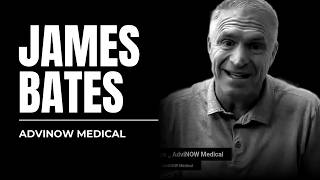
In this Founder Wisdom podcast episode, host Charles Cormier interviews James Bates, founder and chairman of AdviNOW Medical, about the company’s AI platform that automates front‑desk, nursing, physician, and billing workflows in medical practices. Bates explains how the platform doubles practice revenue, raises profitability from ~3% to over 30%, and drives rapid MRR growth—projected to reach $1 M/month by year‑end and $10 M/month the following year. Growth is fueled by inbound referrals, conference exposure, and integrations with Epic and Athena marketplaces. The company invests heavily in product development, spending over 100% of revenue to perfect onboarding automation, and plans a large fundraising round next year. The conversation touches on industry trends such as GLP‑1 drugs, longevity therapies, and the AI arms race with insurers, as well as a critique of the “one‑man billion‑dollar” MedVid story and the importance of accountability in AI‑driven health ventures. Bates shares his background in semiconductor systems for autonomous vehicles, his non‑compete‑driven pivot to healthcare, and the Six‑Sigma lean analysis that identified the core inefficiency—physicians spending 70% of time on billing and legal protection rather than care. He outlines the per‑encounter pricing model, low‑friction EMR‑based onboarding, and the strategic focus on practices that can immediately realize ROI. The episode concludes with discussion of future opportunities in medical imaging, the challenges of patience and exit timing, and where listeners can learn more about AdviNOW.
Chapters
Welcome to another Founder Wisdom podcast. We have James Bates with us today. He's a founder at Advinau Medical. It's his, it's his second time on the podcast, and, uh, I love James's brain. He's super successful. He's a chairman, board member. He's in, uh, private equity and artificial intelligence, building it, not just watching, um, and does M&A turnarounds and all of that in the greater Phoenix area. Uh, James, welcome to the podcast again. Can you tell us a bit more about yourself and what you've been up to?
Hey, Charles, thanks for having me on the podcast. Yeah, I mean, since we last met, Avinow Medical continues to deploy. We've seen some phenomenal results with the medical practices that have adopted us. As a short reminder about what we do, Advinao Medical uses artificial intelligence to completely automate medical practices. So that means everything that the front desk would normally do from a data entry standpoint, everything the nurse would normally do, everything the doctor would do, and everything the biller would do except the actual decisions themselves. Our system engages with the patient directly and automates all of that processes. So Doctors that adopt our platform see revenue double, literally. Um, the revenue per patient goes up 20%. Profitability of medical practices go up 1,000%. So medical practices aren't very profitable. They usually break even and the doctor takes home their fee. And, and essentially that from a business standpoint, a lot of, not a lot of money left in those businesses. Once Avinow is adopted, it goes from net 3% to over 30% net profit in those practices. So they're super profitable. So we've been a, a pioneer in automating the workflows in medical practices. We've been doing this for a number of years now, and really over the past few years, the rush to adopt AI has really taken off like wildfire. So it's, it's been really exciting to be part of that.
And last time we spoke, correct me if I'm wrong, but I think you were like at $50,000 to $100,000 MRR. How has been growth since then?
I mean, we'll be at $1 million a month MRR by the end of this year. So it's, it's growing like crazy. And then we'll be at about $10 million a month recurring by the end of next year, just based off of our current engagements.
And how is that growing so fast? What's your number one GTM channel?
Um, so right now everything is inbound, so we don't do any outbound marketing. It's, it's all we can do to, to support the inbound. So what we're doing to enable that fast growth is really automating the onboarding process. So we have a completely different product which automates the onboarding of the Advinau AI, which automates all of the rest of the practice. Um, that will be deployed here at the end of Q3, and then we have, you know, this almost $300 million of recurring revenue of clients who have signed up to use our platform that can start going live with it in a very fast, rapid clip.
And you say inbound, is it SEO or just referrals from happy clients and you, you going to conferences and word of mouth?
It's referrals, um, it's going to conferences, it's our clients speaking at conferences about us. Yeah, I mean, when, when a medical practice goes from 3% net profit to 30% net profit, in general they tell their friends. And so we end up getting— every client that goes live, we have about 10 other practices that come and sign up because of that.
So From that MRR, like, how much do you invest in actual product? Because it seems that you're hyper-focused on building a great product so that people can come back again and again. Um, yet, like, is that 50% of what you earn is invested in the engineering team?
Well, I mean, right now over, over 100% is invested. Um, we're actually spending more money than we're making still, um, to complete the automation of the onboarding But we do expect to actually break cash flow positive in Q4, and we're, we're very excited about getting to that point. And the, the goal is to stay ahead. I mean, right now, the, the AI world is progressing at such a rapid clip, and there's so much fake news, quite frankly, out there that we really need to stay ahead of it and make sure that our solution is, is the best. So we're going to spend whatever whatever is required to, to win this race and, and be able to turn this into a billion-dollar company.
So you're raising a new round soon?
Um, not today, but, but soon. Probably next year we'll, we'll raise, um, a pretty large fundraise.
Have you heard of, uh, MedVid, the one-man billion-dollar company?
Um, so I've read an article about it. I, I haven't dug into the details, so I, I don't really know how it sounds to me, unbelievable. But, uh, but I, I know it is.
Sorry. Yeah. Um, I mean, this can segue into various directions, right? Like, um, I don't think one, that's, uh, they, that they generate a billion dollars. That's one. I think it's mostly PR. To, um, yeah, what is a billion-dollar revenue company? Is it, is it revenue? Is it profit? Is it, uh, ARR, right? And ARR, we all know that it's projected, right? Mostly. And then second, I think we all want to see that company, and that company would be run on agents mostly, uh, and this guy ran his company with agents, but in the health space when you do that, uh, and when you attract headlines like this guy did? Like, I think this guy's in big trouble right now, and I think he's gonna be the first, uh, negative $1 billion one-man, uh, one-man company. Uh, what do you think about that?
Yeah, I mean, the, the reality is, is that when you run a business, you still need humans to run that business. And if you're charging clients for something that one person could make and deploy, then probably there's 100 other companies that can make and deploy that same thing overnight. And then probably many of those clients can actually make and deploy it themselves. So ultimately, if you have a business that has such a low barrier to entry that, that one person could create a product and and sell it, then I don't see that company surviving. I mean, I just don't see it. And, and so that's— I haven't dug deeper into it, so I can't comment on this specific company other than reading. I think I read a story in the Wall Street Journal or something like that about it.
Yeah, New York, uh, the New York Times covered it with roses and hearts. It was so weird to see that. Um, and while it was obvious that the company also had troubles, right? They received the FDA letter and all kinds of stuff like that. So it's like journalists not doing their responsibility. I still think that the entrepreneur behind that is phenomenal, right? Like, he deploys great quantities of energy, and by definition, that's a one-man billion-dollar, um, company. And I think he used innovative approaches, not just AI, right? So white labeling was pretty cool. He used like all the modern and best business practices, except PR, of course. The PR failed dramatically. Um, I also think like one-man billion-dollar company, the accountability aspect is super important, right? If this guy doesn't have a board, uh, that could mean that the customers could just like not be taken care of. If there's investors, that's a bit worrying as well. What do you think about the accountability aspects in the AI age?
Well, hopefully if he's only one man, then the amount of money that he needed to raise is so low that maybe he doesn't even have a large number of investors. I don't know. Again, I haven't dug in.
His ad spend is gigantic. It was like tens of millions. By the way, his business was a GLP, uh, company, GLP-1.
So he's one of those GLP-1 companies that is selling on Instagram or something and Yeah, with a fake doctor, a fake doctor, right?
Like, that's why he got like, uh, hit by a truck, an FDA truck.
So it's like, yeah.
What do you think about GLP-1s, by the way? Like, because that's another mega trend that is super intriguing, the health space, right? Like the number one drug was like a cancer immunotherapy one, and the number two is GLP-1. And that was— that happened like almost overnight. Isn't that crazy?
Well, I think GLP-1s are fantastic. I mean, when you get into an ultra-rich society like, you know, Europe and the United States are essentially over-rich, right? So we have too much food, we have too much everything, and people's self-control probably isn't where it should be, then everybody's fat, especially in the US, right? That's the situation today. And what the GLP-1s do is they basically shut down your digestive speed. And so you can eat, but then your stomach gets full. And if you continue to eat, then you're sick. And when you take the pleasure out of eating because you get sick when you eat, people get thinner. And quite frankly, it's expensive, but it's probably cheaper on the healthcare system for people to spend $100 a month doing GLP-1s than it is for them to be, you know, 50 kilos overweight, right? And so, so I, I think GLP-1s are great. I'm a, I'm a large supporter of them. I, I, I, I'm sure there'll be things that we don't know about. There'll be after years and years of people doing them. We're going to find some other health issue that they bring about. Again, we're going to have another pill for it, and we'll have some other pill for it. But it's, it's better than people being absurdly obese.
Oh, yeah.
And so from that standpoint, you know, I think, I think the, the whole financial aspect of it is, is rewarded and great. And costs are coming down at such a rapid clip that I'm fully supportive of the effort. Now, what is really interesting to me are a lot of the other peptides that are out there that are coming out, and with AI, the rapid clip of them coming out, it's a very interesting world.
So it's crazy. Do you feel we're gonna reach, uh, longevity escape velocity in your lifetime? Do you think you're gonna live forever, basically?
Um, well, so this goes outside of just the peptide conversation that we were having, but when you start looking into some of the gene therapy, um, there is some real promise there. And so when you look at aging, um, right, I'm 54 years old, you could see me being 54 years old on my face, and I take relatively good care of myself. I exercise, you know, I'm not in the sun a lot, but looking at me, you'd still say, yeah, this guy's probably in his 50s, just because age is real. But slowing down age and actually reversing age, that's a real possibility. And you look at some of the research that's been done, it's absolutely amazing. I would say we'll be able to slow age down to a crawl probably within the next 10 years. And then even reverse it within the next 20. So do you live forever or not? I don't know. I mean, I'm sure something else with your body is gonna start breaking as soon as you do that. But the actual DNA repair, which, you know, is what the aging process is, is our body's not capable of repairing the DNA. And so as you get older, the ability to repair that DNA goes down, down, down, down, down. Well, if we can, bring that DNA repair level back up to what it was when I was 20 years old. You're now young. Now, again, there's something else we're going to find that's going to break us, I'm sure. But, but that's a problem that's solvable given the AI acceleration of that field. It's, it's, it's an impressive place to look, that's for sure.
And is that the space you're eventually gonna be in? Because I don't know, Advinao, if you look at it, I don't know, give it like 3 or 5 years, you're going to have a big exit. Probably to me, that's what my gut is telling me. What will be— what will be next after that? And this comes as part of a broader question as to why choose health? You know, like my first company was a nootropic company for the brain for B2C folks. I vowed never to come back again in that space. Space, it was so not profitable. And nowadays, as a VC, I get a bunch of, uh, health tech founders come in front of me with their companies, and some of them are very promising, but I wouldn't necessarily just invest from a financial standpoint. I would invest from a heart perspective. Like, there's other companies I can have faster exits and make more money than in health, right? So why did you choose health specifically is sort of my question.
Yeah, well, after my last company, so I come from the semiconductor systems space, and the products that we delivered were used heavily in the self-driving vehicle space. So 80% of the world that had any auto brake or auto steer capabilities used our systems. And it was really exciting to be in that space, had a great exit, transacted a $28 billion transaction, and I was running a billion-dollar business inside of that. And it was a phenomenal opportunity. Well, when I retired from that, I had a, a 2-year non-compete that basically meant— it was a very strong non-compete. It was basically, you could do anything you want in this life as long as it was something you've never done before. And healthcare seemed broken, so I figured, hey, I might as well go into healthcare and see what I can do. Now, the, the interesting transition there is I didn't jump into AI and healthcare, even though I was involved with the AI ecosystem in the self-driving vehicle world. Really, I just looked at acquiring medical practices to roll them up as kind of like a mini private equity type of deal. And it wasn't until I looked at the financials and realized that medical practices had very, very poor profitability frameworks that I found where the application of AI actually made sense. So I give you that background because when a lot of people say it's really hard to make money in health tech, it's because they're not looking and finding that real ROI. What they're finding is a problem with healthcare and saying, I'm gonna create a solution for that. Well, great, But is the current infrastructure of that solution willing to pay you for that solution? You're going to make it better, but if nobody cares, you're not going to make any money. And so the example of the $1 billion business, you know, the single-man $1 billion business, a big problem with GLP-1s is the fact that you need a doctor visit and then you have to— you got 1,000 vendors out there. Everyone's telling you they're the lowest price. They all are kind of gaming you and it's it's kind of a low-trust system. So if this guy solves the friction to be able to give a true low-cost GLP-1 to the masses over like an Instagram, you know, ad, which is again my speculation of what he's doing, um, then he's solving a real problem that people are willing to pay for because there's an ROI for them. They get the GLP-1s faster and at a lower cost. And so A lot of companies in healthcare aren't that way. They're gonna say, we're doing remote patient monitoring. We're gonna keep patients healthy. And someday the insurance companies will pay us for that. Yeah, insurance companies don't care about that, right? I mean, they're just not gonna pay. And there's not that there's no money in remote patient monitoring. It's just really, really hard to make. And so, so you gotta find a place that's saving money out of the current system. And so that's what AdvyNow does. I mean, we don't have any special, you know, billing code or anything to use our software. Our software is just taking the current medical encounter and making it more efficient, automating all of the manual workflows that every single person does in the medical practice. We are automating those, and then we're going back to them and saying, you now can do a lot more with the same staff. And so you can see twice as many patients. And so many of our practices actually keep the same staffing levels, but just start seeing more patients because now that they can. And doctors historically would push back on that. They're saying, I'm only seeing, you know, 20 patients a day. I'm not seeing any more than that. But now they're like, they see a patient, they don't have all the paperwork, everything's done. They're like, okay, well, what do I do now? I might as well see another patient and make more money. And That is solving a real problem. And, and, and if we do that, I think there's still a lot of money to be made in healthcare. What I'm really interested after Advie now, hopefully we get a nice billion-dollar transaction here in a couple of years. I mean, I think that's definitely within, within, you know, the framework we were marching towards. I think there's a lot of room in medical imaging still. To eliminate roadblocks. Because today people are spending ridiculous amounts of money and time for MRIs or CT scans, even ultrasound measurements. And you can pull that out of those, those very expensive frameworks with some fundamental technology development, which I would love to be part of.
Interesting. Um, I think another point is patience. Like, a bunch of people don't have the, the patience and the smarts to stay in your niche, uh, that long. Um, because dealing with doctors sometimes, you know, and not sometimes, most of the time is, uh, painful. Uh, they are not super tech-forward. They're not looking for out-of-the-comfort-zone type of solutions, right? And then you deal with their assistants Uh, so what's your tip for that as a high-performing brain? Like, and do you have to lower your levels of energy sometimes to get on their levels, or, um, yes and no?
I mean, so a lot of doctors understand that they have to adopt AI now, so now what they're looking for is the least friction way to do it. How could they adopt AI without them having to retrain everyone, as an example? And that's what our AI onboarding is all about right now. And so I— our— we're investing heavily into the ability to— for the medical practice to just click a button, and then the Advinao AI system is completely configured and customized to their practice needs without anyone doing anything. And so what would happen is the front desk would open up their electronic medical record and everything's already filled out perfectly. And then they just have the patient to confirm, and the doctor would open up the medical record and all of the data's there, all of the orders to be placed, and the doctor just has to approve on the diagnosis and the AI scribes and codes and everything's done. So you don't need to retrain people because they already know they're— it's just what they're doing manually is now automatically done. And so that type of low-friction onboarding is really what a lot of doctors are waiting for. If you go to them and say it'll take months of retraining your staff, I mean, they're like, oh, that's a nightmare. I don't want to do that. I'm making enough money now. You know, I don't want to go through the pain. But if you go to them and say, try it for a week, you don't like it, shut it down. That's a completely different sales approach. And, and that's where Advinow is winning.
And you said inbound, like, um, they try it on the website and there's a free trial. Is that what you mean? And then is there like a payment after 7 days? Like, how— what's a specific funnel here? And how do you follow up if they're happy or not and that they actually implemented and tried the software correctly, right? Because a lot of them, if you just give them a free trial, they'll blow it up?
Yeah, I mean, so medical practices, um, can apply to use Advu now either through the Athena Marketplace or the Epic Marketplace. Those are electronic medical record vendors. Um, both of those have inbound funnels that come directly to us, or they can go to our website and basically just click on, you know, try the solution. Um, We would configure it for them, and then they have a 30-day trial period, and that's it.
The doctors, do they— most of them have— most of the time, do they just have one clinic, or is there an instance in which you can unlock like one person and 10 locations at a time? And how do you split your funnel between independent practices and chains?
So for us, um, we— it doesn't matter if it's a single doctor location or, you know, 100 doctors over 20 locations, right? To us, it doesn't matter. The only thing that matters is the EMR implementation. So if they're using Athena Health, that's where we're doing our one-click onboarding, and that's where we'll be able to have them just click on a link, give us access to the EMR. Once we have that access, we would automatically configure our system and customize it down to the doctor level for locations. And then they can just give it a try. They can turn it on at one location at a time, or they can turn on all locations at the same time. Again, to us it's irrelevant. It's— it really comes down to their appetite. Um, and, and so when a client comes in and says, we want to use you, the first thing we do ask them is, what electronic medical record system are you using? Because if they're using, again, Athena or Epic, it's very easy for us to engage Athena specifically. If they're using a small, you know, old electronic medical record system, then, then we unfortunately today we tell them we'll have to come back to you on a, on a go-live time.
But aren't you charging per head or per usage? So you keep saying like you're not—
per encounter.
Oh, that's interesting.
So per patient that uses the platform. So they can have 1,000 doctors use it or or one doctor. To us, we don't care how many.
$1 per form filled or what?
No, it's, it's per patient engagement.
Client account, they open their, their account.
Yeah, so when patient starts using it, when a doctor sees the patient, that's an encounter. And so that whole process, we charge for that process.
Okay, so first encounter only, right? And is it monthly or is it Per—
no, no, no, it's any encounter per visit.
Oh, got it. That's intriguing model. How did— how come do they accept that? Like, aren't they intimidated by that? It's like, oh, if I have more visits, I'll pay more, and, uh, that doesn't work for me.
Well, it— that there are some people that don't like the per-visit model, and we can put bounds on it, which is what other people do, which is okay per doctor, and then if that doctor sees over 30 patients, then they have to pay extra. You know, there's— everybody comes down. I mean, the cost of our software is directly correlated to the usage. So, um, you can, you can— we can make it straight, or we can estimate what the usage is going to be and then put an excess fee on it if needed. It all comes down to, do they want to pay for the exact usage of the platform? Now, there's a lot of people who have doctors that just work part-time, and so they're paying extra if it's a per-doctor type of fee. There's a lot of places that have problems with that model. So it is a newer model. Um, however, it is the more accurate model, and quite frankly, it's the only model that makes sense going forward, right?
So you save time for the, uh, patients, right? Like, they just fill out the form faster. It's more easier.
It's better. You're not filling out the form. I mean, we're actually predicting every question a doctor is going to ask. And we're asking it to the patient ahead of time. We're predicting what the treatment's gonna be. We're predicting if the insurance company's gonna pay for it. All of that happens through the AI patient engagement. And then when the doctor opens up the chart, the chart is completely filled. And then there's a one-page summary that gives a doctor everything they need to know. And then they just have to click on the diagnosis and the AI scribes an assessment and plan and codes it.
All automatically. VS, what they have is like spreadsheet or a system that is older.
No, it's a database that they're just— they have to enter all the information into themselves.
Got it. Huh, that's, that's cool. So it must be pretty immediate, the effect, right? Like, it's— if I try you on day one, it's like my day is way more optimal today, and I'm like, I'm sold almost from day one, technically, right?
Yep, yep.
Okay, yeah, it's intriguing. I dig it. I like it. You've been doing that for 10 years. Again, to the point about patience, right? Like, aren't you like, man, when is the exit gonna happen? Or, uh, or do you still love the day-to-day of just dealing with patients and doctors, and you love seeing an impact? Because I'd go crazy doing one thing for 10 years. I've run an agency, a go-to-market agency for 10 years, but every day I'm dealing with a new client and I get equity in them. It's like exciting, right? But yeah, how do you deal with that?
Yeah, sure. I mean, I obviously, I wish an exit would have come sooner, but at the same time, the market evolves at such a rapid rate. When we first brought our product to market, it was just a few months before the COVID pandemic hit. And our clients were Safeway, CVS, people like that that did retail medicine. And unfortunately, when the pandemic hit, the first thing grocery stores or pharmacies did is shut down their clinics they had inside their stores. They didn't want sick people in their stores because if a sick person got in the store, they had to shut the whole store down. Yeah. And, and so that forced us to pivot to the large hospital system. So we have people like Mayo Clinic who are, are great users of our platform and investors in the company. And, and, but the problem with large health systems is it takes them forever to onboard new, new technologies, especially ones that are as comprehensive as our system. So it really, it's really since we started focusing on what you call ambulatory practices or practices that are outside of health, health, you know, systems or hospital systems is when we've really started to see this rapid growth. And with the advent of AI, doctors feel it's an urgent— they have an urgency to go and, and start doing it. Another big driver for our platform is that the insurance companies are adopting AI very quickly in the United States. However, the insurance companies are using AI to deny claims. And so instead of a claim being denied maybe 20% of the time, A lot of doctors' offices are getting claims that are denied 50 to 60% of the time. Oh my God. And then they're coming in during audits, and what insurance companies do when they have audits is they come in and they say, give me all your medical records that you billed at this number. So they, by contract, they have to hand over these medical records, and if they don't see the exact language they want to see for medical necessity,, and they use AI to check all these medical records at once. If they don't see that exact language, then they, then they do what's called a clawback where they go to the medical practice and they say, give me back all of this money we gave you already. And that's just causing medical practices to go bankrupt in record numbers. And so Advinau is actually the defense shield in the AI arms race with the insurance companies. Companies. So we're— we allow them to actually continue their business. And, and so we have all of these practices being driven to us because of, of that effect.
I love that. That's— everyone needs to fight a war, right? Like, that's motivating, or being a— some kind of arm race. Um, you talk to some of your peers, uh, health tech founders, right? I'm pretty sure you know that most are not successful as you are. Like, what's special special about you and what you're building, but the skills specifically?
Well, I mean, I, I found a fundamental problem, which is essentially a, a—
there's a bunch of people working to solve that problem. You're one of the only ones that's still alive and fighting and headed for a billion-dollar exit. Why, why is that?
Well, I'm, I'm a little bit hard-headed and stubborn, but also because we did the fundamental analysis to find the real problem. A lot of people claim that they're addressing this problem, but you ask them how did they measure it, they don't really have a true metric. What we did is we did a Six Sigma lean analysis of a medical practice. And what that means is I actually walked into a medical practice with a stopwatch and I measured every single movement that every single person made in that practice. And I correlated it to an outcome that they're trying to achieve. That's the whole concept of Lean, right? The Six Sigma concepts. And so when you do that in a medical practice, you only have 3 outcomes you're trying to achieve. One is positive outcomes for the patient, positive medical outcomes. Number 2, trying to get paid consistently and reliably for every patient that you see. And number 3, you actually don't want to get sued for seeing the patient. And the problem is, is that physicians spend 70% of their time trying to get paid and not get sued, and only 30% of their time practicing medicine. Yet they went to medical school to practice medicine, and they're only doing that for, you know, 30, 30% of their day. So it is a 100% disaster. But when other people say, hey, we're going to solve the inefficiency of medical practices, they put together a scheduling app. Okay, that's great. Scheduling apps are great, but there's 100 companies that can do scheduling apps. Or maybe they do what's called an AmbientScribe, where it's, it's like a note-taker in this meeting and, and they record the doctor-patient interaction and that's going to create a note. Well, does that help? Sure. But it's not solving the fundamental problem that the doctor is spending 70% of the words coming out of their mouth are to get paid and not get sued. And only 30% of them are actually practicing medicine. So we found the core fundamental problem through really an industrial type of analysis of the medical practice. And that's the fundamental difference of our solution over everyone else's.
Yeah, you found the iceberg. And like you said, you're hardheaded, which could also be a synonym with patience, right? Like, you know, you're not giving up like Pitbull. You grab onto something and don't let go. Uh, James, thanks for being on the podcast. Always entertaining, intellectually stimulating talk to you. Where can, uh, people find out more about what you're building?
Yeah, I mean, you can find Advino at www.advino.com, or find me on LinkedIn at, uh, James S. Bates is my handle on LinkedIn. And I'd love to, uh, talk with you about how we're revolutionizing healthcare and increasing profit by over 1,000%.
That was James and Charles for
More from Charles


Founder Wisdom: the audiobook, version 2 (5 hours of stories from founders and CEOs)

8 CEO Questions I Love Asking: the audiobook (64 founders answer, in their own words)





