James Creech - Founder, Quartermast Advisors
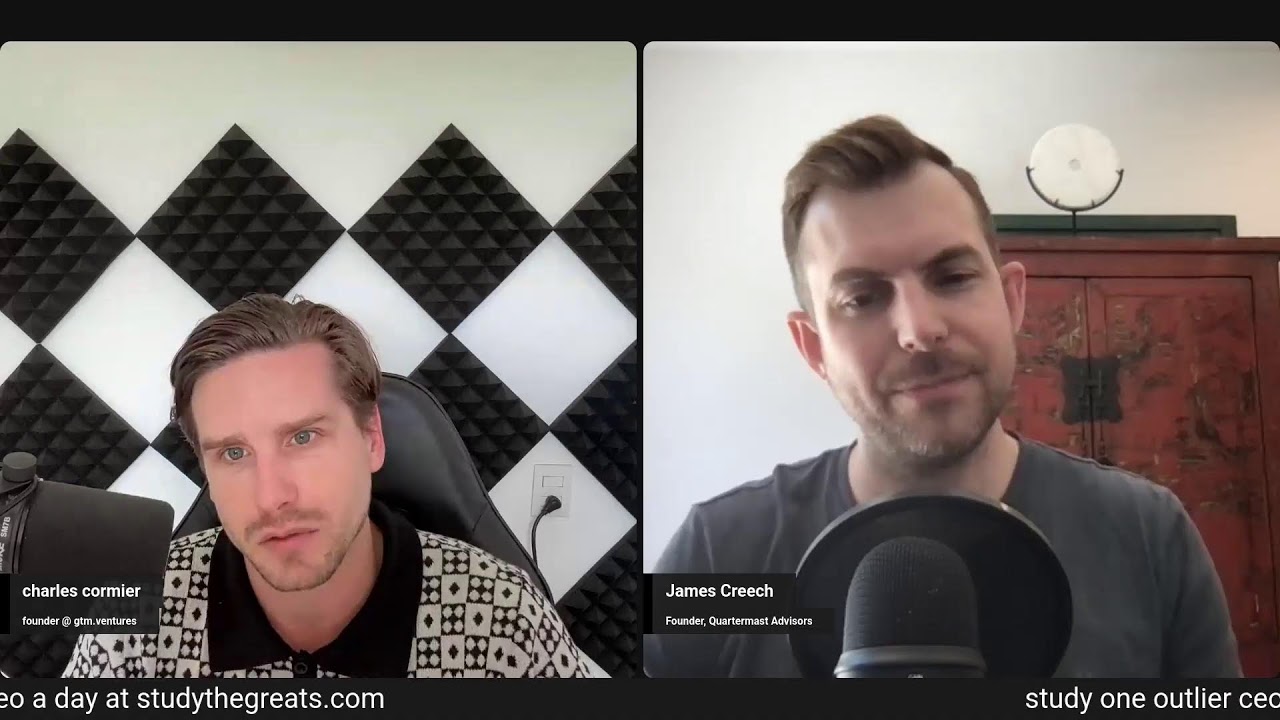
James Creech runs Quartermast Advisors, an investment bank for creator-economy and digital-media M&A, and co-founded Measure Studio, an AI analytics platform that benchmarks social content. He sold his own influencer-marketing SaaS, Paladin, to Brandwatch after six years, and now advises similar exits with retainers of $5-7.5K and mid-single-digit success fees.
Chapters
Welcome to another Founder Wisdom pod. We have James Creech for round 2. James is a founder at Quartermast Advisor. He helps entrepreneurs maximize their M&A outcome. He's a co-founder at Measure Studio. It's an AI-powered social media insights company, uh, down in LA with a new kid now. Congrats, James.
That's right, thanks, Charles.
And my baby just let out a scream because I talked about her former consultants, right? Uh, James, quick intro about yourself.
Yeah, thank you. Good to be back. I am the founder of Quartermast Advisors. We're a boutique investment bank focused on sell-side M&A, so we help founders sell their businesses and maximize their exit outcomes.
Tell me a bit more about like who you work with normally, like your ICP, and how's the business growing since last time we talked? Last time was ChatGPT 4.
Sure. So we work with creator economy and digital media companies. So we're helping founders who run influencer marketing agencies, software businesses, digital talent representation, media properties. We help them sell the business. So yeah, that's who we're focused on. It's lower middle market. So, you know, anyone who's built a meaningful business and is looking to kind of think about the next step, whether they want liquidity or they are trying to find a strategic partner to help accelerate the future growth. The difference about us versus maybe a traditional Wall Street investment bank is we are all founders and operators. So we've sat in the chair, we've built and sold businesses, and now we get to help other entrepreneurs do the same thing.
And what's the yearly revenue usually? Have these companies been funded? Give me a bit more details about that ICP. Obviously it's founders, right? But at what scales precisely?
Yeah. So most of the businesses we work with, if it's a service-based business, is doing at least $1 million in EBITDA, right? So if you're an agency or a talent management firm, you want to be generating sufficient profit. That's ultimately how the business is going to get valued. And for us to take on a meaningful engagement and help the founders get the best outcome, it typically needs to be $1 million+ in EBITDA. For software businesses, we look at recurring revenue. Again, that's how software businesses, you know, get their valuations. And typically about $2 million plus in ARR is when it's appropriate for us or others to start, you know, thinking about taking it on.
And just to cover your background again, right, it's been a while since we haven't spoke. Um, started out at Blizzard for a very short time, then Channel Factory, then you had your own podcast. I guess your exit, was it Paladin?
Uh, that's right. Yeah. So I worked in early-stage startups, um, in and around ad tech, creator economy, working at kind of early creator networks, and then built my first business with two co-founders. So we started a software company to help brands and media agencies run influencer campaigns, which was frankly because we had been doing it ourselves. We were working at an agency and running campaigns and it was very time-consuming, spreadsheets, screenshots, email. And so outta necessity, we started building some tools for ourselves. And then woke up one day and realized, hey, clearly other people need this too. So that became the inspiration for Paladin, which was an influencer marketing software platform. We grew the business over 6 years, sold it to Brandwatch, which is a martech company focused on social listening and social media management. So I spent a couple years integrating the acquisition into Brandwatch and then working on future strategy, corporate development, kind of M&A projects for both Brandwatch and its parent company, Cision. And, um, in the meantime, I had a lot of founder friends who reached out and they said, hey, what was your experience like selling Paladin? What did you learn along, along the way? And oh, we've been thinking about selling our business. Could you give us a hand? So I started just helping a few friends on nights and weekends and fell in love with it and got to a point where it was like, great, I should focus on this full-time and I'm too busy to do it just by myself. So pulled a few other folks, um, in to, to help. And we've been building the firm kind of brick by brick ever since.
And the Paladin exit, how life-changing was it for you and your co-founder?
Uh, it was massive. So, um, when we started the business, uh, we were all in, right? We didn't raise money, but, um, the three of us each made pretty significant sacrifices to start the company. So I had been saving up for a down payment on a house, rolled all of that money just into the business. Um, my co-founder Thomas, uh, he had— he was engaged, saving up to get married. His now amazing wife Daniela graciously let them put their wedding funds into the business. And then Ole, our CTO, my third co-founder, he was in Norway and he had bought one of the first Teslas that was available. He was so excited about that car. He'd worked hard for it. You know, he is excited about like, you know, it's good for the environment and he ended up driving it back to the dealership, getting a refund. And he put all of that money into Paladin. So literally all 3 of us were like committed. We were in from the start and ups and downs, of course, like with any startup, some days it's going great. Some days you're like, what have I done? Uh, but fortunately it was, uh, life-changing for all of us. I mean, we were very fortunate. Part of that was just kind of dumb luck. We, we happened to be in a very busy space and we worked hard, but we took a lot of chances, but it was like influencer marketing as a category was growing really well. And then the other thing where we got incredibly lucky is COVID came along and all of a sudden it was this huge digital accelerant, like influencer marketing, creator marketing was already very active space, but this, it was this just dramatic pull forward of digital ad dollars. And so more brands, more agencies needed tools like ours. And so the business was doing well, all of a sudden started doing crazy well. And so we had some inbound interest. We hired a banker, we ran a process. Ended up finding a great partner in Brandwatch and it was a great deal. And part of that too was just timing. It was like we got lucky with the pandemic accelerating things and then also happened to be pretty nice time for SaaS multiples and not like anyone can time the market perfectly. We just happened to be in the right place at the right time.
And the exit process, everything went well? Like what was that specific story? Because usually it's very stressful. Also for the acquirer, it's hard to get ROI and have like a perfect merge of two cultures. Uh, tell me a bit more about that.
Totally. Um, great question. So on the first part, uh, incredibly stressful. It, to this day, the most, um, you know, the hardest thing I've ever done professionally. And now I help other people do it for a living. So I, I feel their pain because it is intense, right? It's like, first of all, you've poured so much of yourself and your team and into what you're building. You care a lot about it, just emotional investment. Oftentimes founders are very financially invested as well as we were, and that's the case for many other entrepreneurs. And then you're navigating this kind of high wire act of like trying to land the deal, but you're still running the business and you gotta hit your growth targets. So incredibly stressful. I remember people asking me, you know, once the sale announcement went through, they're like, congratulations. You must be so happy. Are you drinking champagne every night? And I remember thinking like, yes, absolutely. You experience all of those emotions, but the biggest thing I felt was relief. It's like, I'm just so glad it's done. You know, we landed the plane for ourselves, for the employees, for the customers. And your second question is another really good one, which is the culture. Yeah, exactly. How do you make it land well within the acquirer? And for me, I thought a lot about Well, the definition of success is not whatever, March 31st, 2022, the day that, you know, we closed, um, money hits the bank account. That's a good feeling, but true success was a year or two or 5 or 10 years later, right? Did this acquisition actually land well and integrate successfully into Brandwatch? Did we hit the targets that we committed to? Did our team, um, you know, have great careers and job opportunities at Brandwatch and beyond? Did our customers get a better product and continue to get served well? And so for me, it was, I cared about the long-term success of the acquisition. And fortunately Brandwatch, I mean, knew what they were doing. They had built a great social listening tool. They were pursuing this social suite strategy. So they had merged with Falcon.io, which is a Danish social listening, or excuse me, social media management tool. And Influencer was kind of the third leg of the stool. So they knew Their customers wanted it, right? They were getting asked for it. They had this unmet demand. They could see validated in industry activity, how much influencer marketing was growing. And then also we had strong commercial traction and they just dramatically accelerated that. So something like 2x our first year targets, high fives all around, CEO, CFO, everyone's thrilled. And a lot of that was good execution. Brandwatch knew, hey, this is an area that we need to be in. And then also our team and their team worked really hard on a successful integration and commercial rollout.
Right. M&A, you need to catch these founders right place, right time. And GTM is a challenge because of that. What's your main GTM systems to attract these founders that want to have an exit and/or acquire?
Yeah. So for us, it's a lot of relationships, right? We've been in the creator economy. I've worked in the creator economy for 15 years. So some of the clients that we've worked with, I've known for quite a long time. We sold second largest Snapchat publisher earlier this year, back in March. And the founder, Shadi, I had known since he started the business. I remember working with him earlier on in his career, in my career, we got to know each other and then he started Sunny State Agency and we kept in touch as he was getting it off the ground. I tried to be helpful with introductions back then and he just remembered me. So when it came time to selling the business, Luckily he gave me a call and we were happy to help him out. Similar for Parker Jones at Towerhouse, right? Been a dear friend for many years and had some interest in his company and gave me a call and said, great, you know, let's, let's do it. So relationship's a big part of it. Events and conferences. So I speak at different things. Um, we do a lot of content marketing. So, you know, whether that's showing up on LinkedIn or we publish these reports where we track all of the M&A activity in our category. And so a lot of this data or information didn't exist. And I was looking for it and I was like, hey, I'm, I'm interested in this. Let's put it together and let's share it because we want to add value. We want to kind of help demystify this stuff and create these resources for other people. So we started publishing these reports where we break down, here are the buyers, you know, here are the types of companies getting bought. These are what the valuation multiples look like, just to kind of make the information more accessible. And so as a result, we now get website traffic. People find us on social. LLMs, increasingly Claude and ChatGPT are great sources of referrals for us because people find our research.
Interesting. Yeah, I'm an outreach guy and most of the time that data is flawed, right? Like, um, selling intent. And even if you pay like the big bucks, you're not sure. I mean, if you pay the big bucks, there's still going to be a couple of other guys paying for that data and outreaching to these, same founders, right? So best methodology I've found is like machine gun pretty much everything with like a podcast, right? Like build relationship at scale on the podcast. You've had your own podcast at some point. What do you think about that strategy? Just get them on pods, like do as many as you can and then follow up with them through a newsletter, LinkedIn post, all of that.
For sure. I think you have to do content because, um, outbound used to be more successful and you're the expert here. So I'd be curious, gut check me if I, if I'm off base, but For me, I started a podcast many years ago, mostly to learn, right? I would meet these really interesting people and selfishly I was kind of like, gosh, I'd love to spend an hour with you and pick your brain.
Hands up though.
Yeah. It was a great way to just like have a networking advantage. This was before everyone and their brother had a podcast. So it was kind of, you know, it was an invitation to be on something and chat about your expertise was flattering for a lot of people.
But I just learned so much. Still is, by the way.
Still is.
Yeah. Everyone does it, but it still is.— the number one, like, excuse to talk to someone. And people will say no to sales call, they'll say yes to podcast.
So— Totally.
Even if, like, everyone's doing it, I'm doing it better and faster and at scale, right? So I'm just like a black hole taking pretty much everything. Mm-hmm. So do you also prospect on the other side of that? Do you also prospect to private equity to get potential buyers to your startups?
That's where we do a lot more outbound. So when we're in the midst of an engagement, right, representing a seller, we will do outreach to folks. Um, and, and sometimes it's like either you're already in network and so it's, it's a warm introduction, or, um, sometimes we'll go in cold to leadership or a corporate development team saying, hey, we've got an opportunity. We'll share an anonymous teaser. Is this something that would interest you? We, we think this could be the strategic fit. Do you guys have a mandate for something like this? And then occasionally we've done buy-side work as well. So we'll represent someone who has a specific thesis. Hey, we wanna buy YouTube channels or we wanna buy influencer agencies. Great. We'll go out and prospect them again. We might know a number of targets or we have existing relationships, but we'll also do kind of a market map and do deep research and then reach out to those founders and say, hey, we've got an opportunity for you if you're interested.
You're building a database, like you have all these guys on a CRM and when you get an opportunity, you just email all these people saying, Hey, are you interested or do you know someone?
Exactly right. Yep.
Okay, love it. On the sales side, you take a percentage, you take a flat fee. How does that work? If I'm hiring you to sell my business, let's say the number is $10 million, that's what I want. Let's say I'm making $1 million per year, right? That would probably be the right figure as a SaaS.
Yep.
What do I pay you? Do I pay you upfront? How does that work?
Yeah, so like most investment banks, we charge upfront retainer and we try to keep that pretty modest, I think, especially relative to other, maybe more traditional or larger banks. A, because I've been a founder and I know what it's like. You want to preserve cash as much as possible. And B, philosophically, we just feel like that's not where we make our money. It keeps the lights on and makes sure founders have skin in the game, but we really make money when we sell companies. So we take a success fee, which aligns our incentives with the sellers. And we say, look, we get paid when you get paid, and then we're going to advocate on your behalf to get the best outcome. And that's certainly valuation, but it's also terms, it's structure, it's certainty of a deal, it's fit with the acquiring party. There's a lot that goes into finding the right acquisition, and we're with them every step of the way to make sure we help them figure that out. Oh, I think we lost you. Oh, you're on mute.
30 grand like upfront, and let's say percentage on the back end. Does that make sense?
Or Yeah, exactly right. Ballpark. Yep. Retainers upfront are, I don't know, $5K a month to $7,500 a month. So $25K, $30K-ish range. And then success fees, sometimes flat fee, just depends on the size of the deal. Kind of like mid-single-digit percentage, or we can do like a double Lehman structure if it's like a larger transaction. It just depends.
So then what happens on your side? You do due diligence, you ask for a bunch of documents, my data room and all of that, like a VC would, or what?
Yeah, absolutely. We build a preliminary data room when we're representing a seller, so that'll have things like their cap table, financial package, so balance sheet, P&L, uh, statement of cash flows. Um, we build a CIM, a confidential information memorandum, basically a big overview deck that breaks down here's everything you need to know about the business, competitive set, etc. Um, and then that anonymous teaser. So we're initially doing outreach to folks, it's Here's the profile of an exciting company we're working with. If you're interested, sign an NDA, you get access to that preliminary data room. And then once they get bids, right, we get LOIs or indications of interest. We negotiate, structure the transaction, they go into exclusivity. So they sign the LOI, go into exclusivity, complete due diligence, which is like a very thorough exam of everything in the business. And then we start working with legal and tax to, you know, formalize all the transaction documents all the way through the finish line. So we're with them every step of the way. On average, that whole process takes anywhere from 9 to 12 months.
You need a special license, take a percentage like broker-dealer. How does that work?
You do for certain types of work. Um, so we operate below the statutory requirements, but there are certainly, you know, FINRA and SEC like, um, regulate, uh, who's able to do this type of work. And if you're operating at a certain scale, larger deals, you absolutely need to be a registered broker. We are not. We operate below those thresholds, but it's an important part of the compliance to make sure people are doing that the right way.
How do you spend your time between this Measure Studio? And I feel you have another one, like Creator Economy jobs. Is that still active?
Yeah. So most of my time and energy is focused on Quartermast and supporting the founders we work with. But I have my good friend and co-founder Thomas, who we started Paladin, sold that business together, and then also built Measure Studio, which is kind of startup number 2 since we're gluttons for punishment. And Thomas has done an amazing job. He's kind of like out front building that business. And I've for a long time supported him behind the scenes. I've gotten a bit more actively involved. In recent years, which has been a lot of fun, but great to see that business growing. It's social media analytics for brands and media agencies. So we learned a lot at Paladin about social media data and the challenges that modern social teams face with paid and earned and their own media. So we built kind of AI-native tools to help understand that. And I've been, it's been fun kind of building another business together with Thomas. And then Creator Economy Jobs really started as a passion project as a founder, one of the hardest things I dealt with was hiring the right people. And, you know, our space is growing really quickly, but then there's also layoffs. And so with all that, you know, going on, there wasn't a place for people to find great opportunities. It's like, maybe you hear about something in your network. I was getting requests, hey, can you introduce me to great salespeople or marketers every week? And it was like email and LinkedIn and, and text message. And it's like, there should be a place for this. So A friend Patricia and I built Creator Economy Jobs together, and it's really more of like, I don't know, a nonprofit. We just try to help job seekers get amazing opportunities. So that's been really fulfilling, but a relatively small fraction of my time these days.
Wasn't there Peter Levels that was making $300 grand a month with his remote jobs website?
I've heard about that. Yeah, he's built an amazing job board. He's for profit? For sure, we are not at that level. We are, um, you know, we offer people the ability to list jobs for free, but there is a model where people can sponsor, and we— that keeps the lights on. But, um, yeah, certainly I think there are enormous opportunities in the hiring and job board market. Uh, we just haven't, you know, focused on that to its full extent, right?
And Measure Studio rhymes with masochism. Indeed, isn't that very competitive category, like social media analytics? How do you guys thrive in that, uh, Snot reddish ocean.
Yeah, no, you're absolutely right. It's incredibly, uh, busy space. And the thing that we've done to differentiate ourselves is if you look at the landscape, it's social media management tools, right, like Hootsuite and Sprout Social, social listening tools like Brandwatch, Talkwalker, which is now part of Hootsuite, um, and then you've got customer care solutions like Emplifi and Sprinklr. And they're all great at those use cases. The challenge is none of them are focused on content intelligence or insight, right? They have analytics, but it's largely an afterthought, right? It's like if I posted an Instagram story a week ago, hey, here's how many impressions it got, but it's a pile of numbers. I don't know if that's good or bad. And so what we did with Measure Studio is we benchmark every single piece of content. We analyze it against yourself and your peer set.. And then we contextualize your growth over time. And then we analyze what's in the content. So we're not just looking at the metadata around it or the basic analytics you get back from the platform. We're also telling you, for example, hey, there are these brand logos, colors and compositions, personalities, or famous faces in a, in a piece of content. So as an example, when we worked with big brands, like we did some stuff in the past with Pepsi. They were curious, what does better, a Pepsi, a can of Pepsi or a, a bottle of Pepsi? And before, a human being would need to go through and find each piece of content, manually tag it, run that analysis. In Measure Studio, you can do that in seconds because we use computer vision to automatically classify everything. We can group all the bottles versus the cans. Hey, turns out bottles do 23% better. So the takeaway is put more bottles in your Instagram content, right? Stuff like that isn't isn't possible on these other platforms today.
Yeah, I love the example here. What's been great about Quartermass and what's been hell so far?
Uh, what's been great about it? Uh, the biggest thing is it's really fun and fulfilling work. So, um, it blends a lot of kind of unique skill sets. It's part strategy, part sales and go-to-market, um, but also part legal and finance. And so you have to kind of blend those things together in an interesting way. And then the other part is you're getting to work really closely with founders at one of the most pivotal, pivotal stages in their business. And it's just, you know, there's a lot of founder therapy that goes along with that, but it's really rewarding to help people, you know, achieve their dreams, get financial freedom, kind of land a great deal. That's the most satisfying part of the job. What's been hell about it? What's been challenging? A lot, right? Like fundamentally we are, we're doing something really challenging. I mean, if it were easy, everyone would do it, but finding the right deal, having the patience to see it through, because like I said, these deals take time. A lot of deals fall apart before they get to the finish line. We've seen that happen and it's painful, right? You spend a lot of time and it dies at the 11th hour, or a founder has to change your heart, or, you know, buyer can't perform because they can't get the financing, whatever it is. It's devastating once you've sunk costs, you've put a lot of time into it. I would say that's the most challenging bit, but again, it makes the wins that much more special when you get them done.
I'm not sure why that example's come to mind, but for some founders, it's like you're in Cuba and you have a ticket for a lifeboat in America, and finally you learn that you don't have that ticket anymore. That's the feeling. It's like, oh, I've worked my ass off for 10 years. Oh, that everything's going well. I may have some offer. I may finally exit and take a break. And then it's like, oh yeah, not gonna happen in the end.
Some people wait too long. Some industries are a little bit of musical chairs, right? Where it's like, hey, all of these acquisitions start happening, and then all of a sudden buyers are like, we placed our bets., you know, and the rest struggle. So there are absolutely some of those dynamics that make it really difficult.
Yeah. How that analogy would be different and what I would advise founders is just don't fucking start a business that you feel you don't have fun, uh, building and scaling, right? Like follow your ikigai, do something you love, and not one day will feel like work. Obviously there's counters to that. At first, some businesses might be fun to run. I don't know, from zero to one, right? And then it might be hell once you scale it and politics start happening inside the company, and that's when you want to get the hell out. But, um, no, I love what you're doing. How do you not absorb the stress of the founders is a question I had, and/or how do you not let stress come in, right? Because you can filter out these founders that are just like too fucking anxious and totally expect the world, right? So what do you think about that?
Uh, you're right. It's— I was joking with one of our clients, um, when we were in the midst of his process. He was like, I don't know how you do it, because he was getting stressed out, right? We're in the midst of like some pretty intense negotiation, and, and sometimes you're playing a bit of poker with the other side. And, uh, and I told him, I eat stress for breakfast. And I was just joking. He's like, you know, look, this stuff can get to me too. But, um, on the one hand, it's helpful when you do it every day, right? So it becomes a habit and you start to recognize the patterns, um, and it doesn't rattle you as much, which is actually why it's very valuable to have a banker. Because as a seller, you know, you have so much on the line, and so you have tells. It's, it's easier to negotiate. You have pressure points, right, that people can exploit. But when you have an intermediary like we are, um, we can insulate you from that stress. And that's a big part of Hey, sometimes we play the bad guy. We push back a little bit in a polite, tactful way, but that can help you get what you want. Um, the other part is, you know, legitimately we try to have win-win solutions. The best deals are those that really make great sense all around. And so the buyer needs to, um, feel like, hey, this is going to be a win for us, and the seller needs to feel the exact same way. Um, and that's how you create long-term value and successful relationships. We've actually sold businesses, and then the other side is like, hey, it was a pleasure working with you. Let's find a way that we can do something together, whether it's a buy-side engagement or whatever down the road. So we're always thinking long-term, playing the long game, and trying to make sure it's equitable. And then the last part of it is you just have to find things to regulate yourself. So for me, it's like working out. If I'm stressed about something, go for a run, go to the gym. That helps me clear my head. Um, talk to my wife or someone not connected to the transaction, like, you know, get away from it for a little bit. So just finding those things that for you help you stay grounded.
Yeah, but I think that's the big money game, right? Big money game is about taking gigantic risk and minimizing your stress, right? So, and you need to have these internal mechanisms, and most of it is perception, right? And there's a lot of noise around you. Other humans tell you things, and you just need to have like a system that filters all that and just tells you, oh, this is noise. Most of the time is noise, by the way. 99% of time it is noise. There's no urgencies, there's no reason to have your cortisol up. So I think, um, yeah, founders, CEOs, they need to take bigger bets and they need to have systems to chill the fuck down, you know. I was like, that's, that's the name of the game, my opinion. What are your main goals for this year?
Yeah, so, um, it's really just continuing to grow the firm, so elevating our profile, um, you know, and that comes through our reports, it comes through, you know, sharing our wins on LinkedIn, doing content, um, and then it's also just continuing to work with great founders and close transactions. At the end of the day, that's the measure of success for us, is did we deliver a great outcome for our clients? Are they satisfied with the results? Um, that's ultimately what gets us results and then attracts more clients in the future. So for us, it's just continuing to grow and land more great deals.
James, thanks for being on. Where can, uh, people find out more about you?
Sure. So you can connect with me on LinkedIn, James Creech, and then also, uh, check out our website, quartermast.com. We share a lot of great insights and research. You can subscribe to our newsletter, uh, which comes out every Thursday. We break down what's going on in the creator economy. So happy to connect with any founders who are curious to learn more.
I was— Jamie and Charles, for another founder wisdom
More from Charles


Founder Wisdom: the audiobook, version 2 (5 hours of stories from founders and CEOs)

8 CEO Questions I Love Asking: the audiobook (64 founders answer, in their own words)





